


According to Vidyesh Swar, who is a specialist in fields like packaging materials, advanced packaging, and conventional packaging. The Asia Pacific TR-BOPP Heat-Resistant Transparent Film market size was USD 2.87 billion in 2025 and is predicted to reach USD 4.49 billion by 2035. The market is expected to grow at a 4.58% CAGR during the forecast period. Continued migration from polyvinyl chloride wraps to mono-material polypropylene formats, stricter recyclability mandates across the region, and multi-year supply agreements with e-commerce logistics operators all collectively boost the market’s momentum.
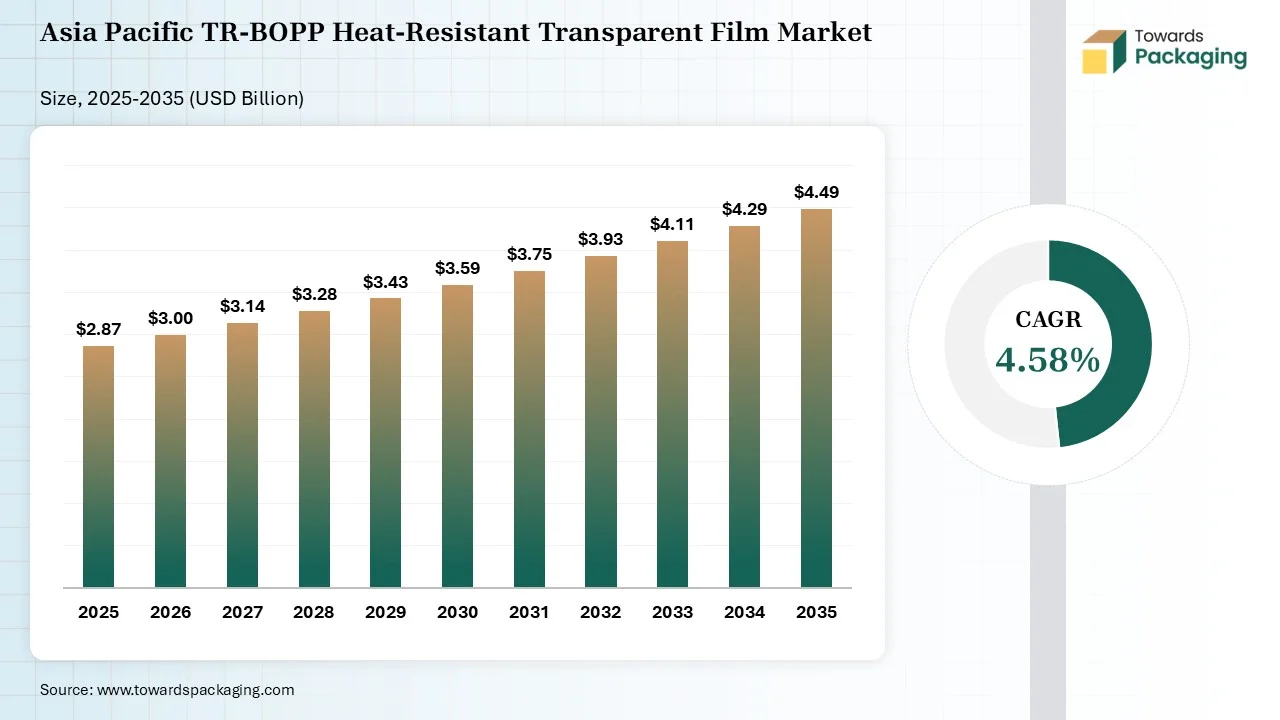
The Asia Pacific market for TR-BOPP (transparent heat-resistant biaxially oriented polypropylene) Heat-Resistant Transparent Film was valued at USD 2.87 billion in 2025. It is projected to grow at a CAGR of 4.58% from 2026 to 2035, reaching approximately USD 4.49 billion by 2035. TR-BOPP films serve as high-heat-resistant, transparent alternatives to traditional PET print layers in multilayer flexible packaging across sectors such as food, pet food, pharmaceuticals, and consumer goods. These films are manufactured using a complex biaxial stretching process that enhances tensile strength and dimensional stability, broadening their application range from packaging, labeling, and printing to electrical insulation and industrial laminates.
The market growth is primarily driven by rising demand for lightweight, durable, and eco-friendly packaging solutions that meet modern supply chain requirements and consumer demands. The industry is also shifting towards high-performance specialty films as converters look for PET substitutes and recyclable, mono-material packaging solutions. Pet food packaging is the fastest-growing application with a CAGR of 9.45%, while heat resistance levels above 175°C are expanding at a 9.10% CAGR. This growth aligns with verified industry developments, including Cosmo Films' launch of the PCT-2 (TR) product capable of withstanding temperatures up to 185°C and their December 2025 release of a TR-BOPP grade specifically designed for pet-food packaging.
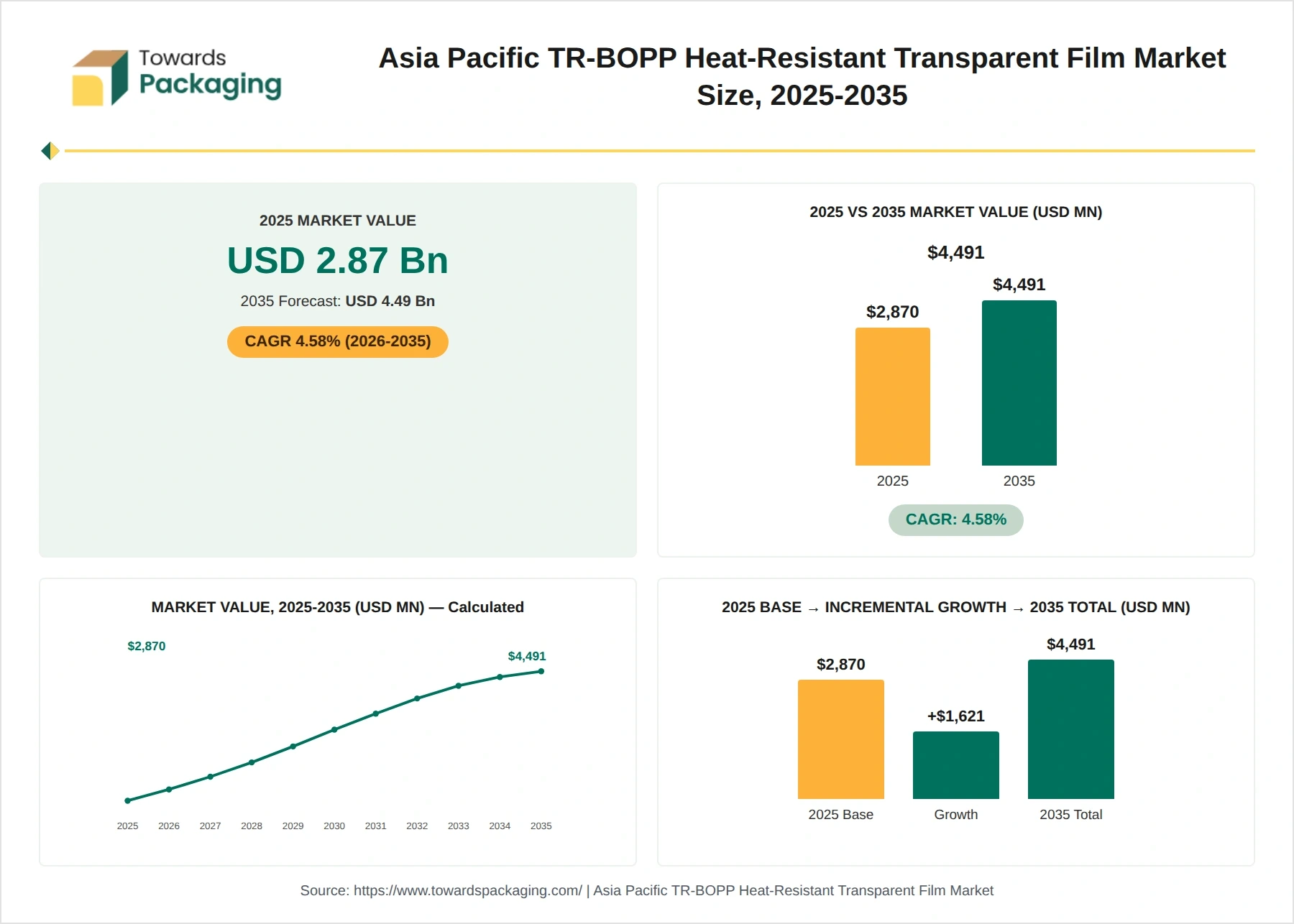
According to the data given above, the Asia-Pacific TR-BOPP heat-resistant transparent films market was estimated at USD 2.87 billion in 2025 and is expected to grow at the fastest CAGR of 4.58% throughout the forecast period. This transformative shift is being driven by various factors such as sustainability mandates, packaging redesign, supply chain resilience, and material-performance innovation.
Packaging regulations in multiple jurisdictions are also increasingly focused on recyclability, recycled-content integration, waste reduction, and extended producer responsibility, thus pushing converters to redesign multilayer laminates and adopt structures that simplify sorting and recycling. The most competitive participants are focusing on functional film architectures, solvent-reduction technologies, recyclable adhesive systems, and downgauged film formats that reduce material consumption while maintaining processability and package integrity.
Key Insight: The market is forecast to grow from USD 2.87 billion (2025) to approximately USD 4.49 billion (2035) at a 4.58% CAGR, adding roughly USD 1.62 billion in incremental value over the decade.
Source: Towards Packaging Analytics & Consulting; calculated compounding
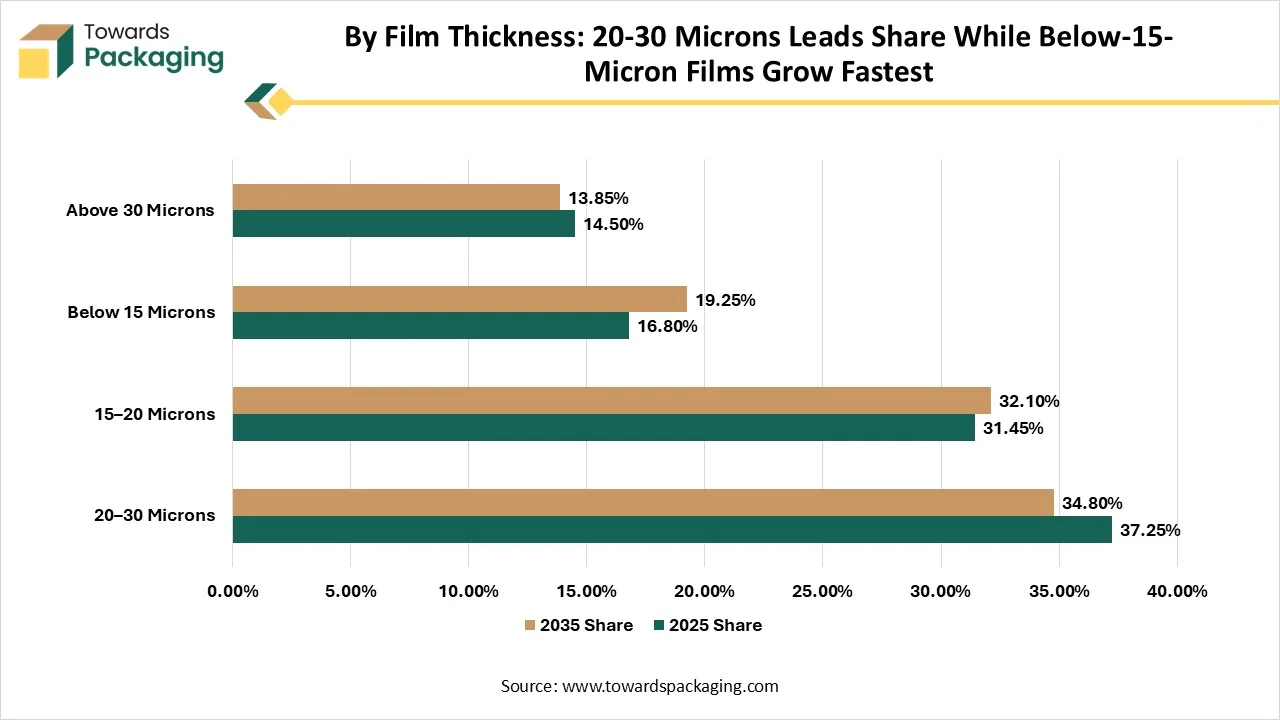
The 20-30 microns segment dominated the market in 2025, with a market share of 37.25%. This dominance can be attributed to the fact that this segment helps to provide a good balance between strength, flexibility, heat resistance, and material efficiency. Films that belong in this thickness range can provide the material performance that is needed for flexible packaging options, while also simultaneously remaining lightweight. The increasing demand for pet food and other food packaging also supports this segment’s demand, particularly where durability and processing are important factors. Similarly, the 15-20 microns segment is expected to grow at the fastest rate, with a CAGR of 6.40% throughout the forecast period. This rapid growth is because manufacturers all over the world are increasingly looking for lighter and more efficient film options. Thinner BOPP films can help to reduce material consumption while still providing transparency, sealing, performance, and flexibility. Rising efforts to reduce packaging material usage are expected to boost segmental growth even further.
Key Insight: Below-15-Micron films post the fastest CAGR (8.15%), consistent with a broader lightweighting trend.
Source: Towards Packaging Analytics & Consulting
Source: Towards Packaging Analytics & Consulting
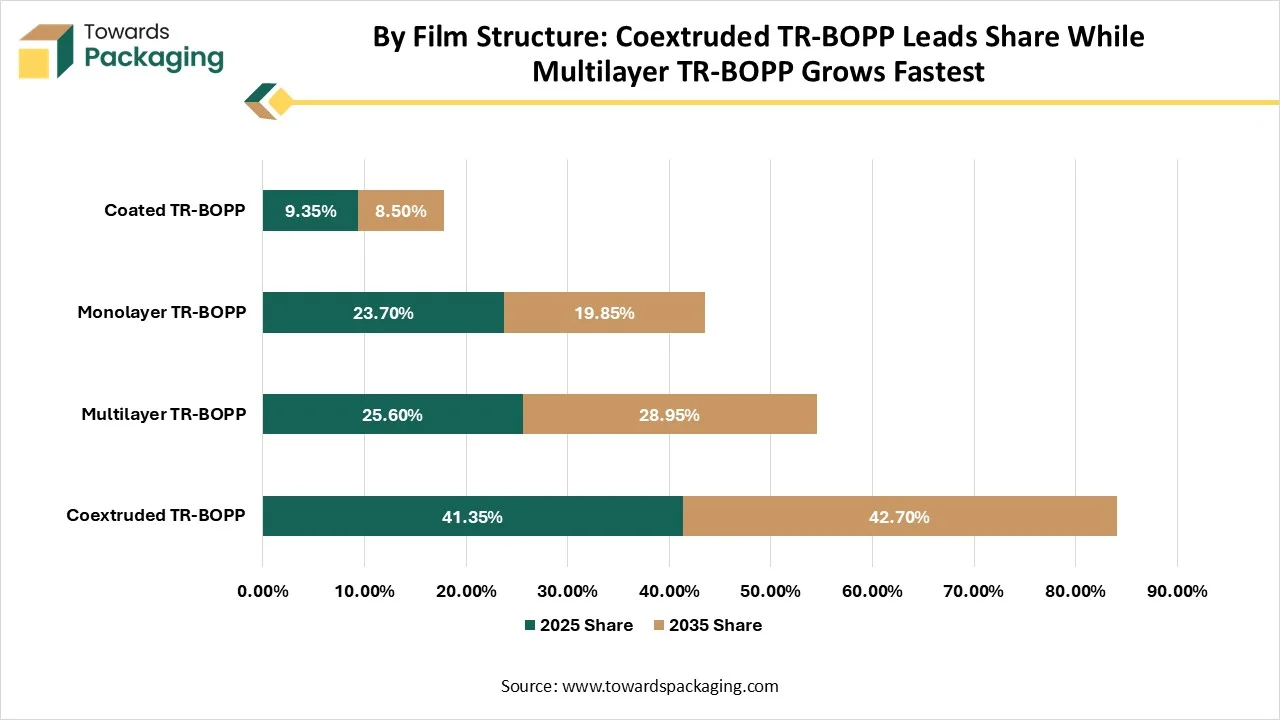
The Coextruded TR-BOPP segment led the market in 2025, capturing a market share of 41.35%. This dominance is because it combines the main film layers during a singular extrusion process, thus allowing manufacturers to easily achieve heat sealing, performance, transparency, strength, and good processing efficiency, all in one film structure. This segment is widely used in flexible packaging, including food, snacks, bakery products and even household products. Its ability to provide a dedicated heat-sealable layer while still retaining the properties of the main BOPP layer makes it a popular segment. Similarly, the multilayer TR-BOPP segment is expected to witness the fastest rate of growth throughout the forecast period, expected to grow at a CAGR of 7.55%. This rapid growth is because manufacturers are increasingly demanding films that can provide multiple functions in a single structure. Additional layers can be designed to help improve sealing, heat resistance, mechanical strength, and optical performance. This property makes it especially useful for more demanding packaging processes. The growing need for high-performance packaging further propels the segment forward.
Key Insight: Multilayer TR-BOPP posts the fastest CAGR (7.55%), while Monolayer TR-BOPP is the only category with meaningful share loss.
Source: Towards Packaging Analytics & Consulting
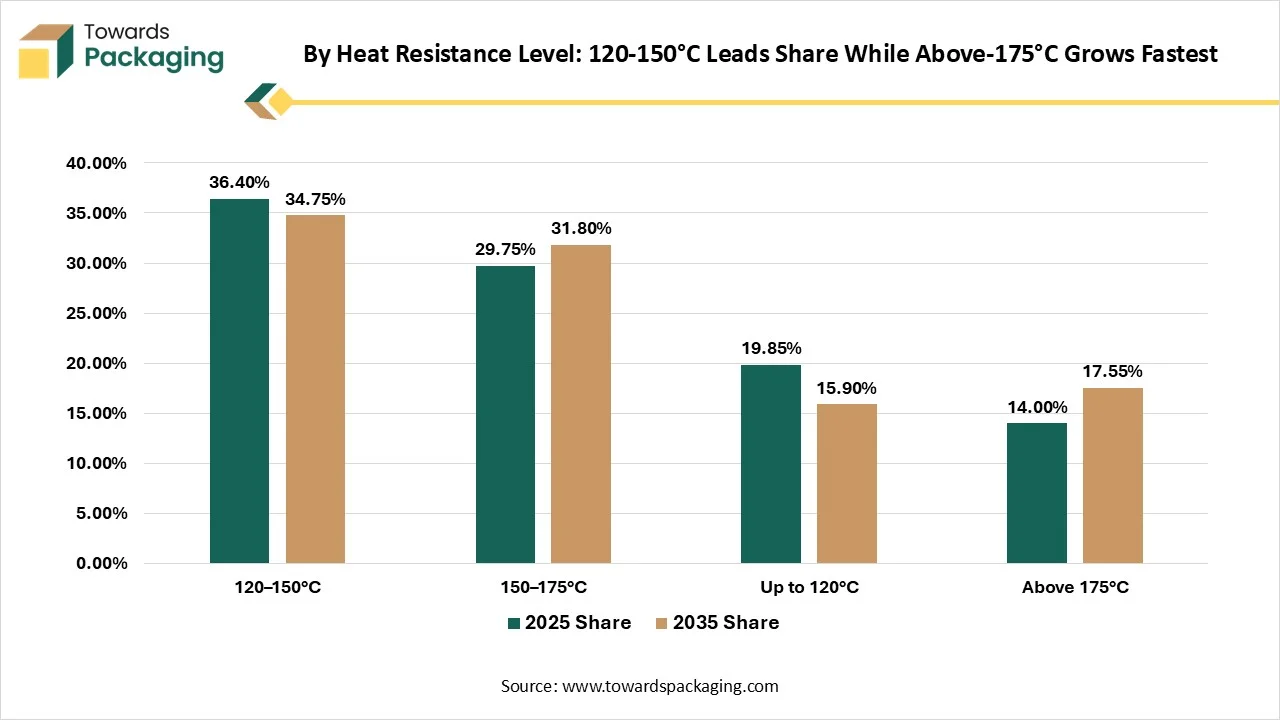
The 120-150 degrees segment dominated the global market landscape, capturing a market share of 36.40% in 2025. This particular heat resistance range is suitable for a wide range of flexible packaging and converting applications. This segment helps to provide the required thermal stability along with transparency, dimensional stability, as well as good machinability. Its wider range of application coupled with existing packaging equipment makes it a popular segment in the global market. Similarly, the 150-17- degrees segment is anticipated to grow at the fastest rate throughout the forecast period, with a CAGR of 6.90%. Higher heat resistance allows TR-BOPP films to be used in more demanding packaging and lamination applications while also maintaining transparency and stability. The replacement of conventional higher-temperature films are expected to support rapid segmental growth.
Key Insight: Above-175C posts the fastest CAGR (9.10%), directly consistent with Cosmo Films' verified 185C-rated PCT-2 (TR) product.
Source: Towards Packaging Analytics & Consulting
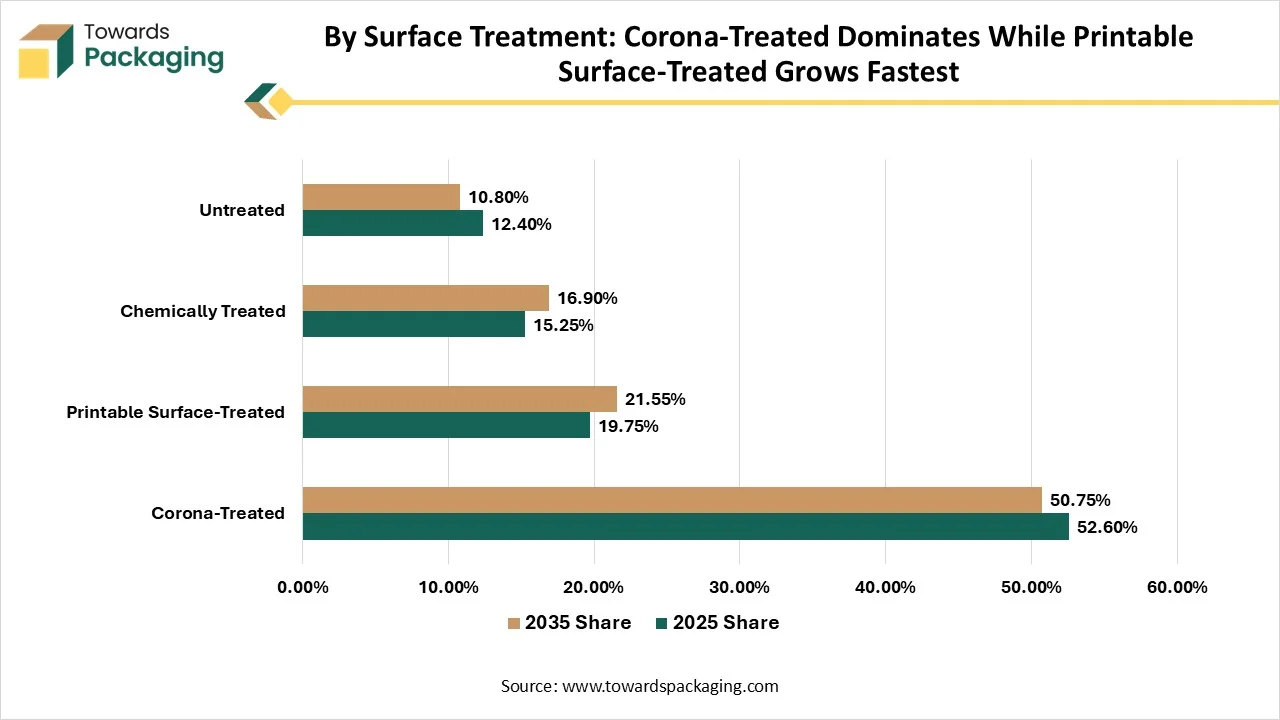
The Corona-treated segment dominated the market with a market share of 52.60% in 2025. This dominance is due to the fact that corona treatment is a widely popular and cost-effective method to help improve the film’s properties. It helps to increase surface energy, allowing inks, adhesives, and coatings to bond more effectively with the BOPP film. This makes this process suitable for aspects like laminations, printing, and other flexible packaging options. It can also be easily integrated into continuous film production, thus supporting large-scale manufacturing. Similarly, the printable-surface treated segment is expected to grow at the fastest rate, with a CAGR of 7.25% during the forecast period. Manufacturers all over the world increasingly require films that provide better print quality, ink adhesion and visual appeal. These films are designed to provide a surface that is more suitable for higher quality printing, which is an important aspect for branded food, beverages, and consumer product packaging. Advancements in surface modifications and coating technologies further propel segmental growth.
Key Insight: Printable Surface-Treated posts the fastest CAGR (7.25%), consistent with industry emphasis on high-speed printability and ink adhesion.
Source: Towards Packaging Analytics & Consulting
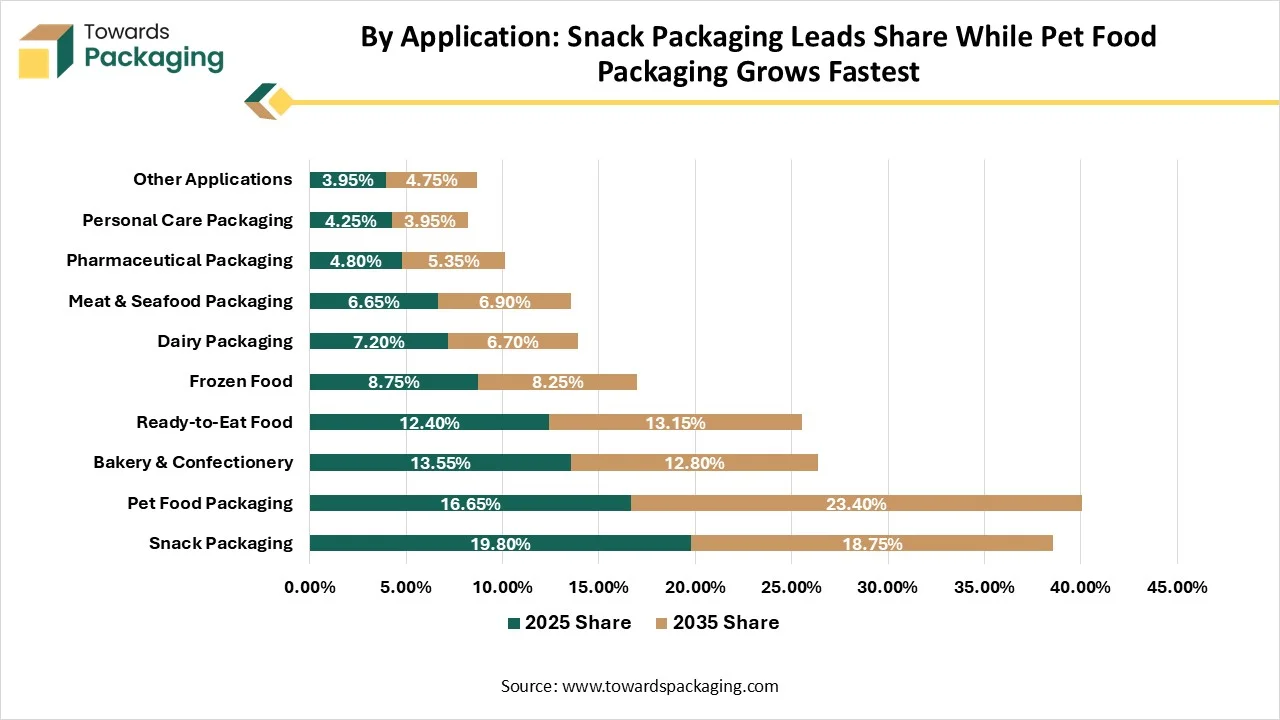
The snack packaging segment dominated the global market share in 2025, capturing a share of 19.80%. This dominance is because BOPP films are widely used for packaging products like biscuits, chips, dry snacks, and other confectionery goods. Its suitability for high-speed flexible packaging further supports large volume use by snack manufacturers. TR-BOPP films also help to provide moisture resistance, printability, and mechanical strength while also maintaining an attractive appearance, thus making this segment ideal. Similarly, the pet food packaging segment is expected to grow the fastest, with a CAGR of 9.45% throughout the forecast years. This rapid growth is due to rising pet ownership and the increasing demand for premium and packaged pet foods. Pet food manufacturers require packaging that provides good product protection, good shelf appeal, and reliable performance during processing and storage. This, in turn, creates several growth and development opportunities in the segment.
Key Insight: Pet Food Packaging posts the fastest CAGR (9.45%) and is forecast to overtake Snack Packaging as the largest application by 2035.
Source: Towards Packaging Analytics & Consulting
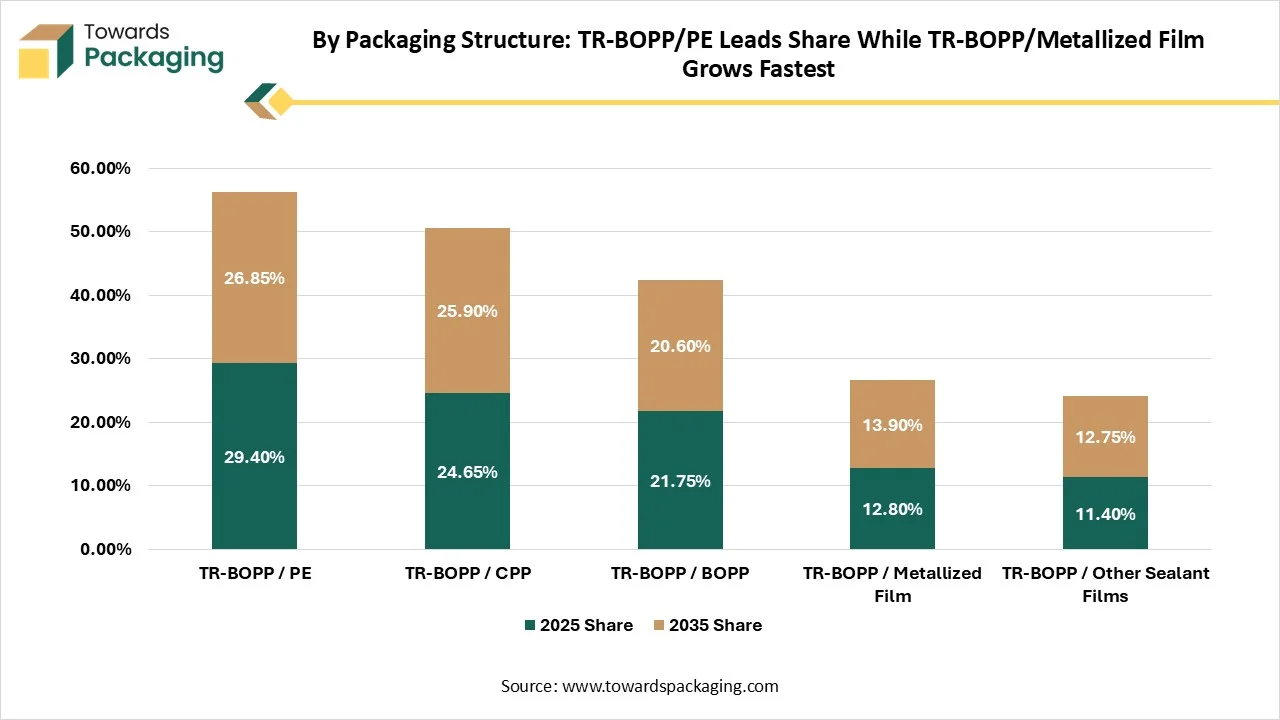
The TR-BOPP/PE segment held the largest market share of 29.40% in 2025. This segment dominated the market as it combines strength, clarity, flexibility, and sealing properties with PE. This, in turn, makes it a suitable option for a wide range of flexible packaging applications. This particular segment also offers good lower temperature sealability, which helps to support its use in common packaging lines. The broad use of PE in the Asia-Pacific region further reinforces this segment’s dominance. Similarly, the TR-BOPP/CPP segment is expected to grow at the fastest rate throughout the forecast period, with a CAGR of 6.45%. This rapid growth is because CPP provides better heat sealability, puncture resistance, and higher temperature performance compared to conventional sealing layers. This segment is already widely used in food packaging sectors and is well suited for applications that require good barrier as well as thermal performance.
Key Insight: TR-BOPP/Metallized Film posts the fastest CAGR (7.10%), consistent with the emerging high-barrier transparent BOPP opportunity.
Source: Towards Packaging Analytics & Consulting
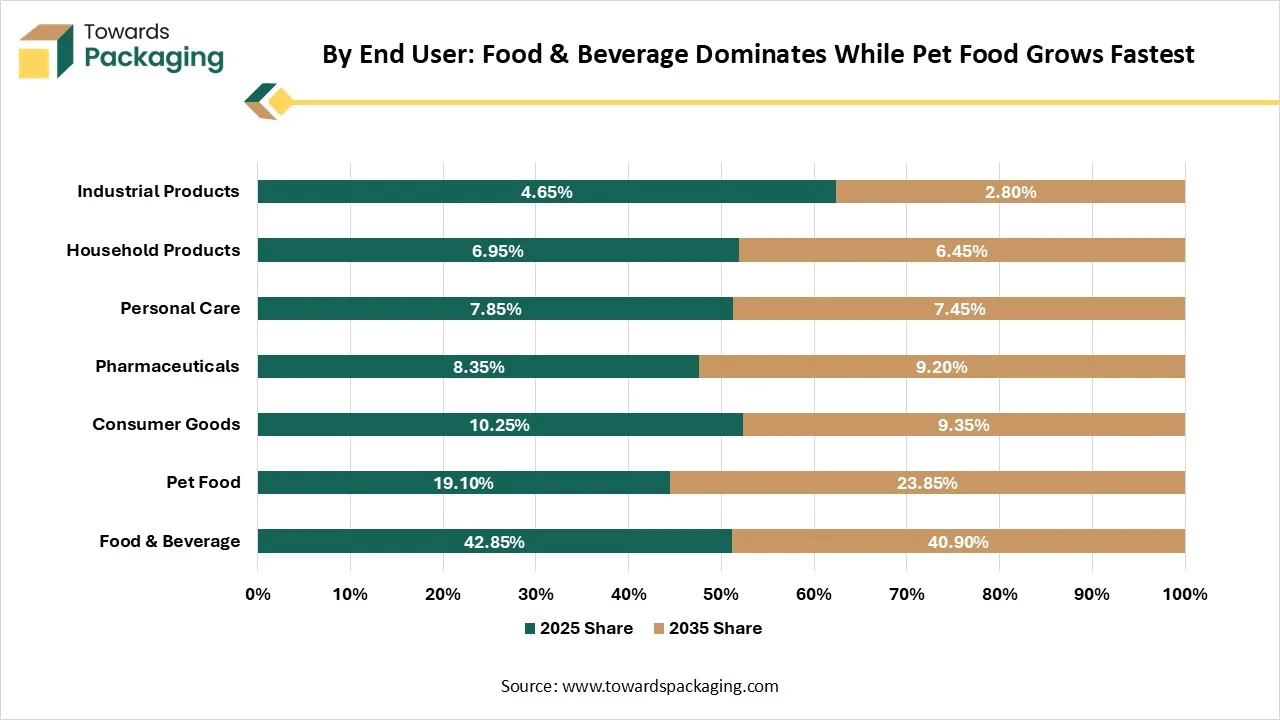
The food and beverage segment dominated the market in 2025, capturing a market share of 42.85%. This dominance can be attributed to the fact that BOPP films are widely used in packaging bakery items, dry snacks, dairy products, and even beverages. The largely expanding food industry in the Asia-Pacific region further helps to create consistent demand for flexible packaging films like these. Similarly, the pet food segment is expected to grow at the fastest rate, with a CAGR of 9.55% throughout the forecast period. The region’s pet food market is expanding rapidly, thus creating additional demand for specialized flexible films. Pet manufacturers require good heat resistance and moisture avoidance, thus making it a popular segment.
Key Insight: Pet Food posts the fastest CAGR (9.55%), mirroring the Application-level finding for a consistent cross-segmentation signal.
Source: Towards Packaging Analytics & Consulting
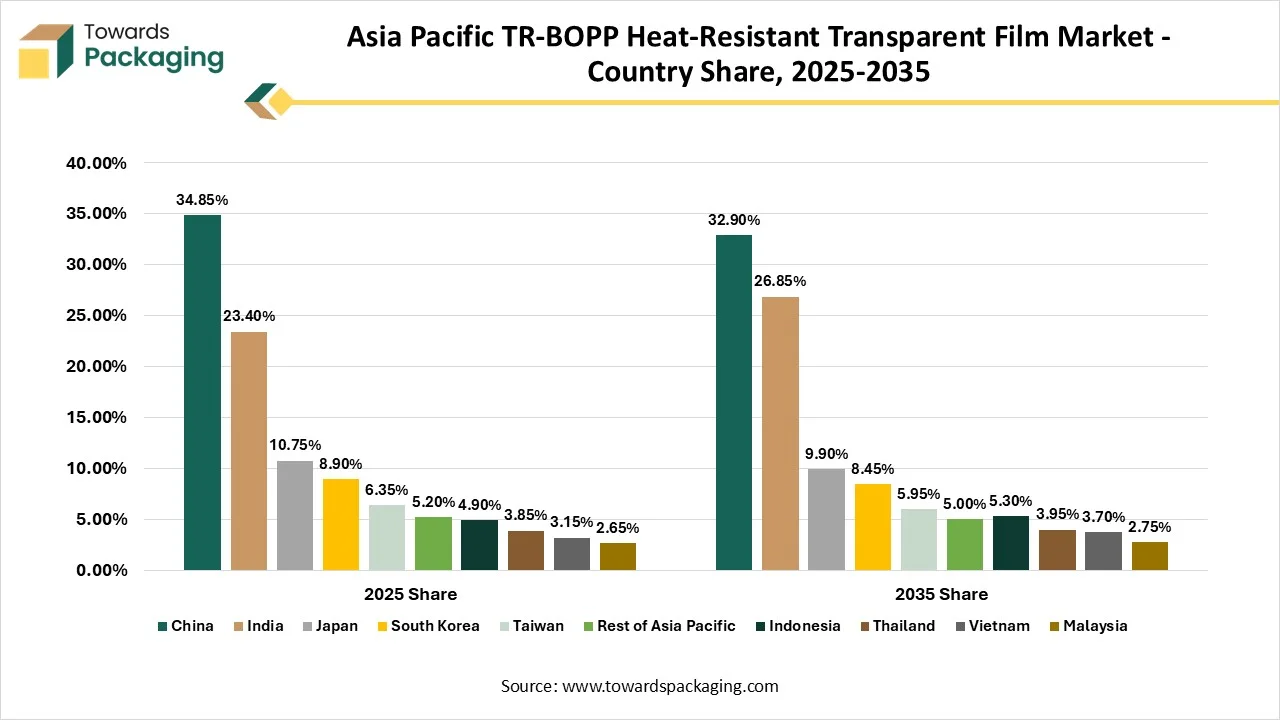
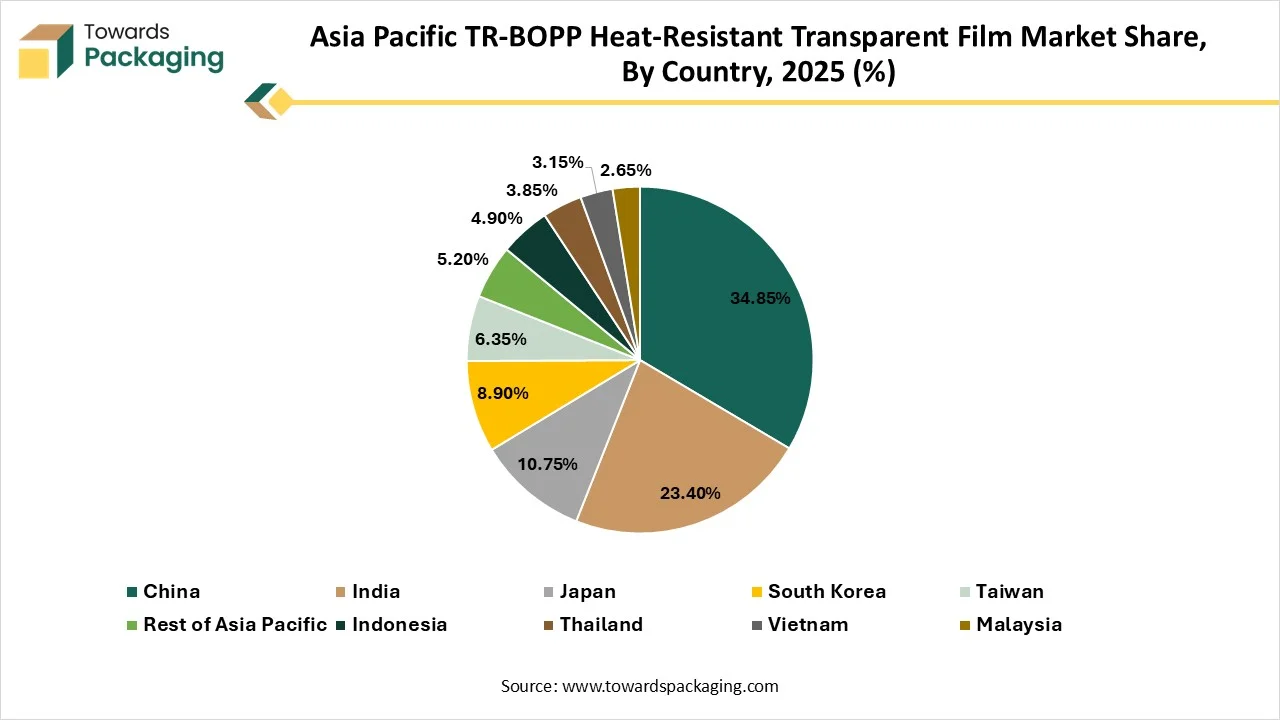
According to the data given above, China dominated the market share, capturing a share of 34.85% in 2025, and is estimated to grow at a CAGR of 32.90% throughout the forecast period. This dominance is because it is a major producer and consumer of BOPP and BOPET films, with applications spanning across various sectors like food packaging, labels, electronics, electrical insulation, solar-related materials, and industrial substrates. The large polypropylene base and the high growth in online retail shipping increase the use of cavitated BOPP film. The strong industrial base in areas like Guangdong helps with expansion. The massive shipping volume and the high demand for light-blocking wrapping support the growth. Similarly, India is expected to witness the fastest growth rate in 2025 and is predicted to grow at a CAGR of 8.45% throughout the forecasted years. This rapid growth is due to its expanding converter base. Despite excess capacity, regional demand remains resilient, supported by snack-food growth, e-commerce packaging, and regulatory pushes for mono-material recyclability.
Key Insight: China leads 2025 share (34.85%) but is the only major country losing share by 2035, while India (8.45% CAGR) posts the fastest country-level growth.
Source: Towards Packaging Analytics & Consulting
Japan
Japan witnessed a significant amount of growth in 2025, capturing a market share of over 10.75%. The country is a highly technology-driven market for advanced BOPP films and is further supported by key companies like Toray Industries and Toppan. Japanese manufacturers are seen to be increasingly focusing on performance and sustainable packaging technologies, including BOPP-based transparent barrier films used for recyclable packaging. The country’s growth is expected to be driven by more premium, high-performance films rather than the basic volume BOPP demand.
South Korea
South Korea held an 8.45% share in the market in 2025. The country has a strong BOPP film supply and export network, with numerous manufacturers and suppliers catering to both domestic and international markets. Companies such as DL FNC, JPNC and PKC are active BOPP film producers, with advanced material operations being carried out in the country. South Korea is offering several opportunities for specialty and high-performance packaging films, supported by its advanced manufacturing capabilities and robust export orientation.
Taiwan
Taiwan has a well-established BOPP film supply base and captured a market share of 5.95% in 2025. The country’s growth is supported by key companies like Nan Ya Plastics and Yem Chio. These companies produce high-quality BOPP film packaging and have operated in Taiwan for several years. The country also has a strong export-oriented transparent film industry, which ensures steady growth and development. The country is especially relevant for specialty, high-quality, and export-oriented BOPP films.
Key Insight: China (34.85%) and India (23.40%) together account for well over half of 2025 country-level share.
| Company | Country/APAC Presence | BOPP Capability | TR-BOPP/Specialty-Film Relevance | Competitive Position |
| Cosmo First / Cosmo Films | India | Very strong | Directly confirmed heat-resistant transparent BOPP | Specialty-film leader |
| Jindal Poly Films / JPFL | India | Very strong | Transparent and heat-sealable BOPP; broad specialty portfolio | Scale leader |
| UFlex / Flex Films | India | Very strong | Specialty, heat-sealable and packaging BOPP | Integrated challenger |
| SRF | India | Strong | Specialty packaging-film capabilities | Specialty-film competitor |
| Polyplex | India | Strong | BOPP and specialty packaging films | Regional/global supplier |
| Toray Industries | Japan | Strong | Advanced polymer and specialty film technology | Technology leader |
| Nan Ya Plastics | Taiwan | Very strong | Large-scale BOPP and polymer-film portfolio | Scale leader |
| Mitsubishi Chemical | Japan | Strong | Advanced functional-film technology | Technology-focused |
| Toppan Speciality Films | Japan/India | Strong | Recyclable and specialty flexible-packaging films | Sustainability challenger |
| Taghleef Industries | Global/APAC | Very strong | Specialty BOPP and packaging films | Global specialty-film leader |
Source: Towards Packaging Analytics & Consulting
Cosmo Films is an India-based specialty film manufacturer and a part of Cosmo First. The company produces packaging, labelling and industrial films and has a particularly strong presence in BOPP films. Its portfolio spans across BOPP, CPP, BOPET, coated, metallized, and specialty films.
Jindal Poly Films is a part of the B.C Jindal Poly Group and is a major Indian manufacturing company that specializes in polyester and polypropylene films. Its wider film business also operates internationally under Jindal Films. Its product range consists of BOPP, BOPET, CPP, metallized and coated films.
UFlex is an Indian flexible packaging company, while Flex Films is its global film manufacturing part. The company manufactures BOPP, BOPET, CPP, AIOx coated and specialty films. Its portfolio is designed for flexible packaging and converting applications.
SRF is an Indian diversified industrial company that majors in performance films and foils businesses. Its manufacturing footprint spans across India, Thailand, and other African regions. Its manufacturing capabilities include TR and STR heat-resistant BOPP films.
PolyPlex Corporation is an Indian film manufacturer that has a global manufacturing and distribution network as well. Its portfolio includes BOPP, BOPET, CPP and blown PP/PE films, along with coated, metallized and holographic films.
Toray Industries is a Japan-based company with its business spanning across films, chemicals, fibers, plastics and other advanced materials. Its polypropylene films are used across various lamination, printing, and packaging applications, and include coextruded and OPP films.
Toppan Specialty Films manufactures a wide range of BOPP/PP films, label films, graphic lamination films, and specialty packaging films. The company combines BOPP film manufacturing with specialty barrier and sustainable packaging technologies.
Source: Towards Packaging Analytics & Consulting
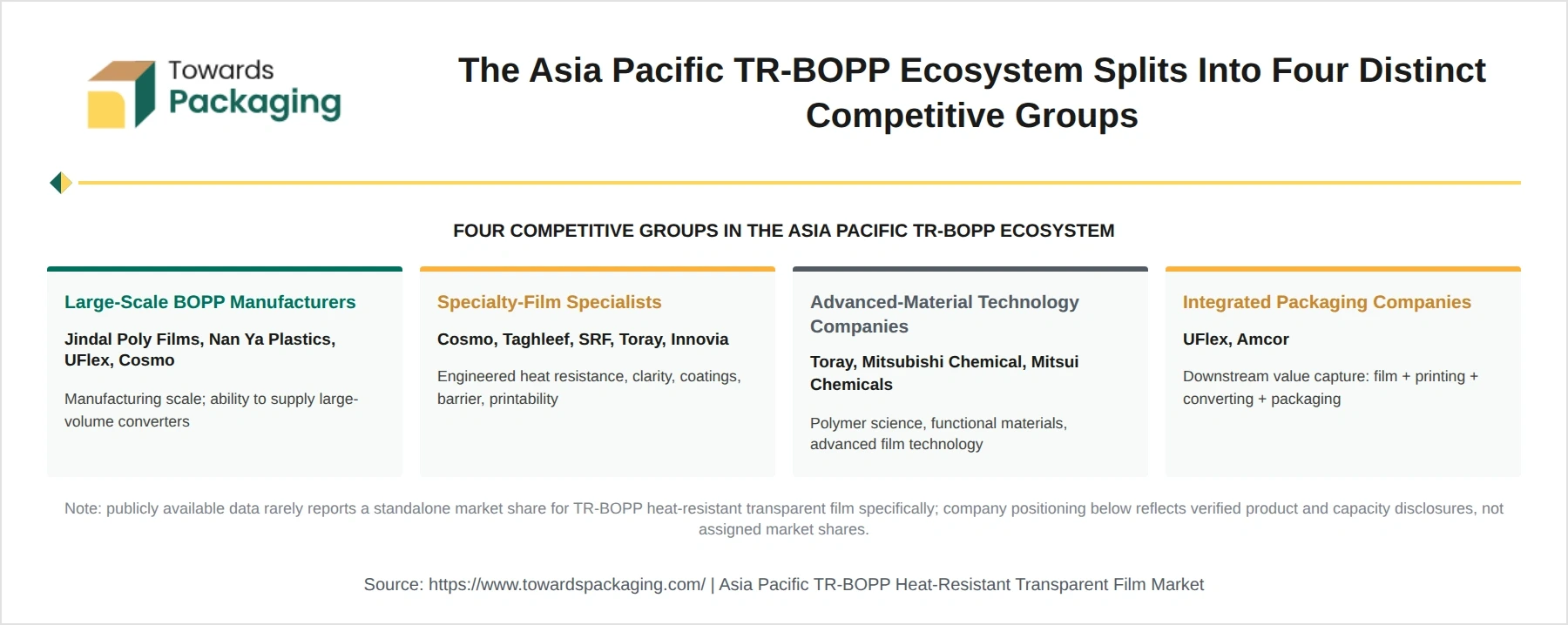
The market can broadly be divided into four competitive groups:
Jindal Poly Films, Nan Ya Plastics, UFlex and Cosmo are key companies. Their principal advantage is manufacturing scale and ability to supply large-volume packaging converters.
Cosmo, Taghleef, SRF, Toray and Innovia are key companies. These companies compete through engineered characteristics such as heat resistance, clarity, coatings, barrier properties and printability.
Toray, Mitsubishi Chemical and Mitsui Chemicals are key companies. Their advantage lies in polymer science, functional materials and advanced film technologies.
UFlex and Amcor are key companies. These companies can capture value further downstream by combining film production with printing, converting and packaging.
Key Insight: Large-scale manufacturers (Jindal, Nan Ya, UFlex, Cosmo), specialty specialists (Cosmo, Taghleef, SRF, Toray, Innovia), advanced-material technology companies (Toray, Mitsubishi Chemical, Mitsui Chemicals) and integrated packaging companies (UFlex, Amcor) represent four structurally distinct ways to compete in this market.
| Region | Competitive Characteristics |
| India | One of the most important manufacturing centers, with major players including Jindal Poly Films, Cosmo First, UFlex, SRF and Polyplex. Recent capacity additions indicate continuing investment in BOPP manufacturing. |
| China | Critical due to its enormous flexible-packaging manufacturing base and large number of polypropylene-film producers. Competition is particularly intense around cost, capacity and access to domestic packaging converters. |
| Japan | Competitive advantage more heavily weighted toward advanced materials and specialty-film technology, with Toray and other chemical/materials companies maintaining important positions. |
| Southeast Asia | Indonesia, Thailand, Vietnam and other Southeast Asian markets are becoming increasingly relevant as flexible-packaging production expands and manufacturers diversify supply chains. |
Source: Industry analysis; company disclosures by region
According to the data given above, we can see that India is one of the most important manufacturing centers, with major players including Jindal Poly Films, Cosmo First, UFlex, SRF and Polyplex. Recent capacity additions indicate continuing investment in BOPP manufacturing. China’s presence is critical in the Asia-Pacific region due to its enormous flexible-packaging manufacturing base and large number of polypropylene-film producers. Competition is particularly intense around cost, capacity and access to domestic packaging converters. Similarly, other regions such as Indonesia, Thailand, Vietnam and other Southeast Asian markets are becoming increasingly relevant as flexible-packaging production expands and manufacturers diversify supply chains.
| Demand Factor | Market Implication |
| Replacement of PET print layers | Creates opportunities for high-heat-resistant BOPP structures |
| Mono-material packaging | Encourages all-polyolefin packaging structures |
| Food packaging growth | Increases demand for high-clarity, printable films |
| Pet food packaging | Creates demand for high-temperature processing and strong tear performance |
| High-speed printing | Raises requirements for ink adhesion and process stability |
| High-speed lamination | Increases demand for controlled COF and thermal resistance |
| Recyclability | Supports replacement of incompatible multilayer structures |
| Specialty-film premiumization | Shifts competition away from commodity BOPP toward engineered grades |
Source: Industry analysis; Cosmo Films product disclosures
According to the data given above, the factors driving the high demand for TR-BOPP heat-resistant films are as follows:
| Technology | Commercial Significance |
| High-temperature BOPP | Enables PET replacement |
| High-clarity BOPP | Improves product visibility |
| Low-haze film | Premium appearance |
| High-speed printability | Improves converter productivity |
| Controlled COF | Supports high-speed processing |
| Improved ink adhesion | Enables reverse printing |
| Mono-material structures | Supports recycling |
| AlOx-coated BOPP | Enables transparent barrier packaging |
| BOPE/BOPP combinations | Supports recyclable polyolefin structures |
| Lightweighting | Reduces material consumption |
| High puncture resistance | Improves packaging durability |
Source: Industry analysis; Cosmo Films product disclosures
According to the data given above, the market’s highest technology trends are as follows:
According to my research, the Asia-Pacific TR-BOPP heat-resistant film market is expanding rapidly. The industry’s next phase is being shaped by sustainability requirements, regional supply chain recalibration, high-performance coating technologies, AI-enabled manufacturing intelligence, and a growing demand for recyclable and downgauged packaging structures. The region continues to anchor its global production and consumption. Organizations that are integrating material science, digital manufacturing, collaborative packaging design, and lifecycle accountability will be best positioned to capture value in the evolving TR-BOPP heat-resistant films market landscape.
Vidyesh Swar researched the 2025 market value, forecast value, demand & supply analysis, regional analysis, and segmental share analysis.
Aman worked on the regulatory environment, technology & innovation, pricing analysis, competitive landscape, product portfolio, recent developments, and value chain analysis.
Aditi reviewed the entire report, corrected inconsistencies, identified errors, maintained quality standards, and made the report ready for publication.
By Film Thickness
By Film Structure
By Heat Resistance Level
By Surface Treatment
By Application
By Packaging Structure
By End User


















Principal Research Analyst
Vidyesh Swar is a Senior Research Analyst at Towards Packaging, bringing over 4 years of dedicated expertise in market intelligence and strategic analysis across the dynamic world of packaging technologies and solutions.
Learn more about Vidyesh Swar

Reviewed By
Aditi Shivarkar, with 14+ years in packaging market research, specializes in food, beverage, and eco-friendly packaging. She ensures accurate, actionable insights, driving Towards Packaging Analytics & Consulting 's excellence in industry trends and sustainability.
Learn more about Aditi Shivarkar


Asia Pacific TR-BOPP Heat-Resistant Transparent Film Market
 Table of Content

 Download Sample
 Schedule a Meeting