


The edible boxes market covers complete data on global market size, multi-year growth trends, source-wise and material-wise segmentation, and regional insights across North America, Europe, Asia-Pacific, Latin America, and the Middle East & Africa. This report includes all key statistics such as Europe’s dominant 2025 revenue share, Asia Pacific’s fastest CAGR outlook (2025-2035), plant-based materials’ largest segment contribution, polysaccharides’ major revenue stake, and B2B channels’ leading distribution share. It also features competitive analysis of major companies like Evoware, Saveggy, Notpla, Wikicell Designs, and others, along with value chain coverage from raw materials sourcing to logistics, trade flow trends, government initiatives, manufacturing capacities, and supplier benchmarking.
Edible boxes are made up of natural and edible resources such as proteins, cellulose, and starch, which are intended to be consumed with the food products. The market development is credited to amplified demand for sustainable food packaging and increasing demand for processed food products. The packaging is mainly made up of natural, biodegradable, and plant-based resources that can be consumed without packaging waste collection, processing, recycling, or disposal. It plays a noteworthy role in delivering customers with an operative substitute to conventional packaging solutions. Packaging with edible resources fulfills the growing demand from customers for sustainable goods, supports the ecology, and limits waste accumulation in landfills caused by packing. With a rising shift in the direction of the requirement for environment-friendliness among customers, governments and critical producers have allocated their funds to emerging such products as a feasible alternative for food and pharmaceuticals packaging.
The growing demand for packaging that is biodegradable and does not generate waste in landfills.
The rapid inclination towards packaging which are made up of plant-based resources or seaweed has influenced the growth of the edible boxes market.
The rising demand for active and smart functionality has compelled innovation in this field to meet the expectations of the consumers.
| Metric | Details |
| Key Drivers | Sustainability demand, eco-safety awareness, biodegradable packaging growth |
| Leading Region | Europe |
| Market Segmentation | By Source, By Material Type, By Packaging Form, By End-Use / Application, By Technology / Process, By Distribution / Channel and By Region Covered |
| Top Key Players | Evoware, Saveggy, Edible Cutlery, Wikicell Designs, Tellus Technologies, Notpla |
In the edible boxes market, AI is widely utilized for checking the authenticity of the resources utilized during the manufacturing process. It tracks goods, collecting information to reduce ecological influence, decrease waste, and improve supply chains. By using RFID tags and sensors to observe several parameters, such as humidity and temperature, AI-allowed packaging safeguards food protection and quality control, resulting to store fresher products. Incorporating AI in the food packaging industry improves operational efficacy.
Growing Product and Ecological Safety Awareness
The rapid growth in the awareness campaign about the ecological impact of the packaging waste has increased the concern towards the ecological effect among consumers is driving the edible boxes market to grow rapidly. Along with the rise in packaging resource waste, the requirement for utilizing or recycling biodegradable packaging substitutes is growing. To fulfil such needs, the main producers in the pharmaceutical and food and beverages trades choose such packaging as an ecologically-friendly solution. The packaging eradicates waste from landfills and preserves the product for a longer life. In addition, the request from customers for healthy and safe goods results in the utilization of edible packaging, therefore enhancing the market development. Furthermore, the use of this packaging to encompass the shelf-life, lessen waste, and preserve the food fresher also contributes to the growth of the edible packaging market.
High Charges and Strict Needs
The edible boxes market development is hindered due to the high material cost and strict packaging standards. The market development is restricted as the products packaged with edible resources need secondary packing as they can be easily susceptible to germs, dust, and harmful particles.
Rising Demand for Biodegradable Packaging
The growing consumption of cooked and processed food items, the rising income levels, and the altering preferences for sterile products contribute mainly to the market development. The rapid evolution in urbanization is evolving countries, and the upsurge in population globally also enhances market development. With the changing customer preferences, the demand for decomposable films is growing. They are an important substitute to petroleum-based packaging and can be established by polysaccharides or proteins, and lipids. Biodegradable packaging is vital in decreasing the dependence on fossil fuels and is environment-friendly, therefore resulting in the worldwide market development.
The plant-based segment is expected to have a considerable share of the edible boxes market in 2025 due to the growing demand for organic packaging resources. There is a rapid development towards introducing packaging that decomposes completely has influenced the usage of these materials. Algae and seaweeds are the plant-based resources widely used by the market players for the manufacturing of edible boxes.
The animal-based segment is expected to grow at the fastest rate in the market during the forecast period of 2026 to 2035. These are extensively used in the packaging of meat products to avoid microbial growth and moisture. The rising demand for protein-based dietary habits from diet-aware customers is fuelling the market development for this section.
The polysaccharides segment is expected to dominant over the edible boxes market in 2025 due to the cost-effectiveness, biodegradability, and non-toxicity. The major materials used in this sector are chitosan, starch, and cellulose. Growing demand from the food and beverage sector will help the development of the segment.
The protein-based segment is expected to grow at the fastest rate in the market during the forecast period of 2026 to 2035. The edible protein-based packaging is mainly made up of gelatin, whey, and soy. These have excellent barrier properties that can support the extension of the shelf life of food items, which further influences the development of the market for this segment.
The films and coatings segment held a considerable share of the edible boxes market in 2025 due to their lightweight and easy-to-seal features. This packaging form confirms the freshness and prolonged shelf-life of the goods at the time of warehousing and shipment. Furthermore, these packages can be tailored to fit diverse shapes and sizes of food items such as vegetables and fruits, which further influences the development of the market for this segment.
The foams and cushioning segment is expected to grow at the fastest rate in the market during the forecast period of 2026 to 2035. This segment is growing significantly due to the rising demand for protective packaging of a wide range of products. These boxes are used for maintaining the quality of the food products for a prolonged period.
The food and beverage segment held a considerable share of the edible boxes market in 2025 due to the requirement for a huge variety of food products such as baked goods, snacks, confectionery, and beverages. Rising demand for processed food products across the world is attributed to the busy life schedules of customers. This results in a rising requirement for suitability and ready-to-eat foodstuffs, therefore influencing the consumption of consumable packaging in this sector.
The pharmaceuticals segment is expected to grow at the fastest rate in the market during the forecast period of 2026 to 2035. Edible packaging advances patient agreement by creating a tablet or capsule suitable for consume. Patients are more expected to take their medicine on time and as arranged if the packing is easy to swallow and does not have an unpleasant taste or quality, which influences the demand for edible packing.
The coatings and films segment held a considerable share of the edible boxes market in 2025 due to its efficient barrier properties and preservation of the freshness of the food products. The rising concern for enhancing the shelf life and maintaining the natural taste of the products has raised the demand for edible boxes. The excellent protection quality against lipids, oxygen, and moisture has raised the demand for this segment.
The nanotechnology-enhanced films segment is expected to grow at the fastest rate in the market during the forecast period of 2026 to 2035. The incorporation of nanofibers, nanoparticles, and nanoclays to improve functional performance and mechanical strength has raised the demand for this segment. The rising supervisory guidelines for sustainable and intelligent packaging have influence the development of the market.
The B2B segment stood dominant over the edible boxes market in 2025 due to the rising manufacturers, food service companies, retailers, and QSRs. These boxes are highly customizable, which attracts a huge variety of brands to this market.
The B2C segment is expected to grow at the fastest rate in the market during the forecast period of 2026 to 2035. This segment is growing significantly due to the increasing e-commerce business, and retailers are influencing the innovation in this market.
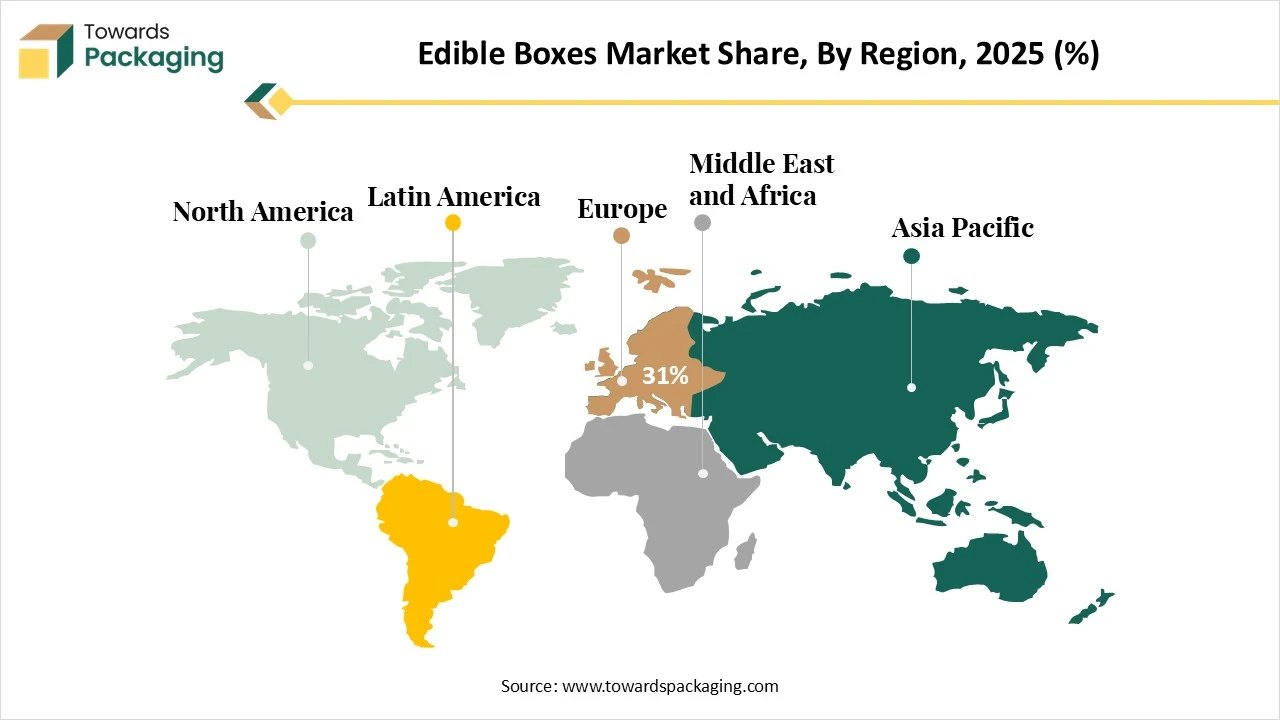
The Europe region held the largest share of the edible boxes market in 2025, due to the presence of strict ecological policies and rising consumer demand. The continuous changing supervisory guidelines according to the rising ecological issues influenced the adoption of biodegradable and sustainable packaging. This has resulted in the rise of investment towards this market to bring innovation to meet the demand of the consumers. The increasing awareness among consumers and the availability of sustainable substitutes have raised the demand for this market.
U.K. Edible Boxes Market Trends
The UK edible boxes market is growing as companies and customers search for environmentally friendly substitutes for single-use plastics. Innovative companies are using plant-based materials to create biodegradable, safe containers. Demand is being driven by growing concerns about food safety and sustainability, which makes edible boxes a workable way to cut down on packaging waste.
India Edible Boxes Market Trends
In India, edible boxes are gaining traction due to the growth of food delivery services and worries about plastic pollution. Companies are creating reasonably priced edible packaging using readily available raw materials like starch and seaweed. Although scaling is still difficult, edible boxes present a viable, environmentally friendly option that supports environmental objectives.
Asia Pacific is estimated to grow at the fastest rate in the edible boxes market during the forecast period. It is due to the societal shift towards sustainable packaging has raised the demand for this industry. The initiatives taken by the governmental bodies to aware people regarding environmental issues have increased the inclination towards edible boxes packaging, which are biodegradable.
The impressive innovations in the region are its mechanism and planned protective design that allows the packaging to be antioxidant and antimicrobial. The involvement of starch, casein, seaweed and alginate is strengthening the base production of edible containers and films. While the capacity of protein-based films is a hero fighting to stop oxygen potency that disturbs the packaging. The coating films, edible pods, and containers are driving more revenue to the regional market and innovations. Sustainability is a benchmark that promotes super-fast biodegradation.
Canada’s Edible Boxes Market Trends
Canada’s trends in this market are alive due to the sincere participation and advancements in edible coatings and films. The eco-friendly efforts are replacing the old plastic packaging. The consumer demand for creative sustainability is attracting protein and plant-based films that promote a rich nutrient profile. The biodegradable options and smart packaging are unifying the effective compounds to enhance nutritional quality and food safety. The sustainable packaging for delivery is bolstering the modernization of the e-commerce sector with more responsible growth in the regional market.
Latin America’s fascinating advancements are the creative materials derived from the agricultural fields, featuring massive use of seaweed for a full biodegradable or edible packaging solution. Observing the sustainable trend, the Dole Food Company continued to utilize Oxifilm recyclable films sufficiently by promoting participation in the pineapple and banana operations. The sustainable alliances are highlighting the compostable flexible food packaging. The FDI is a boon for the regional market advancements that cooperate with the changing dynamics and regulatory frameworks to achieve satisfaction in the market.
Brazil’s Edible Boxes Market Trends
Brazil’s trends are flaunting the craze of the premium gifting culture that brings a luxurious touch to the food and drinks. Currently, the Easter tasting alliances featuring Cacau and Ambev Show promoted the commendable initiatives beneficial for the growth of the regional market. The resealable snack kits and single-serve boxes are attracting fancy revenue to the regional market. The snackle boxes and artisanal grazing boxes are making small gatherings memorable.
The Middle East and Africa region is expected to experience significant growth in this market with the smart and promising advances leveraging the demand for plant-based materials, strengthening the value of the manufacturing site with the tech flaunting using starch and alginate innovation. Following this, the expansion of biodegradable coatings and pouches is supporting the sustainable trend and advancement of the region. The extension of the popular confectionery and catering business is expanding the use of edible wafer papers for practical candy wrapping and food decoration.
The water-soluble films are another advancement supporting the regional sustainable packaging sector. The edible protein and lipid coatings are bringing confidence in the fresh produce sector. The zero waste initiative motive of the region is planting new seeds of sustainable approaches and material alternatives, serving long-standing revenue and development in the market. The advancements are aligned with the regional initiatives, such as plastic bans, encouraging manufacturers to discover best-in-class sustainable innovations like always, with the boon of technologies.
Saudi Arabia Market Trends
Saudi Arabia’s trends highlight the regional responsible packaging with the definitive innovations, such as edible coatings that expand the shelf life of the rich local dates. The compostable boxes reduce landfill waste, promoting the sincerity of the regional leaders towards the environment. The eradication of single-use plastics is another effort supporting sustainable trends. While the quick service restaurants and ready-to-eat meals are stimulating the demand for eco-friendly food containers.
The diversified sectors are a boost to the innovative trends like smart packaging, subscription boxes that bring tech close to the packaging ideas. Following the smart packaging technologies has been hyped at most of the regional packaging manufacturing lines. The edible innovations and tech combination is a spectacular combo contributing largely to the trends, further continuing to deliver more strength to the future endeavours.
The transitions, according to the government initiatives and consumers’ consciousness, are driving specificity and bolstering the base of choices for the edible boxes. The trends speed up the commercialization of the apt sustainable content, delivering sustainable profit to the regional market, boosting significant development in the packaging line.
By Source
By Material Type
By Packaging Form
By End-Use / Application
By Technology / Process
By Distribution / Channel
By Region Covered








Research & Advisory Analyst
Yogesh Kulkarni is an experienced Research Analyst specializing in the packaging sector, with a strong foundation in statistical analysis and market intelligence. He currently contributes his expertise to Towards Packaging.
Learn more about Yogesh Kulkarni

Reviewed By
Aditi Shivarkar, with 14+ years in packaging market research, specializes in food, beverage, and eco-friendly packaging. She ensures accurate, actionable insights, driving Towards Packaging Analytics & Consulting 's excellence in industry trends and sustainability.
Learn more about Aditi Shivarkar

Edible Boxes Market
 Table of Content

 Download Sample
 Schedule a Meeting