


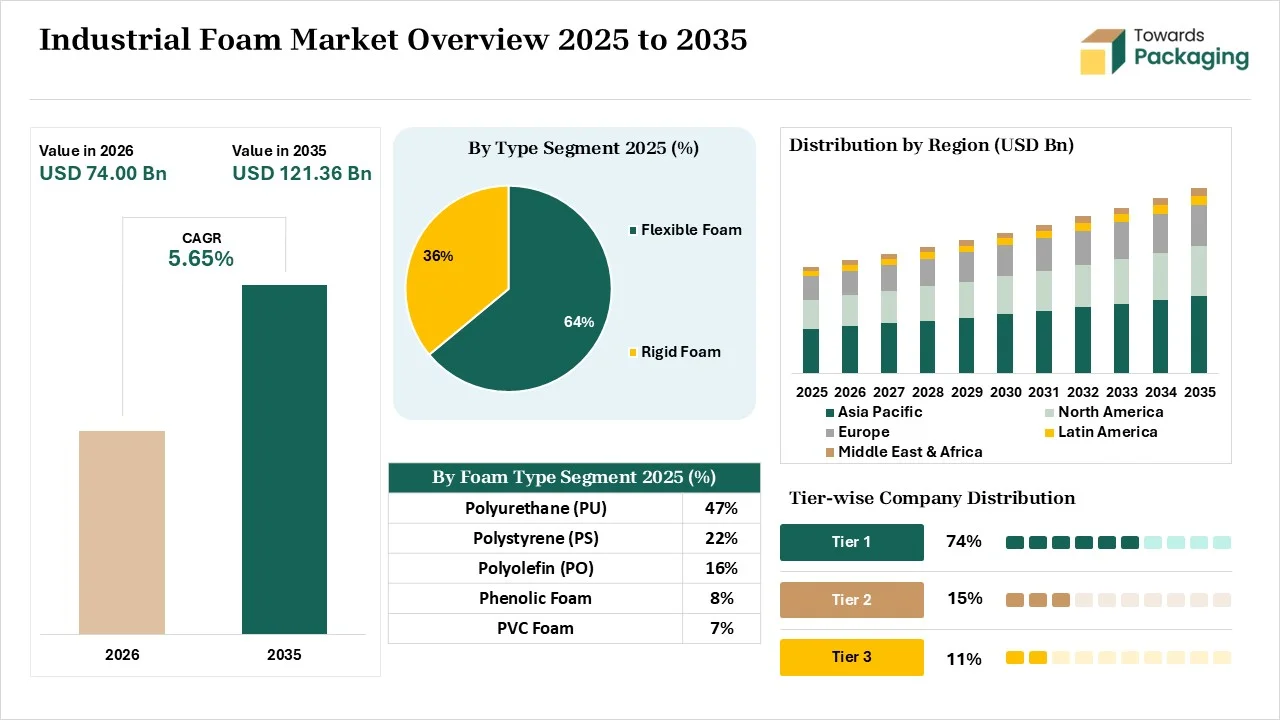
The industrial foam market is forecasted to expand from USD 74.00 billion in 2026 to USD 121.36 billion by 2035, growing at a CAGR of 5.65% from 2026 to 2035. This growth is fueled by rising applications across industries such as construction, automotive, packaging, and healthcare, where foam materials like polyurethane and polystyrene are valued for lightweight, durability, and insulation properties.
Asia Pacific led the market in 2023, while North America is set to record the fastest growth rate due to rapid adoption in wind energy and automotive applications. The market is strongly driven by energy efficiency initiatives, rapid urbanization, and innovation in bio-based foams.
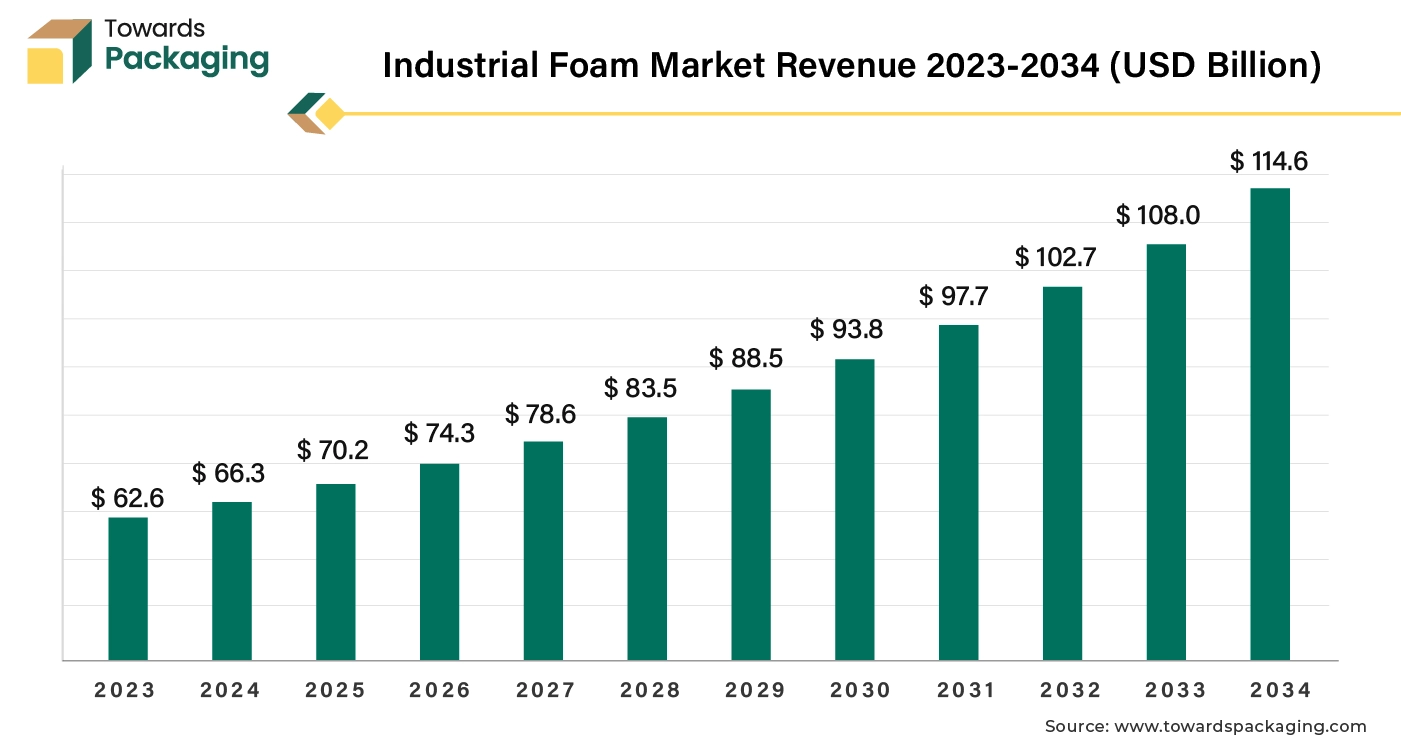
The industrial foam market is experiencing robust growth driven by increasing demand for lightweight and durable material across various sectors such as automotive, construction, packaging, medical, and healthcare.
The industrial form market includes different foam materials that are utilized across various industries for multiple purposes like packaging, insulation, cushioning, structural applications etc. Foam is a material that consists a mass of small bubbles that are formed typically when a gas is trapped in liquid or solid substance. Industrial foams include polyurethane, polyethylene, polystyrene, and polyvinyl chloride. The rising demand for foam can be attributed to several factors across different industries like construction industry, automotive sector, packaging, consumer goods, medical, and healthcare industries.
It is driven by their properties like lightweight, thermal, and insulation capabilities, cushioning, and suitability for various applications across industries. Advancements and innovation in the manufacturing process improve the efficiency, performance, and sustainability of foam as well as the development of biodegradable and recycled foam. The global packaging industry size is estimated to grow from USD 1.20 trillion in 2022 to reach an estimated USD 1.58 trillion by 2032, growing at a 3.16% CAGR between 2023 and 2032.
Artificial Intelligence (AI) is proving to be a game-changer for different industries. Slowly but steadily, it is being integrated into infrastructure across industries. It has the ability to change the work processes of the industrial foam industry. AI driven technology plays an important role s enhancing manufacturing processes, improving efficiency, and lowering operational costs. With AI technology analytics, manufacturers can optimize their productivity and minimize wastage as AI enabled automation can reduce risks of inconsistent quality and human error. Inventory management and supply chain optimization can be streamlined through this technology. Combining AI technology with machine learning or Internet of Things (IoT) can open new opportunities for industrial foam processes o function smoothly. AI helps in predictive maintenance, analyzing patterns and market trends, preferences of consumers etc. that can help the organization gave a competitive edge.
Global foam production is rising because the demand for insulation in buildings and appliances is rising. Rigid polyurethane foam (RPUF) is widely used for building panels because it's lightweight, durable, and has low thermal conductivity. Advancements are ongoing to meet strict fire safety standards in homes and commercial buildings. The focus on reducing energy use for heating and cooling is also increasing, boosting the need for polymeric foams as insulation. Spray Polyurethane Foam (SPF) insulation is a better insulation choice. That has driven the growth of the industrial foam market.
In China, the "Dual Carbon" vision goals to peak carbon emissions by 2030 and achieve carbon neutrality by 2060. This initiative has stimulated energy conservation efforts. China's investment plans focus on opportunities for rigid foams and lightweight polyurethane composites. These materials are used in various sectors such as the cold chain, district cooling and heating systems, high-speed rail, new electric vehicles (NEVs), and temperature-controlled data server centres.
Global population growth drives demand for polymeric foams used in industries, including building & construction, cold chain, furniture & bedding, packaging, and transportation industries, automotive industries. These sectors heavily rely on polymeric foams for various applications, highlighting their essential role in meeting growing needs worldwide, which have driven the growth of the industrial foam market.
Cold chain logistics, which involves transporting temperature sensitive goods such as food and pharmaceuticals, insulated foam packaging ensures that products remain within specified temperature ranges throughout transportation.
One significant restraint affecting the industrial foam industry is the fluctuation in raw material prices. Raw materials like petrochemicals and styrene are highly sensitive to market conditions, geopolitical factors, and global supply-demand dynamics. Petrochemicals used in producing polyurethane foams, and polystyrene foams, limit the growth of the industrial foam market. If there's a sudden increase in crude oil prices, it directly impacts the cost of petrochemical-based foams like polyurethane. Manufacturers may face higher production costs, which can potentially lead to increased prices for foam products.
The increasing demand for bio-based polyurethanes presents significant opportunities within the industrial foam industry. Bio-based polyurethanes are derived from renewable resources such as biomass, vegetable oils, or even waste materials, offering several advantages over traditional petrochemical-based polyurethanes.
Bio-based polyurethanes have a lower carbon footprint compared to their petrochemical foam. There is a growing consumer awareness and preference for environmentally friendly products. Industries and consumers increasingly prioritize sustainable materials and products, creating a market demand for bio-based alternatives across various sectors including building & construction, furniture, packaging, and automotive, which boosts the growth of the industrial foam market.
| Rank | Company | Headquarters | Country | Why Relevant to This Packaging Market | Key Packaging Products/Services |
| 1 | Sealed Air | Charlotte, North Carolina | USA | Global leader in industrial protective foam packaging and foam-in-place systems | Instapak® foam, protective foam packaging |
| 2 | Pregis | Deerfield, Illinois | USA | Leading supplier of protective polyethylene foam and custom engineered packaging | Foam rolls, inserts, end caps |
| 3 | Storopack | Metzingen | Germany | Major provider of industrial foam protective packaging solutions | Foam cushioning, protective inserts |
| 4 | JSP | Tokyo | Japan | Global leader in expanded polypropylene (EPP) and ARPRO® foam materials | EPP packaging and molded foam |
| 5 | Nefab | Jönköping | Sweden | Global industrial packaging company offering engineered foam protection solutions | Custom foam inserts and returnable packaging |
| Rank | Company | Headquarters | Country | Why Relevant | Key Packaging Products/Services |
| 1 | ACH Foam Technologies | Denver, Colorado | USA | Leading EPS foam manufacturer for industrial packaging | EPS protective packaging |
| 2 | Zotefoams | Croydon, England | United Kingdom | Specialist in high-performance cross-linked polyolefin foams | XLPE foam packaging |
| 3 | Recticel | Brussels | Belgium | Producer of polyurethane and specialty foam materials | PU industrial foam |
| 4 | Sekisui Chemical | Osaka | Japan | Manufacturer of high-performance polyethylene foams | PE foam packaging |
| 5 | BASF | Ludwigshafen | Germany | Producer of Neopor® EPS and expandable polymer materials | Expandable foam materials |
| Rank | Company | Headquarters | Country | Why Relevant | Key Packaging Products/Services |
| 1 | FoamPartner | Wolfhausen | Switzerland | Specialist in engineered technical foam solutions | Precision foam packaging |
| 2 | UFP Technologies | Newburyport, Massachusetts | USA | Designer of custom protective foam packaging for medical and industrial markets | Engineered foam packaging |
| 3 | Wisconsin Foam Products | Madison, Wisconsin | USA | Custom foam fabrication for industrial packaging | Foam inserts and cushioning |
| 4 | Rogers Corporation | Chandler, Arizona | USA | High-performance engineered foam materials for precision packaging | Specialty foam materials |
| 5 | Nomaco | Zebulon, North Carolina | USA | Producer of polyethylene foam profiles and protective packaging materials | PE foam profiles and protective packaging |
Asia Pacific dominated the industrial foam market with the largest revenue share in 2023. The growth of the market is driven by the construction and furniture sectors, along with rising demand for foam-based home furnishings like mattresses and pillows. The packaging industry's increasing use of foam to protect delicate items further boosts sales. In automotive, foam enhances fuel efficiency through components like seats and bumpers. These factors together contribute to the region's promising market growth. Rapid urbanization, infrastructure development, and increasing consumer demand for electronics and packaged goods contribute to its leadership in the industrial foam market.
China Market Trends
China has made a major contribution to the growth of the market. The market is expected to grow due to factors such as sustained construction, infrastructure projects, rapid EV manufacturing, energy efficiency mandates, and growing cold chain logistics. State-led infrastructure pipelines and commercial real estate activities also play a major role in the market’s growth. The growing EV sector in the country, driving demand for specialized, flexible, and engineered foams for battery thermal management, also helps to fuel the market’s growth.
Industrial Foam Market in Asian Countries
North America is expected to grow at the highest CAGR in the market during the forecast period, especially in sectors such as wind turbines, automobiles, and construction, primarily in the United States and Canada. Foam has lightweight properties that make it ideal for wind turbine blades, aligning with the region's increasing adoption of wind energy. This illustrates how technological trends drive market expansion. The region's focus on sustainability and stringent building codes further drive the adoption of industrial foams for insulation and structural purposes. Additionally, the expanding electronics and automotive industries contribute to the growth of the industrial foam market in North America.
According to the U.S. Department of Energy, wind energy is the fastest-growing source of renewable energy. U.S. wind energy demand for balsa in 2050 could exceed five times the current level of global production. Material substitution, for example, increases the use of PVC foam.
U.S. Market Trends
The U.S. has a major contribution to the growth of the market. The market’s growth is majorly propelled by strict energy-efficiency building codes, the growing e-commerce logistics sector, and the growing demand for lightweight and fuel-efficient vehicles. Growing consumer awareness regarding the need to reduce vehicle weight to improve fuel efficiency and lower emissions is also a major market driver. Expansion of refrigerated storage and e-commerce shipping, leading to high-performance insulated packaging and shock-absorbent foam padding, also propels the market’s growth.
Europe is observed to have a lucrative contribution to the market’s growth. The growth is majorly propelled by stringent energy and building codes requiring new buildings to be nearly zero-energy and incentivizing deep retrofits of older structures. It also helps to propel the demand for industrial foam by mandating ultra-low thermal conductivity and high R-value materials. Mandatory EU laws requiring new builds to be highly energy-efficient, compelling builders to adopt high-performance insulation to prevent heat loss and minimize long-term energy consumption, also propel the market’s growth.
Germany Market Trends
Germany has a major contribution in the growth of the market, which is majorly driven by strict energy-efficiency regulations, automotive light weighting, and industrial decarbonization. Mandatory government laws of the region compelling high-performance insulation, to enhance thermal efficiency and reduce energy consumption, are also a major market driver.
Latin America is observed to have significant growth in the foreseeable period. The growth is mainly fueled by the growing automotive sector. It further leads to propelling demand for lightweight materials, acoustic insulation, and passenger comfort, fueling the market’s growth. High-resilience foams, helpful for ergonomic seating, armrests, and headrests, also fuel the market’s growth. Lower operational costs to fuel production are also a major market driver.
Brazil Market Trends
Brazil has a major contribution in the growth of the market, majorly driven by factors such as growing demand for energy-efficient building materials, robust automotive manufacturing sector, and expansion in commercial refrigeration. Growing adoption of green building practices and the need to reduce heating and cooling costs, leading to higher use of polyurethane foams, also fuels the market’s growth.
The Middle East and Africa have a major contribution to the market’s growth, which is majorly driven by ensuring seamless supply chains for local vehicle manufacturing and cold-chain distribution. Logistics directly driving the consumption of polyurethane and polyolefin foams also helps to fuel the market’s growth. Expansion of assembly hubs relying on automotive logistics is helpful to meet fuel emission standards and is also a major market driver.
Saudi Arabia Market Trends
Saudi Arabia has a major contribution to the market’s growth, which is majorly driven by mega-infrastructure investments, strict energy efficiency regulations, expanding local automotive manufacturing, and the growing e-commerce sector requiring specialized protective packaging. Local vehicle production, fueling the demand for polyurethane foams in vehicle seating and interiors, is also a major market driver.
Following the same development, Huntsman developed a new type of rigid polyurethane foam that is 25% lighter than conventional materials. This foam was used in seat cushions and dashboard components, resulting in a 5% overall reduction in vehicle weight and a corresponding increase in fuel efficiency.
The flexible foam segment dominated the global Industrial foam market in 2023. Its versatility makes it widely used across industries such as automotive, furniture, bedding, packaging, and construction. Flexible foam molds easily to different shapes, offering excellent cushioning and comfort, making it popular in mattresses, and seat cushions. Flexible polyurethane foams provide acoustic insulation, energy absorption for packaging, and comfort in applications such as mattresses and furniture.
The rigid foam segment is observed to grow at the fastest rate in the industrial foam market during the forecast period. This growth is driven by its increasing applications in construction, insulation, packaging, and other industries. Rigid foam's properties, such as strength, thermal insulation capability, and structural support, are highly valued in these sectors, contributing to its rapid expansion in market demand and production. Rigid foams could be used with lower densities offering low thermal conductivity for hot and cold applications. It was used in tanks, pipes, and construction in panels, roofing, and spray foam in industrial, commercial, and residential buildings. It was also used in the cold chain (commercial and domestic refrigeration and transportation).
The polyurethane segment dominated the industrial foam market in 2023, driven by its versatile properties such as strength, lightweight nature, adaptability, and resistance to vibration and corrosion. Polyurethanes have improved the quality of modern life due to a large number of applications such as insulation foams in houses and buildings to control temperature, flexible foams in car seats and furniture, dampers in shoes for comfort, and coatings to protect wooden and metallic materials or simply to improve aesthetics, packing, and medical devices. Polyurethanes are a unique class of materials that can be used in different applications such as flexible foams, rigid foams, coatings, adhesives, elastomers, sealants, and films. Out of these types, foams based on polyurethane have a high demand.
Polyurethane spray foam (SPF) has been used successfully in the UK, Europe, and worldwide for more than 30 years and is a valuable addition to improving the energy efficiency of many buildings. It is estimated that more than 250,000 properties in the UK have been treated with SPF insulation improving thermal performance for building occupants as well as reducing fuel bills.
The polystyrene segment is expected to grow significantly, primarily due to the widespread adoption of PS foam in applications like food packaging. Polystyrene foam products, commonly referred to as Styrofoam, and are widely used as single-use consumer goods. PS foam is valued for its insulation properties, long operational life, and cost-effectiveness, making it ideal for food service packaging, electronics protection, and lightweight packaging solutions.
Polystyrene foam, particularly expanded polystyrene (EPS), is widely used in packaging due to its excellent cushioning properties, lightweight nature, and ability to protect fragile items during shipping. This makes it indispensable for e-commerce and electronics industries. Polystyrene is used in various consumer goods, including disposable food containers, cups, and trays, due to its moisture resistance and thermal insulation properties.
The building & construction segment led the industrial foam market with the largest share in 2023. The foam is used for air sealing, flooring, and waterproofing, and as thermal insulation. Buildings also use rigid and spray industrial foams for insulation and structural purposes. Spray polyurethane foam (SPF) can play a major role in insulating and air sealing homes and buildings, helping to reduce air leakage, which can result in lower utility bills, reduced greenhouse gas emissions, and enhancing indoor air quality by preventing dust and allergen infiltration that boost the growth of industrial foam market. In the construction industry, polystyrene foam is used for insulation purposes. It provides thermal insulation in walls, roofs, and foundations, contributing to energy efficiency in buildings.
The aerospace segment is expected to grow at the highest CAGR in the market during the forecast period. Increasing demand for high-performance polymer foams due to their lightweight, insulating, and shock-absorbing properties. These foams, made from materials like ceramics, metals, and polymers, are utilized in various applications such as walls, ceilings, aircraft seats, and floors. Additionally, there is a rising need for aerospace foams that can reduce aircraft noise, meeting requirements across general aviation, commercial aviation, military aircraft, and rotary aircraft sectors. Aerospace manufacturers are focusing on producing custom-built, flame-retardant polyurethane products including integral-skin foams for aircraft flight decks and interior cabins.
By Type
By Foam Type
By End Use Industry
By Region








Principal Research Analyst
Vidyesh Swar is a Senior Research Analyst at Towards Packaging, bringing over 4 years of dedicated expertise in market intelligence and strategic analysis across the dynamic world of packaging technologies and solutions.
Learn more about Vidyesh Swar

Reviewed By
Aditi Shivarkar, with 14+ years in packaging market research, specializes in food, beverage, and eco-friendly packaging. She ensures accurate, actionable insights, driving Towards Packaging Analytics & Consulting 's excellence in industry trends and sustainability.
Learn more about Aditi Shivarkar


Industrial Foam Market
 Table of Content

 Download Sample
 Schedule a Meeting