


The polyolefin shrink sleeve labels market is forecasted to expand from USD 1.45 billion in 2026 to USD 2.71 billion by 2035, growing at a CAGR of 7.2% from 2026 to 2035. The brand shifts away from regular plastics like PVC to align with sustainability compulsions and develop product visibility.
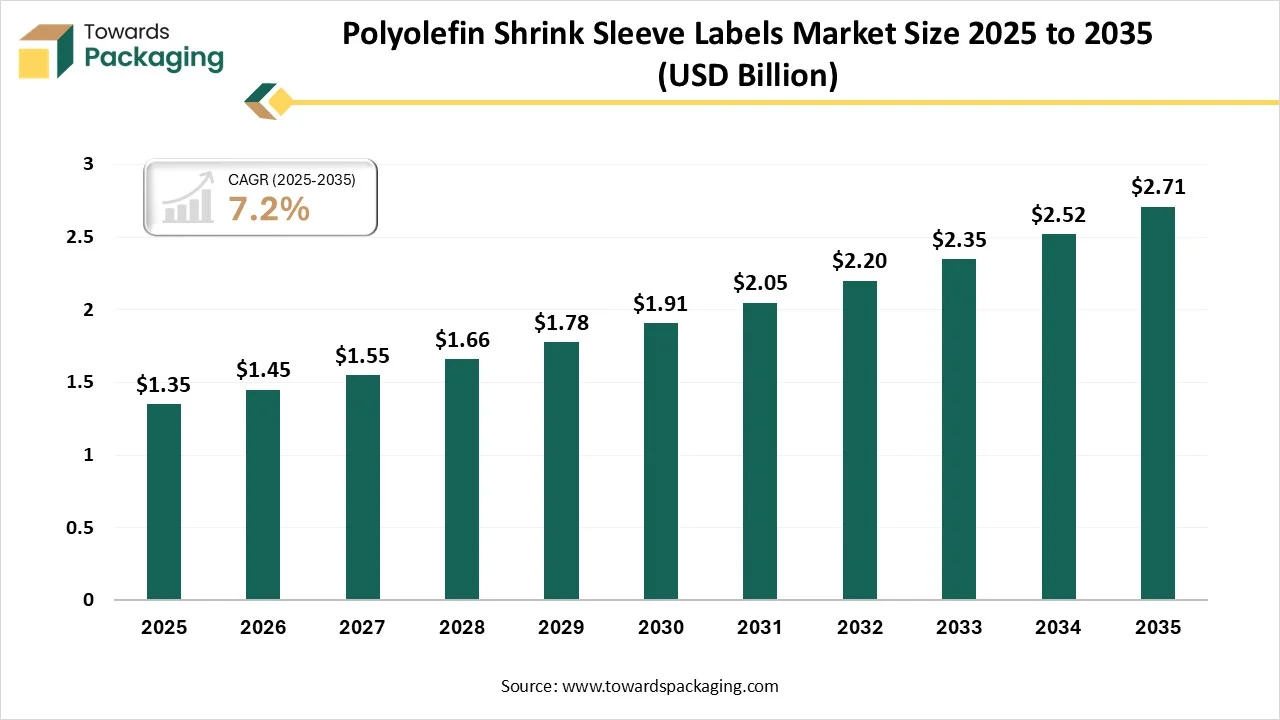
The polyolefin shrink sleeve labels market is rapidly growing sector, driven by strong demand for high-impact, full-body product decoration and increasing emphasis on sustainability. Shrink sleeve labels are flexible plastic films that, when heated, conform tightly around containers, offering 360° branding, tamper-evidence, and excellent print quality across complex shapes advantages that are especially valued in personal care, food & beverage, pharmaceuticals, and domestic products packaging.
The sleeve label enables security characteristics to be mixed directly into the packaging without the demand for further elements or added industrial complexity. Either through NFC Chips or an RFID, invisible inks, or different serialized codes, such elements develop product traceability at each stage of its lifecycle -from manufacturing to an end-user. They match with relevant needs in a fragile sector like cosmetics, pharmaceuticals, and nutrition, which also ensures product integrity through characteristics like tamper evidence. By integrating protection with invisibility, this sleeve becomes a smooth shield against counterfeiting, all while mixing seamlessly into manufacturing lines.
Package Design and Prototyping: Shrink sleeve classified at the corner of design flexibility, durability, and functionality, which is unaligned and acceptable across the container types and has perfect opposition to the surrounding challenges, polyolefin shrink sleeve labels are transforming how sectors use product packaging and branding.
Recycling and Waste Management: Consumers are excessively urging sustainable packaging selections, and businesses are giving feedback with passionate sustainability goals and loyalty to lower their eco-friendly footprint. Governments are also implementing strict regulations on the packaging waste and recyclability. Plastic waste, in particular, has become a major concern, with huge quantities that end up in oceans and landfills.
Logistics and Distribution: One of the main challenges associated with storing and shipping shrink sleeves is that such labels are very fragile in the surrounding environments. If the shrink sleeves get too cold, hot, dry, wet, or apart from these conditions. It can lead to material that gives feedback on the labels and makes them completely unusable. It’s crucial to make any shipping and storage areas as climate-managed as possible to keep your funding safe.
The PVC (Polyvinyl Chloride) segment has dominated the polyolefin shrink sleeve labels market in 2025 as they are the most common type of shrink labels that serve complete tailored solutions, enabling product details, brand logos, and marketing messages to be hugely displayed through high-quality multi-color printing and developing the brand recognition. Apart from perfect product prevention, these labels deliver as a smooth marketing tool that ensures distortion-free and bright printing through high-level processing techniques.
The polyolefin segment is predicted to witness the fastest CAGR during the forecast period. Polyolefin shrink film is a kind of luxury and multi-layer shrink film that has an integration of materials such as polyethylene (PE) and polypropylene (PP). Such materials can be co-processed in different multi-layer co-extruded procedures to make a premium shrink film that has flexibility, strength, clarity, and the shrinkage that tightly wraps around the products when heat is used. They are free of any toxic plasticizers and or chlorine -dependent elements, which are compliant with EU and FDA regulations for food contact. Furthermore, its film serves as a highlighted barrier to oxygen and moisture, hence it allows for a stretched shelf life and the product flavor.
The full body shrink sleeve segment has dominated the market in 2025 as they cover the complete container, from top to bottom, by serving a 360-degree solution for overall graphics and a huge area for branding. Such an option serves the biggest printable space, which enables intricate design, complete product information, and vibrant colors, too. Also, they are perfect for differently shaped or outline containers, as the film shrinks to perfectly accommodate a product’s design.
The partial body shrink sleeve segment is predicted to witness the fastest CAGR during the forecast period. These sleeves cover only a specific portion of the container, such as the middle area or the shoulder area, leaving such areas uncovered. Such sleeves are a more economical selection, as they are full-body sleeves and utilise less material without sacrificing effect. Also, it enables displaying the container’s actual texture or color while it still serves a huge amount for the main branding factors. And the necessary information too, for nutritional facts.
The bottles segment has dominated the polyolefin shrink sleeve labels market in 2025, as this bottle, which uses recycled materials to lower its own greenhouse gas emissions at the time of both procurement and product disposal, such as incineration. By accepting multi-layer molding, which sandwiches a recycled material, the bottle can be used for a huge variety of non-food uses, which include daily products.
The pouches and flexible containers segment is expected to witness the fastest CAGR during the forecast period. One of the advantages is cost-effectiveness as compared to strong packaging like bottles, cans, or jars. Pouches use less material, which results in lower manufacturing costs as well as reduced travelling costs. Their advanced level product-to-package ratio also lessens material waste. The shape flexibility enables inventive structural designs that stand out on the retail shelves.
The food and beverage segment has dominated the market in 2025 as container types are applicable to a shrink sleeve packaging, which includes cans, jars, bottles, and tubs too. The containers are cylindrical and tall, and even short too, which are shrink sleeve labels and are different in their potential to conform to the curves, uneven geometrics for an regular labels which struggle to cover. Glass, plastic, and metal containers are all compatible with the shrink sleeve as a labelling procedure. The main thing is to utilize a container strongly enough to firmly withstand the shrink forces of the sleeve while also managing the heat of the shrink tunnel.
The personal care and cosmetics sectors are predicted to witness the fastest CAGR during the forecast period. This industry uses shrink sleeves for products such as lotions, shampoos, and creams that serve a well-polished and attention-grabbing look. Pharmaceutical organizations also use the shrink sleeves for medical bottles and containers, which serve clear labeling and prevention against tampering. While delivering a luxury look which is frequently linked with costly packaging, the polyolefin shrink sleeve can develop a solution, particularly when compared to custom-printed containers.
Asia Pacific dominated the market in 2025 as it is being driven by encouragement from technological, economic, and regulatory factors. As economic moves continue to encourage the production hubs across developing markets, several countries with strong industrial design are developing rapidly as their export capabilities and manufacturing transformation to develop the quality standards and efficiency.
India Polyolefin Shrink Sleeve Labels Market Trends
Producers in India are heavily accepting full-body shrink sleeve to develop the “shelf appeal” and serve more space for compulsory and regulatory information, and lastly for brand storytelling. There is a huge demand for a tamper-evident characteristic to protect against adulteration, specifically in the pharmaceutical and beverage industries. The “Make in India “ campaign continues to attract investments for packaging companies in order to invest in new manufacturing technologies.
North America expects the fastest growth in the market during the forecast period, which is being driven by the developing user choice, developing demand, and innovative packaging solutions for a brand classification across sectors such as personal care, beverages, and food products. Furthermore, the industry is classified by a demand for eco-friendly and sustainable label options, along with technological developments that allow deeper designs and perfect product protection.
Canada Polyolefin Shrink Sleeve Labels Market Trends
The versatile nature of these labels has increased the demand in Canada, which enhances product visibility and appearance, too. There is growing acceptance in the food and beverage sector, particularly for the luxury and easy products, which further fulfills industry growth. Furthermore, developments in printing technologies allow tailored designs, high -quality products that attract producers who find differentiation.
Europe expects the notable growth in the market. The acceptance of high-level labelling technologies develops the brand differentiation, product visibility, and user engagement, too. There is growing importance on eco-friendly and sustainable packaging options, which further have market development as producers find eco-friendly conscious materials. Furthermore, the rising e-commerce industry in Europe makes a compulsion for tamper-proof and shrink labelling solutions, which boosts the acceptance of stretch sleeve labels and shrink too.
Germany Polyolefin Shrink Sleeve Labels Market Trends
The urge for the excessively pushed by the Packaging and Packaging Waste Regulation and Germany's Verpack G has led to a main shift towards PET-G, which commands a high regional share and cPET materials, which are being favoured for their suitability and clarity for Germany's mature deposit-return scheme (DRS). Also, the urge for 360-degree graphics is to develop on-shelf requests, which is an initial driver, specifically in terms of markets such as Germany.
By Material / Polymer Type
By Sleeve Type
By Container Type
By End-Use Industry
By Region







Research & Advisory Analyst
Yogesh Kulkarni is an experienced Research Analyst specializing in the packaging sector, with a strong foundation in statistical analysis and market intelligence. He currently contributes his expertise to Towards Packaging.
Learn more about Yogesh Kulkarni

Reviewed By
Aditi Shivarkar, with 14+ years in packaging market research, specializes in food, beverage, and eco-friendly packaging. She ensures accurate, actionable insights, driving Towards Packaging Analytics & Consulting 's excellence in industry trends and sustainability.
Learn more about Aditi Shivarkar

Polyolefin Shrink Sleeve Labels Market
 Table of Content

 Download Sample
 Schedule a Meeting