


According to Vidyesh Swar, who specializes in biomaterials packaging, production techniques, and packaging applications with 5+ years of experience in market research. His specialization indicates biomaterials packaging market growth opportunities. The global biomaterials packaging market size was estimated at USD 18.40 billion in 2025 and is predicted to increase from USD 20.9 billion in 2026 to approximately USD 66 billion by 2035, and is expected to grow at a CAGR of 13.60% during 2025-2035. His research showcases that circular economy rules, buyer sustainable preference, and advancements in biopolymers are responsible for market growth. The leading innovators are Novamont S.p.A., Taghleef Industries, NatureWorks LLC, and BASF SE.
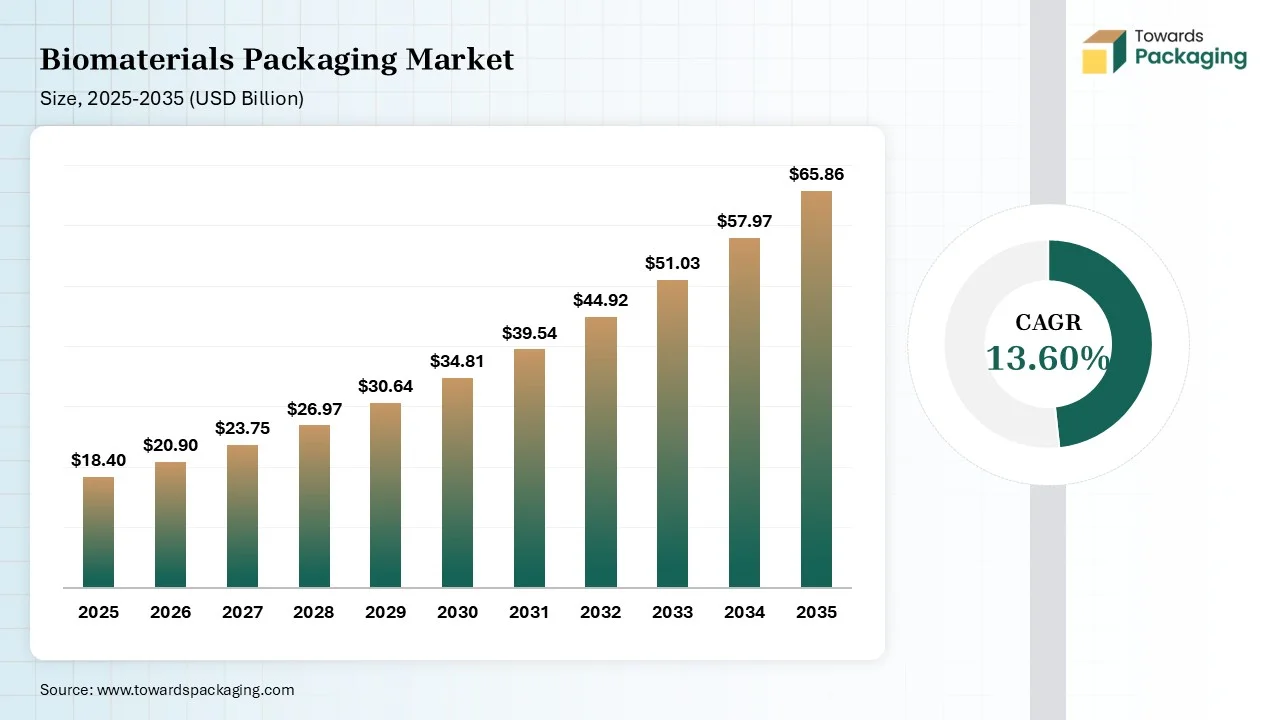
The Biomaterials Packaging market is predicted to increase to USD 20.9 billion in 2026 due to the growing financial pressures and the innovations in plant-waste chemistry. The market is expected to grow to approximately USD 66 billion by 2035, expanding at a CAGR of 13.60% from 2026 to 2035 due to the burgeoning eco-consciousness and advancing biopolymers.
Biomaterials packaging is packaging made from natural materials like microorganisms, starches, and others. It possesses characteristics like renewable origin, circular economy support, reduced footprint, and biodegradability. The benefits like natural breakdown, improved food safety, fossil fuel savings, brand appeal boost, and low carbon output provided by biomaterials packaging. Biomaterials like proteins, agro-waste fibers, polysaccharides, and bio-based polyesters are widely used in biomaterials packaging. It's used in pharmaceutical blisters, edible coatings, and compostable clamshells. The global biomaterials packaging market size was estimated at USD 18.40 billion in 2025. The main drivers are demand for green brands among consumers, corporate goals, global prohibitions, and ongoing material innovations. Factors like the leading F&B sector, rising PLA innovation, expanding flexible formats, high supply of agricultural feedstocks, scaling processing capacities, and retailers' pledges are drivers for the market.
Source:- Towards Packaging Database
The market is expected to grow to approximately USD 66 billion by 2035, due to the growing circular economy integration, introduction of aggressive EPR, and advancing material science. Factors like brands' focus on earth safety, new technology innovation, consciousness about food freshness, development of easy composting infrastructure, expansion of new investors, rising number of green buyers, increasing fossil fuel cost, and growing plastic trash crisis will increase the production of biomaterials packaging.
Source:- Towards Packaging Database
The biomaterials packaging market is expected to grow at a CAGR of 13.60% during 2025-2035. Carbon reduction goals and the eco-friendly transition are the main factors for the growth. Factors like availability of subsidies for bio-based packaging, high cost of plastic disposal, rise in biodegradable product packaging, food brands' commitment, incorporation of nanotechnology, integration of intelligent features, and scaling biopolymer processing drive the market growth.
Key Insights:- The market is growing with a 13.60% CAGR due to regulations.
Source:- Towards Packaging Database
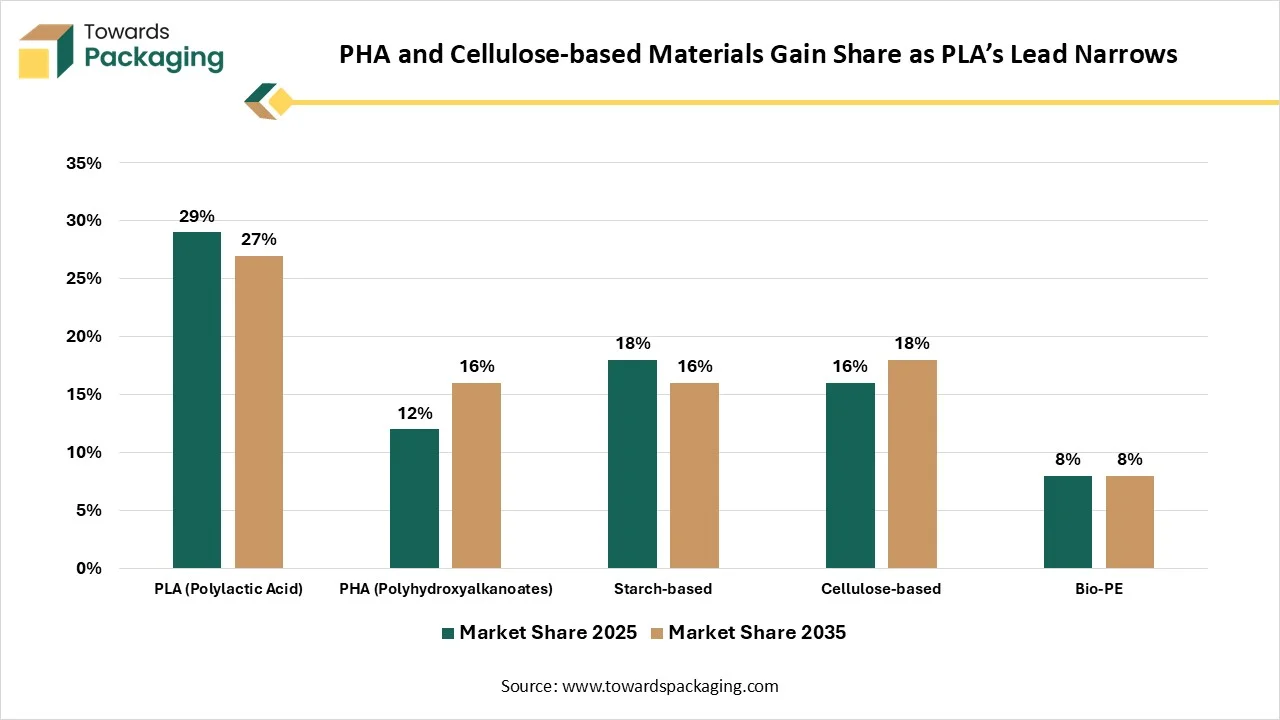
Biomaterials like PLA, cellulose-based materials, PHA, bio-PE, and starch-based materials are used in the production of biomaterials packaging. PLA held a 29% share in 2025 due to manufacturing compatibility and visual clarity. But PLA is expected to drop its share through 2035 due to thermal limits, premium pricing, and no compatibility with home composting. PHA held a 12% share in 2025 due to its superior product protection and is expected to lead through 2035 due to manufacturing innovations & total biodegradability. The starch-based held an 18% share in 2025 due to material abundance & growing number of consumers choosing eco-friendly options, whereas it is expected to decline its share through 2035 due to thermal instability and high moisture sensitivity. The cellulose-based held a 16% share in 2025 due to the strong physical traits & renewable sourcing and is expected to lead through 2035 due to the high barrier protection & endless supply. Bio-PE held an 8% share in 2025 and maintains the same share through 2025 due to feedstock dependency and high premium pricing.
Source:- Towards Packaging Database
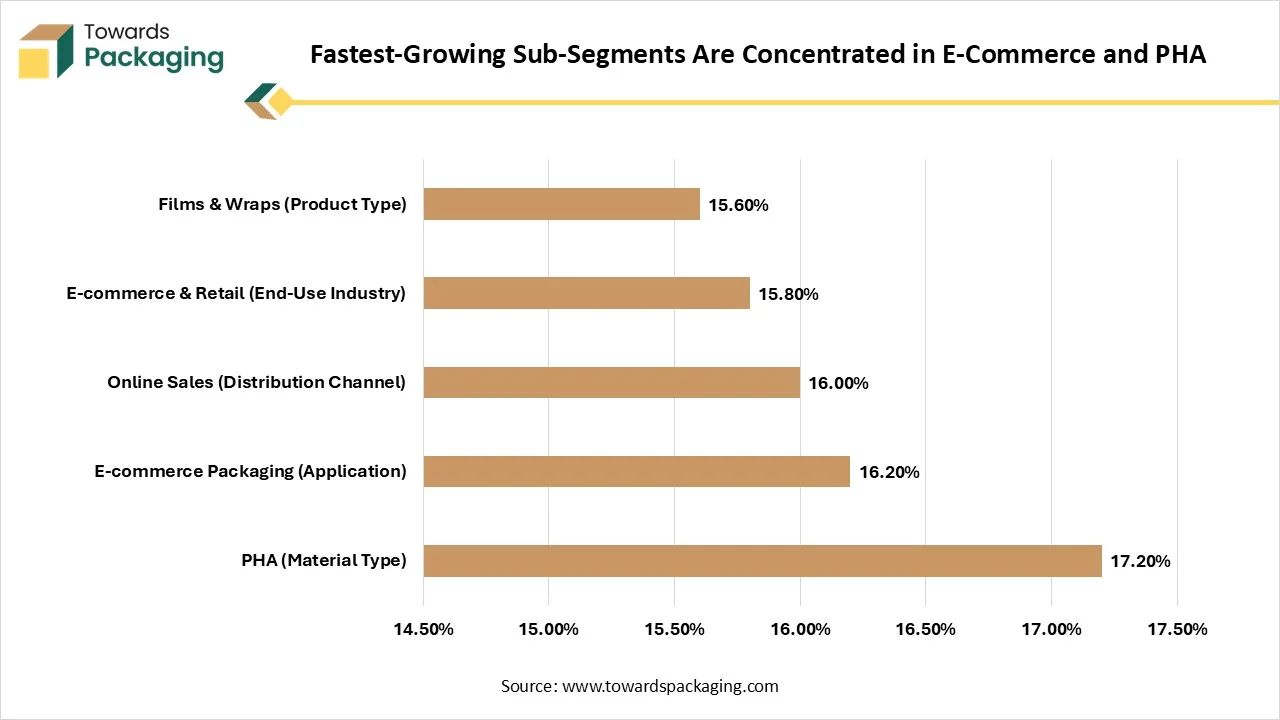
The fastest-growing sub-segments are PHA by material type, e-commerce packaging by application, online sales by distribution channel, e-commerce & retail by end-use industry, and films & wraps by product type. PHA is expected to grow fastest with 17.2% CAGR through 2035, driven by PFAS restrictions and strong shelf-life performance. E-commerce packaging is expected to grow fastest with 16.2% CAGR during the forecast period, driven by logistics adoption and shoppers' demand. Online sales are expected to grow at the fastest rate of 16% CAGR during the predicted timeframe, driven by strong shopping power and better unboxing. E-commerce & retail is growing with the fastest CAGR of 15.8% during the predicted time, driven by burgeoning shipping boxes. Films & wraps are growing with the fastest CAGR of 15.6% during the forecast period, driven by demand for shelf-life extension.
Source:- Towards Packaging Database
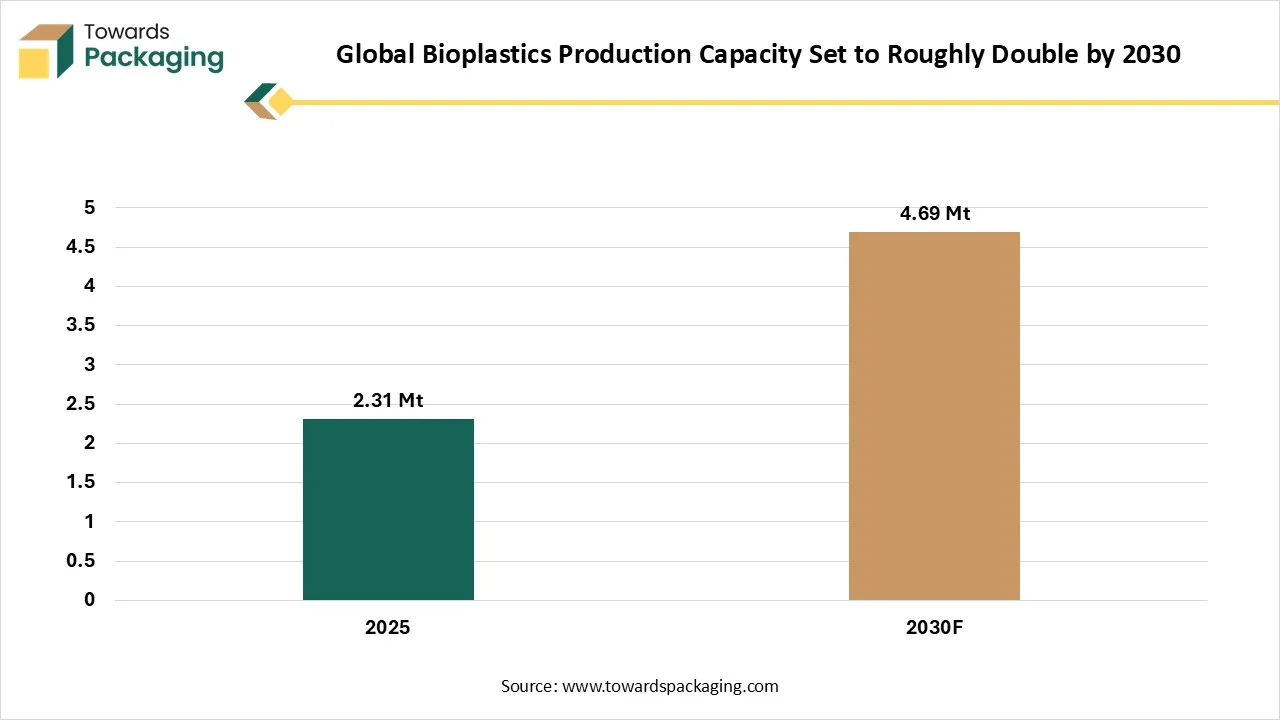
In 2025, global bioplastic production reached 2.31 million tonnes. Factors like packaging growth, growing consumer pressure, and expanding regional frameworks increased bioplastic production. Limitations on plastic waste and the expansion of better-performing polymers increase the use of bioplastics. Packaging application accounts for the largest share in 2025. Packaging dominates due to the explosion of short-lived goods, large retail giants, and the rising use of sustainable beverage bottles. Global bioplastic production is predicted to reach 4.69 million tonnes. The production capacity is doubling due to regional expansion of processing plants, sustainability promises, biodegradable polymers innovation, increasing use in electronic housing, and higher utilization in food service.
Source:- European Bioplastics, Market Update (2025/2026), european-bioplastics.org.
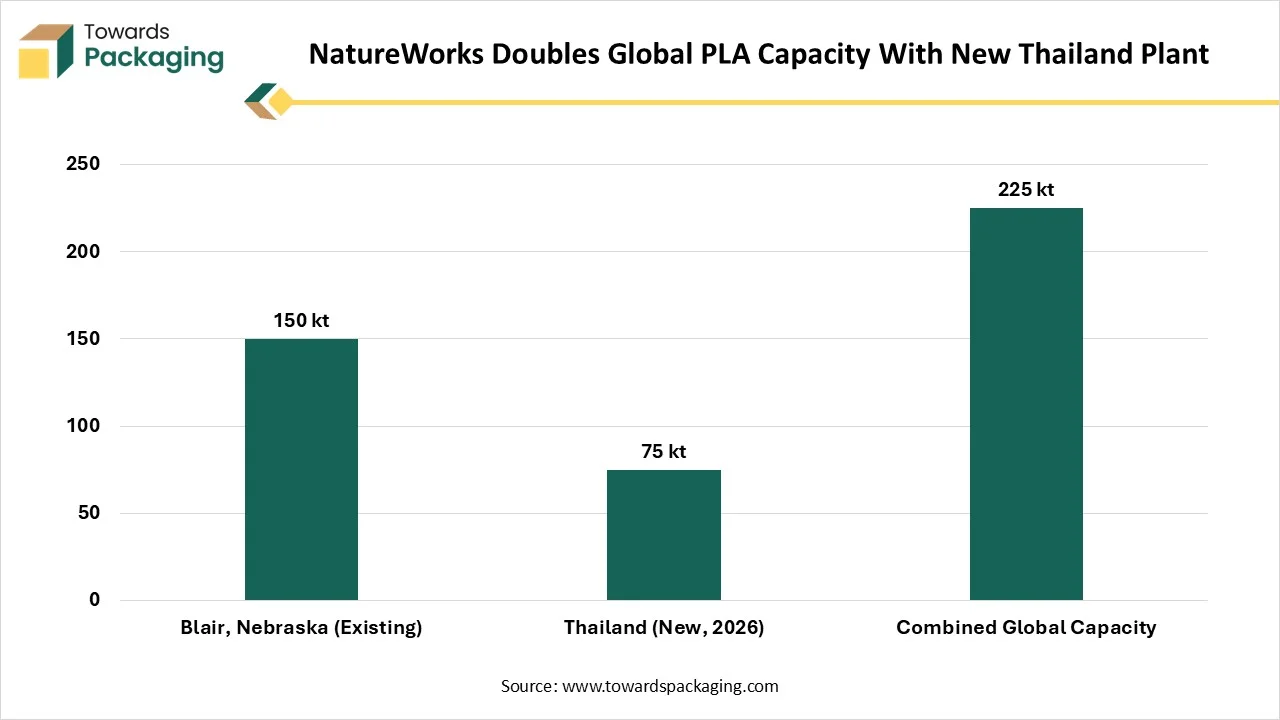
NatureWorks expanded its production capacity to 150000 metric tonnes in Blair, Nebraska. The facility produces Ingeo polylactic acid biopolymer. The facility uses corn feedstock for the production of Ingeo PLA. The expanded capacity supports applications like nonwoven hygiene masks, compostable teabags, 3D printing, and many more applications. In April 2026, the company developed a new facility in Thailand for producing Ingeo biopolymer. The new facility opened in Nakhon Sawan, and the single facility includes polymer manufacturing, lactic acid production, and lactide monomer development. Thailand’s facility has a manufacturing capacity of 75000 metric tonnes. The capacity expansion meets growing demand across consumer applications, packaging, and fiber applications. The combined capacity of Nebtaska and the Thailand facility is 225000 metric tonnes. NatureWorks secured a $350M investment from Krungthai Bank for the development of the new Thailand plant.
Source:- NatureWorks press releases (2023–2026)); PR Newswire/GC (May 2024); Engineering.com and BusinessWire (Apr–May 2026)
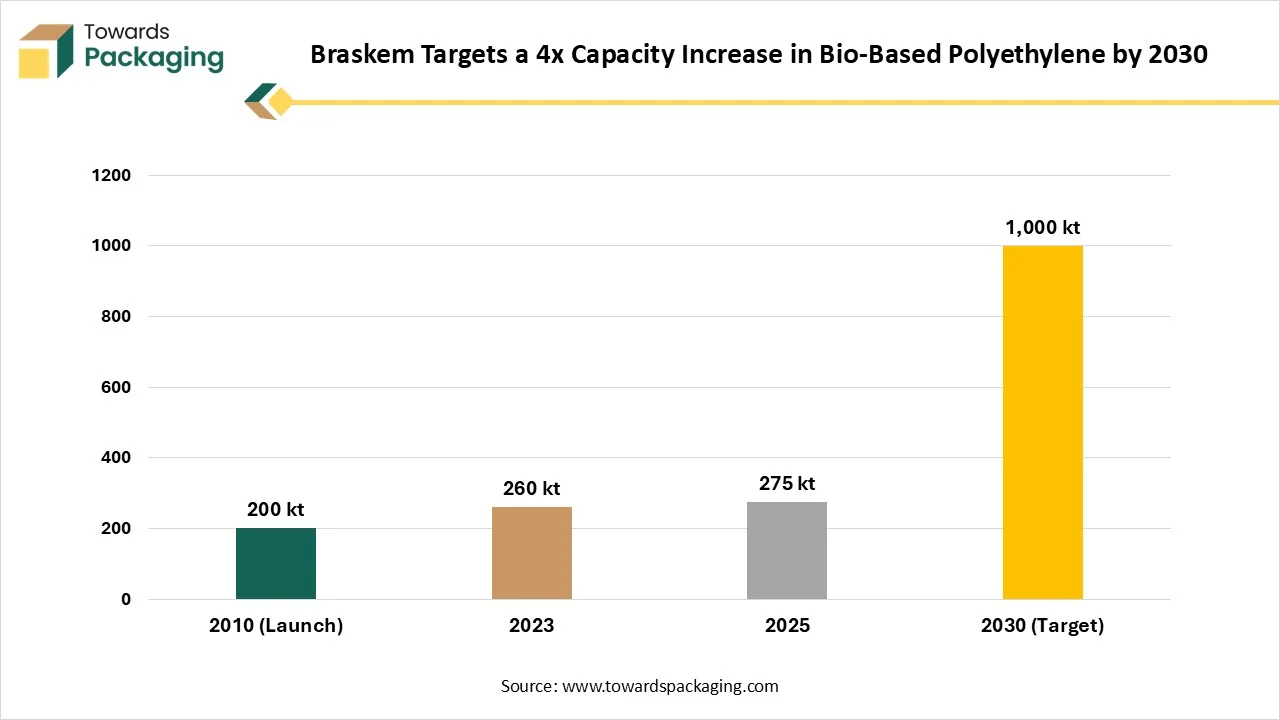
Braskem opened its first bio-PE production plant in 2010 in Brazil. The feedstock used for the manufacturing is sugarcane-based bioethanol. The new facility manufactures I’m green bio-based PE. The manufacturing process includes ethanol conversion, dehydration, polymerization, and carbon sequestration. The facility expanded its production capacity by 30% in 2023. The facility received a US$ 87 million investment for the expansion. The facility expanded its annual capacity from 200000 tonnes to 260000 tonnes. In 2025, the company expanded its production capacity up to 275000 tonnes. The expanded capacity removes carbon dioxide. The company focuses on producing 1 million tonnes of bio-based PE by 2030. The company is expanding production capacity to lower dependence on virgin fossil feedstock.
Source:- Braskem press releases (Jul 2023, May 2025); Packaging World; BusinessWire
The global PHA market size was estimated at USD 123.8M in 2025. Factors like reductions in manufacturing cost, high demand in Europe, global regulations, growing demand across Asia Pacific, strongly established packaging industry are responsible for PHA adoption. The market is set to reach approximately USD 265.2 million by 2035. The market growth is expanding due to demand for complete biodegradable solutions, development of superior microbes, growing demand across the application sector, and enforcement of regulations. In 2024, the global PHA production capacity increased by 35000 metric tonnes. Europe holds a dominant position with a 57.4% share in the global PHA market. Europe dominated due to the expansion of circular economy packages, higher plastic taxes, a rise in patent creation, strong bioplastic engineering hubs, and automotive brands' commitments.
Source:- as cited in elevenflo.com Danimer Scientific case analysis (Mar 2026)
According to Aman’s research, on March 18, 2025, Danimer Scientific registered a Chapter 11 petition in Delaware. Factors like high expansion costs, heavy debt load, and slow commercialization increased the pressure on the company. The total debt on the company is $400 million. In the first nine months of 2024, the company lost $72 million on $26 million in revenue. The company had 480+ patents. The company sold all its patents and assets to Teknor Apex. The company got Danimer Scientific assets for $19 million in May 2025. CJ Biomaterials upgraded its facility in Woburn, Massachusetts in 2024. The facility upgraded testing and technical capacities for packaging. The company also increased production capacity of scPHA and aPHA in April 2024. The company increased production capacity of the Pasuruan facility. In April 2025, the company decided to retain their biomaterial division.
Source:- bioplasticsMAGAZINE (Mar 2025); ICIS (Mar 2025); Packaging Dive (Feb 2026); elevenflo.com Danimer case summary (Mar 2026)
EU PPWR officially started on 11 February 2025. The EU PPWR includes mandatory recyclability rules, waste reduction targets, refill goals, substance restrictions, and many other rules. The EU PPWR rules application started on 12 August 2026 in the EU member states. The application limited PFAS use and replaced older directives. Consumer labelling application will start in August 2028. The incorporation of stricter recyclability, reuse quotas, and recycled-content thresholds will be applicable from 2030. From 2035 to 2024 EU PPWR will focus on advancing recycling and prohibiting low-quality packaging.
Source:- European Union, Regulation (EU) 2025/40 (Official Journal, Jan 2025); Kelley Drye/Katten (khlaw.com) legal analysis (Nov 2025); Fieldfisher (Jul 2026); Greenberg Traurig (Aug 2025)
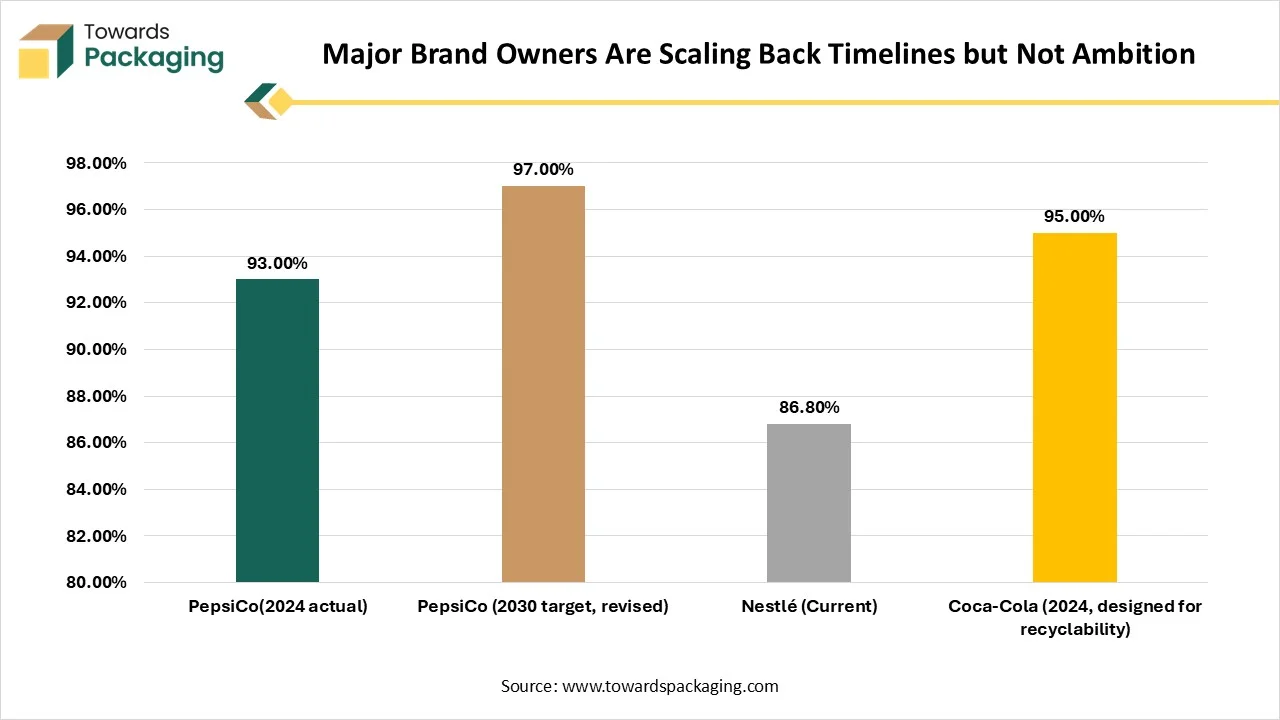
According to Aman’s research, in 2024, PepsiCo reached its 93% RRC packaging target. The company lowered its virgin plastic use and started utilizing recycled content. The company used RRC packaging in its snack packaging and beverage packaging. The company uses RRC due to evolving goals, sustainability compliance, and waste reduction. The company first decided to achieve 100% RRC packaging by 2025, but later the company focused on achieving a 97% target by 2030. Currently, Nestle uses 86.8% reusable and recyclable packaging into their products. Nestle uses rPET, recyclable paper wraps, provides refill pilots, and offers return systems. Coca-Cola achieved 95% recyclability in 2024. The company increased use of PET and enhanced adoption of reusable packaging. The company increased the use of recyclable content, and its virgin plastic use increased approximately 9.84% from 2023.
Source:- Packaging Dive (May 2025); ESG Dive (May 2025); Recycling Today (2025); Packaging Europe (2026); Nestlé ESAR sustainability page; PepsiCo ESG packaging page
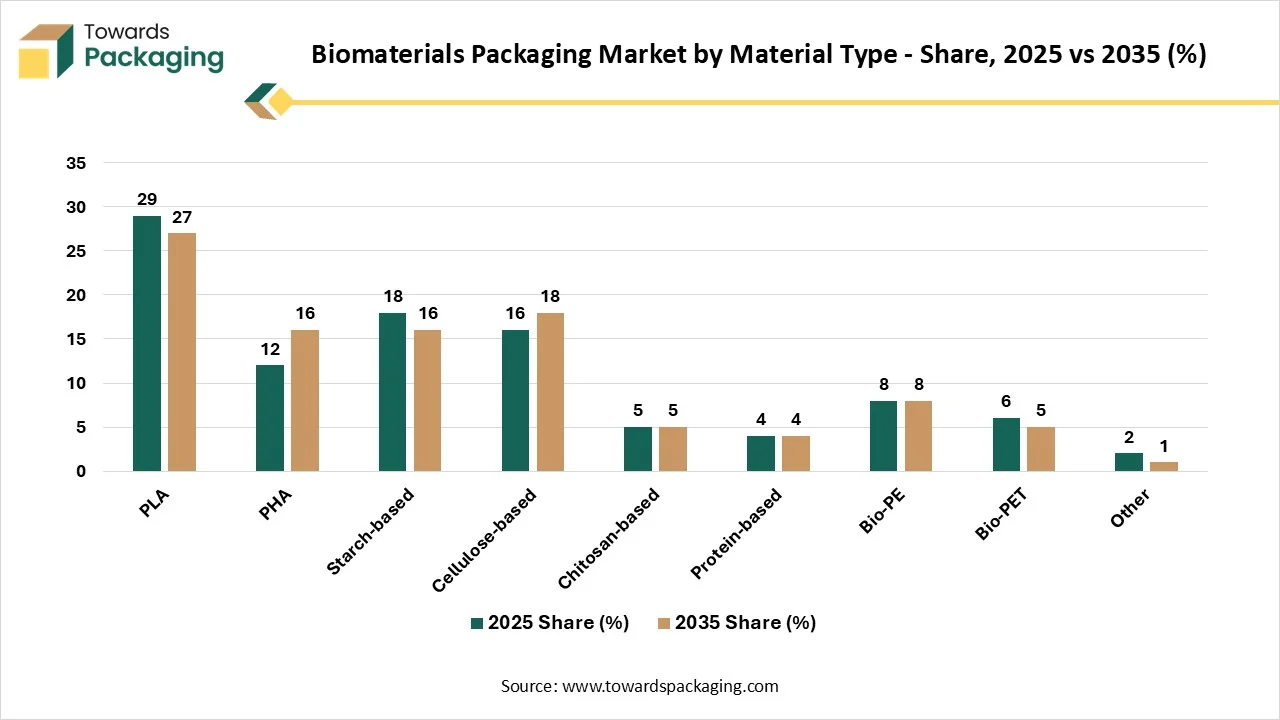
The diverse material types are polylactic acid (PLA), starch-based biomaterials, polyhydroxyalkanoates (PHA), cellulose-based biomaterials, protein-based biomaterials, bio-PET, chitosan-based biomaterials, and bio-polyethylene. Polylactic acid (PLA) dominated the biomaterials packaging market with a 29% share in 2025 due to the good optical transparency and the move away from petroleum plastics. The manufacturing of drink containers and their compatibility with plastic processing equipment help with the growth. The polyhydroxyalkanoates (PHA) are growing at the fastest CAGR of 17.2% during the forecast period due to the focus on mimicking rigid packaging. The high use of shopping bags, interest in suit films, and the consumer focus on home compostability increase the use of PHA. The starch-based biomaterials held an 18% market share in 2025 due to the abundance of starch-based plants. The push to green materials and the interest in safe green packaging increase the use of starch-based biomaterials. The development of dry food trays and wrapping of fresh items increases the use of starch-based biomaterials, supporting the growth.
Source:- Towards Packaging Database
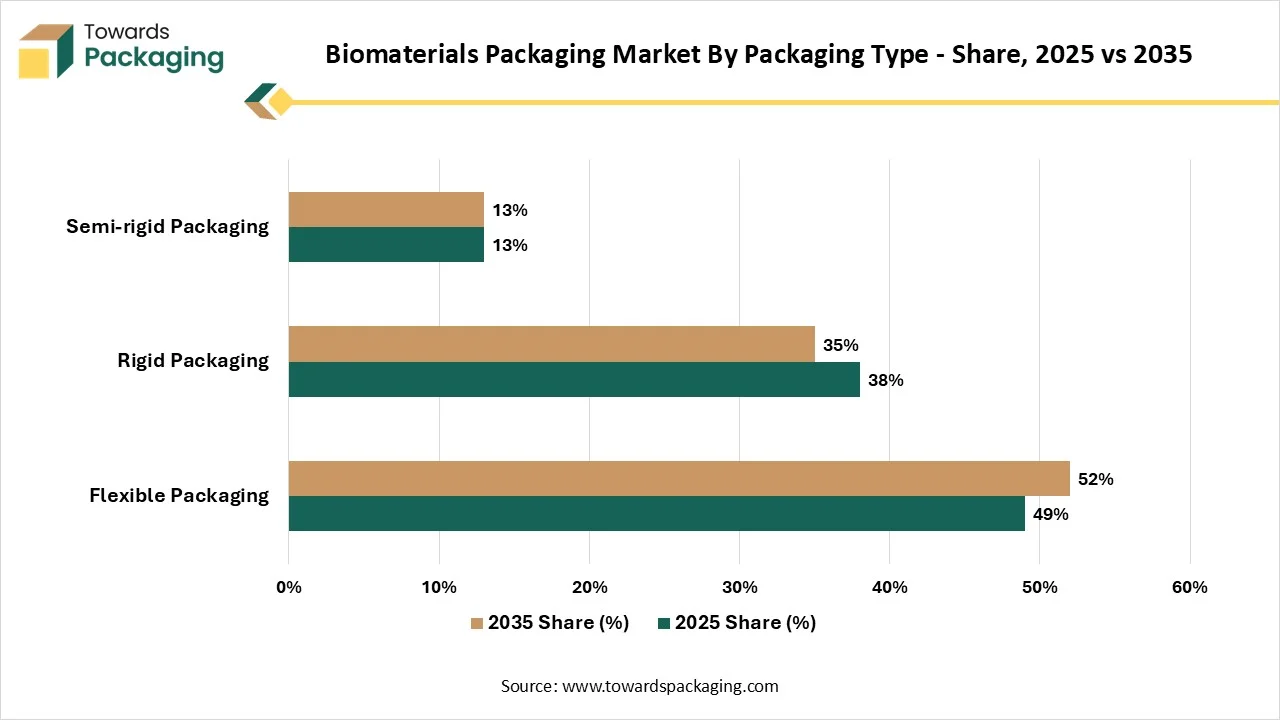
The packaging type is characterized as flexible packaging, semi-rigid packaging, and rigid packaging. Flexible packaging held the dominant position with 49% in the biomaterials packaging market in 2025 and is expected to grow at the fastest CAGR of 14.8% during the forecast period. The push away from rigid metal containers and the focus on lowering resource use increases adoption of flexible packaging. Factors like biopolymer compatibility, consumer convenience, and low shipping weights of flexible packaging help with expansion. The high suitability of flexible packaging with solid items and cosmetic products boosts the growth. Rigid packaging held the 38% share in the market in 2025. The presence of commercial filling lines and durable materials increases demand for the use of biomaterials-based rigid packaging. The expansion of compostable rigid containers, increasing use of rigid tubs, and the explosion of rigid plastics help with growth. Semi-rigid packaging held a 13% market share in 2025. The focus on cutting food waste and the replacement of fossil plastics increases use of semi-rigid packaging. The machinery compatibility, thermoforming ease, shape retention, and exceptional product visibility in semi-rigid packaging help with expansion.
Source:- Towards Packaging Database
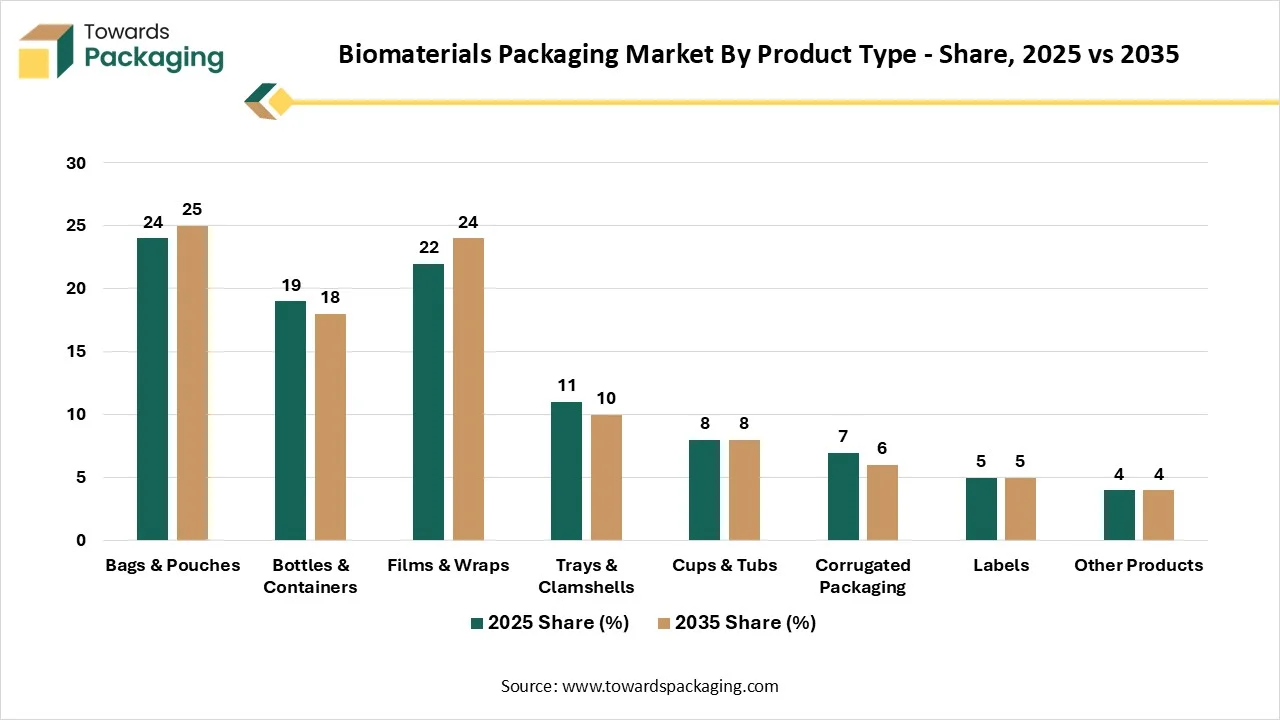
Product type includes various products like bottles& containers, trays & clamshells, bags & pouches, cups & tubs, and many more. Among all the product types, bags & pouches held the largest revenue share of 24% in the biomaterials packaging market in 2025. The focus on safe holding snacks and the compatibility with delivery trucks increases the use of bags & pouches. The rise in flexible mailer bags and the need to satisfy corporate sustainability goals help with expansion. The easy scaling, low weight, and less material in bags & pouches support the growth. Films & wraps are expected to grow at the fastest CAGR of 15.6% during the forecast period. The interest in compostable wrapping formats and the need for stretch-wrapping films help with expansion. The rising use of films & wraps in retail-ready pouches, meat packaging, and beverage packaging helps with growth. Bottles & containers held a 19% market share in 2025. The exploding liquid cosmetics and the high consumption of soft drinks increase use of bottles & containers. The expansion of skin care lines and burgeoning cleaning brands increases use of bottles & containers.
Source:- Towards Packaging Database
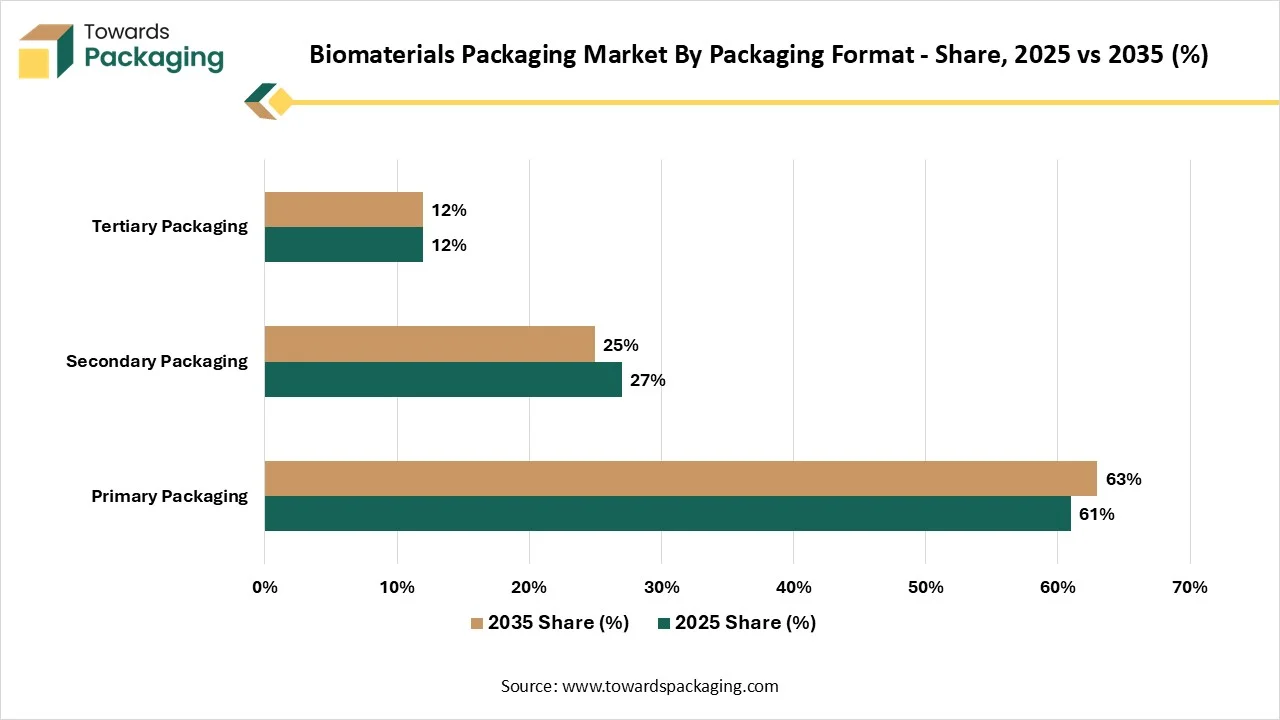
Among all the packaging formats, primary packaging dominated the market with a 61% share in 2025 and is expected to grow at the fastest CAGR of 14.2% during the forecast period. The focus on blocking contaminants in packaging and the demand for immediate retail packaging increase the use of primary packaging. Shoppers' interest in eco-friendly clamshells and food safety rules increases the use of primary packaging. The secondary packaging held a 27% share in the biomaterials packaging market in 2025. The need to prevent e-commerce transit damage and the rise in circular-waste systems increase the use of secondary packaging. The growth in molded packaging and the development of earth-friendly boxes help with expansion. The growing bio-based secondary formats drive the growth. The tertiary packaging held a 12% share in the market in 2025. The interest in bio-based transit materials and the need to lower supply chain waste increases the use of biomaterials-based tertiary packaging. The expansion of biomaterials-based shipping containers and bulk pellets in transportation supports the growth.
Source:- Towards Packaging Database
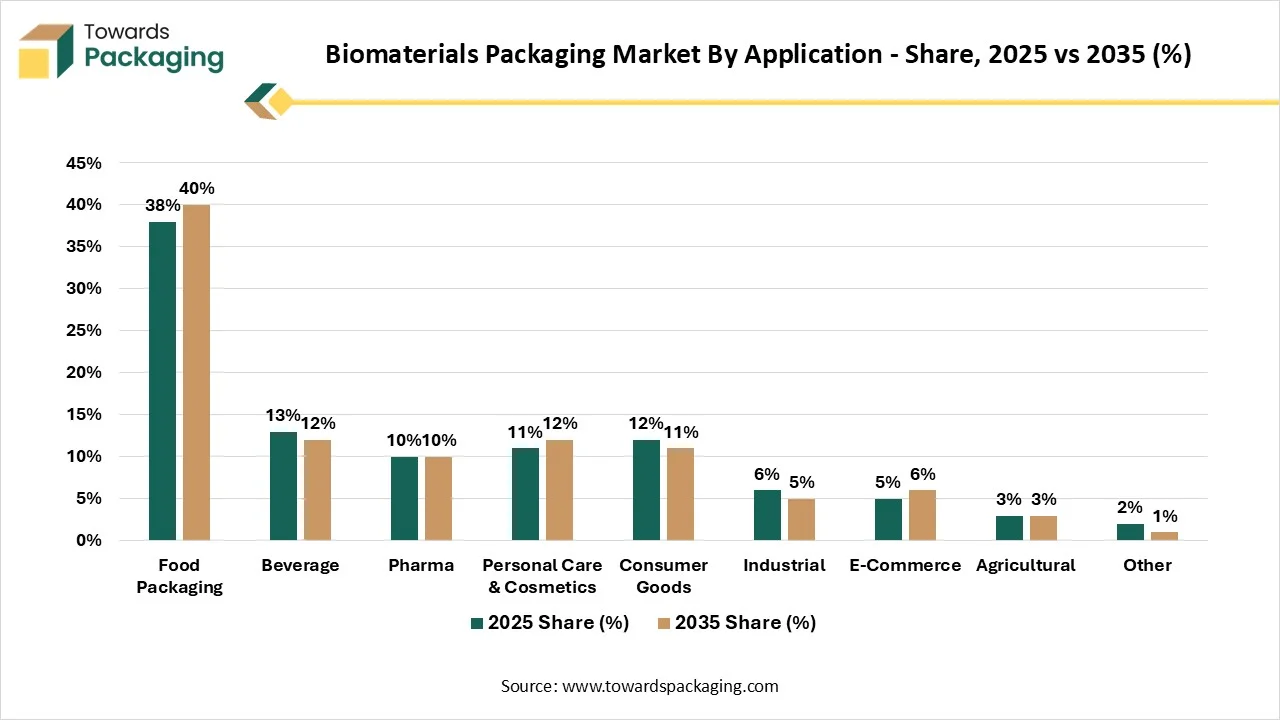
According to research, food packaging dominated the biomaterials packaging market with a 38% share in 2025. The demand for short-lifespan packaging in the food industry and the transition away from oil-based plastics increase the use of biomaterials packaging. The focus on integrating antioxidant qualities and the rise in sustainable takeout drive growth. E-commerce packaging is expected to grow at the fastest CAGR of 16.2% during the forecast period. The platforms focus on building customer loyalty, and the high volume of online deliveries increases the use of biomaterials packaging. The exploding digital retail and transformation to guilt-free packaging help with growth. Beverage packaging held a 13% market share in 2025. The rise in on-the-go beverage consumption and the expansion of packaged juices increase the use of biomaterials packaging. The protection of drink freshness and the growth of major beverage companies support market growth.
Source:- Towards Packaging Database
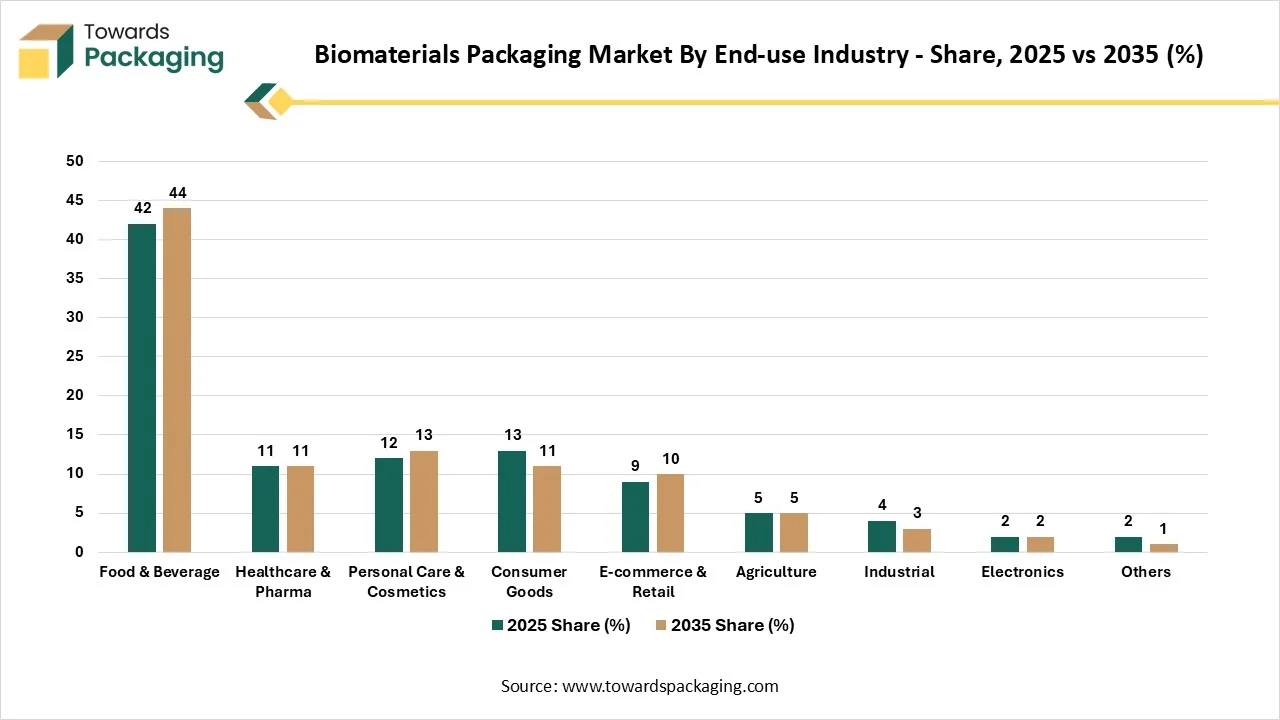
Food & beverage dominated the biomaterials packaging market with a 42% share in 2025. The large daily output of snack consumption and the use of bio-based solutions in food brands increase the use of biomaterials packaging. The high volume of fresh produce and the rise in on-the-go drinks drive the growth. Healthcare & pharmaceutical held an 11% market share in 2025. The focus on medication integrity and vaccine protection increases the use of biomaterials packaging. The biologics surge and focus on carbon reduction in the healthcare industry help with expansion. E-commerce & retail is expected to fastest with a 15.8% CAGR during the forecast period in the market. The high preference of people for online shopping and the availability of eco-conscious brands on online platforms help with expansion. The e-commerce shift to low-impact packaging supports the growth.
Source:- Towards Packaging Database
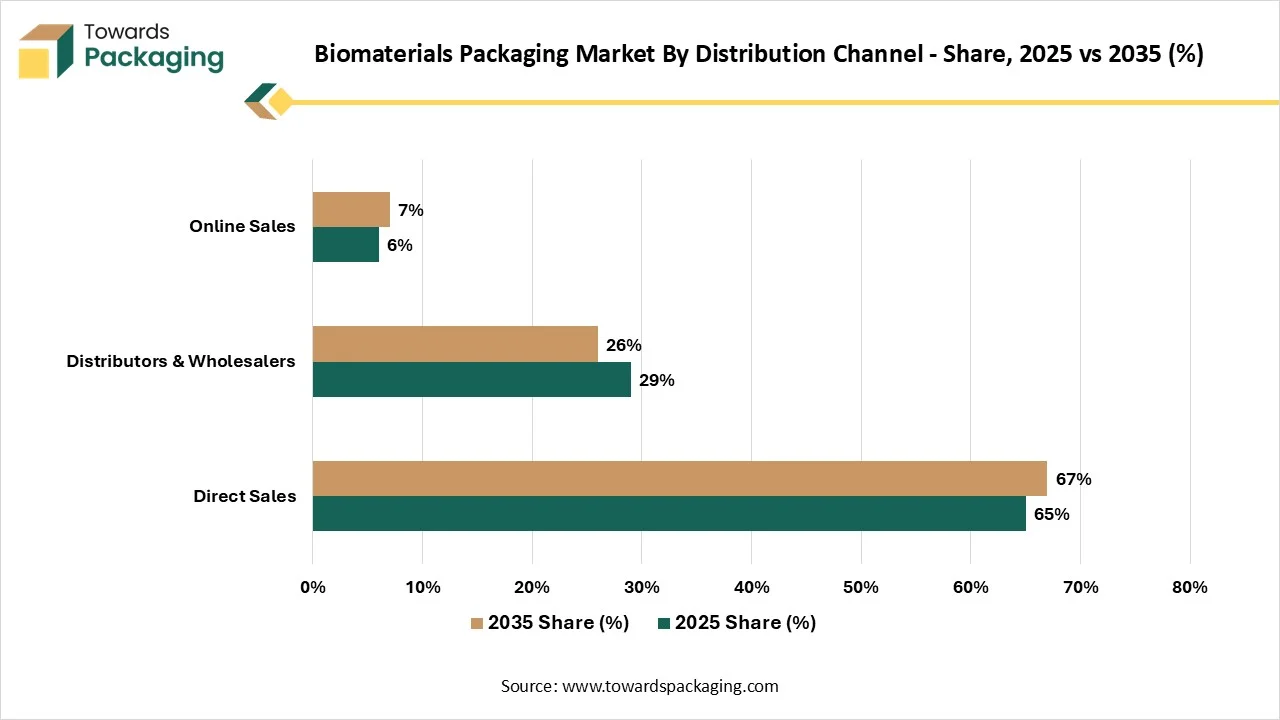
According to my research, direct sales held the highest revenue share of 65% in the biomaterials packaging market in 2025. The demand for custom specifications and technical consultations increases the use of direct sales. The demand for long-term delivery and the need to educate corporate buyers increase the use of direct sales. The availability of direct supplier communication helps with growth. Distributors & wholesalers held a 29% share in 2025. The complex global logistics and the rise in local vendors increase buying from distributors and wholesalers. The growing small-brands demand and need to cut delivery times drive the growth. Online sales are expected to grow at the fastest rate in the market, with 16% CAGR during the forecast period. Buyer interest in bulk ordering, vendor variety, fast comparison, availability of global buyers, and easy logistics in online sales help with expansion. The expansion of DTC digital platforms supports the growth.
Source:- Towards Packaging Database
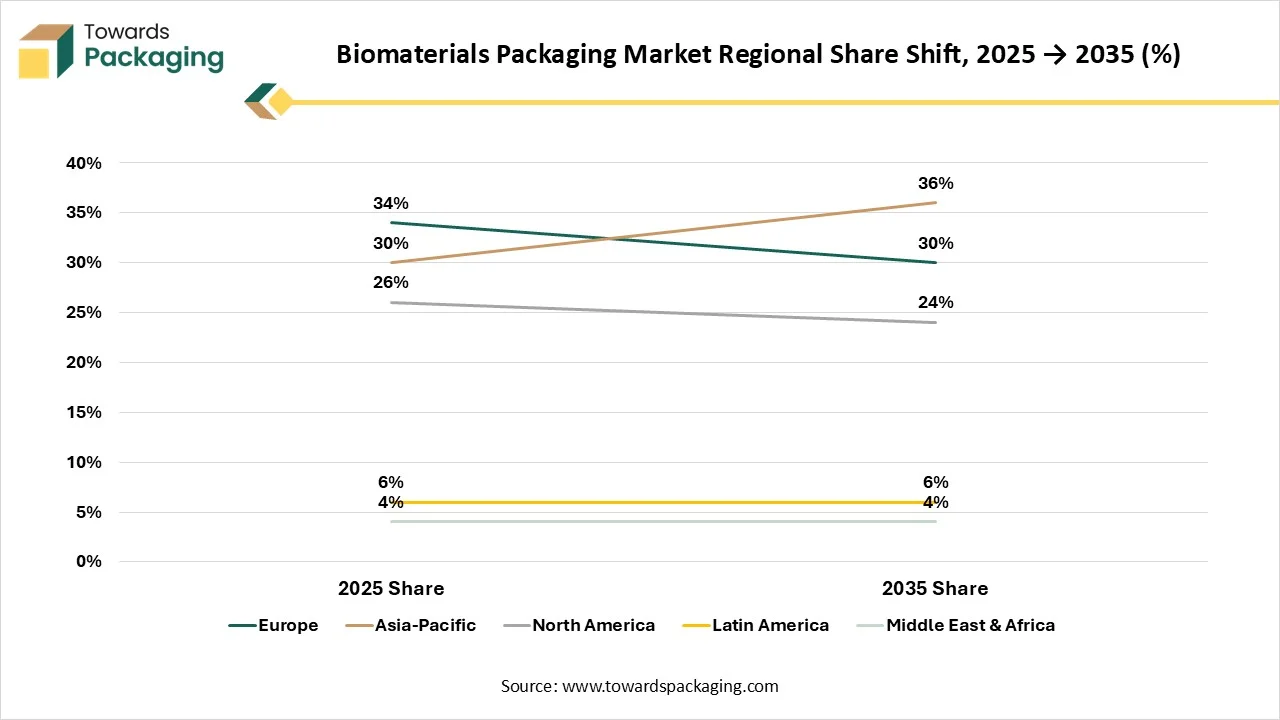
Europe dominated the market with a 34% share in 2025 due to growing corporate accountability and aggressive environmental directives. Europe is expected to decline in share in 2035 due to contamination in the recycling stream and increased manufacturing costs. Asia Pacific held a 30% market share in 2025 due to plastic restrictions & e-commerce, and Asia Pacific is expected to lead in 2035 due to a massive industrial ecosystem and online retail. North America held a 26% market share due to infrastructure investments and stringent labelling rules. Latin America held a 6% market share in 2025 and is expected to maintain the same position through 2035 due to the evolution in environmental policies and limited infrastructure. MEA held a 4% market share in 2025 and is expected to maintain the same position through 2035 due to the limited production infrastructure and high availability of petrochemicals.
Source:- Towards Packaging Database
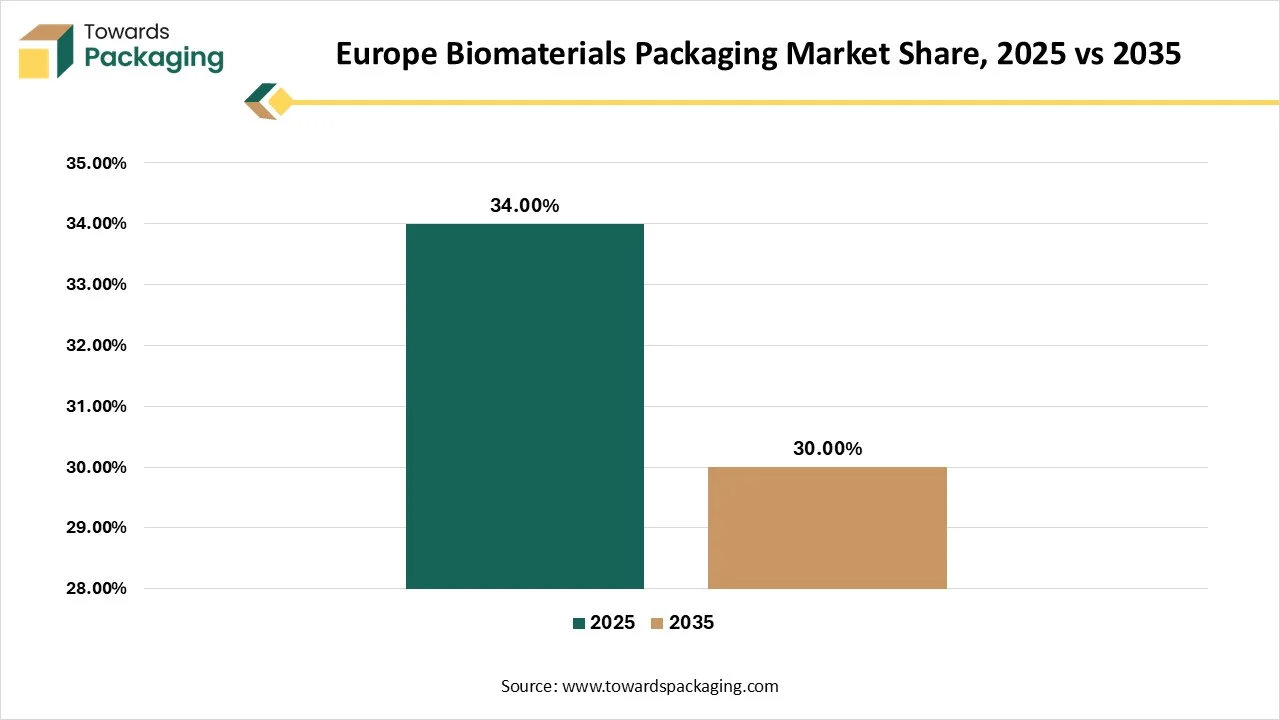
Europe held the dominant position with a 34% share in the biomaterials packaging market in 2025. The stricter legislation for waste reduction and the high financial penalties on recyclable packaging increase the adoption of biomaterials packaging. The increased standardization of green rules and the strong organic waste disposal ecosystem increase demand for biomaterials packaging. Brand sustainable pledges and robust research networks drive the growth. France is expanding in the market due to the penalties on non-recyclable items. The surge in biopolymers and the expansion of high-end cosmetics increase the production of biomaterials packaging. The French AGEC law and the growing eco-surcharges support the growth.
Source:- Towards Packaging Database
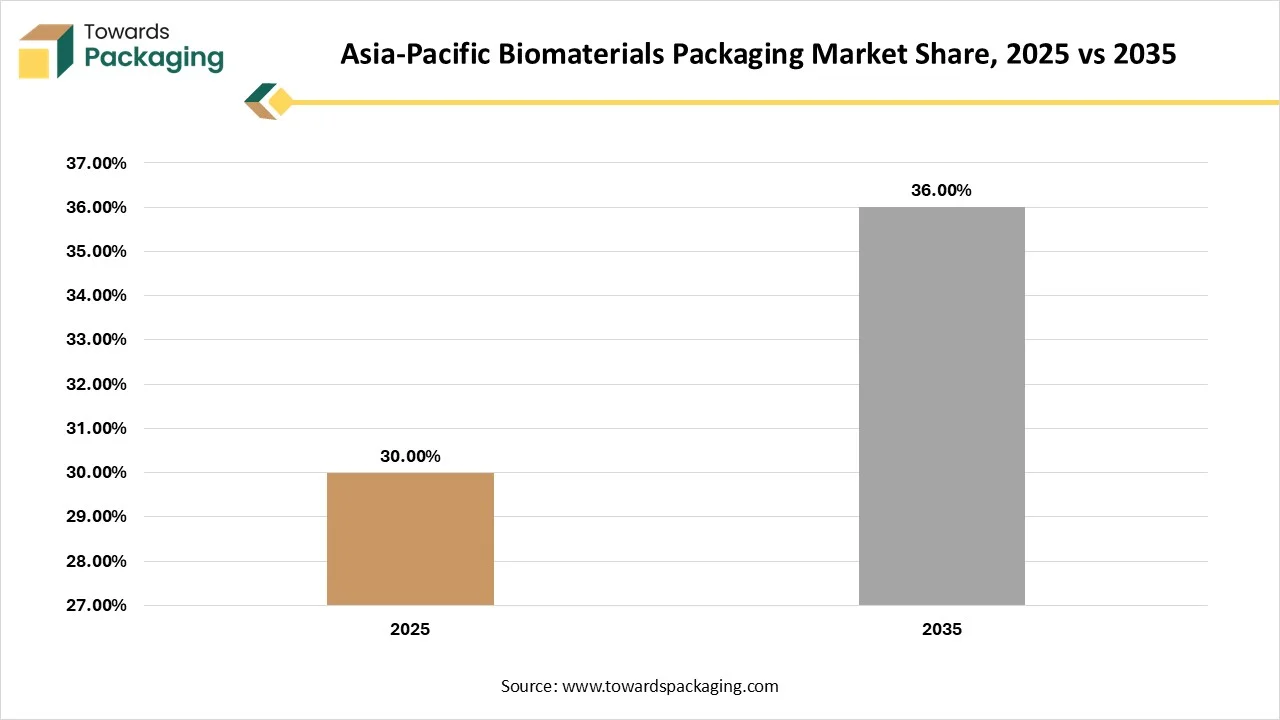
Asia Pacific held a 30% share in the biomaterials packaging market in 2025 and is expected to grow at the fastest CAGR of 16.5% during the forecast period. The enforcement of rules and eco-friendly compliance increases the production of biomaterials packaging. The large cassava industries and massive local farming increase the development of biomaterials packaging. The scaling of e-commerce and high goods purchasing helps with expansion. China held a dominant position in the Asia Pacific region. The stringent provincial controls and the rise in green-procurement frameworks increase the use of biomaterials packaging. The large-scale consumer brands and strong ecosystems like Heilongjiang for biomass increase the production of biomaterials packaging. The high commercial demand helps with the growth.
Source:- Towards Packaging Database
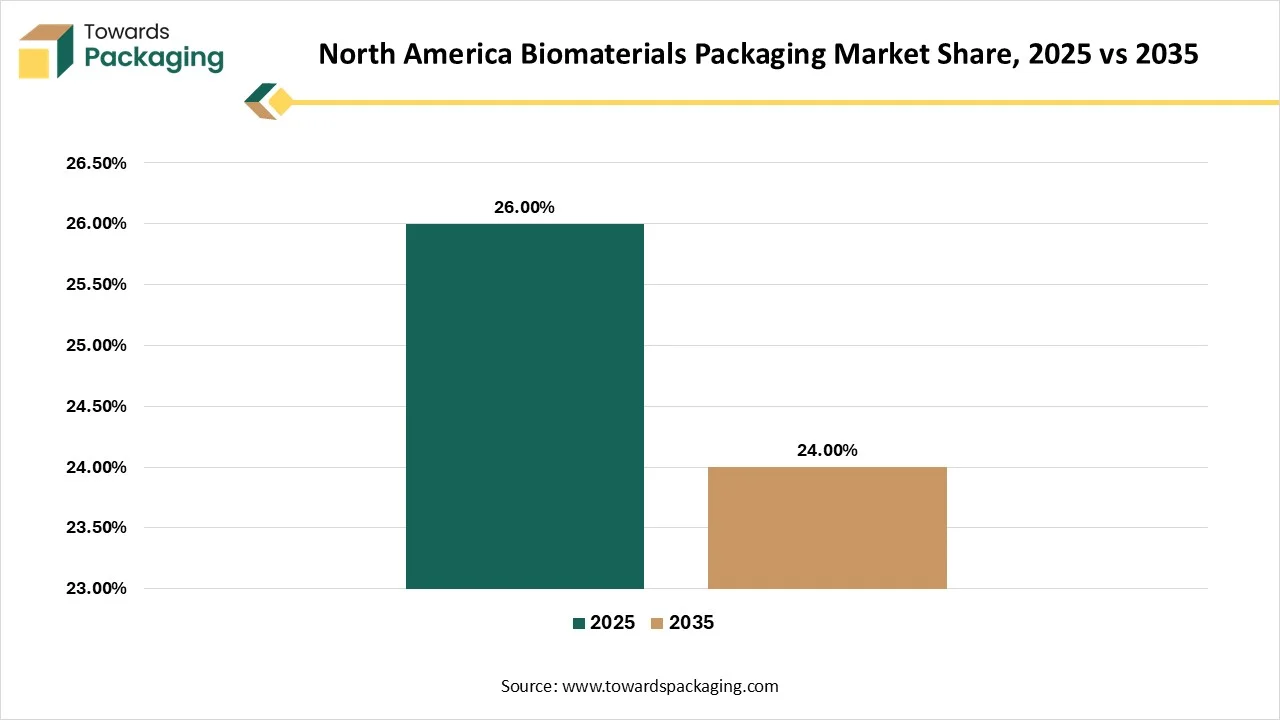
North America held the 26% share in the biomaterials packaging market in 2025. The government is forcing companies to utilize compostable materials, and the rise in grants for green production increases the use of biomaterials packaging. Big firms transition to plant-based plastics, and the growing collaborations for increasing biodegradable production help with the expansion. The development of advanced biopolymers helps with expansion. United States is a major contributor in the North American region. The stricter bans in states like New York and the use of green packaging in e-commerce increase the adoption of biomaterials packaging. The cost-effectiveness of bacterial packaging and preference for microbial fermentation support the growth.
Source:- Towards Packaging Database
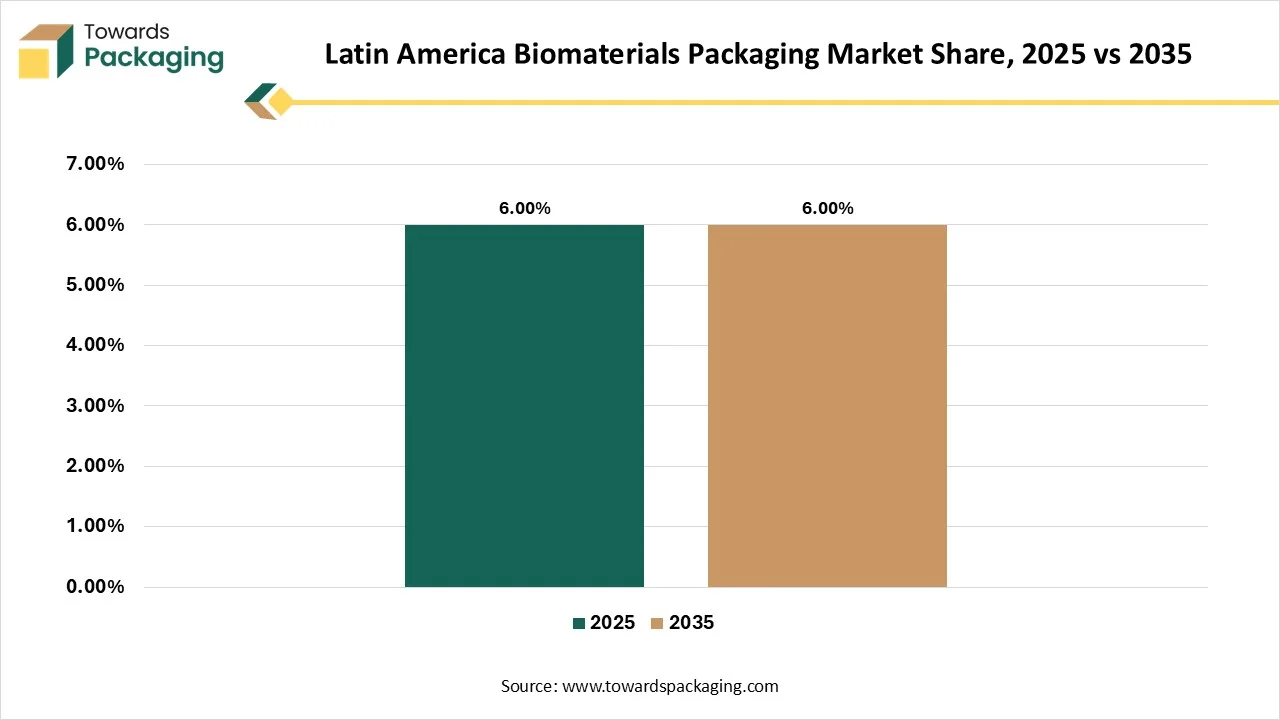
Latin America held a 6% share in the biomaterials packaging market in 2025. Government bans across countries like Brazil and the rise in eco-friendly brands increase the use of biomaterials packaging. The strong bio-based capabilities and food delivery expansion increase demand for biomaterials packaging. Rich forestry ecosystem and growing younger shoppers increase use of biomaterials packaging. Argentina is growing in the market due to the growing premium export industries. The higher utilization of PLA and the adoption of biodegradable options increase production of biomaterials packaging. The preference for compostable bags boosts the growth.
Source:- Towards Packaging Database
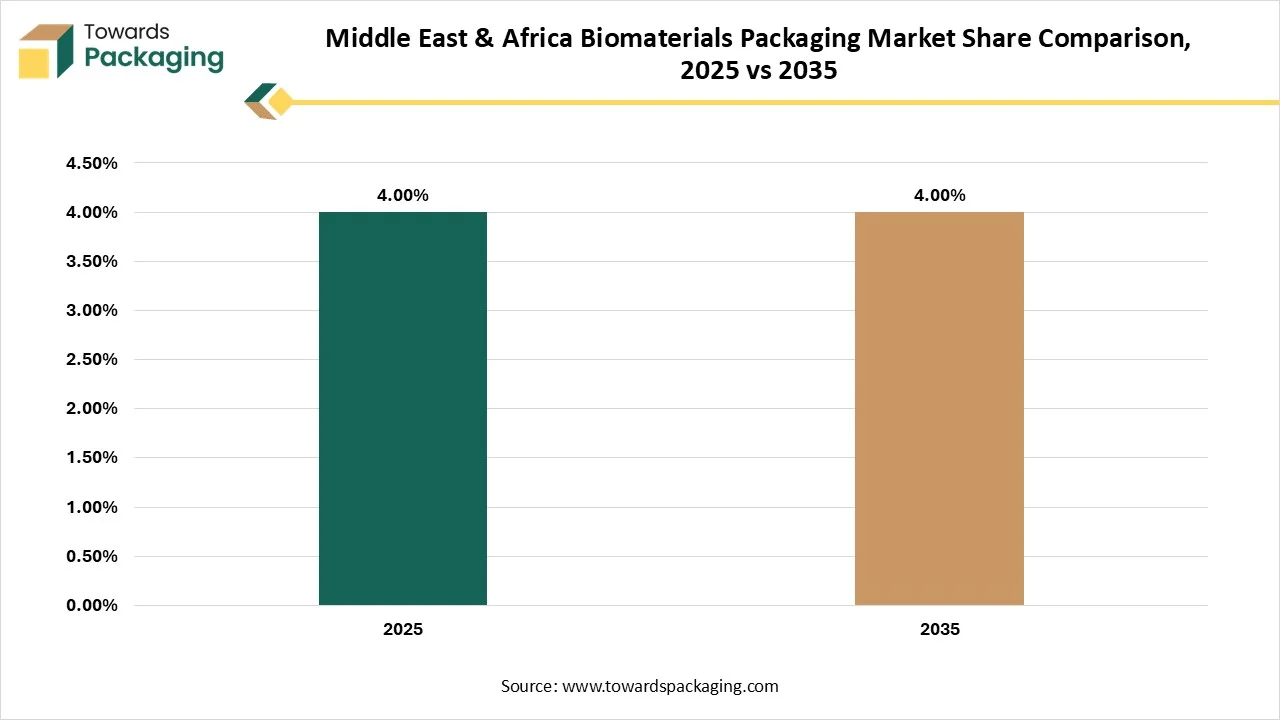
The Middle East & Africa held a 4% share in 2025. The increased force on retailers for biodegradable alternatives and the investment from oil-reliant nations increase the production of biomaterials packaging. The booming high-performance beverage industry and the growing coastal pollution increase the use of biomaterials packaging. The exploding local biopolymer production capacities help with growth. Saudi Arabia is a key player in the MEA region. Local industries transition to green alternatives, and upcoming compliance levies increase the production of biomaterials packaging. The expansion of plant containers supports growth.
Source:- Towards Packaging Database
According to my research, the biomaterials packaging market is expected to expand during the forecast period. The market is expanding due to technological progress, changing shopper choices, and high use of compostable materials. New developments like high-performance blends, integration of antimicrobial agents, growing agricultural upcycling, and PHA scaling help market growth. Factors like compliance standards, food industry requirements, public perception, and cost reduction decide the future growth.
By Material Type
By Packaging Type
By Product Type
By Packaging Format
By Application
By End-use Industry
By Distribution Channel
By Region





















Principal Research Analyst
Vidyesh Swar is a Senior Research Analyst at Towards Packaging, bringing over 4 years of dedicated expertise in market intelligence and strategic analysis across the dynamic world of packaging technologies and solutions.
Learn more about Vidyesh Swar

Reviewed By
Aditi Shivarkar, with 14+ years in packaging market research, specializes in food, beverage, and eco-friendly packaging. She ensures accurate, actionable insights, driving Towards Packaging Analytics & Consulting 's excellence in industry trends and sustainability.
Learn more about Aditi Shivarkar


Biomaterials Packaging Market
 Table of Content
 sales@towardspackaging.com
 +1 804-441-9344
 Download Sample
 Schedule a Meeting