


The Europe air-kife coating in medical packaging market is projected to grow from USD 408.12 million in 2026 to USD 775.94 million by 2035, registering a CAGR of 7.4% during the forecast period. The market growth is primarily driven by the increasing requirement for sterile barrier protection in medical device packaging and rising demand for high-performance coated packaging materials across healthcare applications. The report covers detailed market size analysis, segment-wise revenue forecasts, regional trends, competitive analysis, value chain assessment, trade statistics, and comprehensive manufacturers and suppliers data across Europe.
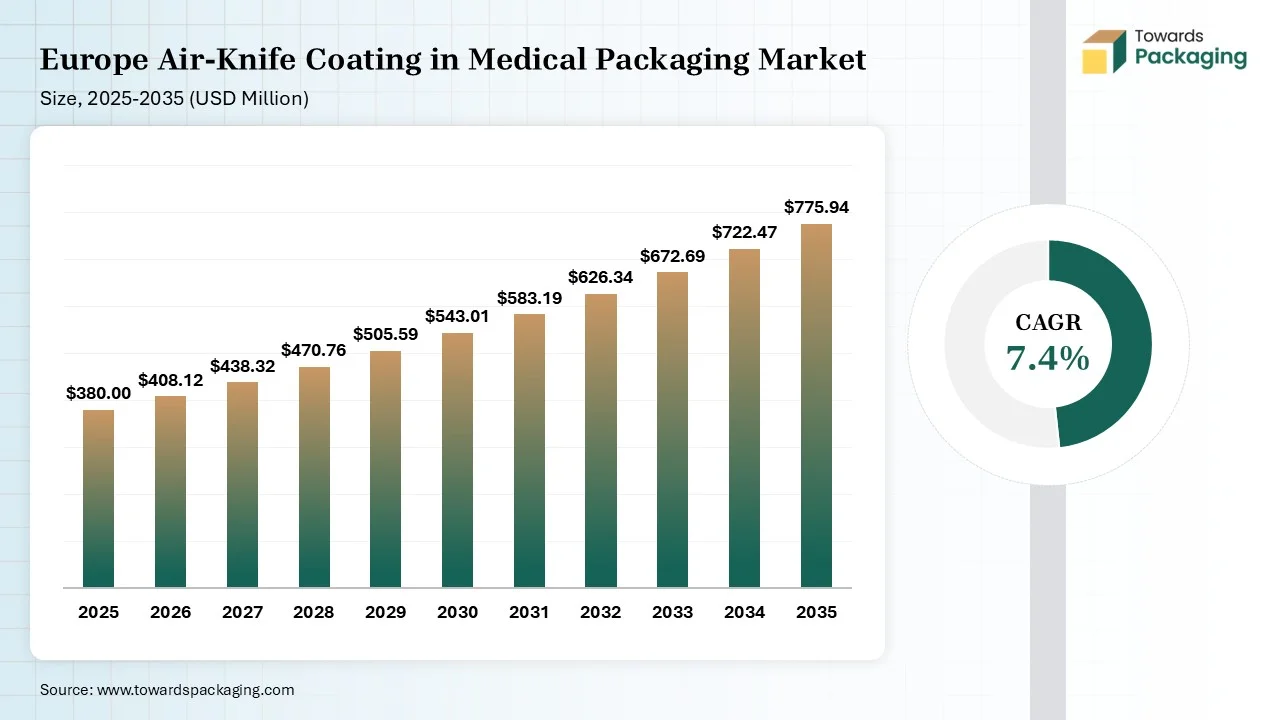
Market Size (2025): USD 380 Million
CAGR Forecast (2025–2035): 7.4%
Market Volume (2025): 120,000 Metric Tons (Coated Medical Packaging Substrates)
Volume CAGR (2025–2035): 6.8%
Pricing Data (2025):
Air-knife coating is the application of a thin layer on the substrate of medical packaging. It offers benefits like uncompromising sterility, lowered material waste, seamless pre-packaging processing, excellent thickness uniformity, and exceptional contamination control in medical packaging. Its core features are superior cleanliness, versatile fluid compatibility, uniform thickness, and high-speed operation. The applications of air-knife coating in medical packaging are sterilization pouches, Coated Tyvek, clean-peel packaging, peelable seals, and medical papers.
The Europe air-knife coating in medical packaging market growth is driven by stricter regulatory compliance, eco-conscious initiatives, expansion of regional manufacturing, strong barrier performance, need for waste reduction, rising sterile packaging, the explosion of Industry 4.0, and the transition to mono-material films.
The Europe air-knife coating in medical packaging market is experiencing technological advancements like IoT integration, advanced material engineering, predictive maintenance, blower-based systems, and data-driven optimization. The technological advancements help in enhancing energy efficiency, improving fluid dynamics, and minimizing wastage of material. The key advancement is artificial intelligence, which helps in the optimization of the coating process.
AI easily adjusts slit gaps and identifies gaps in the coating. AI maintains 100% sterile integrity and offers defect-free coating. AI schedules maintenance and cuts the manufacturing cost. AI predicts the mechanical wear and auto-corrects the defects in the coating. AI predicts the failures of hardware and ensures uniform coating. Overall, AI helps in coating uniformity and significant savings of materials.
The raw materials like aluminum foil, medical paper, adhesives, antimicrobial coatings, polymers, additives, resins, and functional nanocomposites are required.
The processing involves steps like solution preparation, substrate unwind, coating application, air-knife metering, drying, and rewinding. Conversion includes methods like heat sealing, slitting, rotary die-cutting, and lamination.
Logistics and distribution focus on supply chain resilience, cold chain tracking, contamination control, sterile barrier integrity, and regulatory stability.
| Rank | Company Name | Headquarters | Country | Why Relevant to This Market | Key Packaging Products/Services |
| 1 | Actega | Wesel, North Rhine-Westphalia | Germany | Leading provider of heat-seal and functional coatings used in medical packaging substrates | Medical packaging coatings |
| 2 | Henkel | Düsseldorf, North Rhine-Westphalia | Germany | Major healthcare packaging adhesive and coating supplier | Functional medical coatings |
| 3 | Michelman | Cincinnati, Ohio | USA | Advanced barrier and water-based coatings for healthcare packaging | Medical barrier coatings |
| 4 | DuPont | Wilmington, Delaware | USA | Key supplier of Tyvek® substrates used with air-knife coating technologies | Medical packaging materials |
| 5 | Oliver Healthcare Packaging | Feasterville-Trevose, Pennsylvania | USA | Major converter utilizing coated medical packaging structures | Sterile packaging solutions |
| Rank | Company Name | Headquarters | Country | Why Relevant to This Market | Key Packaging Products/Services |
| 1 | Wipak | Nastola | Finland | Significant healthcare packaging and coated material expertise | Sterile barrier packaging |
| 2 | Nelipak | Cranston, Rhode Island | USA | Medical packaging specialist utilizing coated materials | Medical device packaging |
| 3 | Amcor | Zurich | Switzerland | Large healthcare packaging portfolio requiring advanced coating technologies | Healthcare flexible packaging |
| 4 | Coveris | Vienna | Austria | European healthcare packaging producer | Medical packaging materials |
| 5 | Sun Chemical | Parsippany, New Jersey | USA | Functional coatings and healthcare packaging solutions | Coating technologies |
| Rank | Company Name | Headquarters | Country | Why Relevant to This Market | Key Packaging Products/Services |
| 1 | Coatema Coating Machinery | Dormagen, North Rhine-Westphalia | Germany | Specialized coating equipment supplier including air-knife systems | Precision coating machinery |
| 2 | Valmet | Espoo, Uusimaa | Finland | Advanced coating and converting systems | Air-knife coating technology |
| 3 | Tekra | New Berlin, Wisconsin | USA | Specialty coated films for medical applications | Medical coating solutions |
| 4 | Loparex | Cary, North Carolina | USA | Release-coated substrates for healthcare applications | Silicone-coated liners |
| 5 | Coim Group | Offanengo, Lombardy | Italy | Specialty coating chemistries for healthcare packaging | Functional coatings |
The water-based polymer coatings segment dominated the market with 38% share in 2025, due to the rising adoption of low-VOC medical packaging coatings. The production of sensitive pharmaceutical products and the shift to lightweight materials in the medical industry increase demand for water-based polymer coatings. The emphasis on lowering hazardous waste and the preservation of drug stability increases the use of water-based polymers. The stronger regulations in healthcare packaging drive the segment growth.
The UV-curable coatings segment held the 27% market share in 2025. The focus on lowering hazardous air pollutants and the focus on enhancing production line speed increase the use of UV-curable coatings. The emphasis on preventing microbial contamination in pharmaceuticals and stricter food-safe standards increases the adoption of UV-curable coatings. The shift to UV-LED technology and superior uniformity supports the segment growth.
The solvent-based coatings segment held the 20% market share in 2025 due to its strong adhesion properties. The focus on preserving implant sterility and the strong hospital sterilization methods increases the adoption of solvent-based coatings. The humid climate and the need to prevent pinholes in blister packs increase the adoption of solvent-based coatings. The exceptional sterility performance and superior durability of solvent-based coatings boost segment growth.
The sterile barrier packaging segment dominated the market with 34% share in 2025, due to the increased surgical procedures. The need for barrier protection in surgical instruments and the rise in the number of minimally invasive surgeries increase demand for sterile barrier packaging. The focus on lowering accidental touch contamination and the critical safety boundaries increases demand for air-knife coating. The high compatibility of sterile barrier packaging with air-knife coating drives the segment growth.
The blister packs segment held the 26% market share in 2025 due to the growing home-based healthcare. The stricter anti-counterfeiting measures and the focus on individual dose tracking increase the use of blister packs. The emphasis on lowering material waste and the need to lower medication errors increases demand for blister packs. The growing pharmaceutical dosage packaging and the availability of tamper evidence support the segment growth.
The pouches & sachets segment held the 22% market share in 2025. The stricter pharma guidelines and the rise in at-home health monitoring increase demand for pouches & sachets. The strong carbon-reduction policies and the focus on lowering shipping weight increase the use of pouches & sachets. The rise in lightweight medical packaging and the growing use of single-dose pharmaceuticals boost segment growth.
The plastic films (PET, PE, PP) segment dominated the market with 41% share in 2025, due to the excellent barrier properties. The focus on maintaining pharmaceutical sterility and the need to eliminate pinholes enhance demand for plastic films. The growing medical packaging and the need for defect-free packaging increase demand for plastic films. The flawless uniformity and excellent sterilization compatibility of plastic films drive the segment growth.
The paper & paperboard segment held the 28% market share in 2025 due to the increasing usage of secondary packaging. The stricter packaging waste laws and the healthcare industry's focus on lowering carbon footprints increase the use of paper & paperboard. The changing consumer expectations and the integration of advanced biopolymers help with expansion. The increased use of recyclable packaging in the healthcare sector supports the segment's growth.
The aluminum foils segment held the 18% market share in 2025 due to its impenetrable barrier. The focus on keeping the pharmaceutical stable and the popularity of unit-dose pharmaceuticals increase demand for aluminum foils. The need to prevent the degradation of medicines and the emphasis on defect-free distribution increase the adoption of aluminum foils. The growing advanced biologics production boosts the segment growth.
The pharmaceutical packaging segment dominated the market with 39% share in 2025, due to the massive drug production. The robust growth in temperature-sensitive biologics and the emphasis on protecting drugs increase the use of pharmaceutical packaging with air-knife coating. The focus on preventing active ingredient damage and increasing medication shelf life creates demand for air-knife-coated pharmaceutical packaging. The strong regulatory scrutiny in the pharmaceutical sector drives the segment growth.
The medical devices packaging segment held the 28% market share in 2025 due to the increased manufacturing of disposable medical devices. The rise in home-health diagnostics and the focus on barrier performance of medical devices increases the use of medical device packaging with air-knife coating. The explosion of single-use medical devices and the surging complex medical devices support segment growth.
The hospital & clinical supplies segment held the 18% market share in 2025 due to the strong growth in hospital infrastructure. The growing number of hospital admissions and the need for advanced infection control increase the adoption of air-knife coating. The expansion of HAIs and the rise in consumable packaging increase the use of air-knife coating. The expansion of disposable clinical consumables boosts segment growth.
Germany dominated the market due to the higher manufacturing of automated machinery. The highest sterility standards and the focus on protecting medical devices increase demand for air-knife coating. The advanced engineering infrastructure and the strong packaging industry increase demand for air-knife coating. The strong presence of specialty polymer conglomerates drives the overall market growth.
France is rapidly growing in the market due to the stricter EU regulations. The strong MedTech industry and the high demand for testing kits increase demand for air-knife coating. The well-established medical packaging industry and the focus on digitized pharmaceuticals increase the use of air-knife coating. The popularity of advanced barrier films and the rising manufacturing of single-use medical equipment support the overall market growth.
The United Kingdom is growing in the market due to the growth in home-care models. The focus on protecting drug delivery systems and the transition to functional dispersions increases the use of air-knife coatings. The use of sensitive medical devices and the burgeoning flexible healthcare packaging increases the utilization of air-knife coatings. The huge need for sterile flexible packaging boosts the segment growth.
By Coating Material Type
By Application
By Substrate
By End-Use Industry








Principal Research Analyst
Vidyesh Swar is a Senior Research Analyst at Towards Packaging, bringing over 4 years of dedicated expertise in market intelligence and strategic analysis across the dynamic world of packaging technologies and solutions.
Learn more about Vidyesh Swar

Reviewed By
Aditi Shivarkar, with 14+ years in packaging market research, specializes in food, beverage, and eco-friendly packaging. She ensures accurate, actionable insights, driving Towards Packaging Analytics & Consulting 's excellence in industry trends and sustainability.
Learn more about Aditi Shivarkar


Europe Air-Knife Coating in Medical Packaging Market
 Table of Content

 Download Sample
 Schedule a Meeting