Next-Gen Paper & Fiber-Based Packaging Market Size, Trends and Regional Analysis (2026–2035)

The next-gen paper & fiber-based packaging market, valued at USD 370 billion in 2025, is anticipated to reach USD 526.99 billion by 2035, growing at a CAGR of 3.6% over the next decade. North America led the market in 2025, while Asia Pacific is set to grow the fastest through 2035. Recycled fiber and food & beverages dominated in 2025, whereas virgin fiber and personal care & cosmetics are expected to see strong future growth.

Last Updated: 06 February 2026 Category: Advanced Packaging Insight Code: 5986 Format: PDF / PPT / Excel

The next-gen paper & fiber-based packaging market is forecasted to expand from USD 383.32 billion in 2026 to USD 526.99 billion by 2035, growing at a CAGR of 3.6% from 2026 to 2035. The demand for this industry is roaring high due to heavy pressure to substitute single-use plastics, strict environmental regulations, and user demand for recyclable, biodegradable, and sustainable alternatives.
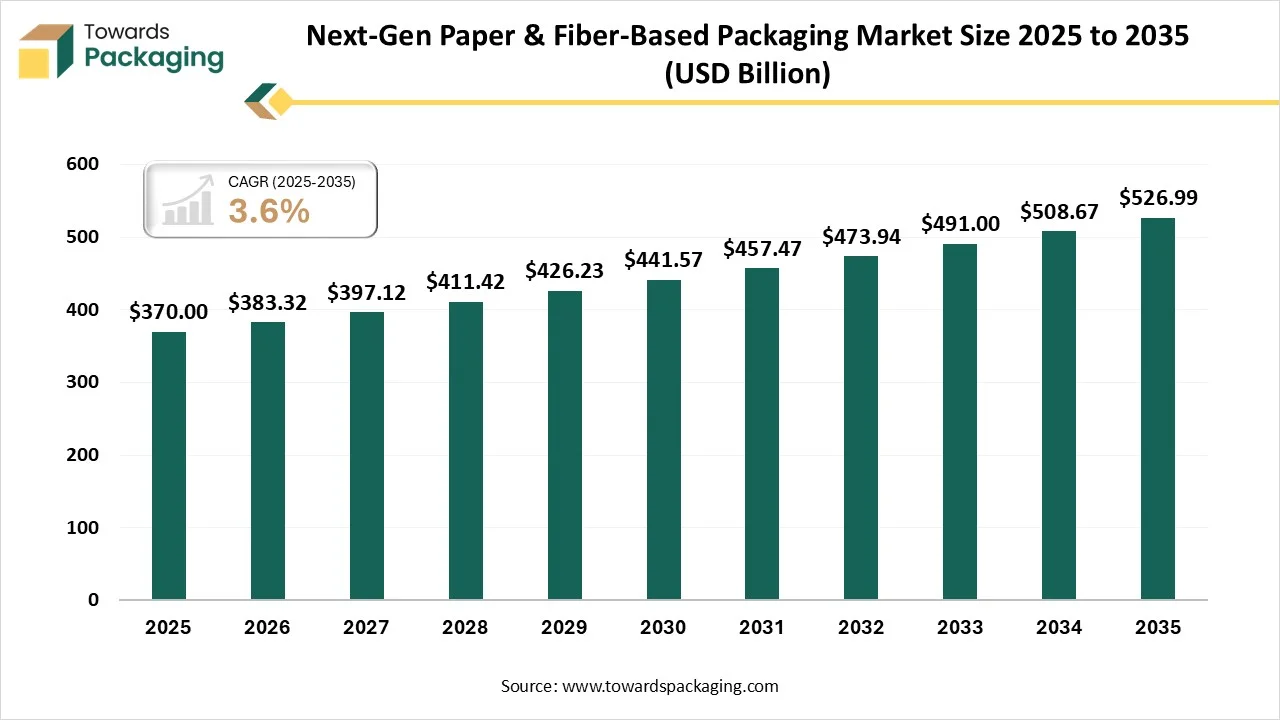
Next-Gen Paper & Fiber-Based Packaging Market Size 2025 - 2035

Major Key Insights of the Next-Gen Paper & Fiber-Based Packaging Market

  • In terms of revenue, the market is valued at USD 370 billion in 2025.
  • The market is projected to reach USD 526.99 billion by 2035.
  • Rapid growth at a CAGR of 3.6% will be observed in the period between 2026 and 2035.
  • By region, North America has dominated the global market by holding the highest market share in 2025.
  • By region, Asia Pacific is expected to grow at the fastest CAGR from 2026 to 2035.
  • By material, the recycled fiber segment dominated the market in 2025.
  • By material, the virgin fiber segment will be developing at a significant CAGR between 2026 and 2035.
  • By application, the food & beverages segment dominated the market in 2025.
  • By application, the personal care & cosmetics segment will be growing at a main CAGR between 2026 and 2035.

What is Next-Gen Paper & Fiber-Based Packaging?

Next-generation or next-fibers are known as virgin paper created from agricultural waste such as flax straw and wheat straw, which are generated from agricultural products that were manufactured responsibly, or FSC-certified wood, which is not sourced from old and vulnerable forests, necessarily, an apple with no managed wood ingredient. They are the answers that come from what is generally landfilled, such as waste food scraps, waste textiles, or burned (agricultural residues) to make the latest fabrics, pulp, paper, and packaging.

  • Edible Packaging Alterations for Lowering Waste: Edible packaging alterations serve as an inventive solution to lower the waste in the packaging field. Such materials created from natural elements such as rice, seaweed, or starch serve the advantage of being consumable, hence they lower the demand for disposal.
  • Avail Developments in Biodegradable Polymers for Packaging: Growth in biodegradable polymers is updating sustainable packaging solutions that serve eco-friendly options to regular plastics. Producers are increasingly using biodegradable products that not only align with regulatory standards but also match user demand for eco-friendly, responsible items.
  • Classify Metrics for Measuring Sustainable Packaging Impact: Calculating the effect of sustainable packaging includes measuring different metrics that show development and smoothness. There are significant indicators that count the reduction in greenhouse gas emissions, the price of waste that comes from landfills, and the percentage of recycled materials utilized.
  • Highlighting the Influence of Government Regulations on Packaging: Government regulations play a major role in designing next-gen and fiber-based packaging, as the latest policies that restrict the usage of single-use polymers and market the biodegradable alternatives encourage producers towards mixing environment-friendly solutions like plant-based cutlery.

Technological Developments in the Next-Gen Paper & Fiber-Based Packaging Market

The emerging technological developments in such markets are chemi-thermal mechanical pulp (CTMP), which is perfect for sustainable packaging, integrating high power with a perfect price-outcome ratio. Such material allows for smooth and flexible manufacturing for eco-friendly uses in which consistent quality is needed. Another one is annual plant fibers, which are a sustainable option for cutting-edge packaging. They serve a noteworthy carbon footprint and are generated by using highly ESG-compliant procedures.

Trade Analysis of Next-Gen Paper & Fiber-Based Packaging Market: Import & Export Statistics

  • Between the period of July 2024 to June 2025, as buyers have globally imported 9,766 shipments of fiber packaging.
  • These shipments were being supplied by 9,766 exporters and bought by 10,233 checked buyers.
  • China, Vietnam and Ukraine have come up as top three fiber packaging importing countries.

Next-Gen Paper & Fiber-based Packaging Market - Value Chain Analysis

  • Package Design and Prototyping: Fiber-based packaging solutions are made through a range of perfectly designed procedures, which begin with pulp making, forming, pressing, and drying procedures, and last with finishing too. This pulp or a molded process starts with a slurry created from recycled materials, natural fibers, and other kraft paperboard, which is then designed by using transfer molds, making tools, and pressing tools too.
  • Recycling and Waste Management: Management of waste in the pulp and paper sector is no longer a subject of tracking the boxes that are linked to package compliance, which is possible while accepting the responsibility. The perfect bet of moving from the linear designs of manufacturing to a circular model will rely on the smoothness of paper recycling.
  • Logistics and Distribution: The custom -fit design has frequently avoided the demand for further void fill, that saves the material costs. Several fiber-based and pulp designs are also stackable, mainly lowering the storage space needs in retail locations and at warehouses. Updating inventory management and transportation costs, particularly bulk orders, is necessary.

Segmental Insights

Material Insights

Why the Recycled Fiber Segment Dominated the Next-Gen Paper & Fiber-Based Packaging Market in 2025?

The recycled fiber segment dominated the next-gen paper & fiber-based packaging market in 2025. Such materials experience a diagnosis and an updated procedure to transform into yarns and fabrics, which are perfect for producing the latest products. The most prevalent material is recycled polyester, which is created from the recycling of plastic bottles and other PET products. Additionally, recycled wool is created from leftovers from the field or reused wool garments.

The virgin fiber segment is expected to experience the fastest CAGR during the forecast period. They relate to cellulose fibers that come directly from wood or non-wood plant resources, which have not been previously refined into paper products. It exemplifies the starting input material needed for paper manufacturing before the recycling options are considered. Virgin fiber is mandatory for producing high-power papers and specialty products in which purity and reliability are necessary result criteria. It also refills the fiber pool, as a secondary fiber that degrades with every recycling cycle.

Application Insights

How the Food and Beverages Segment Dominated the Next-Gen Paper & Fiber-Based Packaging Market in 2025?

The food and beverages segment dominated the market in 2025 as next-gen paper and fiber-based solutions are experiencing rapid development, which is being driven by their recyclability and user requests. Manufacturers are making water-and oil-resistant coverings that come from natural polymers like chitosan and cellulose, which lowers the dependency on fluorochemicals. These papers are excessively used for ready-to-eat meals and beverages that also benefit from material science developments that improve heat durability and resistance. Cutting-edge inventions count seaweed-based films, polysaccharide mixtures, and protein-derived covering that can expand shelf life while being secured for usage.

The personal care & cosmetics segment is projected to witness the fastest CAGR during the forecast period. Primary packaging means a material or container that arrives in direct link with the cosmetic itself, like tubes, thin jars, compacts, bottles, and pump dispensers, too. Its principal responsibility is to protect the product from the mechanical pollutant, moisture access, microbial pollutant, UV exposure, and other external elements that can affect smoothness, honesty, or freshness. As it touches the skin or is used on the face, primary packaging should also be formulated from non-reactive and compatible materials, such as FDA-approved plastics.

Regional Insights

How North America Dominated the Next-Gen Paper & Fiber-Based Packaging Market?

North America dominated the next-gen paper & fiber-based packaging market in 2025. In North America, recycled fiber fields have started to grow and have stayed constant throughout the rest of the year. Moreover, extended producer responsibility (EPR) frameworks and the packaging regulations have further redeveloped the trend towards fiber-based solutions. Paperization has continued to receive attention as brands filter alterations to plastic packaging, which serves a meaningful paper-based packaging urge.

How is the Next-Gen Paper & Fiber-Based Packaging Market Growing in the United States?

The next-gen paper & fiber-based packaging market is developing as the demand for packaging materials-specifically corrugated boxes and sustainable packaging solutions. The fast transformation of e-commerce has developed the demand for lightweight, durable, and recyclable packaging, which has stretched the market demand. Users select the environmentally friendly packaging as there is a growing user demand for bath tissue, tissue paper, napkins, and other hygiene products, particularly in hospitality, households, and healthcare, which are investing in constant market development.

Why is the Next-Gen Paper & Fiber-Based Packaging Market Growing Rapidly in Asia Pacific?

Asia Pacific expects the fastest growth in the market during the forecast period, as user demand for environmentally friendly products is excessively encouraging buying decisions across different demographics, particularly among Generation Z and millennials, who place importance on sustainability. This move is marketing brands to accept paper bags, which are a crucial element of their packaging procedure, thereby further developing demand. Likewise, the development of retail and e-commerce sectors in the region makes it compulsory to tailor and make reliable paper ag solutions that are being made through inventive production procedures.

Why is India using the Next-Gen Paper & Fiber-Based Packaging Market Importantly?

The overall demand for tissue products, whether for commercial or household usage, has also witnessed major growth. Products such as paper napkins, toilet paper, and kitchen towels are becoming heavily popular. While a big part of the urge for paper napkins is currently shifting towards MG paper because of its cost-effectiveness, there is a highlighted move towards soft tissue items. This update is initially driven by the highlighted alertness for hygiene practices and development in disposable incomes.

Recent Developments

  • In September 2025, Nefab revealed the latest version of its certified EdgePak Collar, due to growing pressure to lower emissions and reduce waste, which is a fiber-reinforced alternative for wooden pallet collars that are crafted for one-way shipments.
  • In August 2025, an industry veteran named Zaheer Abbas disclosed the launch of his latest venture, PrimeFiber Global Paper Solutions, whose goal is to progress collaborations with chosen European paper mills and run as their carving agent across the Middle East and South Asia.
  • In January 2026, Sabert introduced its PulpUltra packaging series across Europe, Ireland, and UK. The PulpUltra is industrially compostable, and recyclable.
  • In September 2025, Fiberdom partners with Kiefel to integrate its fibre-based Duranova material with advanced dry fibre forming technology of Kiefel with the vision to develop recyclable, home-compostable packaging formats.
  • In November 2025, PulPac, which is a top leader in Dry Molded Fiber Technology, and Future Materials Sweden, which is a cutting-edge Swedish start-up, revealed a major partnership whose goal is to drive the transformation from plastic to manageably generated fiber-based packaging solutions.

Top Companies in the Next-Gen Paper & Fiber-Based Packaging Market

  • PAPTIC
  • Ranpak
  • The Paper Bottle Company
  • PulPac
  • Stora Enso
  • Smurfit Kappa
  • International Paper
  • Koehler Paper
  • Mondi
  • UPM Speciality Papers
  • Nexgen Packaging, LLC

Next-Gen Paper & Fiber-Based Packaging Market Segments Covered

By Material

  • Recycled Fiber
  • Virgin Fiber

By Application

  • Food and Beverages
  • Retail & E-commerce
  • Healthcare & Pharmaceuticals
  • Personal Care & Cosmetics
  • Others

By Region

  • North America
    • U.S.
    • Canada
    • Mexico
    • Rest of North America
  • South America
    • Brazil
    • Argentina
    • Rest of South America
  • Europe
    • Western Europe
    • Germany
    • Italy
    • France
    • Netherlands
    • Spain
    • Portugal
    • Belgium
    • Ireland
    • UK
    • Iceland
    • Switzerland
    • Poland
    • Rest of Western Europe
  • Eastern Europe
    • Austria
    • Russia & Belarus
    • Türkiye
    • Albania
    • Rest of Eastern Europe
  • Asia Pacific
    • China
    • Taiwan
    • India
    • Japan
    • Australia and New Zealand
    • ASEAN Countries (Singapore, Malaysia)
    • South Korea
    • Rest of APAC
  • MEA
    • GCC Countries
      • Saudi Arabia
      • United Arab Emirates (UAE)
      • Qatar
      • Kuwait
      • Oman
      • Bahrain
    • South Africa
    • Egypt
    • Rest of MEA

Tags

FAQ's

Answer : Next-gen paper and fiber-based packaging refers to advanced packaging materials made from recycled paper, agricultural residues (such as wheat straw or flax straw).

Answer : Major companies include Stora Enso, Smurfit Kappa, Mondi, International Paper, PulPac, Ranpak, UPM Specialty Papers, PAPTIC, and The Paper Bottle Company, among others.

Answer : Key benefiting industries include food & beverage, retail & e-commerce, healthcare & pharmaceuticals, and personal care & cosmetics.
Share With : linkedin twitter facebook

Meet the Team

Yogesh Kulkarni is an experienced Research Analyst specializing in the packaging sector, with a strong foundation in statistical analysis and market intelligence. He currently contributes his expertise to Towards Packaging.

Learn more about Yogesh Kulkarni


Aditi Shivarkar, with 14+ years in packaging market research, specializes in food, beverage, and eco-friendly packaging. She ensures accurate, actionable insights, driving Towards Packaging 's excellence in industry trends and sustainability.

Learn more about Aditi Shivarkar

Related Insights

Next-Gen Paper & Fiber-Based Packaging Market
Updated Date : 06 February 2026   |   Report Code : 5986