


The semi-chemical fluting solutions market is projected to grow from USD 8.2 billion in 2026 to USD 12.62 billion by 2035, registering a CAGR of 4.9% during the forecast period. This report provides a comprehensive analysis of market size, detailed segmentation by type and application, and regional performance across key geographies. It also includes insights into major companies, competitive landscape, value chain analysis, and detailed data on manufacturers and suppliers along with trade flow statistics.
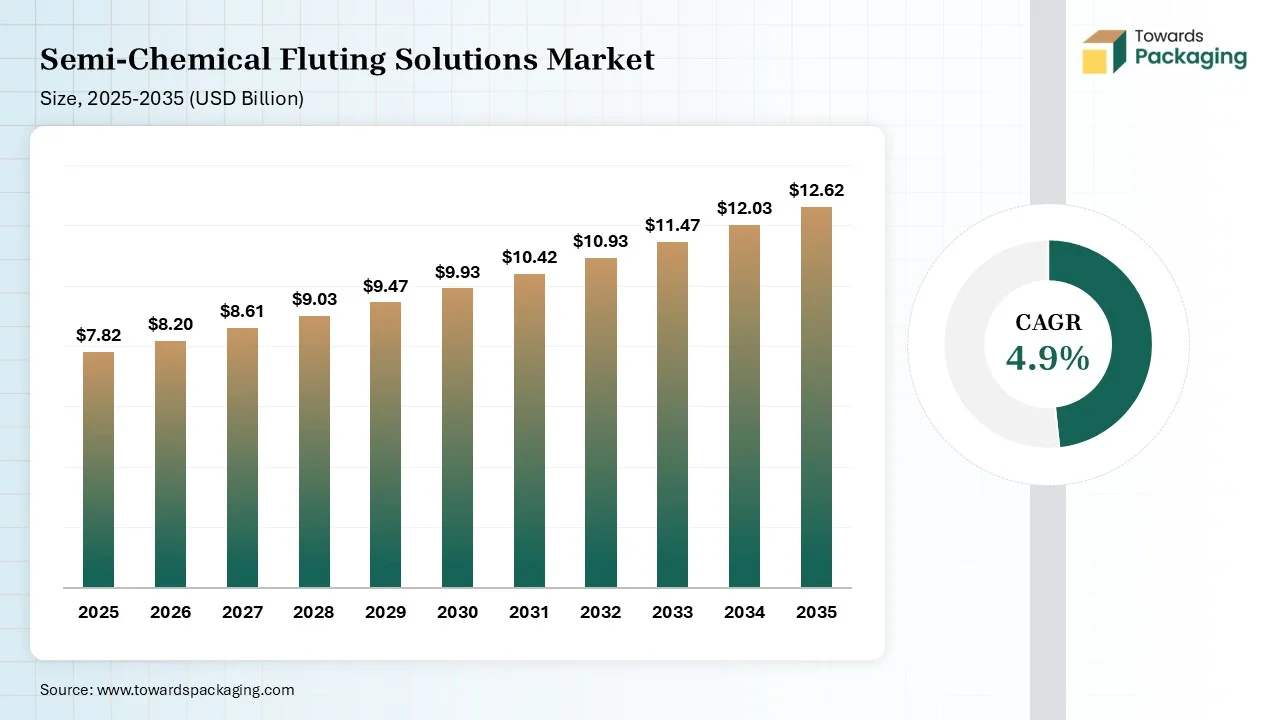
Market Size (2025): USD 7.82 Billion
Market CAGR (2025–2035): 4.9%
Market Volume (2025): 18.6 million Tons
Volume CAGR (2025–2035): 4.3%
Pricing Data (2025):
Semi-chem fluting packaging is short-term for semi-chemical packaging, which refers to a kind of packaging material that undergoes a semi-chemical pulping procedure. Unlike regular chemical pulping procedures that get fully dissolved wood fibers, semichemical pulping specifically breaks down the fibres, resulting in rigid and more reliable material, which is frequently used for corrugated and fluting packaging. Such different characteristics create semi-chem packaging, which is a reliable selection for a variety of usage, that is particularly time-consuming as the packaging is essential.
One of the most crucial technological developments in corrugated packaging manufacturing is the integration of robotics and automation. Automated systems are now capable of managing everything from material handling to box making, gluing, and even quality analysis. This has led to a significant development in fabrication smoothness, which lowers costs and labor costs. Furthermore, cutting-edge growth in materials science has led to the growth of lighter, stronger, and more sustainable corrugated materials. For instance, the discovery of bio-based and recycled fibres has created corrugated packaging that is more durable and stronger.
Package Design and Prototyping: The word “corrugated” means a particular design, which is a wavy, fluted medium that is fixed between flat linerboards. This design makes different power-to-weight ratios by making vertical columns that oppose compression forces during transport and stacking. A corrugated fiberboard is a designed material with a different fluted layer that serves the strength needed for the shipping containers.
Recycling and Waste Management: Corrugated cardboard is recycled in discovered collection, processing, and sorting designs. The collected paper fibres are being reused and processed as a secondary raw material, specifically for the manufacturing of corrugated base paper. Corrugated cardboard can invest in the smooth usage of paper fibers inside the framework of working recycling systems.
Logistics and Distribution: Recycled fibre supply means the quality and quantity of secondary raw material that comes from post-industrial waste or post-consumer waste, which is easily accessible for application in the production of current packaging, paper, or textile products. Such supply chain elements are necessary for marketing a circular economy by lowering the urge for virgin resources, which decreases energy and water consumption, and are linked with manufacturing.
Virgin fiber segment dominated the market with a 62% share in 2025 as virgin kraft is a kind of paper created from fresh and unprocessed wood fibers. The word “virgin” shows that the fibers have not been reused or recycled, which ensures maximum durability and strength. Such papers are usually brown in color because of their natural lignin ingredients and the absence of bleaching agents that are used in some other kinds of paper. Like recycled kraft paper, which counts reused materials, virgin kraft paper is generated from wood that is harvested particularly for this purpose.
The recycled fiber segment held a 38% market share in 2025, and it is also expected to grow at the fastest CAGR of 5.40% during the forecast period. They are linked with lower-quality items, as the primary recycling procedure lowers the durability and strength of materials. Additionally, with developments in chemical and mechanical recycling, it has become a possibility to update the actual elements of the fibers without any adjustment of their properties. Currently, recycled fibers are utilized in growing sectors like automotive, fashion, and construction, which proves that sustainability does not arrive at the cost of quality.
NSSC fluting segment dominated the market with 54% share in 2025 because they generally use coins cooking in Na2SO3-buffered solution at a neutral PH, which is after mechanical refining to transform fibers. Wood chips are being crisped in a neutral solution of sodium carbonate and sodium sulphide during NSSC pulping. The feedback between sulfite ions and lignin in the wood makes this procedure operate effectively. Sodium bicarbonate behaves as a buffer to track neutral conditions, and due to its potential to act as a semi-chemical procedure for receiving pulp to wood returns.
The unbleached semi-chemical fluting segment held the 30% market share in 2025, and it is also expected to grow at the fastest CAGR of 5.60% during the forecast period. They cook by using wood chips that have sodium hydroxide and sodium sulfide in an actual kraft procedure. It completely avoids lignin and classifies cellulose fibers to generate rustic-shade pulp, which is rigid in nature. By using such kraft pulp to make the middle surfaces of paperboard, it delivers strong reliability and rigidity for a packaging solution.
The bleached semi-chemical fluting segment held the 16% market share in 2025 because bleached kraft paper is a deluxe-grade packaging material created from 1005 virgin fiber that offers unparalleled purity, unusual power, and look. Its highlighted white shade and soft finish make them perfect for high-end packaging, which is both durable and visually attractive. They are crafted to serve perfect rigidity, tear resistance, and tensile power. Bleached kraft makes sure relevant results in a huge series of uses, from premium packaging to the hygiene and food industry. Its actual layer also allows perfect lamination and printability compatibility.
The C-Flute segment dominated the market with 36% share in 2025 as it is the second-broadband option, with a thickness of about 3.2 millimeters -11/64 inches. C-flutes are specifically used for transporting boxes due to their adjustable and opposing crushing. Like B flutes, they are ideal options for printing premium and marketing materials. Between 3.3mm and 4mm thickness, the C-flute provides higher compression power, which indicates that it delivers perfect accumulating power when used for lightweight products.
The E-Flute segment held the 18% market share in 2025, and it is also expected to grow at the fastest CAGR of 5.90% during the forecast period. They are roughly 1mm to 1.5mm in breadth and serve a fine flute. This not only delivers crushing opposition and strength but also ensures a high-quality layer for printing purposes. Such thin-profile E-flute mediums serve high-quality printability and resolution, which makes them perfect for skincare packaging, die-cut boxes, and advanced-quality branding.
A-Flute segment held the 14% market share in 2025 because this are one of the biggest and thickest kind of corrugated flute that has thickness of 5mm or ¼ inch (3/16”) in terms of height, which points towards 33 flutes per liner foot, which makes A-flute and perfect for sensitive products and heavy-duty packaging which delivers extra prevention form any type of external pressure or any type of accidental damage. It has a big flute size that delivers shock absorption, cushioning properties, and insulation elements.
The corrugated boxes segment dominated the market with 68% share in 2025 because retail and e-commerce depend on corrugated packaging due to its structural power, tailored design, and cost-effectiveness. The fast development of omnichannel distribution and online shopping models urges packaging that can secure goods with the assistance of multi-storage handling while tracking branding consistency. Corrugated boxes align with worldwide testing rules like ISTA 3A for parcel delivery and are widely used by initiatives like Amazon Frustration-Free Packaging.
The E-commerce packaging segment held the 10% market share in 2025, and it is also expected to grow at the fastest CAGR of 6.40% during the forecast period. In this sector, green packaging does not point to using only recyclable corrugated boxes. It also counts sustainable mailers, mono-material packaging, FSC-certified papers, and water-based adhesives. The overall ideal is to create packaging that is fully compostable, recyclable, and has less of an effect on the environment. On the other hand, for logistics brands, environmentally friendly packaging assists in lowering the carbon footprint. For instance, substituting plastic bubble wrap with a kraft paper honeycomb lowers plastic waste and delivers rigid protection to the product.
The retail-ready packaging segment held the 12% market share in 2025 because they are also known as shelf-ready packaging, which are crafted to shift directly from transformation to shelf, smoothing retail stocking, and developing in-store visibility. Such invention designs serve effective prevention against convenient-open functionality, transit, and developed product visibility on the shelf. With reliable designs and automation -friendly designs, every shelf-ready packaging box assists brands to serve an experience from packing series to shelf.
The food & beverages segment dominated the market with a 34% share in 2025 because flute paper is a kind of corrugating medium that is particularly crafted to make the wavy inner surface of corrugated board. They are manufactured from semi-chemical or recycled pulp with the assistance of a high-temperature corrugation procedure, in which the paper is pressed between heated rollers to make a wave-like design. Such a “fluted” shape delivers the outcome board that has its cushioning effect, impact opposition, and overall strength. The flute paper is not a utilized packaging material, but it plays a crucial design role in terms of food-safe corrugated packaging.
The personal care & cosmetics segment held the 14% market share in 2025, and it is also expected to grow at the fastest CAGR of 5.90% during the forecast period. The correct cosmetic packaging material is chosen depending on the weight of the product, the sustainability aim of the brand, nd complete desired aesthetic appeal. Cardboards are ideal for highly versatile and lightweight products that are conveniently printed on. Corrugated boards are perfect for protective and shipping aims, and lastly, kraft paper is exceptionally eco-friendly and perfect for organic brands.
The consumer electronics segment held the 18% market share in 2025 because plain corrugated boxes and packaging are a core product due to their adaptability. The design of such boxes consists of several layers of corrugated cardboard.
Such containers have lightweight yet reliable solutions, and their design serves as cushioning, which is complicated for high-value and fragile electronics. The structure of cardboard boxes enables them to collapse naturally over time without damaging the surroundings. This further pushes their environmentally friendly profile with a smaller carbon footprint. Such biodegradability is a trend in the electronics sector as it excessively shifts towards sustainable business.
The 112-150 GSM segment dominated the market with 38% Share in 2025. As the weight of any shipment grows, the predictions are that its value will increase actively as well. With a developed value, there is no time to adjust the packaging; rather, brands should use the triple wall. In this case, four sheets of liner board are designed with three mediums in between that create 3 walls for huge toughness. Such boxes carry 180 Ibs of material that deliver added protection and structural reliability when they are shifted.
Above 200 GSM segment held the 20% market share in 2025, and it is also expected to grow at the fastest CAGR of 5.60% during the forecast period. This range is a popular one for regular folding cartons, as this series serves a complete balance between strong features and weight. They are perfect for retail packaging and food products in which actual prevention is needed without creating the packaging to feel heavy. Such thickness is ideal for high-end products. It delivers rigid reliability and a luxury appearance that makes it a favorite for upgraded packaging, such as watches and boutique products.
The 150-200 GSM segment held the 30% market share in 2025 because they are lightweight materials, as this series is frequently used for envelopes, flyers, and flexible packaging. They manage a perfect balance between being light enough for convenient handling, but also reliable for everyday demands such as brochures and product wraps. These are conveniently used for industrial, heavy-duty, and high-value products that deliver mainly higher resistance to crushing and piercing.
Asia Pacific dominated the market with 46% share in 2025, because it is responsible for a total 40% of the worldwide market share, which is assisted by India and China. Rigid urges from food & beverages, e-commerce, and user goods industries have driven development, which is being assisted by government programs on recycling and waste reduction. On the other hand, discovered recycling design helps expansion, as issues include price variability of recycled fibers and inconsistent collection machines in making nations.
India Semi-Chemical Fluting Solutions Market Trends:
In India, semi-chemical fluting solutions point to a kind of packaging material created from corrugated fiberboard, which is pre-folded for convenience of assembly. Such material is widely used in different sectors, which include food services, e-commerce, and user goods, because of its durability, lightweight, and potential to protect products while shipping. The importance of the corrugated paper industry is present in such a role in using packaging effectively, which lowers waste, and invests in sustainable practices, which are given excessive importance by organizations.
Latin America held an 8% market share in 2025 and expects the fastest CAGR of 6.10% during the forecast period as the corrugated boxes industry in Latin America is ready for a major transformation over the next year, which is being driven by digital transformation, regulatory moves, and updated user expectations. Producers are predicted to mix sustainable raw materials, biodegradable adhesives, and water-based inks to match the eco-friendly norms. The urge for moisture-resistant, high-power, and convenient-to-assemble products will develop from the pharma, food delivery, and electronics industries.
Brazil Semi-Chemical Fluting Solutions Market Trends:
The Brazil semi-chemical fluting solutions are being designed by government-supported sustainability compulsions and favourable industrial packaging rules that push recyclable materials. Regulatory match with ANVISA and eco-friendly principles approved by the Brazilian Institute of Environmental and Renewable Natural Resources are designing the move towards low-effect packaging designs. Additionally, Brazil’s developing food exports, specifically beef, poultry, and the fruit industry, make compulsion for strong packaging to track product reliability across international supply chains and logistics.
By Source Type:
By Product Type:
By Flute Type Compatibility:
By Application:
By End-Use Industry:
By Basis Weight:
By Regions:


Research & Advisory Analyst
Yogesh Kulkarni is an experienced Research Analyst specializing in the packaging sector, with a strong foundation in statistical analysis and market intelligence. He currently contributes his expertise to Towards Packaging.
Learn more about Yogesh Kulkarni

Reviewed By
Aditi Shivarkar, with 14+ years in packaging market research, specializes in food, beverage, and eco-friendly packaging. She ensures accurate, actionable insights, driving Towards Packaging Analytics & Consulting 's excellence in industry trends and sustainability.
Learn more about Aditi Shivarkar

Semi-Chemical Fluting Solutions Market
 Table of Content
 sales@towardspackaging.com
 +1 804-441-9344
 Download Sample
 Schedule a Meeting