


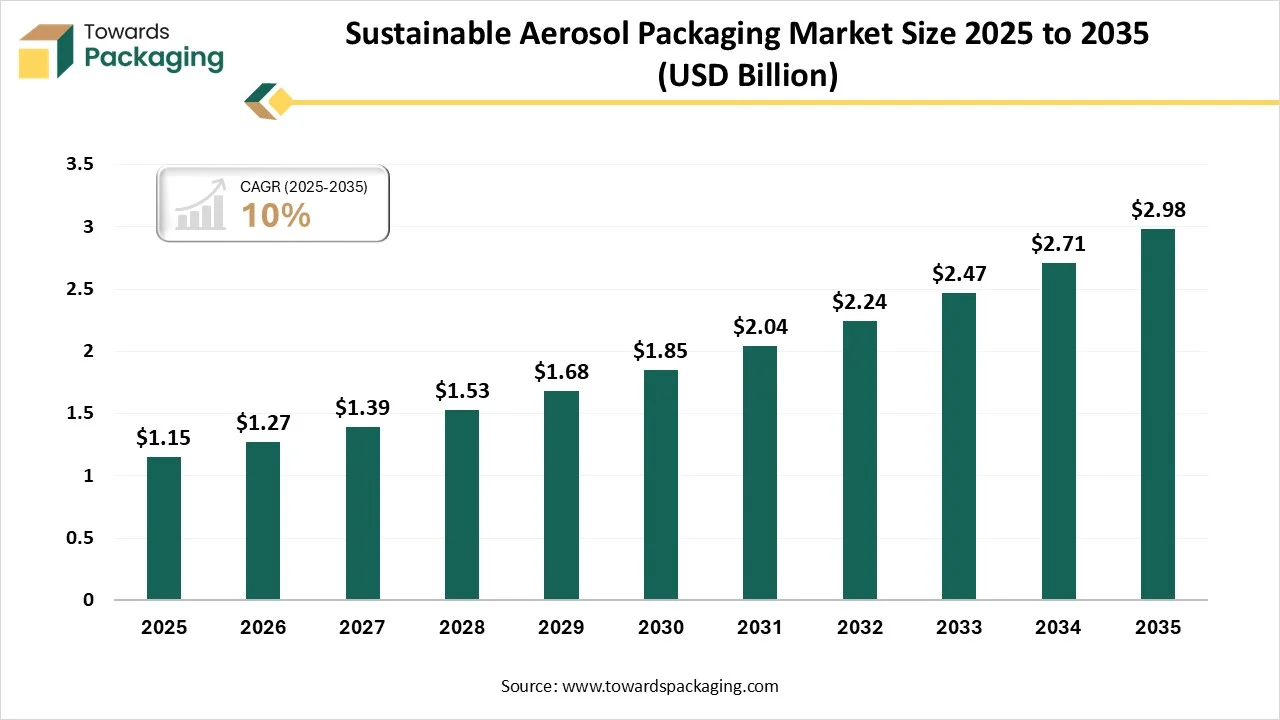
The sustainable aerosol packaging market is forecasted to expand from USD 1.27 billion in 2026 to USD 2.98 billion by 2035, growing at a CAGR of 10% from 2026 to 2035. The growth is due to policies that market low-GMP energy and recyclable packaging that have pushed the invention of sustainable aerosol solutions. Consumer awareness that links to environmental effects has reinforced the urge for environmentally friendly products, which include recyclable and refillable cans.
Sustainable aerosol packaging refers to aerosol containers and delivery systems designed to minimize environmental impact across their lifecycle. These products aim to reduce carbon emissions, material waste, and resource consumption while maintaining the safety, performance, and convenience of traditional aerosol packaging.
Current aerosol production plants that are using automated systems improve efficiency and accuracy at every stage of the procedure. The implementation of technologies such as Internet of Things (IoT) enables real-time tracking of complicated elements such as temperature, pressure, and mixture composition, lowering the threat of mistakes and improving safety. The latest checking technologies, which include machine vision systems that can check issues, are invisible to human eyes to check integration of products and more fragile and quicker leak testing instead of regular methods.
The aluminum and steel segment dominated the sustainable aerosol packaging market in 2025, as aluminum aerosol cans are a sustainable and easy choice for the packaging of chemical products, personal care, and food. They are fundamentally opposite to rush and corrosion, which ensure dominant protection and product integrity in several challenging scenarios. Additionally, aluminum monobloc cans are accessible in different shoulder shapes that include bullet, round, flat, rim, specialty shapes, and mushroom. Steel aerosol cans are chosen for uses that need high resistance to impact and puncture, relevant performance, and a structurally strong nature in standard designs. It is a relevant solution under an urgent supply chain condition and in surroundings that require deep handling. Household sprays, industrial products, and particular mass-market segments come into this category.
The polyhydroxyalkanoates (PHA) segment is projected to experience the fastest CAGR during the forecast period. PHA is a kind of polyester that is manufactured via microbial fermentation. Biobased PHAs utilize renewable feedstocks like sugarcane, which are sustainable sugar sources for the fermentation procedure. Like fossil-based plastics, PHA has a lower carbon footprint and is compostable and biodegradable in every environment, which makes it a perfect candidate for packaging that aligns with growing waste legislation and greenhouse gas emissions.
The personal care & cosmetics segment has dominated the sustainable aerosol packaging market in 2025, as aerosol filling technology enables fine particulate and liquid, which need to be sprayed out in a spray design that has pressurized gas. The most prevalent of such products, such as hair spray, are utilized for styling, hair fixing, etc., which not only serves convenience but also develops the entire distribution and continuation of the product. Furthermore, sunscreens that have become more famous in recent years can also be checked, which come in this category.
The household products segment is expected to witness the fastest CAGR during the forecast period. Household aerosols are aerosol products that users can buy in stores or on online platforms to clean and disinfect their home settings. They generally include compressed gas, which drives ingredients outside of the can and into the air in a spray and mist form. The common instances of these aerosols are air fresheners, which are used to refresh the air with synthetic fragrances, disinfectant sprays that are utilized in classrooms and hospitals, and remaining disinfectant layers.
Asia Pacific dominated the sustainable aerosol packaging market in 2025 as it is initially growing positively, which has featured a focus on functionality and sustainability. Crucial trends count and the developing importance of sustainable materials, which are driven by surrounding issues and the regulatory pressures, along with a surge for developed convenience and aesthetic requests in terms of packaging. Inventions in valve technology and fuel are also designing the safety and performance, which stretches the use range for aerosol solutions across different sectors.
How is the Sustainable Aerosol Packaging Market Growing in India?
The Indian government’s Extended Producer Responsibility (EPR) framework and various initiatives have lowered plastic waste, which is encouraging a move from regular designs to refillable and recyclable systems. There is an overall 500 million urban resident consumption calculated in the year 2024 as the urge for easy -driven personal care products, such as deodorants and hair sprays, which are packaged sustainably, and which are ready at an all-time high. Further, it is driven by a mixture of urbanization, regulatory updates, and growing consumer environmental alertness. While the industry remains primarily related to more high-level geographies, there is a demand for herbal sprays, personal care, and organic food aerosols, which are growing quickly.
North America expects the fastest growth in the market during the forecast period, because technological invention is a crucial element that is changing this region, as aerosol packaging scenarios are allowing organizations to create more sustainable, safer, and user-friendly products. Sectors such as the growth of environment-friendly fuels, refillable aerosol systems, and the lightweight container patterns have received importance. Such developments not only solve environmental issues but also develop consumer ease and product outcomes.
Why Is The United States Using The Sustainable Aerosol Packaging Market Importantly?
The United States sustainable aerosol packaging industry is meant for constant development, which points to its durability and versatility, which makes it a selected choice for different end-user sectors. The growing demand for eco-friendly, sustainable packaging solutions offers opportunities for producers to develop lightweight and recyclable materials. Furthermore, the growing healthcare and personal care industries are further driving the demand for luxury and streamlined aerosol containers, which ensure product safety and integrity.
By Product
By End-Use
By Region



Research & Advisory Analyst
Yogesh Kulkarni is an experienced Research Analyst specializing in the packaging sector, with a strong foundation in statistical analysis and market intelligence. He currently contributes his expertise to Towards Packaging.
Learn more about Yogesh Kulkarni

Reviewed By
Aditi Shivarkar, with 14+ years in packaging market research, specializes in food, beverage, and eco-friendly packaging. She ensures accurate, actionable insights, driving Towards Packaging Analytics & Consulting 's excellence in industry trends and sustainability.
Learn more about Aditi Shivarkar


Sustainable Aerosol Packaging Market
 Table of Content
 sales@towardspackaging.com
 +1 804-441-9344
 Download Sample
 Schedule a Meeting