


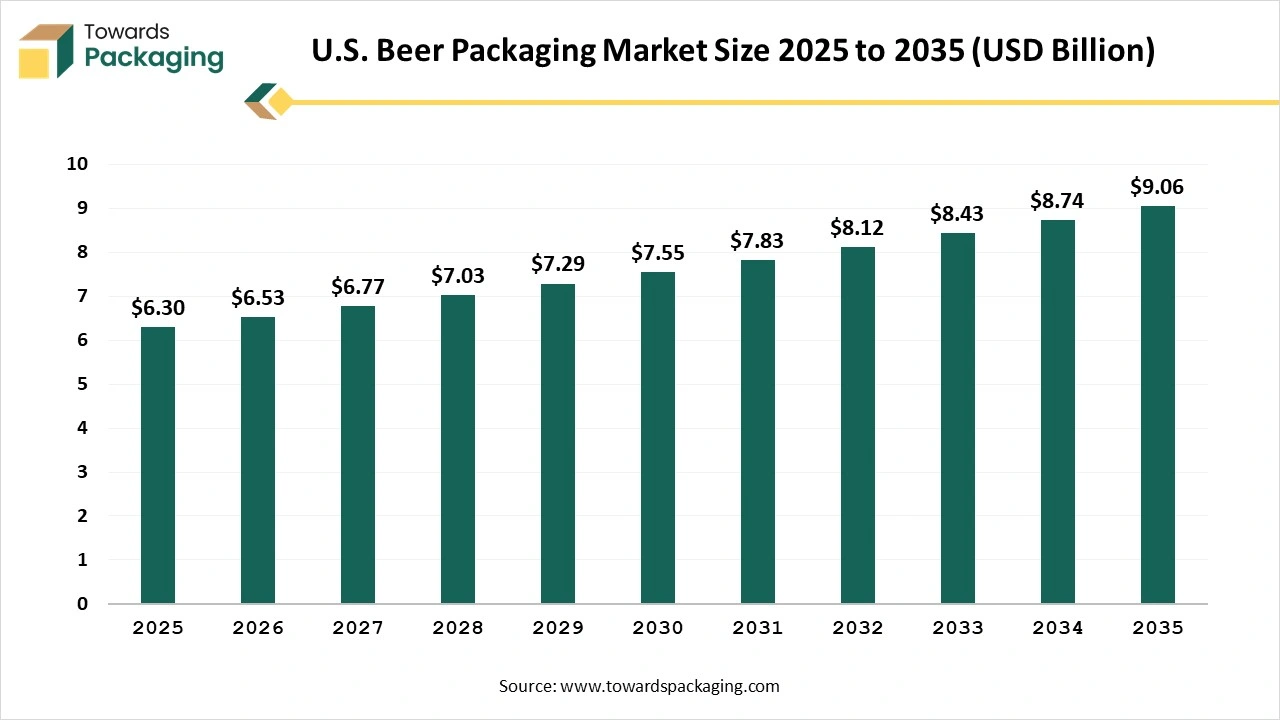
The U.S. beer packaging market reached USD 6.30 billion in 2025 and is set to grow steadily over the forecast period. The market is expected to increase from USD 6.53 billion in 2026 to nearly USD 9.06 billion by 2035, registering a CAGR of 3.7% from 2026 to 2035. Craft brewery expansion continues to drive demand, as brewers adopt innovative packaging solutions to strengthen brand identity and respond to rising consumer preference for premium and sustainable packaging.
Beer packaging is an important procedure in the manufacturing and sale of such beverages. It includes not only kegging, canning, or bottling beer but also the strategy and aesthetic request of cans, bottles, and kegs, as well as the secondary packaging, which includes paper wraps and cardboard boxes. Every category of packaging has its own opportunities and drawbacks, which affect the user s point of view and product shelf life.
The tag, named the sober curious movement, has continued to change drinking habits, which has more users finding flavorful alternatives to regular alcoholic beverages. Craft brewers are taking the lead with a variety that serves complicated and hop-forward selections.
Local and Hyper-Local Ingredients: Brewers are shifting to local ingredients to make different flavors and assist the regional agriculture. They have set hops which are developed in nearby farms to heirloom grains and locally made foraged fruits.
Breweries are accepting green practices like carbon -neutral brewing procedure, the usage of renewable energy, and water protection. Some are even discovering circular economy designs that are shifting grains into edible products such as animal feed or granola bars.
Beer tourism is developing in the current year 2025 with a fervor that moves to dissolve brewery trails, participate in huge experiences like brew-your-own beer workshops, and even attend beer festivals. Breweries are finding taproom upgrades that make welcoming spaces that double as community centers.
The technological growth in the beer packaging industry is experiencing a drastic change as the efforts to make a truly closed-loop recycling system for aluminum cans are receiving attention globally. Organizations are funding smoother collection, classification, and reusing the technologies to make sure that used cans are constantly reused with less wastage. Lowering energy usage in can manufacturing is overall a significant focus for producers. Additionally, inventions such as low-temperature can make, advanced water-saving procedures, and solar-powered canning facilities will help make the canning sector more eco-friendly.
The U.S. beer packaging market is expanding steadily due to rising beer consumption, the growth of craft breweries, and increasing demand for convenient and sustainable packaging formats. Packaging types in the market mainly include aluminum cans, glass bottles, and corrugated multipack cartons, with aluminum cans gaining strong popularity due to their lightweight, recyclability, and portability.
Major packaging manufacturers such as Ball Corporation, Crown Holdings, and Ardagh Group play a significant role in supplying containers and packaging solutions to breweries across the country.
Current beer package design has maintained a balance between brand storytelling, functional sustainability, and shelf visibility. There is a rigid move towards eco-friendly materials, like recycled paperboards, plastic-free round cans, and even experimenting with paperboard bottles.
Key Players: Studio One Eleven, TricorBraun, SmashBrand, and Norka Inc.
Recycling beer bottles has saved crucial energy as compared to manufacturing new glass from raw materials. It lowers greenhouse gas emissions, stores valuable materials in circulation patterns, and protects natural resources like limestone and stands. Several recycling initiatives have adopted colored glass bottles and processed them separately in order to protect the quality.
Key Players: TerraCycle, Ball Corporation, Ardagh Group, and Novelis Inc.
Several beverages are being transported within temperature ranges. Refrigerated trucks are necessary for protecting quality and freshness. For instance, craft beers or wines can be compromised if exposed to too much heat or sunlight, which makes temperature control a leading priority in beverage logistics.
Key Players: Ryder System, Kenco Group, Buschke Logistics, and McLane Company
The U.S. Beer Packaging market is seen to grow notably in California, as it has topped the nation in terms of both the number of craft breweries and the largest manufacturing in terms of number. The state has topped in the production of barrels of craft beers in a year. As the breweries find classification, several of them are searching for some development in the hospitality industry and with stretched offerings beyond a regular beer. The BA and CCBA stay loyal to ensure that every brewer has industry-free availability and align with user demand and update the market trends. On the other hand, value and standard beer segments are witnessing double-digit losses, while the super-luxury segment is premium. Users are excessively selecting their higher quality, and more luxury selections as reliable alterations are the spirits.
In the center of Texas, a transformation is brewing as it has changed how locals appreciate beer. The craft beer scene has been discovered over the past decade, with local breweries coming up like wildflowers after a good season. As per the Texas Craft Brewers Guild (TCBG), approximately 300 little independent breweries are now operating across the entire state. Such a place not only invests mainly in local economies but also demands, like with Texans who ensure quality skills in their beverages.
Amcor plc – Provides flexible and rigid beverage packaging solutions such as lightweight PET bottles and recyclable packaging formats that help breweries improve product protection, shelf life, and sustainability.
ALPLA – Manufactures plastic packaging solutions, including PET bottles, preforms, and closures that can be used for beer and other beverage packaging applications.
Ardagh Group S.A. – Supplies glass beer bottles and aluminum cans designed for breweries, including lightweight glass containers that help reduce transportation costs and emissions.
Smurfit Westrock – Produces paperboard and corrugated packaging such as multipack carriers, cartons, and protective transit packaging used for transporting and displaying beer products.
Crown Holdings – Manufactures aluminum beverage cans and closures that protect beer quality and extend shelf life while offering high recyclability.
Gamer Packaging – Provides packaging materials, containers, and distribution solutions that support beverage and beer packaging supply chains.
O-I Glass – Produces high-quality glass bottles widely used by breweries for premium beer packaging and brand differentiation.
Berlin Packaging – Offers a wide range of beer packaging products, including glass bottles, aluminum cans, caps, and closures, along with design and supply-chain support for breweries.
CCL Industries – Supplies pressure-sensitive and shrink-sleeve labels used on beer cans and bottles to enhance branding and product identification.
CANPACK – Produces aluminum beverage cans and ends tailored for beer brands, particularly supporting craft brewers with customizable can designs.
By Material
By Product
By End-Use


Principal Research Analyst
Vidyesh Swar is a Senior Research Analyst at Towards Packaging, bringing over 4 years of dedicated expertise in market intelligence and strategic analysis across the dynamic world of packaging technologies and solutions.
Learn more about Vidyesh Swar

Reviewed By
Aditi Shivarkar, with 14+ years in packaging market research, specializes in food, beverage, and eco-friendly packaging. She ensures accurate, actionable insights, driving Towards Packaging Analytics & Consulting 's excellence in industry trends and sustainability.
Learn more about Aditi Shivarkar


U.S. Beer Packaging Market
 Table of Content
 sales@towardspackaging.com
 +1 804-441-9344
 Download Sample
 Schedule a Meeting