


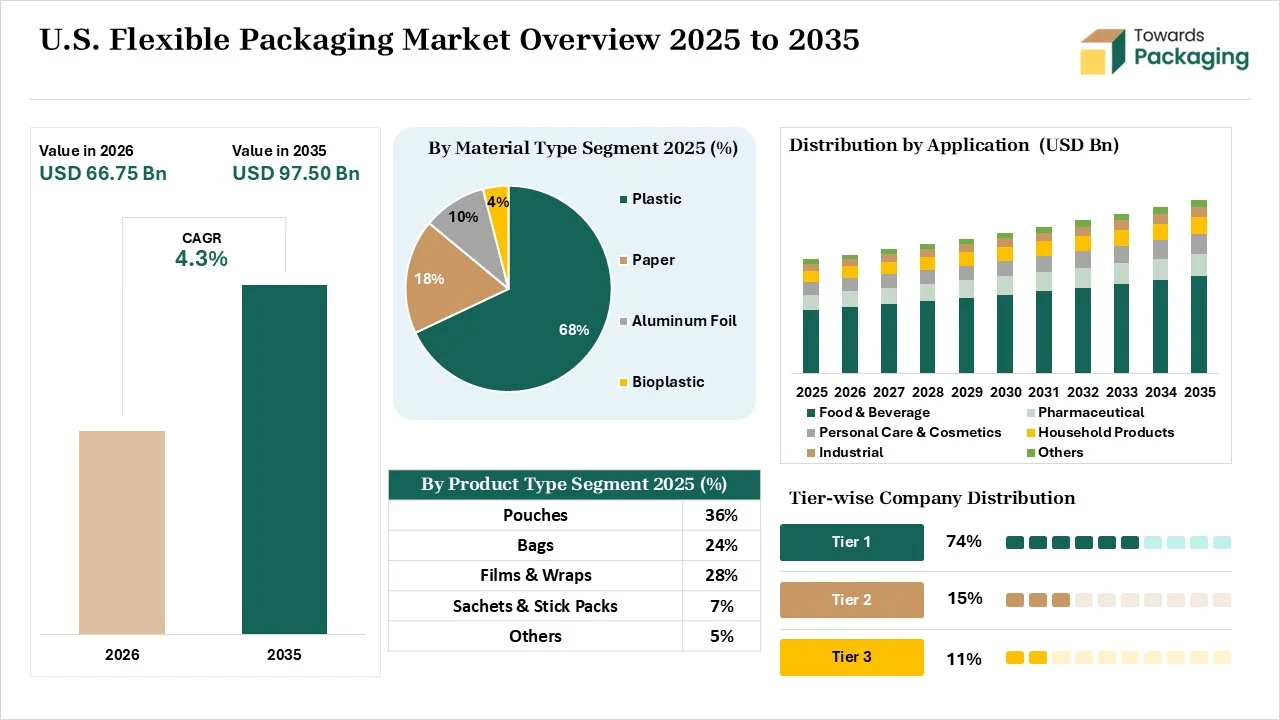
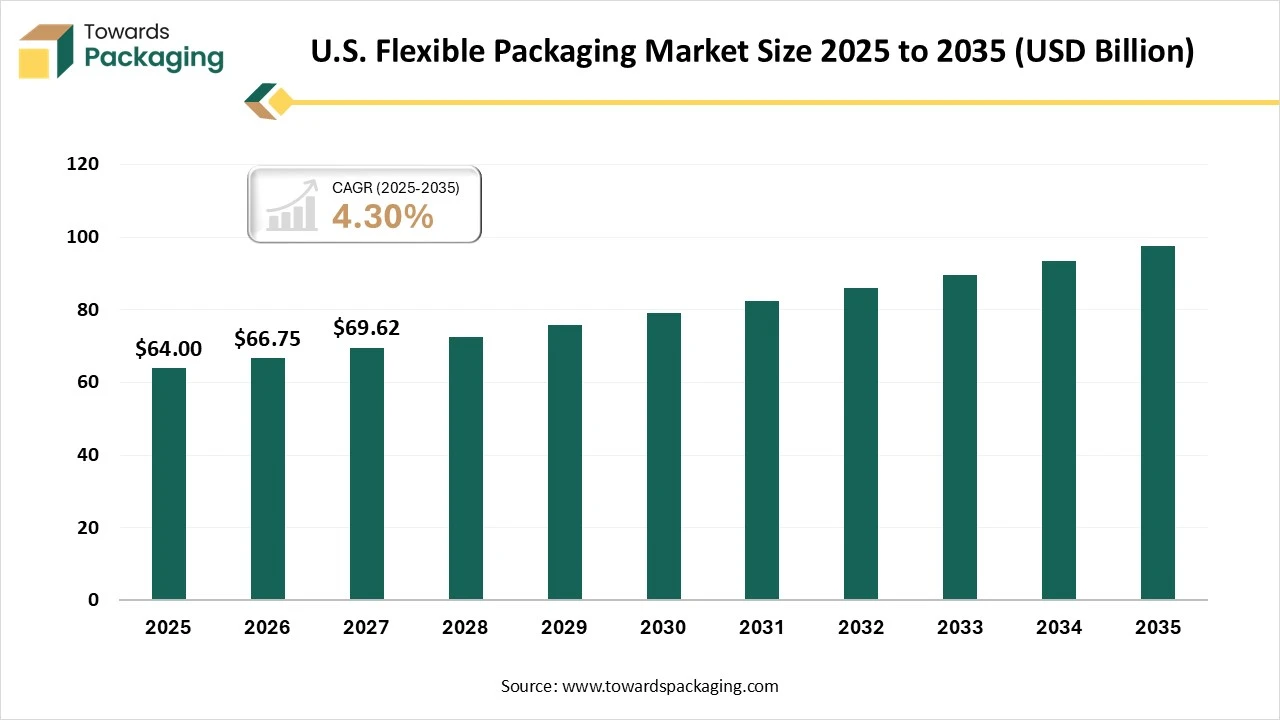
The U.S. flexible packaging market was valued at USD 64 billion in 2025 and is expected to grow from USD 66.75 billion in 2026 to approximately USD 97.50 billion by 2035, expanding at a CAGR of 4.30% during the forecast period. This report provides a complete overview including detailed segmentation by material (plastic, paper, metal, bioplastic), product (pouches, films & wraps, bags), and application (food & beverage, pharmaceuticals, cosmetics). It also includes competitive analysis of leading companies, value chain and supply chain insights, along with trade data highlighting 1,189 import shipments and key exporters such as Vietnam, India, and China. The study further covers manufacturers, suppliers, and emerging sustainability trends shaping the market.
Flexible packaging points to a kind of packaging created from reliable materials such as laminates, plastic films, or paper. It can conveniently be molded into different shapes, which include bags, pouches, or packets, and are crafted to carry a huge range of products. Like rigid containers, flexible packaging is compact, lightweight, and acceptable, which makes it a versatile and smooth selection.
AI is rapidly transforming the U.S. flexible packaging market. AI enables smarter, faster and more sustainable production. Packaging manufacturers are increasingly integrating AI to monitor production lines in real time, detect defects, reduce material waste and improve overall operational efficiency. AI enables brands to create more personalized and visually appealing packaging based on consumer behavior and purchasing trends. AI is used to optimize supply chains, forecast demand more accurately and manage inventory efficiently. Smart analytics tools help manufacturers reduce excess plastic usage, improve recyclable packaging design and lower energy consumption during production. AI-driven predictive maintenance enables companies to avoid costly machine breakdowns by identifying potential equipment failures before they happen.
| Material Type | Barrier Strength | Recyclability Capability | Prevalent Uses |
| Polypropylene | Rigid Moisture Barrier | HIgh in PP Flow | Confectionery,Snacks |
| Polyethylene | Accurate moisture Barrier | High in terms of moo-material industry | Liners, Frozen Foods |
| PET Laminates | Perfect structural reliability | Medium-level relying on layers | Ready Meals |
| Paper Laminates | Moderate barrier that has cover | Developing | Bakery, dry foods |
| Aluminium Foil | Light barrier/ Perfect Oxygen | Restricted unless rearranged | Coffee Powders |
Converted flexible packaging counts integrating various raw materials like paper, plastic, aluminum foil, and adhesives to make final packaging products such as pouches, bags, cartons, sachets, and film. Such packaging is widely used in sectors like pharmaceuticals, food and beverages, personal care, and consumer goods. Additionally, artificial intelligence is updating how packaging is crafted and generated. It assists producers in lowering waste, developing efficiency, and cutting costs by tracking manufacturing data and checking machine maintenance demands. It means fewer breakdowns and softer operations.
Flexible packaging design counts on making non-rigid containers by using materials like foils, plastic films, and paper that can be conveniently folded, shaped, molded, or foiled. Such a strategy concentrates on balancing consumer convenience, sustainability, and product protection.
For the single-use flexible packaging that cannot currently be avoided without unplanned consequences, unwanted efforts are needed to ensure they are recycled. This can be counted by remaining with a conventional plastic with a related one and then ranging across those machines.
Flexible films are less heavy as they occupy less space and hence are convenient for storage, distribution, and transportation. They can be packaged together with less wastage of storage space and frequently need no preventive secondary packaging material like crates and cartons, which leads to increased potential in warehouses and during transportation.
| Rank | Company Name | Headquarters | Country | Why Relevant to U.S. Flexible Packaging Market | Key Products |
| 1 | Amcor | Zürich | Switzerland | Largest global flexible packaging supplier with extensive U.S. presence | Pouches, films, laminates |
| 2 | Berry Global | Indiana | USA | Major U.S. flexible packaging producer | Films, bags, pouches |
| 3 | Sealed Air | North Carolina | USA | Leader in food and protective flexible packaging | Barrier films and food packaging |
| 4 | ProAmpac | Ohio | USA | Strong U.S. flexible packaging footprint | Pouches and specialty films |
| 5 | Sonoco Products Company | South Carolina | USA | Diversified packaging company with flexible packaging portfolio | Flexible consumer packaging |
| Rank | Company Name | Headquarters | Country | Why Relevant to U.S. Flexible Packaging Market | Key Products |
| 1 | Printpack | Georgia | USA | Major food packaging supplier | Flexible food packaging |
| 2 | Constantia Flexibles | Vienna | Austria | Healthcare and food packaging specialist | Flexible packaging laminates |
| 3 | Coveris | Vienna | Austria | Sustainable flexible packaging developer | Recyclable packaging solutions |
| 4 | ePac Flexible Packaging | Wisconsin | USA | Digital flexible packaging leader | Short-run customized pouches |
| 5 | Glenroy | Wisconsin | USA | Specialty flexible packaging supplier | Recyclable pouches and films |
| Rank | Company Name | Headquarters | Country | Why Relevant to U.S. Flexible Packaging Market | Key Products |
| 1 | American Packaging Corporation | New York | USA | Regional flexible packaging leader | Flexible packaging films |
| 2 | PPC Flexible Packaging | Illinois | USA | Consumer packaging specialist | Flexible consumer packaging |
| 3 | Sigma Plastics Group | New Jersey | USA | Film manufacturing expertise | Stretch and shrink films |
| 4 | Charter Next Generation | Wisconsin | USA | Sustainable film innovation leader | Flexible films |
| 5 | Nosco | Wisconsin | USA | Healthcare packaging specialist | Flexible pharmaceutical packaging |
The plastics segment dominated the U.S. flexible packaging market in 2025, as they point to any non-rigid packaging created from plastic sheet, film, or laminate. It can be conveniently included in any shape of the product and is accessible in formats like pouches, bags, film rolls, and wraps. Prevalent materials used in polyethylene that are highly flexible and are excessively moisture-positive are prevalently used in plastic liners, bags, and film. Multilayer laminates integrate various materials for additional power and barricade prevention, which are often utilized in high-performance industrial packaging.
The bioplastics segment is expected to witness the fastest CAGR during the forecast period. They display a variety of materials that are either biodegradable or biobased. Prevalent Base materials include cellulose, starch, polyhydroxyalkanoates, polylactic acid (PLA), and agricultural byproducts. Like petroleum-dependent plastics, several bioplastics can be decomposed under natural surrounding conditions or in industrial composting facilities, consequently, for long periods of waste usage. Further, some of the bioplastics serve as a mechanical property and a compostable barrier.
The pouch segment dominated the U.S. flexible packaging market in 2025, as this flexible packaging is a kind of bag that can be effortlessly sealed and shaped. They are generally created with plastic, such as polyethylene, but some of the pouch packages are also created from paper and metal foil. As flexible pouches are eco-friendly and reusable, they have become very famous among users. Currently, they are less costly than other packaging materials, such as glass containers. Several sectors globally utilize this bag in borders to pack snacks, food, medical products, chemicals, fluids, and other products.
The films & wraps segment is projected to experience the fastest CAGR during the forecast period. Flexible packaging is created from thin flexible materials such as paper, plastic, and aluminium or an integration of such materials laminated together to make packaging material that has specific different properties. These films are created from various base materials of plastic, which are accessible as a monolayer or can be covered to make multi-layer packaging, depending on the series of characteristics needed.
The Food & Beverages segment dominated the U.S. flexible packaging market in 2025, as users' urges for the development of sustainability, convenience, and invention, food and beverage producers are excessively shifting to flexible packaging solutions. Flexible packaging is crafted to align with current demands by developing the product shelf life, lowering waste, and serving environmentally friendly options, all while creating your product, which gets classified in a competitive industry. With the development of highlighted features of e-commerce and the demand for lower environmental impact, flexible packaging is more crucial than ever.
The pharmaceutical segment is projected to witness the fastest CAGR during the forecast period. Composite flexible packaging optimizes application and sales. The manufacturing procedure for pharmaceutical flexible packaging naturally requires good-quality adhesives and high accuracy. Apart from regular food and pharmaceuticals, composite flexible packaging bags are widely used in the electronics, pesticides, and cosmetic sectors. In the food packaging sector, composite flexible packaging has different uses, which include boiling, pasteurization, and vacuum packaging.
The U.S. Flexible Packaging market is seen to develop notably because this industry carries a major importance within the huge packaging field, which is driven by large consumption surfaces and the technological standard. The food and beverage segment holds the greatest market importance, owing to the huge application of flexible packaging for frozen foods, dairy products, snacks, ready-to-eat meals, and beverages.
Healthcare and pharmaceutical packaging displays another main amount of the U.S. flexible packaging industry, which includes flexible materials that are widely utilized for sackets, blister packs, and medical device packaging because of their safety, hygiene, and barrier properties. Furthermore, household and personal care products include a huge market share, which takes advantage of the developing urge for portable, resealable, and attention-grabbing packaging.
California Market Trends
California’s market is majorly driven by factors such as strict environmental regulations, PCR content mandates, and EPR laws. Such laws are helpful for the market to shift it from multi-layer laminates towards recyclable, mono-material structures. Pouches and films/wraps are some of the fastest-growing segments of the market, heavily driven by the growth in the e-commerce industry of the region and growing demand for on-the-go snacking options. Strict environmental law compliance in the region compels brands to prioritize mono-material designs and bioplastics to reduce packaging waste and meet regulatory requirements.
Texas Market Trends
Texas is known as a major national manufacturing hub in the U.S., largely driven by access to petrochemical raw materials, strong logistics networks, and high demand from the state’s booming food, beverage, and pharmaceutical sectors. It is also considered home to several leading manufacturers and converters supplying custom pouches, roll stock, and high-barrier films. Accredo Packaging, Inc., ePac Flexible Packaging, Overwraps Flexibles, and Dallas Plastics are some of the major key companies of the region focused on specialized packaging, along with a major focus on maintaining sustainability as well.
Ohio Market Trends
Ohio’s market is majorly driven by factors like e-commerce, sustainability, and consumer convenience. It is also known as a major manufacturing hub of the industry and is home to the headquarters and large-scale facilities. A major shift of the market from rigid packaging to lightweight films and pouches is a market driver. Growth of e-commerce platforms and a major push of the market towards mono-material, recyclable packaging to meet sustainability mandates also fuel the growth of the market. The food and beverage industry and the pharmaceutical industry make a major contribution to the growth of the market due to the availability of various options, such as extensive pouches, bags, and sustainable-material packaging.
By Material
By Product
By Application




Principal Research Analyst
Vidyesh Swar is a Senior Research Analyst at Towards Packaging, bringing over 4 years of dedicated expertise in market intelligence and strategic analysis across the dynamic world of packaging technologies and solutions.
Learn more about Vidyesh Swar

Reviewed By
Aditi Shivarkar, with 14+ years in packaging market research, specializes in food, beverage, and eco-friendly packaging. She ensures accurate, actionable insights, driving Towards Packaging Analytics & Consulting 's excellence in industry trends and sustainability.
Learn more about Aditi Shivarkar


U.S. Flexible Packaging Market
 Table of Content
 sales@towardspackaging.com
 +1 804-441-9344
 Download Sample
 Schedule a Meeting