U.S. Organic Substrate Packaging Material Market Size, Share, Trends and Growth Forecast
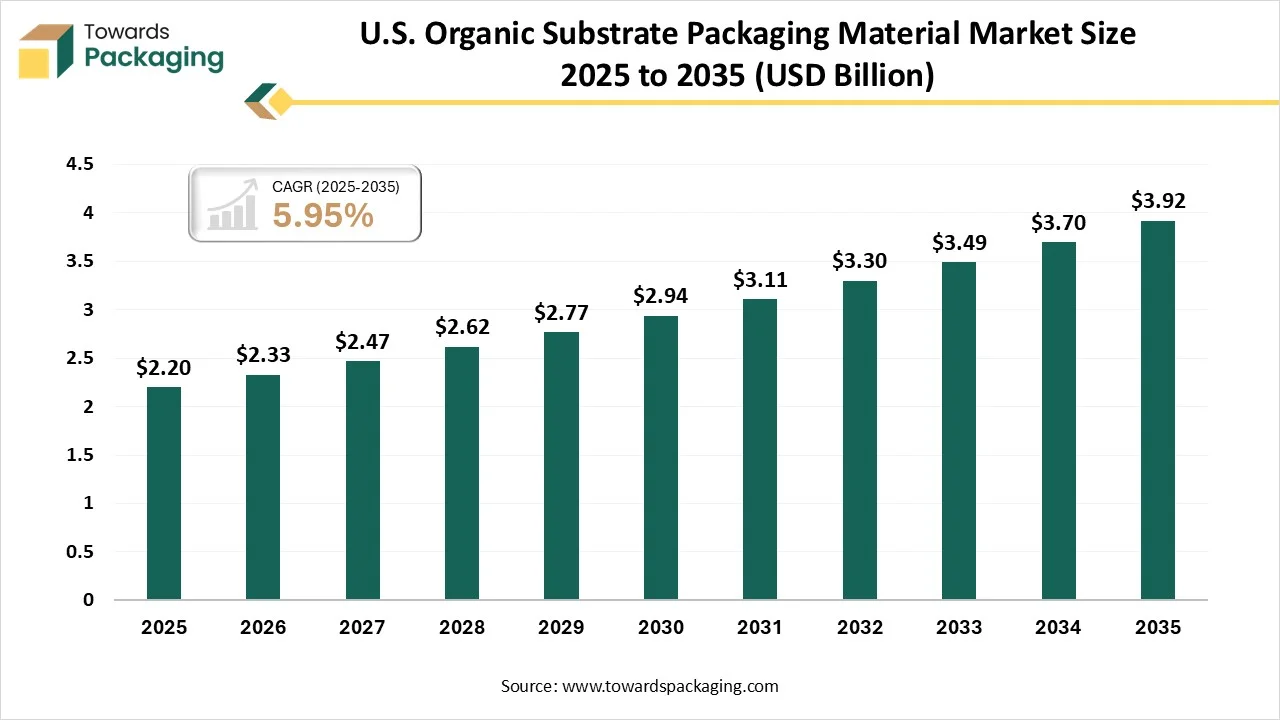
The U.S. organic substrate packaging material market is projected to grow from USD 2.33 billion in 2026 to USD 3.92 billion by 2035, registering a CAGR of 5.95% during the forecast period. The report provides comprehensive coverage of market size, detailed segment-wise data by material type, application, and end-use industry, along with regional demand analysis across the United States. It also includes in-depth insights into key companies, manufacturers, and suppliers, supported by competitive analysis, value chain evaluation, and trade data to present a complete market outlook.
Major Key Insights of the U.S. Organic Substrate Packaging Material Market
- In terms of revenue, the market is valued at USD 2.2 billion in 2025.
- The market is projected to reach USD 3.92 billion by 2035.
- Rapid growth at a CAGR of 5.95% will be observed in the period between 2026 and 2035.
- By technology, the SO packages segment dominated the market in 2025.
- By technology, the GA packages segment will be developing at a significant CAGR between 2026 and 2035.
- By application, the consumer electronics segment dominated the market in 2025.
- By application, the automotive segment will be growing at the main CAGR between 2026 and 2035.
What is the Organic Substrate Packaging Material Market?
The significance of organic substrates is underlined by their main role in updating the functionality and integrity of the electronic devices. In the quickly developing scenario of technology, such substrates have become universal, which seeks uses across a wide spectrum, from prevalent user electronics to innovative industrial and aerospace systems.
Trends in U.S. Organic Substrate Packaging Material Market
- Advanced Materials Changing Electronics Packaging: Nanotechnology is changing how the packaging conducts electricity and heat. Graphene-dependent films and nanocomposites are currently being used to make flexible, ultra-thin, and thermally effective packaging surfaces.
- Thermally Conductive Polymers: For high-performance electronics, heat management is necessary. Thermally conductive polymers integrate the advantages of plastics, which are flexible and lightweight, with the potential to conduct heat smoothly, and substitute metals in particular uses.
- Biodegradable and Eco-friendly Materials: As sustainability is becoming a crucial part, the electronics sector is heavily accepting eco-friendly packaging solutions. Materials such as bioplastics, molded pulp, recycled cardboard, and compostable polymers are being utilised for the external packaging of electronics like chargers, gadgets, and earphones.
- 3D Integrated Circuit Packaging: 3D packaging has several semiconductors that connect vertically and are connected by Through-Silicon Vias (TSVs). This allows high-speed data shifting between chips while lowering the footprint. There are uses in high-outcome and AI chip processors, data centers, and edge-computing gaming and mobile devices.
- AR and QR-Integrated Packaging: Companies are adding QR codes and augmented reality (AR) experiences to packaging, which enables users to access installation rules, brand stories, and product details via smartphones. AR-allowed packaging lets consumers imagine the product setup in real time.
Contribution of Artificial Intelligence (AI) in the U.S. Organic Substrate Packaging Material Market
Memory Chips ( specific chips that are collected into a bigger chip ) and Graphics processing units (GPUs) can be checked to enable data and energy to shift quickly and smoothly, which depends on various technologies and designs to link chiplets in a path that best matches the chip’s aim in a device. It updates results by packaging processors and memory together, data is being shifted much more effectively, which serves fast and the potential capabilities demanded for AI uses. The creation factors are the stacking elements that are vertical in nature, so advanced packaging assists producers in aligning with the ever-growing demand for minute and more reliable devices.
Technological Developments in the U.S. Organic Substrate Packaging Material Market
The sector of substrate packaging technology is constantly growing, which is driven by the urge for stronger, smoother, and more compact electronic devices. As the devices became smaller in size, there is a rising demand for substrates that assist higher element density and integration. Technologies such as SiP, HDI, and 3D packaging are at the forefront of such a trend. Stretchable and flexible substrates are receiving attention in uses such as flexible displays and wearable electronics. Such substrates enable the latest creation and inventive device patterns.
U.S. Organic Substrate Packaging Material Market - Supply Chain Analysis
- Package Design and Prototyping: Multi-chip module (MCm) packaging has emerged as an important technology in the sector of electronic assemblies and chip packaging. By implementing several integrated circuits (ICs), discrete components, and semiconductor dies on a different substrate. It delivers a useful and effective solution that can be managed as a bigger integrated circuit.
- Recycling and Waste Management: Bio-based substrates that come from lignin, cellulose, and natural fiber composites are receiving attention for their renewability and biodegradability. Organizations like Jiva Materials have grown commercially acceptable options like Soluboard, which gets dissolved in hot water, enabling the convenient transformation of materials and elements without toxic processing.
- Logistics and Distribution: Organic materials such as polyamide and epoxy resin are fragile to high temperatures and moisture. Such compulsions, such as climate-controlled storage and transport, protect adjusted or laminated electrical results. As the chips become smaller in size and deeper, packaging has become more sensitive and needs a high-accuracy handling stage.
Segmental Insights
What Are the Key Technologies Driving the U.S. Organic Substrate Packaging Material Market?
| Segments |
Share 2025 (%) |
| SO Packages |
40% |
| GA Packages |
30 |
| Flat no-leads packages |
20% |
| Others |
10% |
- SO Packages (40%): SO Packages dominate with a 40% market share due to their widespread use in consumer electronics, automotive, and manufacturing for efficient component integration.
- GA Packages (30%): GA Packages are gaining momentum with a 30% market share as their advanced technology increasingly appeals to specialized sectors like healthcare.
- Flat no-leads Packages (20%): Flat no-leads Packages hold a 20% share, growing due to the trend towards environmentally friendly and lead-free alternatives in electronics.
- Others (10%): Other technologies make up 10% of the market, showing growth as innovative materials find niche applications across various industries.
The SO packages segment dominated the market in 2025, as a small outline package is a kind of surface-placed package utilized to place electronic elements, such as integrated circuits (ICs). It highlights a rectangular and small body that has leads like metal contacts on every side, which enables it to be conveniently mounted onto a printed circuit board (PCB) at the time of assembly. The SOPs are crafted to be effective and condensed, which makes them the most prevalent package types utilized in electronic devices. They play an important role in the world of electronics as they serve as a smooth solution for the production of small-to-medium scale electronic machines.
The GA packages segment is expected to experience the fastest CAGR during the forecast period. BGA packages have an integrated circuit (IC) and link it to a printed circuit board (PCB) by using an array of solder balls placed under the package. The balls behave as mechanical and electrical connections when they are soldered to pads on the PCB. BGA packages are available in various counts and designs to include ICs with various complications, and the I/O demands. A typical BGA count plastic and ceramic, that has pitches which range from 0.8 mm to over 2mm.
What Are the Major Applications of Organic Substrate Packaging Materials in the U.S. Market?
| Segments |
Share 2025 (%) |
| Consumer Electronics |
35% |
| Automotive |
25% |
| Manufacturing |
20% |
| Healthcare |
15% |
| Others |
5% |
- Consumer Electronics (35%): Consumer Electronics leads with a 35% market share, driven by the high demand for organic substrates in lightweight, protective packaging for electronic devices.
- Automotive (25%): Automotive applications hold a 25% share, gaining momentum as electric vehicles and ADAS demand high-performance organic substrate packaging.
- Manufacturing (20%): Manufacturing represents 20% of the market, with increased demand for sustainable packaging solutions in industrial products.
- Healthcare (15%): Healthcare holds 15% of the market, gaining traction due to the need for eco-friendly and protective packaging for sensitive medical devices.
- Others (5%): Other applications make up 5% of the market, representing emerging and experimental uses of organic substrate materials.
The consumer electronics segment dominated the market in 2025, as substrate packaging plays a crucial role in the smoothness and functionality of semiconductor machines and electronics products. It directly affects the device's durability, result, and size. With the current trend towards miniaturization and developed functionality in electronics, high-level substrate packaging technologies are necessary for aligning with the demands of current uses in consumer telecommunications, electronics, and automotive systems, and more.
The automotive segment is projected to witness the fastest CAGR during the forecast period. There are developments in autonomous driving, connected car technologies and electric vehicles will develop the demand for strong, high-result substrate packaging solutions which care potential of firmly standing with toxic automotive surroundings. The crucialness of the substrate packaging technology cannot be overemphasised. It is a complicated allowed of good-performance computing, consumer electronics, telecommunications, and developing uses such as wearable electronics, IoT, and automotive systems.
Country Level Analysis
The U.S. organic substrate packaging material market is seen to grow notably as it is driven by a current user focus on eco-friendly and sustainable products. Organizations are excessively accepting organic materials to match a user demand for products that have a lower environmental impact. The region has perfectly developed regulatory frameworks that assist the application of compostable and biodegradable materials, further completing the market growth. Furthermore, the growth of e-commerce and the demand for sustainable packaging solutions in logistics are the main contributors to such regional market growth.
Additionally, the ongoing transformation towards 5G technology is predicted to mainly develop the demand for high-performance packaging solutions. As per the market industry, the worldwide semiconductor industry is expected to develop more as the packaging shows a constant space for this growth. The growing complications of the semiconductor designs make it compulsory to package substrates, which helps multi-chip integration and high-density interconnections.
Government Initiatives in the U.S. Organic Substrate Packaging Material Market
Electronic technologies and devices continue to develop and grow in number as well. Such technologies have become important in every path and in a rising economy, too. With such technologies, hence, are welcomed by increasing problems of preventing human health and the surrounding environment from the harmful toxic effects linked with their unseemly disposal and handling. A long-term sustainable strategy in terms of electronics stewardship is compulsory everywhere. With commonness in electronics, the federal government is loyal to users of electronics and a leader in electronics stewardship in the United States. Sustainable Electronics Management counts the following practices
- Recycling Electronics: If the donation for resume or repair is not a perfect option, but the business and households can send their used electronics for recycling.
- Buying Green: The environmentally-friendly, responsible electronics count not only on an accurate end-of-life disposal of the absolute machine, but also on buying the latest machine, which has been crafted with environmentally selected attributes.
- Donating and Reusing Electronics: Protecting waste in the primary location is selected over any kind of waste management option, which includes recycling. The donation used for electronics for the resume purpose expands the lives of valuable products and stores them out of the waste stream for a longer period.
Recent Developments
- In May 2025, Asahi Kasei made the TA range of Sunfort dry film photoresist, which has a current product crafted to align with developing demand in the sector of high-level semiconductor packages used in different applications, such as artificial intelligence (AI) servers.
- In September 2025, the TSMC North America Open Innovation Platform, OIP Ecosystem Forum, Siemens Digital Software has revealed several new mergers with TSMC, which include inventive design solutions and product certifications.
- In April 2025, NVIDIA is operating with its production collaborators to implement and design factories that, for the first time, will generate NVIDIA AI supercomputers completely in the U.S.
Top Companies in the U.S. Organic Substrate Packaging Material Market
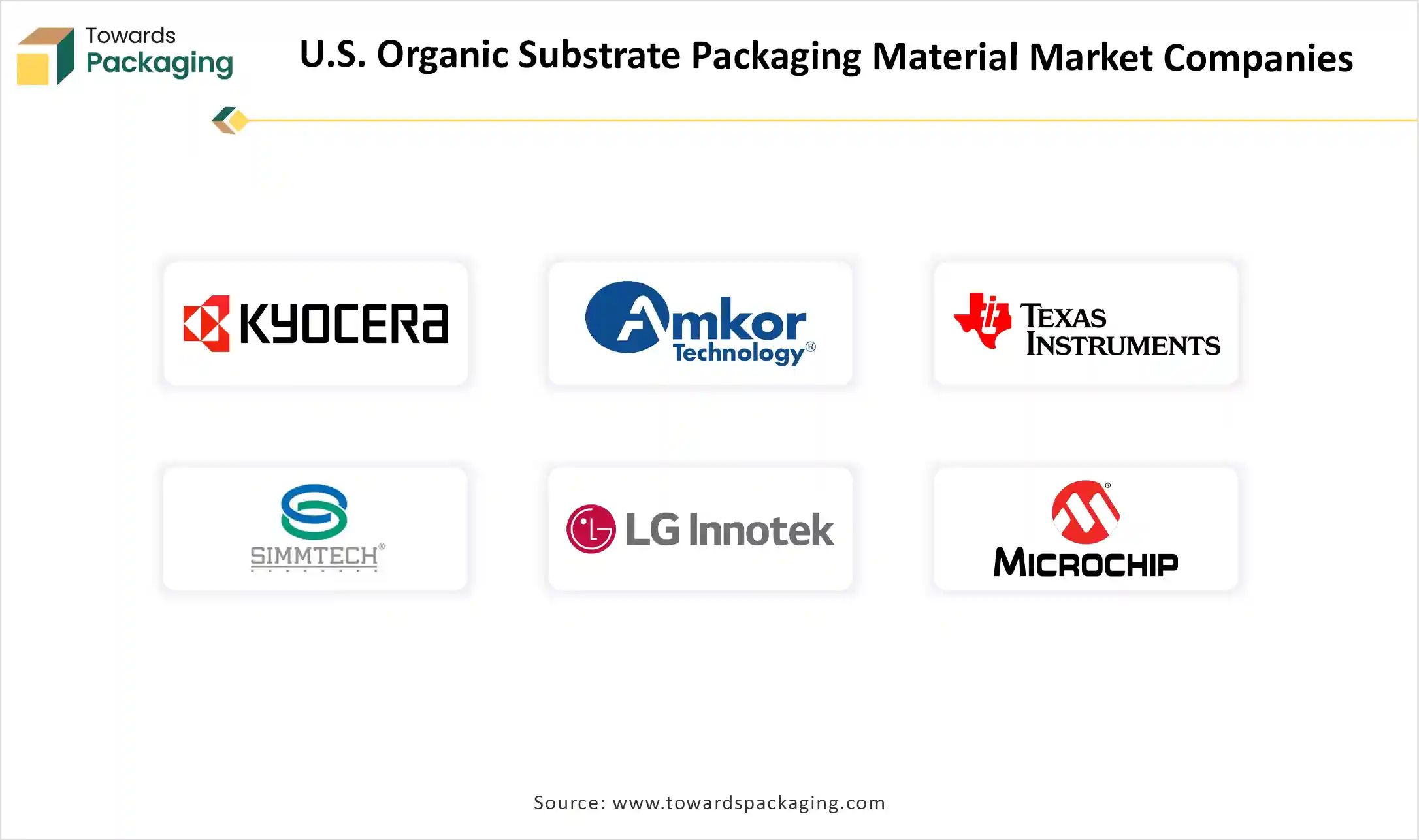
- Kyocera Corporation
- Amkor Technology Inc
- Texas Instruments Incorporated
- Simmtech Co. Ltd
- LG Innotek Co.Ltd
- Microchip Technology Inc
- AT&S
- Daeduck Electronics Co., Ltd
- Onto Innovation Inc
U.S. Organic Substrate Packaging Material Market Segmentation
By Technology
- SO Packages
- GA Packages
- Flat no-leads packages
- Others
By Application
- Consumer Electronics
- Automotive
- Manufacturing
- Healthcare
- Others
Find Out:
- How are production and consumption trends of BOPP films evolving across key European countries such as the UK and Germany?
- What do import-export patterns and intra-European trade flows reveal about supply dependencies and regional competitiveness?
- How are manufacturers improving production efficiency in BOPP film processes to optimize output, reduce waste, and maintain consistent quality?
- What supply chain constraints exist in sourcing polypropylene resins and additives, including lead times, cost volatility, and recycling integration?
- How do film specifications such as 15–30 micron thickness, barrier performance, and printability influence adoption across food, personal care, and labeling applications?
- How do logistics, transportation costs, and distribution networks impact the efficiency and scalability of BOPP film supply across Europe?
- How is increasing demand for sustainable, recyclable, and mono-material packaging shaping regional consumption trends and end-use growth?
- What are the key financial metrics, including production costs, pricing trends, and profit margins, affecting manufacturer profitability in Europe?
- How are evolving European regulatory standards and environmental policies influencing product innovation and compliance strategies?
- What competitive strategies, technological advancements, and product innovations are leading companies adopting to strengthen their market position?










 Table of Content
 sales@towardspackaging.com
 +1 804-441-9344
 Download Sample
 Schedule a Meeting