U.S. Ready-to-Drink Packaging Market Size, Segments, Companies, Competitive Analysis, Value Chain & Trade Analysis 2026-2035

The U.S. ready-to-drink packaging market is expected to expand from USD 41.38 billion in 2026 to USD 70.5 billion by 2035, growing at a CAGR of 6.1%. Increasing demand for ready-to-drink beverages such as energy drinks, juices, flavored water, and functional drinks is driving packaging innovations focused on lightweight, sustainable, and portable solutions. The report covers comprehensive statistical data on market size, detailed segmentation by packaging materials and product types, regional distribution trends, competitive benchmarking, company market share analysis, value chain structure, trade statistics, and insights into leading manufacturers and suppliers across the United States.

Last Updated: 05 March 2026 Category: Material Packaging Insight Code: 6023 Format: PDF / PPT / Excel

U.S. Ready-to-Drink Packaging Market Growth, Demand and Production Forecast

The U.S. ready-to-drink packaging market is projected to grow from USD 41.38 billion in 2026 to USD 70.5 billion by 2035, registering a CAGR of 6.1% during the forecast period. The market is expanding steadily due to rising consumer preference for convenience, portability, and on-the-go beverage consumption, particularly among urban and working populations. This report provides detailed market size analysis, segment-wise data by material type, packaging format, and end-use beverage category. It also includes regional performance insights across key U.S. states, in-depth company profiling, competitive landscape assessment, value chain evaluation, trade flow analysis, and comprehensive data on manufacturers and suppliers operating in the industry.
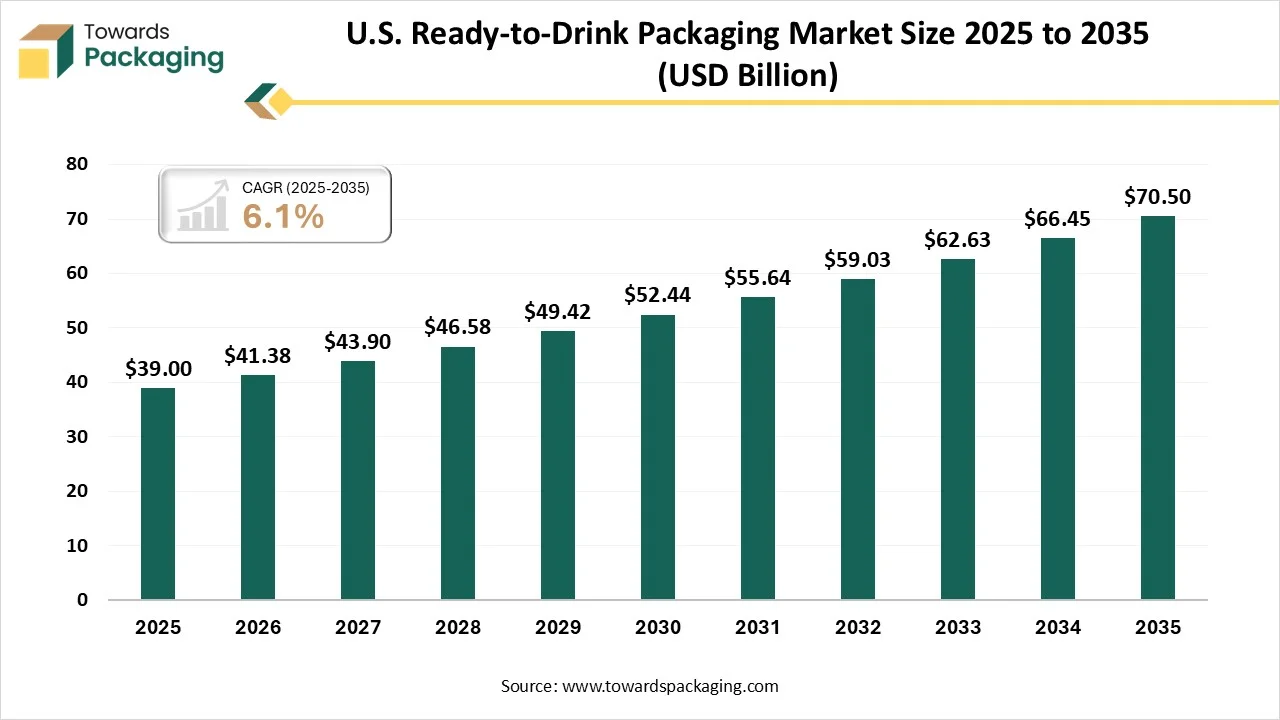
U.S. Ready-to-Drink Packaging Market Size 2025 to 2035

Major Key Insights of the U.S.Ready-to-Drink Packaging Market

  • In terms of revenue, the market is valued at USD 39 billion in 2025.
  • The market is projected to reach USD 70.5 billion by 2035.
  • Rapid growth at a CAGR of 6.1% will be observed in the period between 2026 and 2035.
  • By material, the plastic segment dominated the market in 2025.
  • By material, the paper & paperboard segment will be growing at a main CAGR between 2026 and 2035.
  • By product, the bottles segment dominated the market in 2025.
  • By product, the pouches segment will be developing at a significant CAGR between 2026 and 2035.
  • By end-use, the bottled water segment dominated the market in 2025.
  • By end-use, the plant-based beverages segment will be growing at a main CAGR between 2026 and 2035.

What is Ready-to-Drink Packaging?

Ready-to-Drink beverage packaging is pre-packaged, easy drinks crafted to serve good quality on the go. They have gained attraction among busy professionals and health-conscious users who are seeking fast nutritional boosts without any hassle of preparation. Such beverages are available in different formulations and flavors, which are frequently filled with minerals, vitamins, and other functional contents to assist complete health factors.

  • Ergonomics & Potability: RTD coffee packaging demands to go where the user goes, like the gym, car, around the home, and office. It denotes lightweight, durable designs that are convenient to grip and fit in cupholders, which cannot leak in a bag. The perfect packaging integrates ease of application and design, which serves a smooth experience no matter where they are enjoyed.
  • Minimalism with a Punch: Several brands use minimal designs that showcase clean ingredients and luxury quality. Simple fonts, matte finishes, and soft color palettes are a few of the design trends that top the headlines. Such a minimalist strategy stands out in a cluttered cold case and appeals to health-conscious buyers.
  • Shelf life & Freshness: Sticking aroma, taste, and security -particularly for dairy-based or cold brew varieties- requires high-level barrier prevention and airtight sealing. Packaging inventions in such space assist in expanding the shelf life, which lowers spoilage and ensures every sip is as fresh as the primary one.
  • Sustainability in Focus: Sustainability has changed from being a classifier to a demand. Users are carrying brands responsible for not just the ingredients of their beverages but also for how they are being packaged.
  • Storytelling through Design: Current users get to know more than what is present in the bottle and the actual story behind it. Brands are utilizing it to feature original stories. functional advantages and originating practices that change labels into communicative labels.

Technological Developments in the U.S. Ready-to-Drink Packaging Market

At its crucial point, AI in ready-to-drink packaging includes the mixing of computer vision, machine learning, and predictive analysis into the packaging procedure. Such technologies develop brands to craft packaging that is not only cost-effective but also personalized for a lower environmental impact and recyclability. On the other hand, AI-powered vision machines check defects in real time. Mainly, that lowers waste and improves quality control. In supply Chain logistics, AI is used to right-size packages -that avoids extra air and space. This process not only cuts shipping costs but also lessens the release by reducing the need for delivery trucks.

Predictive algorithms manage overall stock levels and project demand, which protects against over manufacturing and lowers storage waste. Such inventions make AI a main player in the circular economy methods.
Trade Analysis of U.S. Ready-to-Drink Packaging Market: Import & Export Statistics

  • According to the official recorded import data of U.S. Ready To Drink Packaging, between June 2024 and May 2025, the buyers have globally imported 39 shipments of U.S. Ready To Drink Packaging.
  • Such shipments were being facilitated by 39 exporters and bought by 56 worldwide buyers.
  • Russia, Vietnam, and Colombia have come up as the leading importing countries.
  • Belgium, Russia, and South Korea are the top 3 exporting countries.

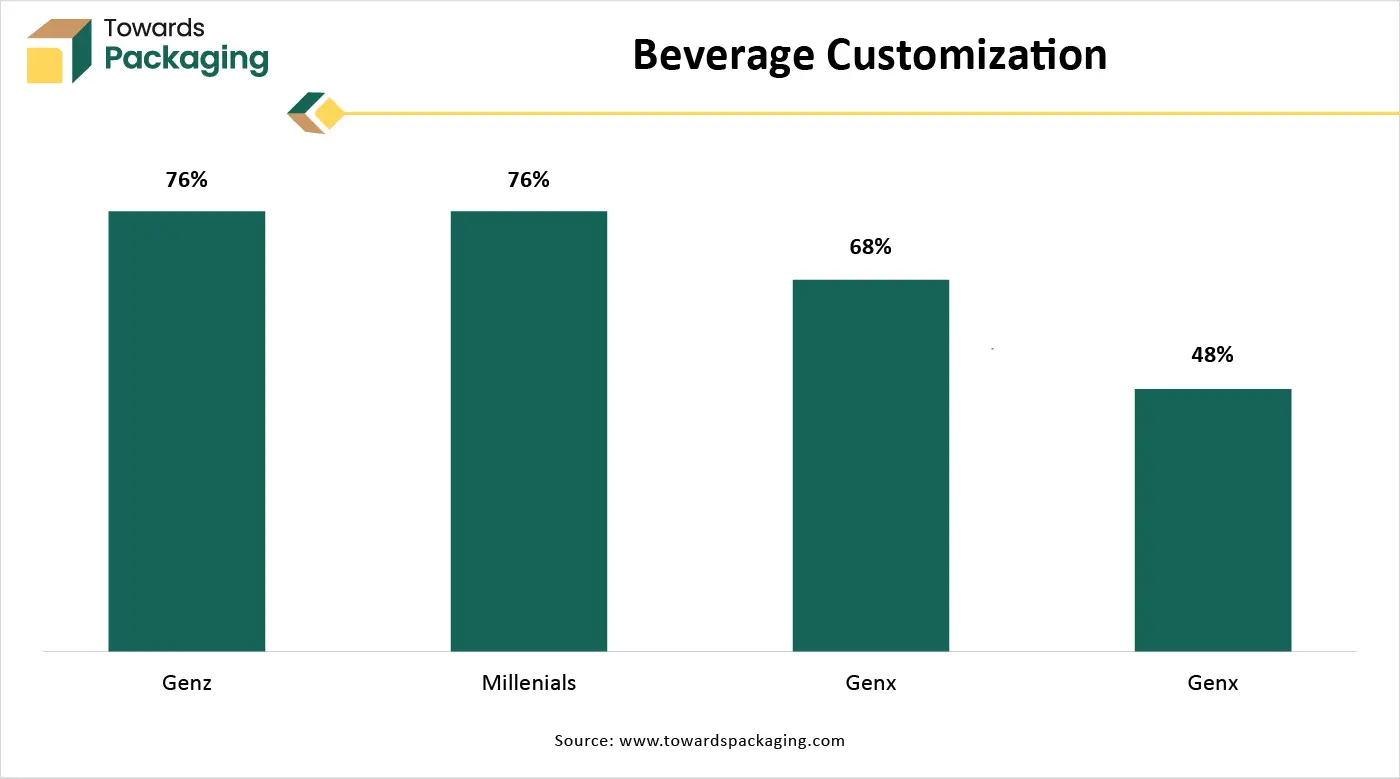
Beverage Customization

U.S. Ready-to-Drink Packaging Market - Supply Chain Analysis

  • Package Design and Prototyping: Current ready-to-drink packaging designs include technology like QR codes, NFC chips, and augmented reality (AR) and IoT-allowed sensors. Such technologies enable users to communicate with the brand, access complete product information, witness huge amounts of content, and check real insights by scanning or tapping the packaging with the use of smartphones.
  • Recycling and Waste Management: Plastic has remained a constant choice for beverage packaging as it is cost-effective and light, but brands are seeking biodegradable, recyclable, and bio-based plastics. For instance, strong PET bottles are made from a high percentage of recycled content. Packaging material producers are also making the latest kind of plastics from plants that break down naturally.
  • Logistics and Distribution: Productive loading and unloading systems are important for beverage truck bodies, as frequent stops and big deliveries often require fast turnaround times. Many high-level mechanisms have been developed to update the procedure. Several beverage trucks use gravity-fed shelving machines, which enable cans and bottles to move forward as the products are avoided. Such a system makes sure that the next product is always within convenient reach, which lowers manual labor and speeds up deliveries.

Segmental Insights

Material Insights

How Plastic Segment Dominated the U.S. Ready-to-Drink Packaging Market in 2025?

The plastic segment dominated the U.S. ready-to-drink packaging market in 2025 as plastic bottles deliver reseal ability and are generally appreciated for multi-serving designs, beverages, or sports drinks, which are crafted to be consumed on the go. Users favor the potential to drink in their own space and save it for later consumption. They move to match a value-generated regular, or a family-size beverage option. Plastic bottles have a crystal-clear design that enables the product to be visible, which can be beneficial for types of drinks like wellness beverages.

The paper & paperboard segment is expected to witness the fastest CAGR during the forecast period. Liquid packaging board (LPB) is significantly used to create cartons for juice, milk, and other beverages. In such a case, the paper which is supplied is just the foundation material that demands to be integrated with aluminiums foil and polyethylene to create the resulting multi-layer beverage carton. Such crayons are environmentally friendly, food safe, and designed to keep the liquids for a long time. Liquid packaging board is a paramount material in the beverage sector, which substitutes plastic bottles in several markets and helps the recyclable carton packaging trends.

Product Insights

How Bottles Segment Dominated the U.S. Ready-to-Drink Packaging Market in 2025?

The bottles segment dominated the U.S. ready-to-drink packaging market in 2025 as they are known as PET (polyethylene terephthalate) containers, which are a famous packaging design. They are re-sealable and so perfect for people on the shift who demand to remain constantly hydrated, and their transparent nature allows users to watch the drink as they are buying one. PET containers are 100% reusable, and the total single-use bottle has lessened weight by some 50% over the last 10 years.

The pouches segment is projected to experience the fastest CAGR during the forecast period. Single-serve wine and ready-to-drink cocktails spouted pouches are convenient to serve any collectibles. They are lightweight and perfectly fit inside coolers of every size and shape. This alcoholic beverage's flexible packaging solution also brings much less space in the refrigerator and cannot be crushed or broken down like regular bottles and cans. Another is a custom spouted pouch, which is an ideal way to pack vodka mixers, mixed cocktails, and other beverages. The flexible element of the film material points out to users which can pack a cooler or more drinks.

End-Use Insights

How Bottled Water Segment Dominated the U.S. Ready-to-Drink Packaging Market in 2025?

The bottled water segment dominated the U.S. ready-to-drink packaging market in 2025, as it can be conveniently stored and packed, which comes in handy in terms of emergency cases. There is no expiry date present on the bottled water if the seal is officially untouched and protected accurately, which guarantees clean drinking water in an urgent scenario. They even taste better than tap water, as they have no impurities. Bottled water is being packed after experiencing a deep purification procedure. Thus, it totally avoids any metallic taste or foul smell that can stay in the tap water.

The plant-based beverages segment is projected to witness the fastest CAGR during the forecast period. This drink manufacturing continues to develop as manufacturers give feedback to update user choice, quality expectations, and sustainability needs. Whether they are releasing a new line, developing capacity, or changing formulations, manufacturers should completely balance texture, taste, cost efficiency, and shelf life. The updated flexible technology selections, process design, and relevant scale -up are necessary to track constant product quality across markets, raw materials, and the manufacturing volumes.

Country Level Analysis:

The U.S. Ready-to-Drink Packaging market is seen to grow rapidly, as in the American alcoholic beverage industry, one of the most prosperous trends in the current period is the growth of ready-to-drink cocktails (RTD) or pre-mixed cocktails, which are ready to consume. In the United States, revenue of canned cocktails and remaining ready-to-drink alcoholic beverages has witnessed exceptional growth, like wine and beer, and impressive development. Additionally, new crossovers and flavor inventions are also accessible from changing hybrid categories. For example, along with “flavored beverages” and classic cocktails, we are discovering hard kombucha, hard coffee, and hard tea. The wine globe is accepting, as evidenced by the current demand for canned wine, which is receiving attention around the U.S., and is approved by millennials.
Recent Developments in the U.S. Ready-to-Drink Packaging Market

  • In May 2025, Ball Corporation, which is the top worldwide supplier of sustainable aluminium packaging for personal, beverages, and home care products, collaborated with Acai Motion, which is a Brazilian brand of natural energy drinks, to introduce latest can which is officially certified by the Aluminium Stewardship Initiative (ASI).
  • An official brand of whiskey from San Francisco named Gold Bar Whiskey has disclosed the release of its first-ever day-to-drink cocktail in partnership with legendary Hall of Fame quarterback Joe Montana, categorized as Gold Bar Whiskey “Double Gold”.
  • In July 2025, Sierra Nevada Brewing Co. officially declared the launch of CanDo, which is a full-service future co-packaging running, which is fully focused on generating premium adult beverages.
  • In July 2025, Ozzi, a US-based wellness brand, launched its very first product, which is basically a plant-based drink perfectly designed to control everning appetite and avoid stress-eating.
  • In November 2025, Tetra Pak launched a sunflower protein, which is a plant-based ingredient crafted to assist food and beverage manufacturers in expanding into plant-based and functional product range that will develop the present manufacturing infrastructure.

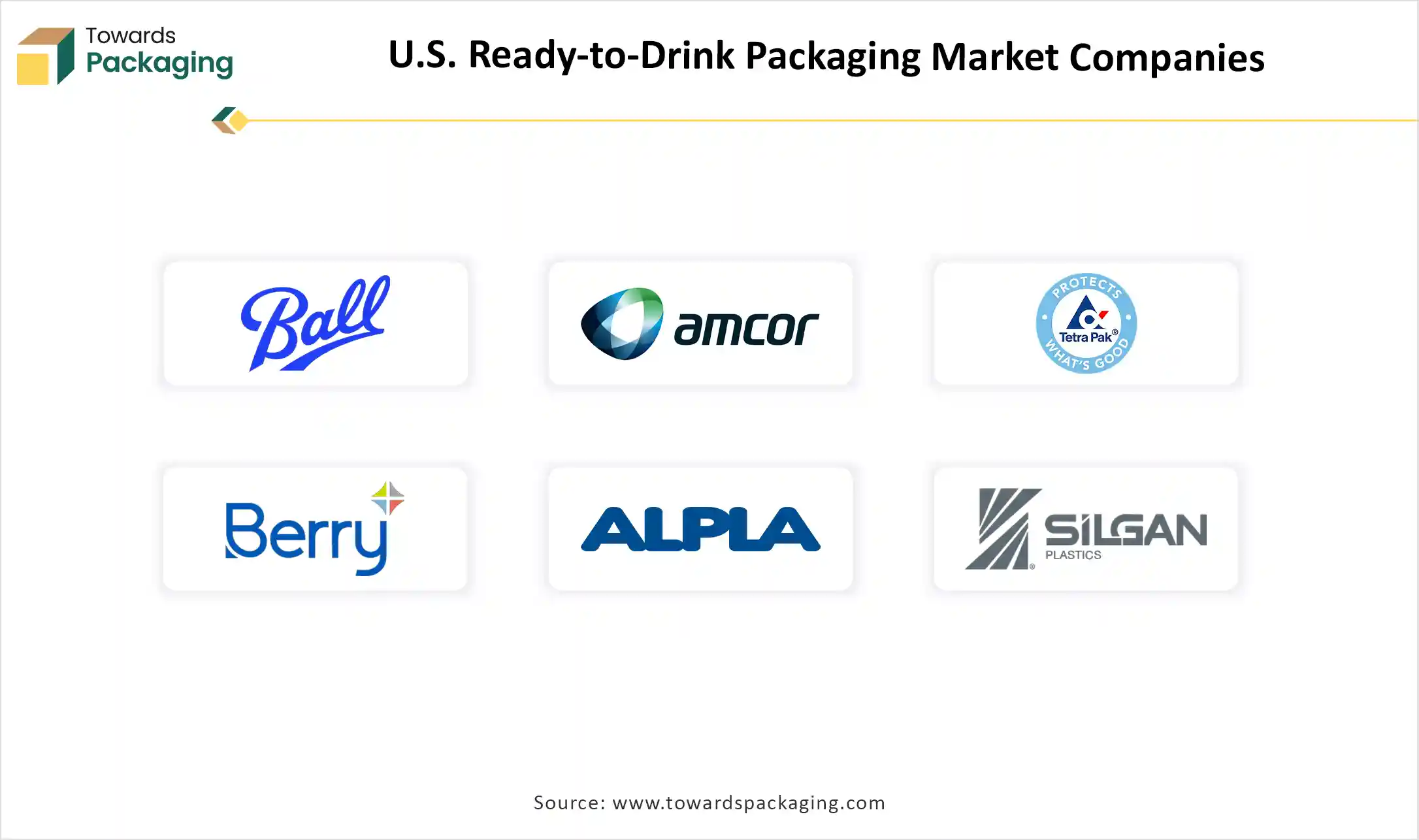
Top Companies in the U.S. Ready-to-Drink Packaging Market

U.S. Ready-to-Drink Packaging Market Companies

  • Ball Corporation
  • Amcor plc
  • Tetra Pak
  • Berry Global
  • ALPLA
  • Crown
  • SIG
  • Silgan Plastics
  • Smurfit Westrock
  • DrinkPAK, LLC

U.S. Ready-to-Drink Packaging Market Segmentation

By Material:

  • Glass
  • Plastic
  • Paper & Paperboard
  • Metal
  • Others

By Product:

  • Cans
  • Cartons
  • Bottles
  • Pouches
  • Others

By End-Use:

  • Alcoholic Beverages
  • Bottled Water
  • RTD tea & Coffee
  • Fruit Juices
  • Dairy-Based Beverages
  • Carbonated Soft Drinks
  • Plant-Based Beverages
  • Functional & Energy Drinks

Tags

FAQ's

Clarification : The plastic segment dominated the U.S. ready-to-drink packaging market in 2025 as plastic bottles deliver reseal ability and are usually appreciated for multi-serving designs, beverages, or sports drinks, which are designed to be consumed on the go.

Clarification : The bottled water segment dominated the U.S. ready-to-drink packaging market in 2025, as it can be conveniently kept and packed, which comes in handy in terms of emergency cases.

Meet the Team

Vidyesh Swar is a Senior Research Analyst at Towards Packaging, bringing over 4 years of dedicated expertise in market intelligence and strategic analysis across the dynamic world of packaging technologies and solutions.

Learn more about Vidyesh Swar


Aditi Shivarkar, with 14+ years in packaging market research, specializes in food, beverage, and eco-friendly packaging. She ensures accurate, actionable insights, driving Towards Packaging 's excellence in industry trends and sustainability.

Learn more about Aditi Shivarkar

Related Insights

U.S. Ready-to-Drink Packaging Market
Updated Date : 05 March 2026   |   Report Code : 6023
WhatsApp