


The diaper packaging market is predicted to expand from USD 30.29 billion in 2026 to USD 42.82 billion by 2035, growing at a CAGR of 3.92% during the forecast period from 2026 to 2035. The demand for diaper packaging is increasing because of growing hygiene awareness, demanding diapers, rising baby/elderly populations, user/brand concentration focus, and eco-friendly materials that drive invention in automated and sustainable packaging solutions.

The diaper packaging market comprises primary and secondary packaging solutions designed to protect, store, transport, and market baby and adult diapers. These packaging formats ensure hygiene, moisture resistance, and product integrity while enabling efficient handling and shelf presentation. Commonly manufactured using plastic films, paper-based materials, and sustainable alternatives, diaper packaging supports branding, convenience features such as resealability, and growing e-commerce requirements. The market serves infant care, toddler care, and adult incontinence segments across retail and online distribution channels globally.
| Diaper Type | Materials & Features | Typical Use & Benefits |
| Cloth | Cotton, hemp, bamboo, microfiber | Reusable, eco-friendly, customizable fit |
| Disposable | Polyethylene outer, superabsorbent polymers, nonwoven fabric | Convenient, leak-proof, with features like wetness indicators |
| Fitted Diapers | Adjustable snaps, elastic edges, liners | Customizable fit, used with washable or disposable inserts |
| Training Pants | Similar materials to disposables, designed for toddlers | Easy to pull-up, encouraging independent diapering |
Diapers are incorporating smart technology. This develops care for both adults and babies. Indicators and sensors are becoming prevalent. Smart diapers can check the moisture levels, and so they raise awareness for caregivers to create updates. Technology in the diaper serves additional advantages as smart diapers manage health measures. Due to these characteristics, the elderly have greatly benefited from these developments. Smart features ensure timely updates, as this develops their health and comfort. Such inventions are game-changing as they serve growth differently.
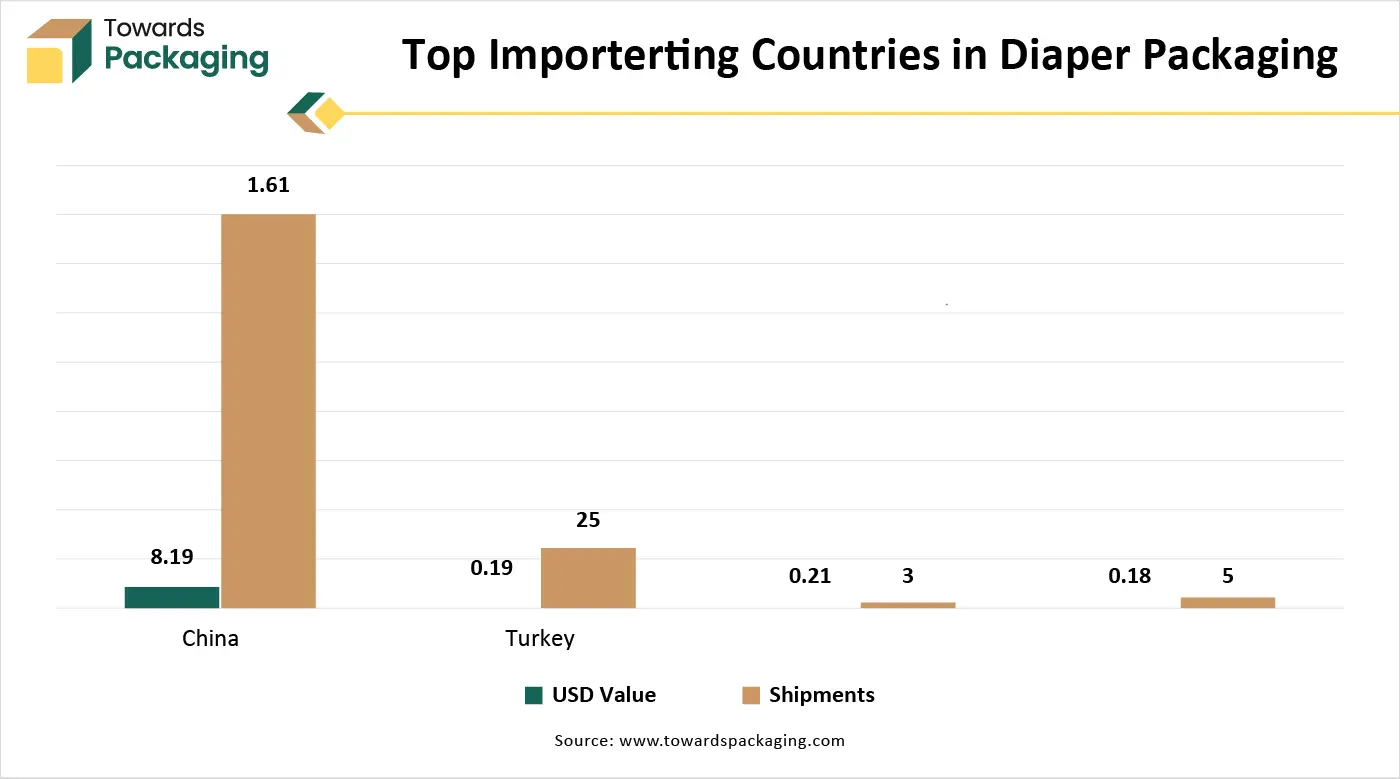
Non-woven fabrics are the crucial layer of the diapers. Such materials are usually soft, friendly to the air and nature to the skin, and hence, are quite perfect for babies and adults too. Generally, the npn-woven fabric can enable moisture to be absorbed smoothly, and at the current time, it has the potential of storing the absorbent material of the diaper still very dry despite the breakout of the moisture.
The disposable diaper manufacturing procedure is a minutely managed series of steps that transforms the raw materials into the relevant baby diaper we utilise each day. At its main, it includes five main stages, like creating the absorbent, making nonwoven surfaces, setting the components, including elastic bands, and ensuring the quality with the assistance of packaging and testing.
Direct-to-consumer structures serve regular and automated shipments that need accurate route optimization and inventory tracking to prevent stockouts. To manage high shipping costs, producers utilise regional distribution centers to focus on targeted markets. Also, current startups frequently use OEM (Contra Manufacturing) to avoid the costs of tracking their own production and logistics machinery.
| By Material Type | Market Share 2025 (%) |
| Plastic | 50.40% |
| Biodegradable Materials | 25% |
| Other Materials | 24.60% |
The plastics segment has dominated the market with a share of 50.4% in 2025, as polyethylene uses are big, with several sectors depending on its versatility and reliability. Polypropylene instances count automotive parts, packaging materials, personal care, and diapers, too, along with medical devices. Its power, opposition to chemicals, and flexibility make it a famous choice for the items. It is more flexible and forms to low temperatures, frequently used in products like containers and plastic bags, as polyester.
The biodegradable materials segment is expected to experience the fastest CAGR during the forecast period. There are big biodegradable disposable diapers that are accessible in the industry, produced from plant-based materials. They are an alternative for the families who choose the ease of the disposable diapers but still need to reduce their ecological footprint. They are made of bio-plastics, like PLA, which have hormonal effects and can contribute to infertility. The materials used in the diapers are cotton, bamboo, non-woven polypropylene, wheat starch, and cellulose pulp.
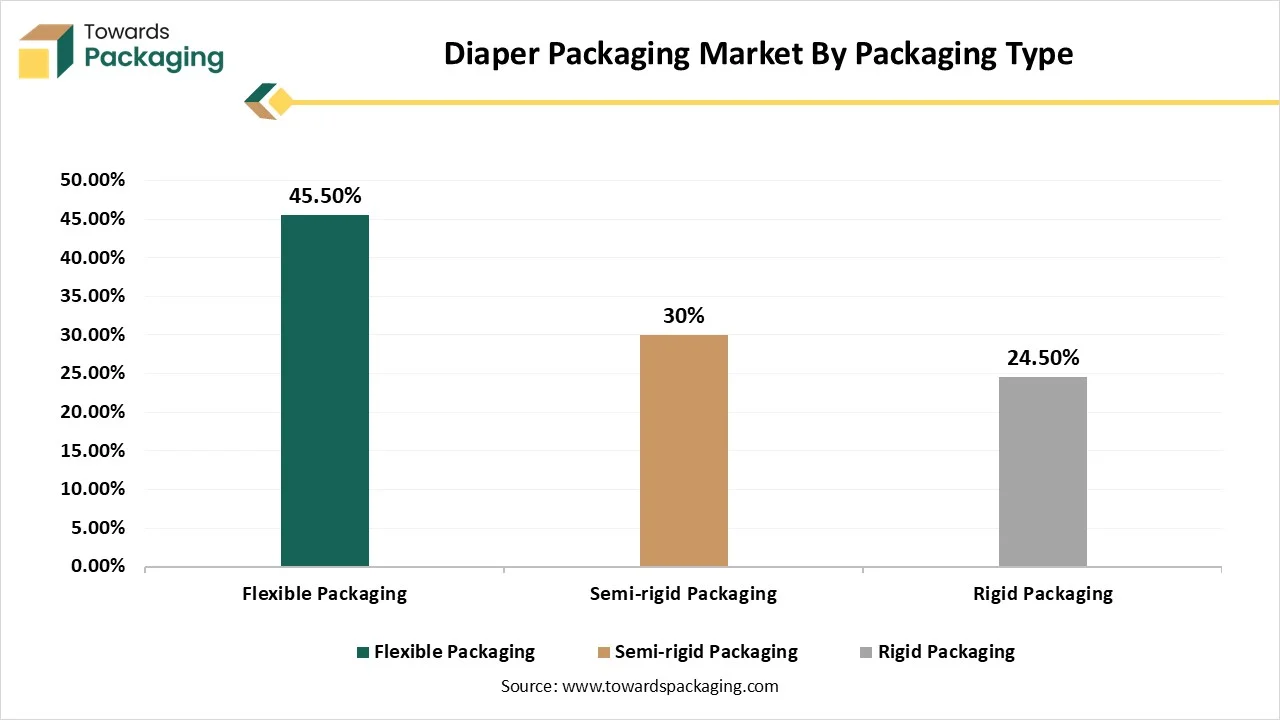
The flexible packaging segment has dominated the market with 45.5% share in 2025, as these pouches are made from the multi-layer laminate film structures, which are crafted to serve the compulsory barrier characteristics for product security. These laminate designs generally have an outer layer for reliability and printability, which is an inner packaging layer of compatible material that has a filling item and has one or more barrier layers fixed in between.
The semi-rigid packaging segment is expected to experience the fastest CAGR during the forecast period. The semi-rigid packaging for the diapers generally has materials that serve a perfect balance of design and flexibility, like cardboard, crayons, and boxes, specific to polyethylene films and laminated materials. This kind of packaging assists in protecting the product that has its shape to some limit while staying relevant to relatively lightweight materials. This type of packaging protects the diaper from contamination, moisture, and physical pollutants during transportation and storage.
| By Product Type | Market Share 2025 (%) |
| Baby Diapers | 56.60% |
| Adult Diapers | 25% |
| Other Product Types | 18.40% |
The baby diapers segment has dominated the market with a 56.6% share in 2025, as baby diapers are initially packaged in moisture-resistant polyethylene, durable plastic pouches, too, with a developing move towards eco-friendly and paper-based materials. The packaging is being crafted for protection, hygiene, and user convenience, which often has handles and precise product information. Also, due to rising consumer demand for environmentally friendly products, organizations are discovering innovations like paper-based and recyclable bags that have post-consumer recycled content.
The adult diapers segment is expected to experience the Fastest CAGR during the forecast period. The adult diapers industry is growing as products are now completely focusing on convenience, reliability, and discretion. When anyone is at work or commuting, it is basically for the on-the-go people. A developing share of buyers are the self-users instead of the caregiver tracked. Currently, there are about 1 million users who have already been accepted. There are different types of adult diapers available, like pant-style, tape-style, overnight diapers, gender-specific, and incontinence pads, too.
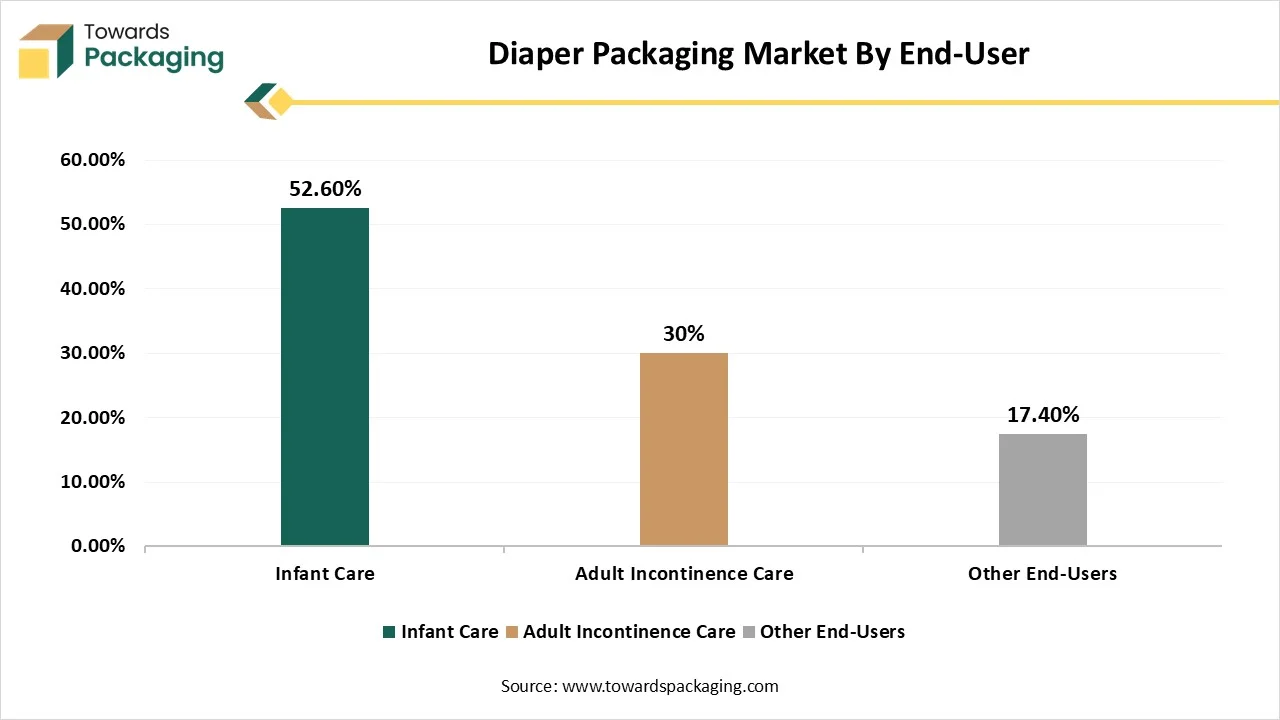
The infant care segment has dominated the market with a 52.6% share in 2025 as the most crucial element of any newborn diaper is its potential to absorb moisture and to protect against leaks quickly. Newborns urinate often, and a diaper that has less absorbency can lead to rashes and discomfort. So, cloth-based or organic newborn diapers created from cotton or bamboo serve exceptional breathability. Additionally, diapers serve to ease the burden by releasing parents time from constantly changing the soiled cloth diapers.
The adult incontinence care segment is predicted to witness the fastest CAGR during the forecast period. Relevant adult diapers can smoothly mix into bedtime and morning schedules, which helps seniors feel clean, fresh, and comfortable throughout the day or nighttime. Whether one is at home or in supported living, caregivers can perfectly plan around the toileting demands when there is reliable protection included. Adult diapers can count to outings, hobbies, and family visits too, which are convenient to get delighted without any dread of embarrassment or leaks. Predictable diapers get updates, which become a part of the schedule, lowering the stress and creating personal care that is less intrusive.
| By Distribution Channel | Market Share 2025 (%) |
| Supermarkets & Hypermarkets | 42.40% |
| Online Retail | 35% |
| Other Distribution Channels | 22.60% |
The supermarkets and hypermarkets segment has dominated the market with 42.4% share in 2025, as the accurate packaging updated on the supermarket shelves is updated for the shelf appearance, cost-effectiveness, and product protection too. Flexible plastic base is the most widely used design because of its low cost, durability, light weight, and capability to be attractively branded. Boxes and cartons are frequently used for the bulk packs, which are sold in warehouse retailers or for the luxury product lines. Cartons serve perfect protection, and a big layer is for high-quality graphics.
The online retail segment is expected to experience the fastest CAGR during the forecast period. For this segment, diaper packaging is updated for the e-commerce efficiency and logistical durability that frequently has regular brick and mortar shelf packaging, as this procedure mixes high-speed automation with a particular “Ships in own Container” (SIOC). Every pack is being crafted with different code for full traceability, which goes back to the manufacturing minute. High-accuracy sensors and the checkweighers make sure each online pack has the correct number of diapers, which protects against user complaints in the subscription design.
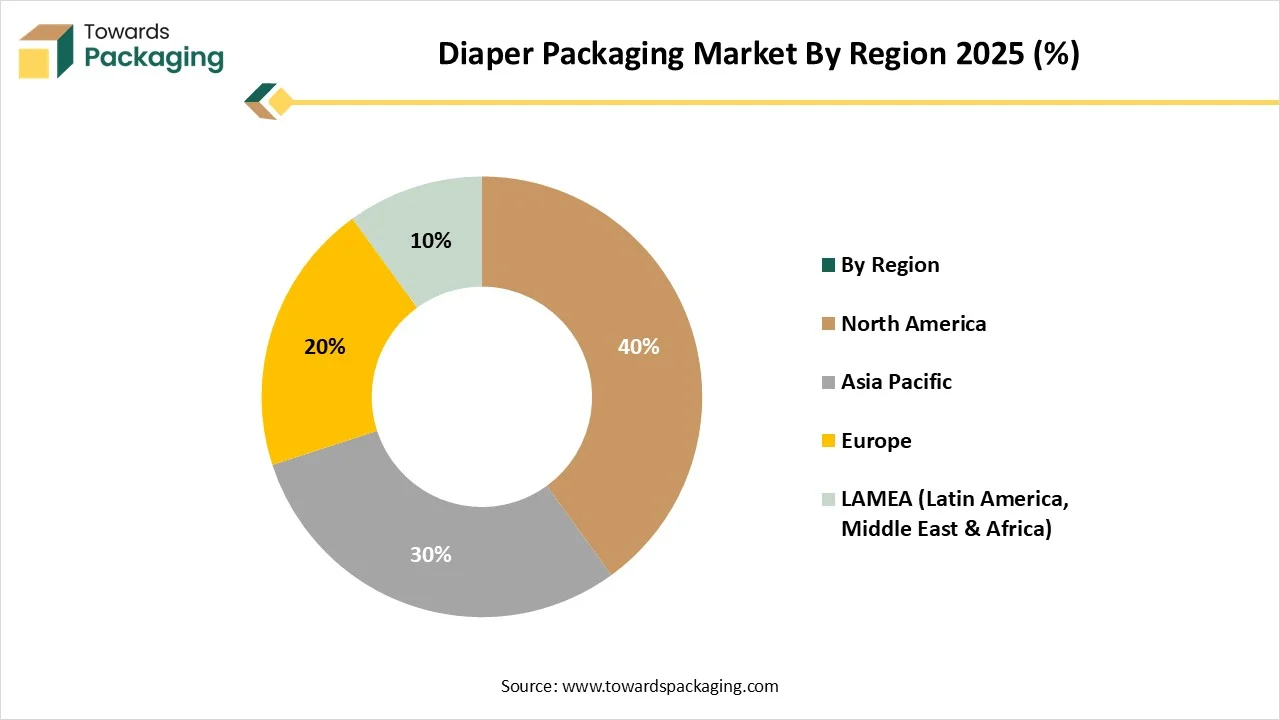
The North America has dominated the diaper packaging market in 2025 as rising eco-friendly awareness among users drives the urge for environmentally friendly diapers in this region. With sustainability being the latest discussion, many parents need compostable, biodegradable, and organic diapers. Giving feedback to these urges, diaper producers have mixed the natural materials, such as plant-based polymers, into the diaper products. Hence, developing users are ready to pay an additional luxury to find eco-friendly diapers, which contribute to constant updates in this trend.
How is the Diaper Packaging Market Growing in Canada?
Canadas developing diaper packaging market is about sustainability trends and technological development. Other main drivers include growing urbanization, developing awareness of convenience and hygiene, too, and a developing concentration on environmentally friendly products. The distribution channels are stretching beyond regular retail outlets to include subscription services, e-commerce platforms, and direct-to-consumer models, which is driven by the digital transformations.
Asia Pacific is the fastest-growing region in the diaper packaging market in 2025, as this region is initially being driven by the move towards sustainable materials, digital ease, and high-tech automation to assist fast urbanization and an aging population, too. Producers are mixing Industry 4.0 technology, such as IoT-enabled and AI-driven personalization, to develop operational smoothness. So, the high-speed machines are potential enough for generating both tape-style and pant-style diapers at scale, which are becoming standard in India, Vietnam, and Indonesia.
Why is India using the Diaper Packaging Market Importantly?
The diaper packaging industry in India is witnessing major development, which is because of developed awareness of hygiene, growing population, and developing disposable incomes. Hence, several business entrepreneurs are looking to penetrate the diaper production in India. Also, the diaper market size in India is significant and growing rapidly. Both adult and baby diapers are looking to increase their presence in the diaper packaging field in India, which is very competitive, for both new entrants and well-established brands, for market development.
The Diaper Packaging Market in the European region is growing as under EU single-use plastics limitations, several brands are updating to mono-material plastic packaging, which is convenient to recycle, or are lowering the overall thickness of the plastic films to lessen the waste. Packaging is developing in terms of digital touch as it frequently has QR codes that lead to sustainability trends, subscription services, and sourcing transparency. Also, the European Green Deal and the particular EU plastics bans are moving towards a move to a circular economy design.
Germany Diaper Packaging Market Trend
The market is experiencing a demand in terms of Research and Development for the AI-driven moisture alert machines and the intelligence fabric integration, particularly in luxury and elder-care product lines. User choices are moving towards comfort-driven, tailored designs with stretch-fit and breathable surfaces. Furthermore, developing attention in terms of metropolitan areas such as Frankfurt, Hamburg, and Munich is allowing organizations to update a micro-focused market entry method. Digital advertising and social media are becoming dominant channels for awareness and engagement, specifically among the digitally native parents.
The diaper packaging market in the Middle East &Africa (MEA) region is growing quickly as it is witnessing a major shift, which is being driven by the rising middle-class, increasing hygiene awareness, and a complicated move towards sustainable materials. Nigeria is classified as the fastest-growing market in Africa, which is predicted to look for main funding as global players like Unicharm discover local production at lower costs and reach sub-Saharan users.
UAE Diaper Packaging Market Trend
The UAE is experiencing a major update due to strict environmental regulations and a move towards luxury and health-conscious user choice. Packaging designs are concentrating on the clean and organic aesthetics to attract the Gen Z and Millennial parents, and main brands are substituting the regular plastic with bio-based and recyclable paper packaging. This shift is driven by Dubais plastic ban and the deferral of Extended Producer Responsibility (EPR) pilots, which are compulsory for the sustainable material application and take-back schemes, too.
In South America, the diaper packaging market is growing steadily as the market is further being driven by the developed health consciousness and the remaining government policies that focus on maternal and infant health. Public campaigns that are being kept on cleanliness rules and perfect infant care are affecting buying trends, which make parents select disposable diapers over the conventional cloth options. Economic development, along with developed distribution channels, is catering to an in-depth entry of markets, particularly in the rural regions in which disposable diapers have been regularly entered.
Brazil Diaper Packaging Market Trend
Brazil is the biggest contributor, which is driven by the government-oriented health programs, which have developed hospital births and developing incomes too. The Diaper brands are contributing to reliable product series, distribution collaborations, and local manufacturing to solve the regional price sensitivity. Proliferation and urbanization of current retail channels such as supermarkets, hypermarkets, and online stores are further developing the market. Hence, economic instability and high inflation in some countries pose issues for sustained development.
By Material
By Packaging Type
By Product Type
By End Use
By Distribution Channel
By Regions






Research & Advisory Analyst
Yogesh Kulkarni is an experienced Research Analyst specializing in the packaging sector, with a strong foundation in statistical analysis and market intelligence. He currently contributes his expertise to Towards Packaging.
Learn more about Yogesh Kulkarni

Reviewed By
Aditi Shivarkar, with 14+ years in packaging market research, specializes in food, beverage, and eco-friendly packaging. She ensures accurate, actionable insights, driving Towards Packaging Analytics & Consulting 's excellence in industry trends and sustainability.
Learn more about Aditi Shivarkar

Diaper Packaging Market
 Table of Content
 sales@towardspackaging.com
 +1 804-441-9344
 Download Sample
 Schedule a Meeting