


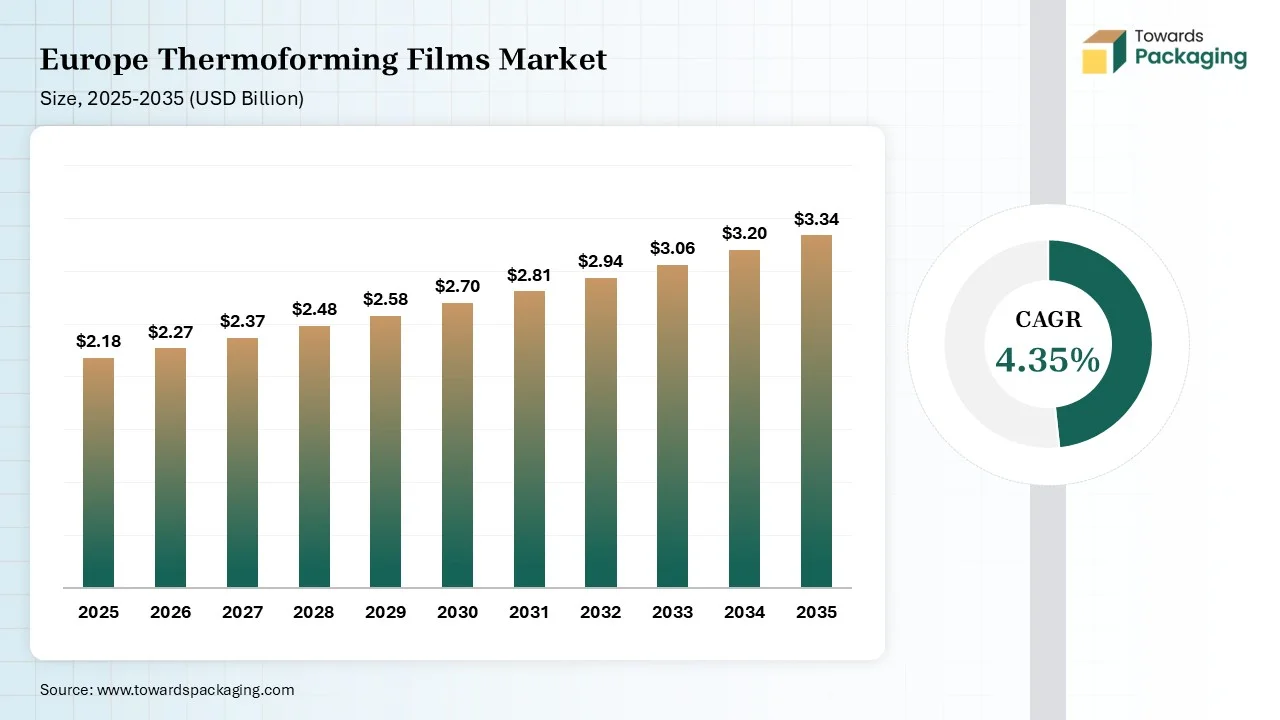
According to Vidyesh Swar, who has highly experienced and detailed knowledge of thermoforming films, packaging films, and the packaging industry. The Europe thermoforming films market size was estimated at USD 2.18 billion in 2025 and is predicted to reach USD 3.34 billion by 2035. The market is expected to grow at a 4.35% CAGR during the forecast period. The high use of thermoformed trays in the medical industry, high consumption of meat products, and manufacturers' transition to thinner films drive the market growth. Companies like Amcor plc, Klockner Pentaplast, Coveris, and Berry Global Group support the growth.
Thermoforming films are plastic films made from thermoplastic materials. The film becomes soft when heated. Its characteristics are high pliability, high tensile strength, high optical transparency, exceptional dimensional stability, and high sealability. It offers benefits like safeguarding sharp products, optimizing space, providing custom printing options, and keeping food items fresh. Materials like PP, PVC, PE, EVOH, and PET are used in thermoforming films. The thermoforming process includes heating, forming, and cooling. Thermoforming films are used in applications like fresh food packaging, protective housing, electronic component containers, and others.
The Europe thermoforming films market held a value of $2.18B in 2025. Factors like eco-modulation taxes, thriving ambulatory surgical centers, and focus on perishable foods' shelf life drive the market growth. Thermoforming films are customized into cups, blister packs, trays, containers, and clamshells. The customized formats are used across the consumer goods, pharmaceutical, food, and medical industries. Poland is predicted to grow with the fastest CAGR of 6.4% during the forecast period.
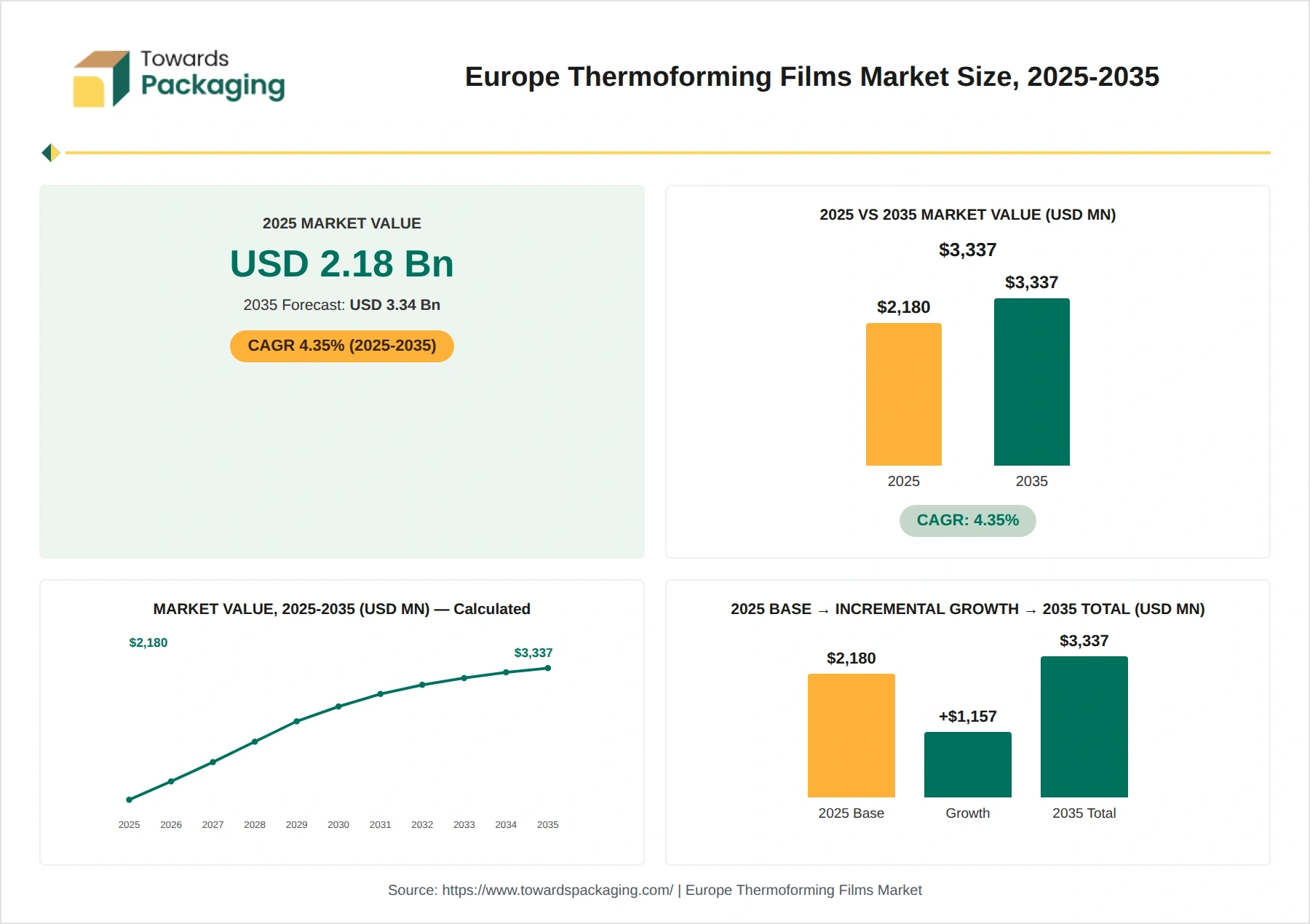
Europe thermoforming films market size was estimated at $2.18B in 2025 and is expected to grow at a 4.35% CAGR during 2025-2035. The market growth is driven by factors like brand owners' transition to reusable packaging structures, preference for mono-material thermoforming films, growth in bioplastics, advancing thin-gauge thermoforming, preference for high-barrier films, high utilization of MAP, burgeoning pharmaceuticals, and e-commerce growth. The major leaders include Klockner Pentaplast Group, Berry Global Inc., Coveris Holdings S.A., Huhtamaki Oyj, and Amcor plc supports the growth.
Europe thermoforming films market size is expected to reach $3.34B by 2035, and the incremental growth value is $1.157. Factors include growing demand for 100% compostable packaging, rise in high-barrier extrusion, thriving RTE foods market, expanded sterile packaging, lightweighting innovations, adoption of compostable resins, rise of Industry 4.0, explosion of retail logistics, and demand for low-cost tools, which will support the overall growth. Players like Sealed Air, Amcor, Sudpack, Wipak, Berry Global, and Coveris drive the overall growth.
Source: Towards Packaging Database
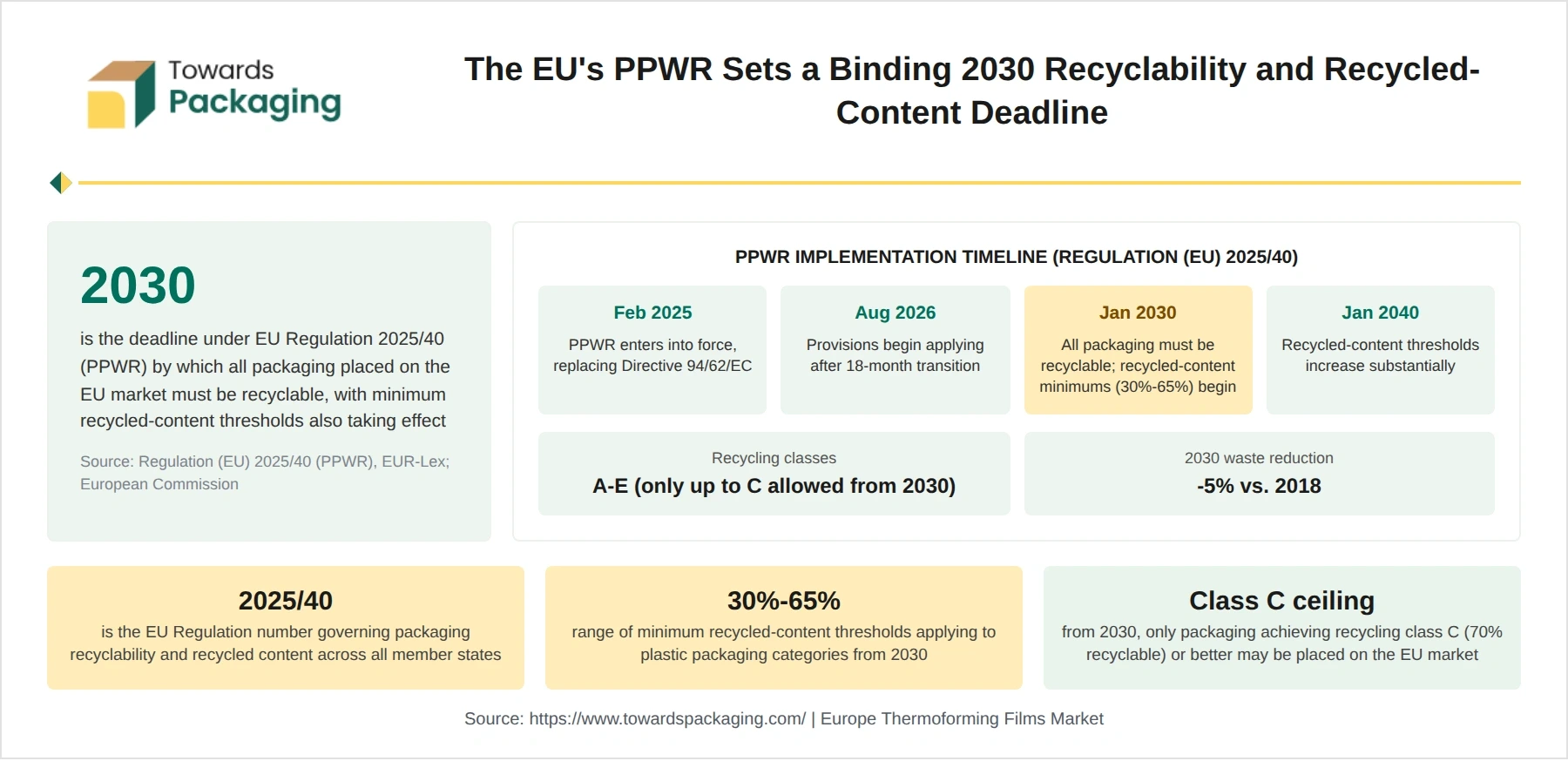
EU PPWR officially came into force in February 2025. It replaced Directive 94/62/EC, and official application started after an 18-month transition. The rule officially started in August 2026. In August 2026, its core objectives include producer responsibility, safety restrictions, harmonized compliance, and traceability. The compostable packaging format requirements will start on 12 February 2028. In January 2030, its main focus includes recyclability grades, single-use bans, and recycled content thresholds. The recycled content threshold will increase by January 2040. The main focus includes reducing packaging waste by 15% from 2018. The main goals of EU PPWR include harmonizing labeling, improving recyclability, restricting harmful substances, and lowering packaging waste.
Source: Regulation (EU) 2025/40 (PPWR), EUR-Lex; European Commission
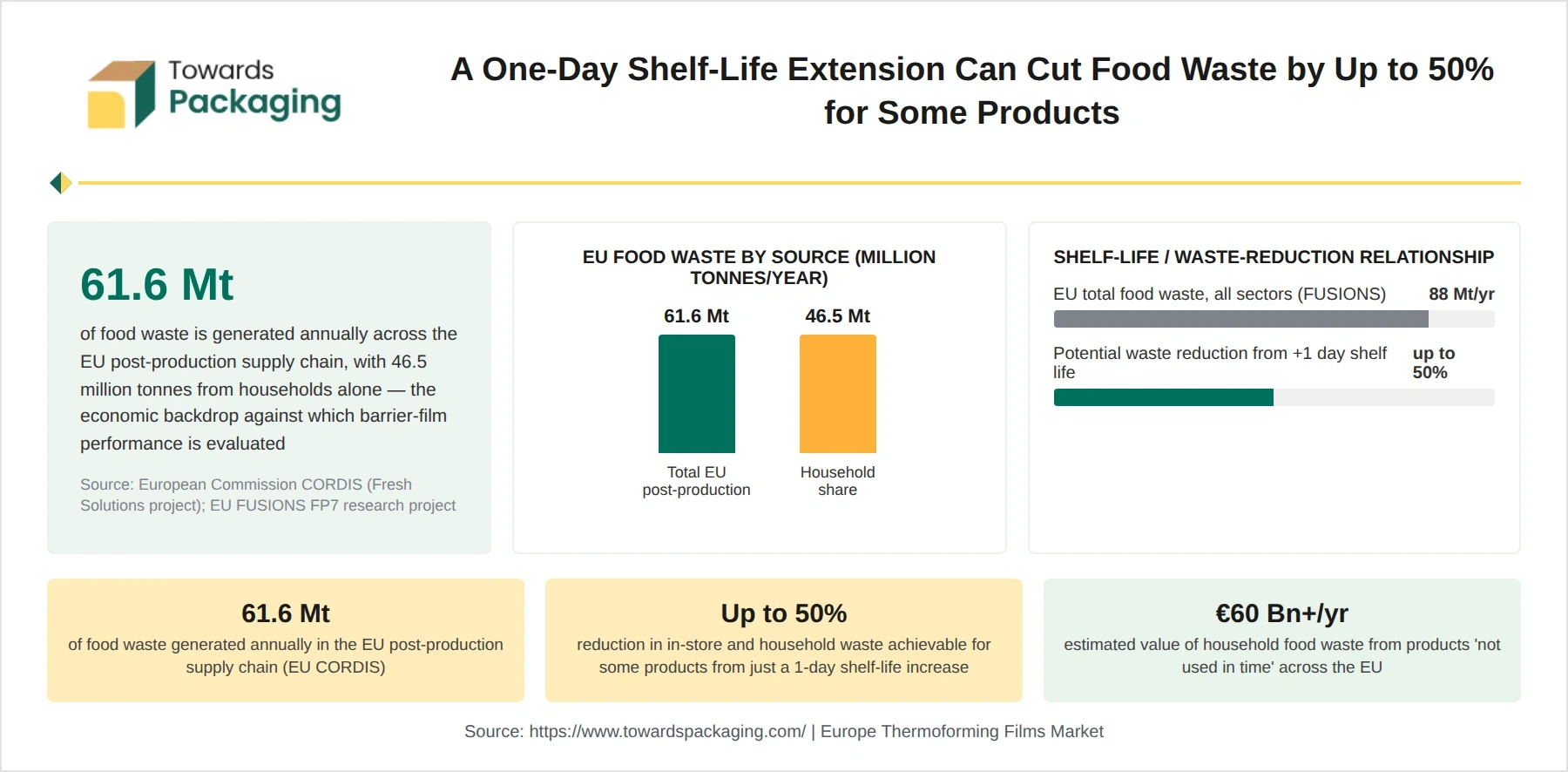
EU post-production supply chain generated 61.6 million tonnes of food waste yearly. Households generate up to 46.5 million tonnes of food waste annually. All industrial sectors generate up to 88 million tonnes of food waste. The one-day shelf-life increment of food products helps to reduce waste by up to 50% in households and in-store applications. The shelf life increment offers benefits like better stock flow, more selling time, and fewer markdowns for stores. It provides benefits like resource savings and fewer premature discards for consumers.
Source: European Commission CORDIS (Fresh Solutions project); EU FUSIONS FP7 research project
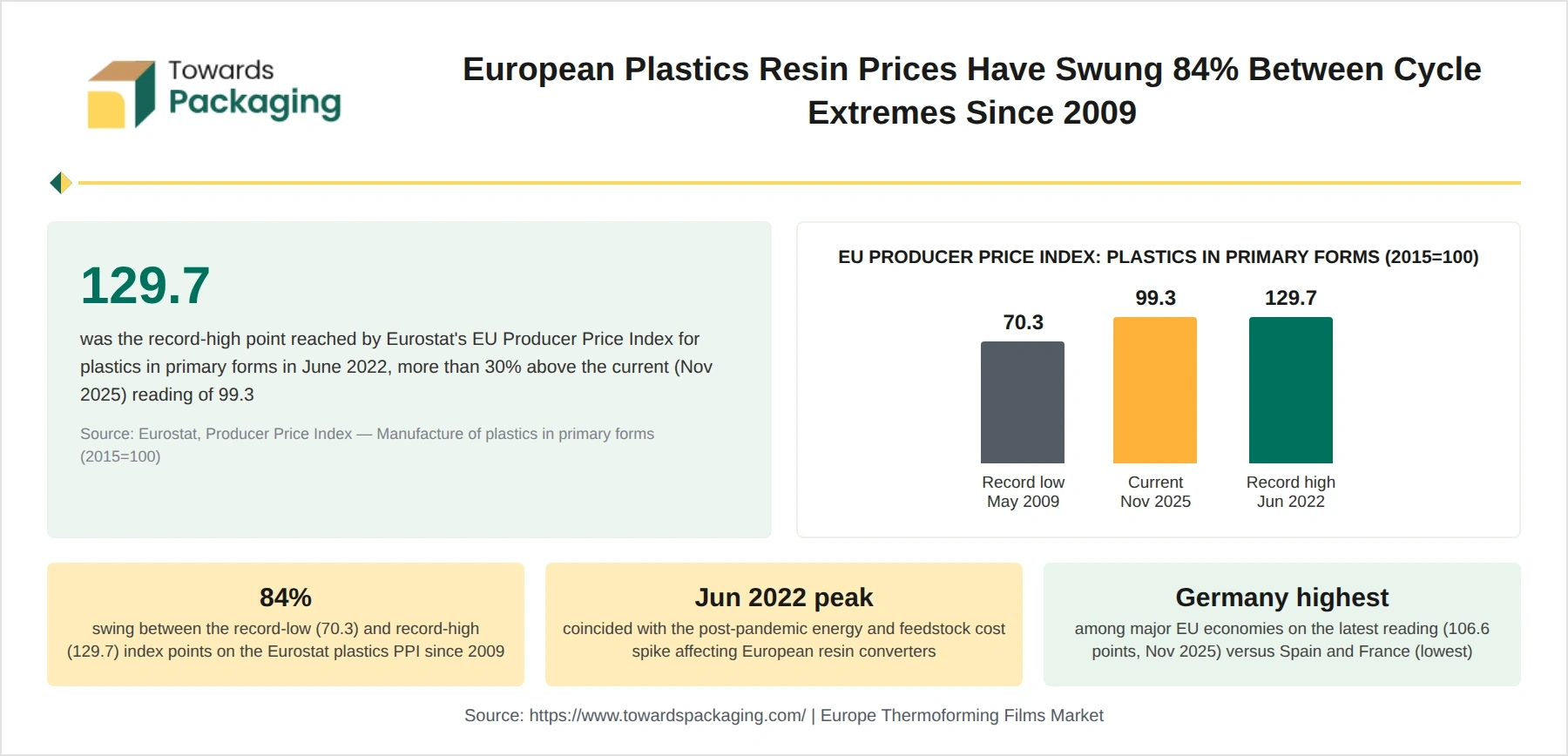
In May 2009, the price of plastic resin was low which is 70.3 index. In November 2025, it reached 99.3 index. The plastic resin recorded its highest price index of 129.7 in June 2022. The price index was 30% above the November 2025 price index. 84% price swing from May 2009 to June 2022. The resin price was highest due to high crude oil prices, unprecedented electricity bills, high freight costs, and supply disruption. In November 2025, Germany recorded the highest price index of 106.6 points. Countries like France and Spain recorded the lowest price index among other EU countries.
Source: Eurostat, Producer Price Index - Manufacture of plastics in primary forms (2015=100)
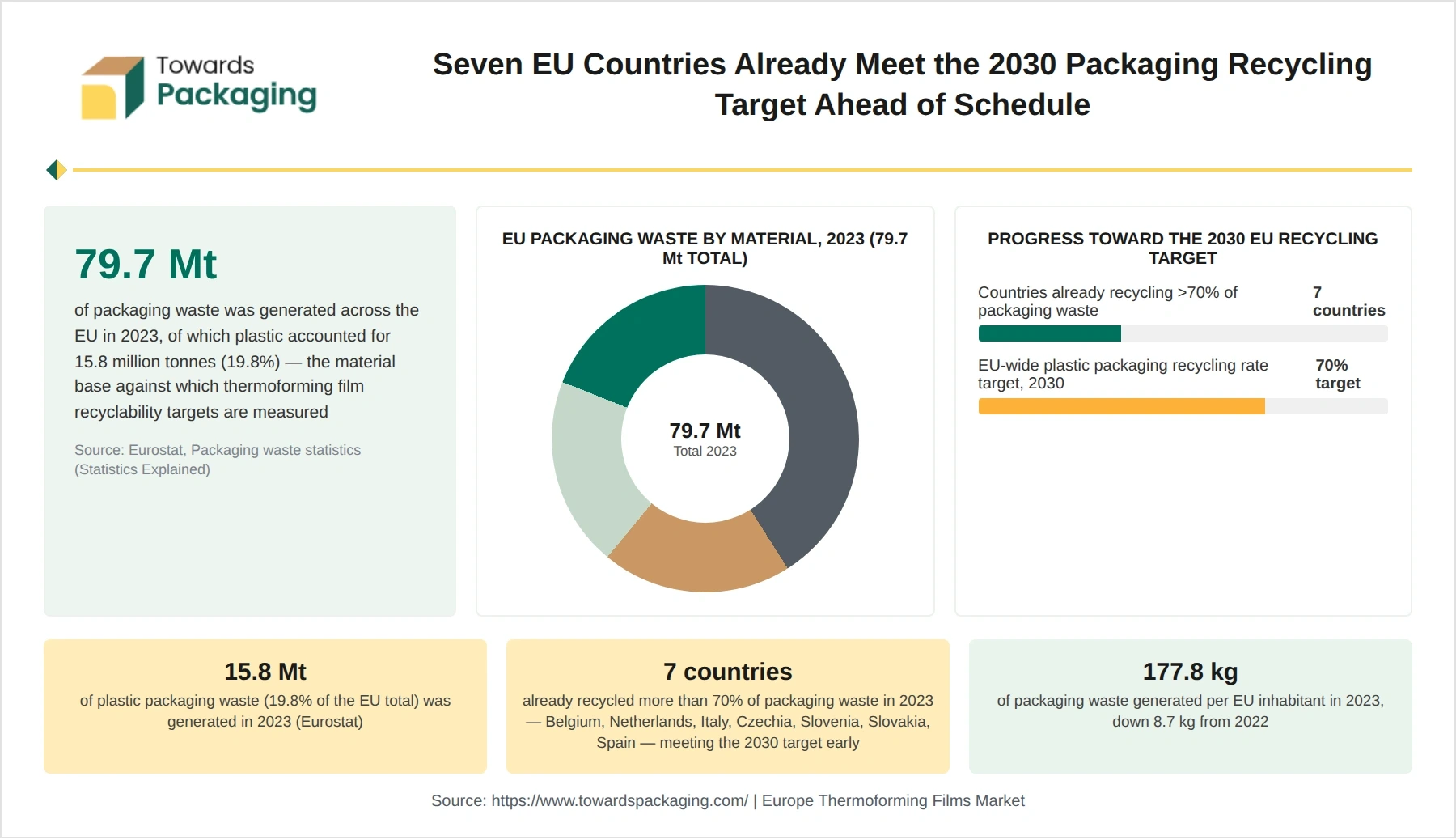
The total packaging waste generated in the European Union was 79.7 million tons in 2023. The total plastic waste was 15.8 million tonnes. Plastic accounted for a 19.8% share of total waste. In 2023, more than 70% of packaging waste was already recycled by 7 European Countries. Countries like Spain, Slovenia, Italy, Belgium, Slovakia, the Netherlands, and Czechia completed the 70% target early. These country meets 2030 packaging recycling target. Each EU inhabitant generated 177.8kg f packaging waste in 2023. Per EU inhabitant, waste generation decreased by 8.7kg from 2022.
Source: Eurostat, Packaging waste statistics (Statistics Explained)
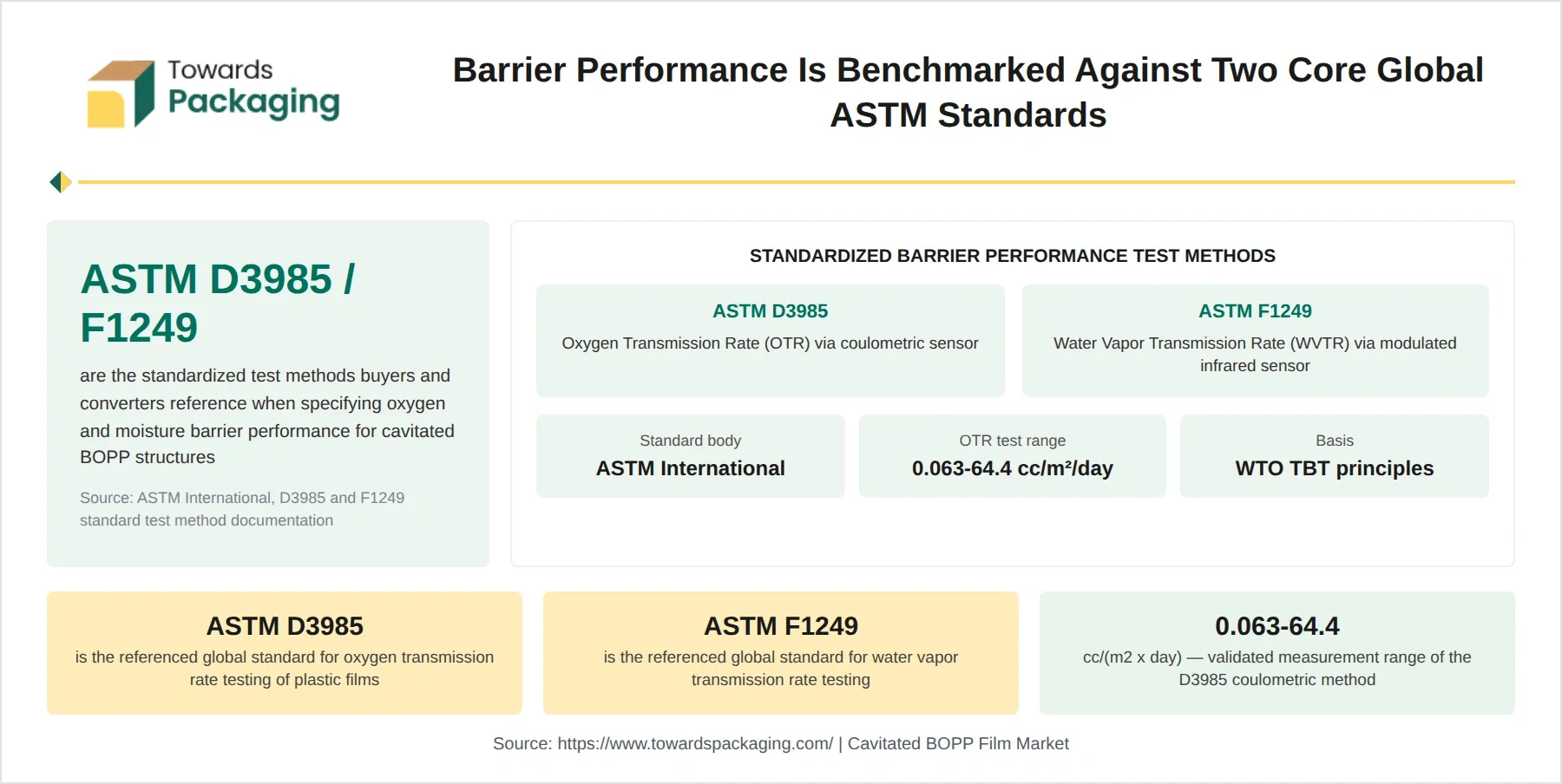
ASTM D3985 is used to test oxygen transmission rate. It uses a coulometric sensor to measure OTR. It measures the permeability coefficient, OTR, and permeance. It is used in industrial applications, food packaging, electronics packaging, and medical packaging. Its role in thermoforming is process impact assessment, shelf-life assurance, barrier validation, and quality control. ASTM F1249 is used to test water vapour transmission rate. It tests materials like coextrusions, polymer sheets, plastic films, and others. Its role is quality control, process optimization, barrier verification, and shelf-life prediction. ASTM D3985 and ASTM F1249 are applicable for multilayer thermoforming films.
Source: ASTM International, D3985 and F1249 standard test method documentation
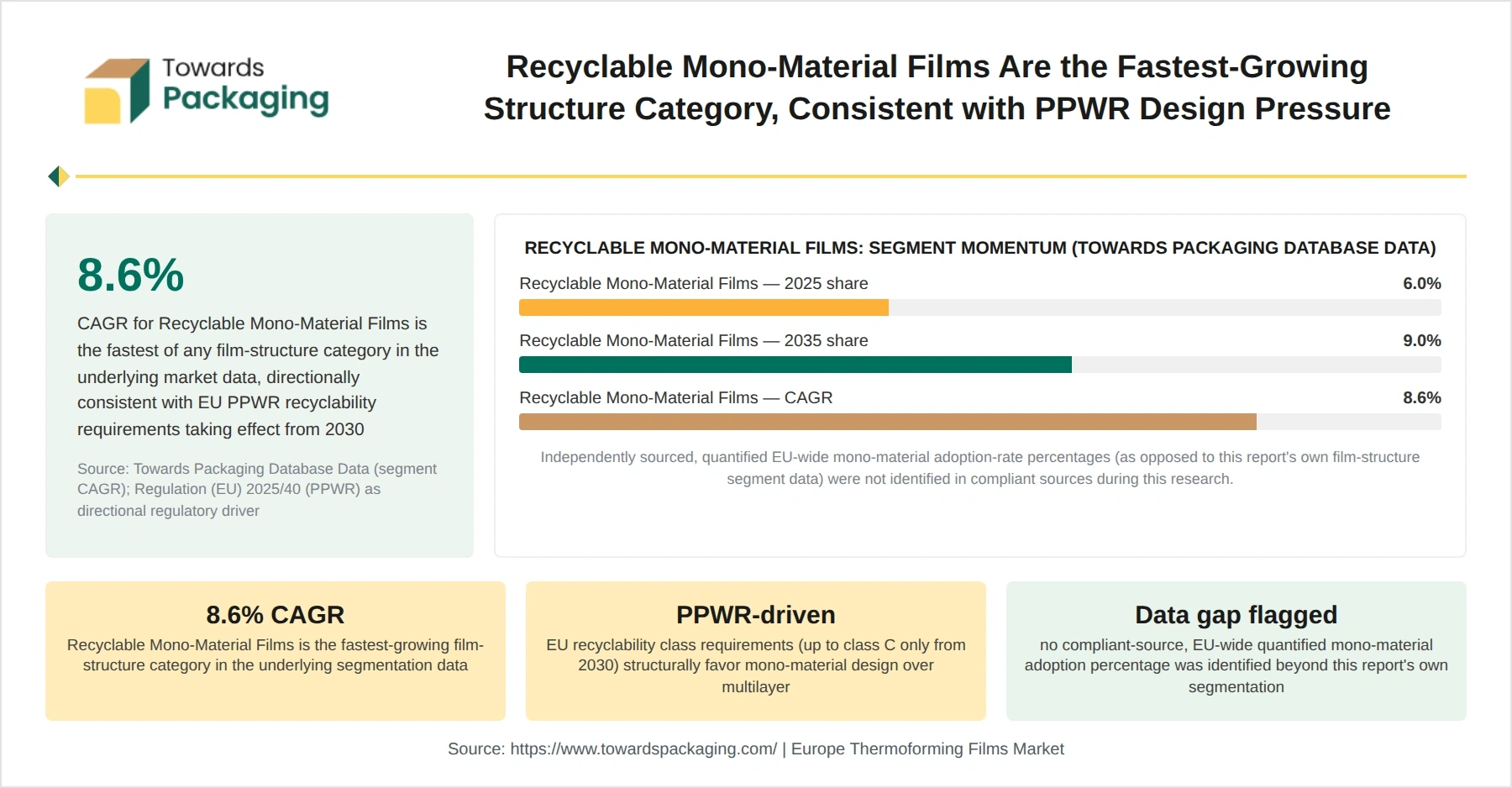
Recyclable mono-material films held a 6% share in 2025 and are expected to reach 9% by 2035. Drivers like PPWR mandates, high thermoforming compatibility, recycled content targets, and focus on brand reputation drive the growth. It is expected to grow at an 8.6% CAGR during the forecast period. Factors like a simple recycling process, strong protection, eco-friendly brand goals, new government laws, and a shift away from multi-layer mixes support the growth. It is widely used in packaged sliced meats, protecting medical devices, housing consumer goods, boxing cheese blocks, and sealing fresh seafood. Companies like Walki, kp, Amcor, and SUDAPACK manufacture recyclable mono-material films.
Source: Towards Packaging Database Data; Regulation (EU) 2025/40 (PPWR) as directional regulatory driver
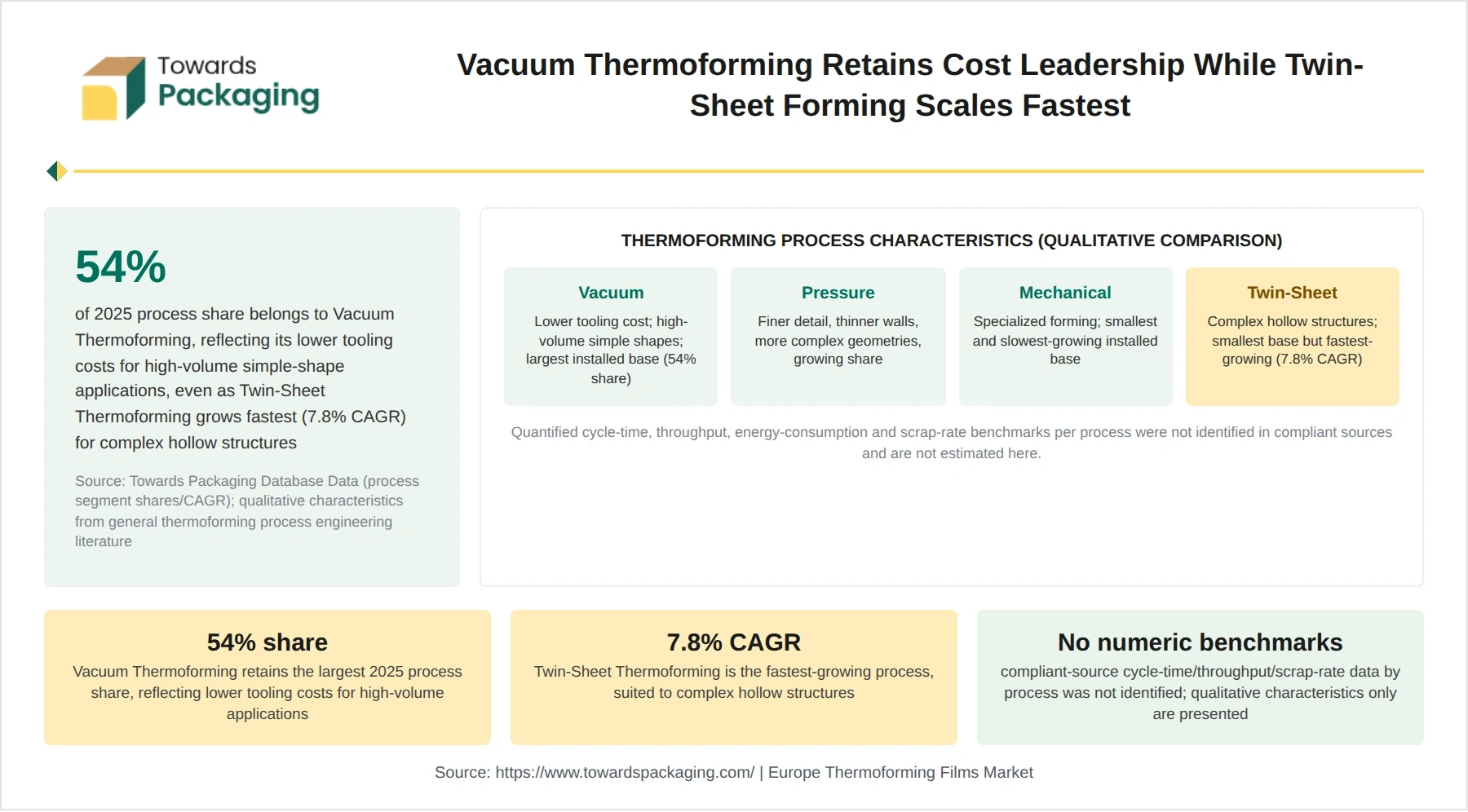
Vacuum thermoforming leads with a 54% share in 2025. Factors like fast production cycles, rise in automated food processing, high uptake of single-use medical trays, and low tooling cost help in maintaining the lead. Vacuum thermoforming supports high-volume, simple-shape applications. Twin-sheet thermoforming scales fastest with 7.8% CAGR. Factors like a focus on cutting vehicle weight, cheaper tooling investment, and high structural rigidity drive the growth. Twin-sheet thermoforming is used to design integrated hollow structures. Pressure thermoforming's share is growing, and it is used to create more complex geometries. Mechanical thermoforming held the smallest share and offers dimensional precision & high mechanical strength.
Source: Towards Packaging Database Data (process segment shares/CAGR); qualitative characteristics from general thermoforming process engineering literature
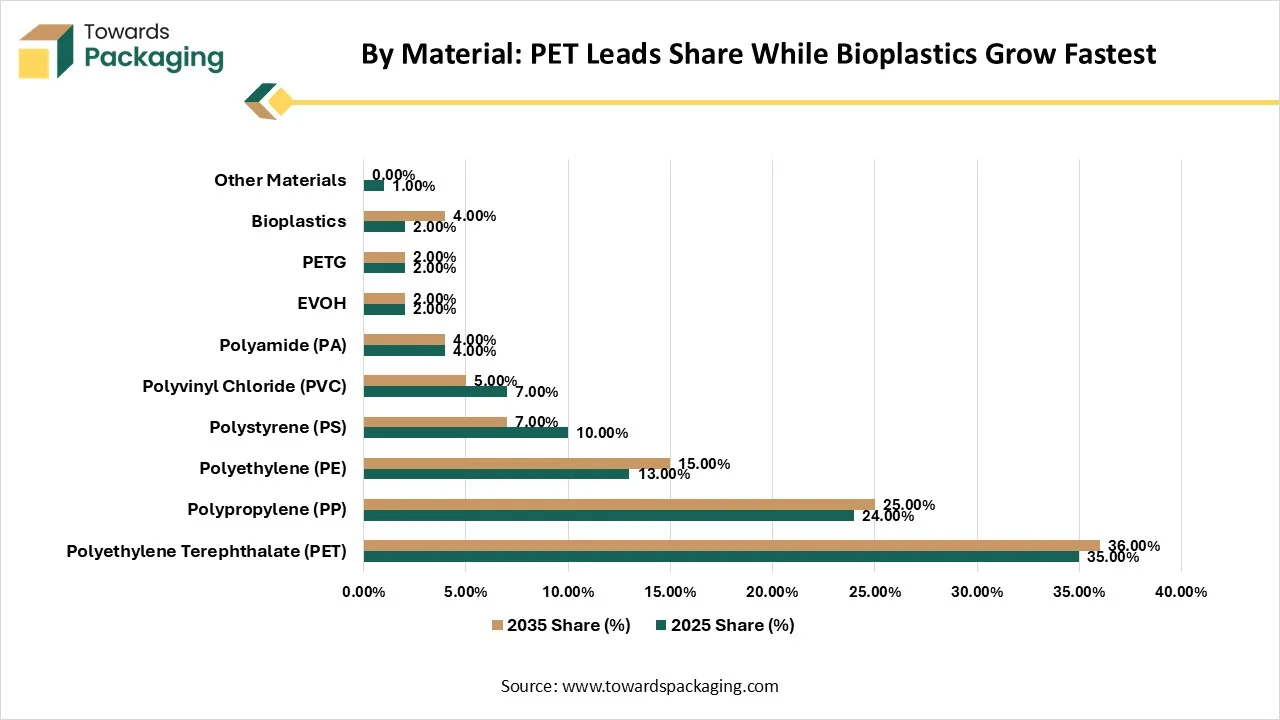
Polyethylene terephthalate (PET) dominated the Europe thermoforming films market with a 35% share in 2025. The heavy personal care manufacturing hubs and high material recyclability mandates increase the use of PET. The high mechanical quality, strong barrier performance, and superior process stability of PET drive the growth. Polypropylene (PP) held a 24% share in the market in 2025. The medical product shelf life extension and demand for stable processing increase the use of PP. The mono-material design, lightweight efficiency, and high heat resistance of PP support the market growth. Bioplastics are expected to grow with the fastest CAGR of 11.5% during the forecast period. The big shops are transitioning to renewable packaging, and the high cost of imported oil plastics increases the use of bioplastics. The exceptional puncture resistance, low distribution cost, and better technology in bioplastics boost the overall growth.
Source: Towards Packaging Database
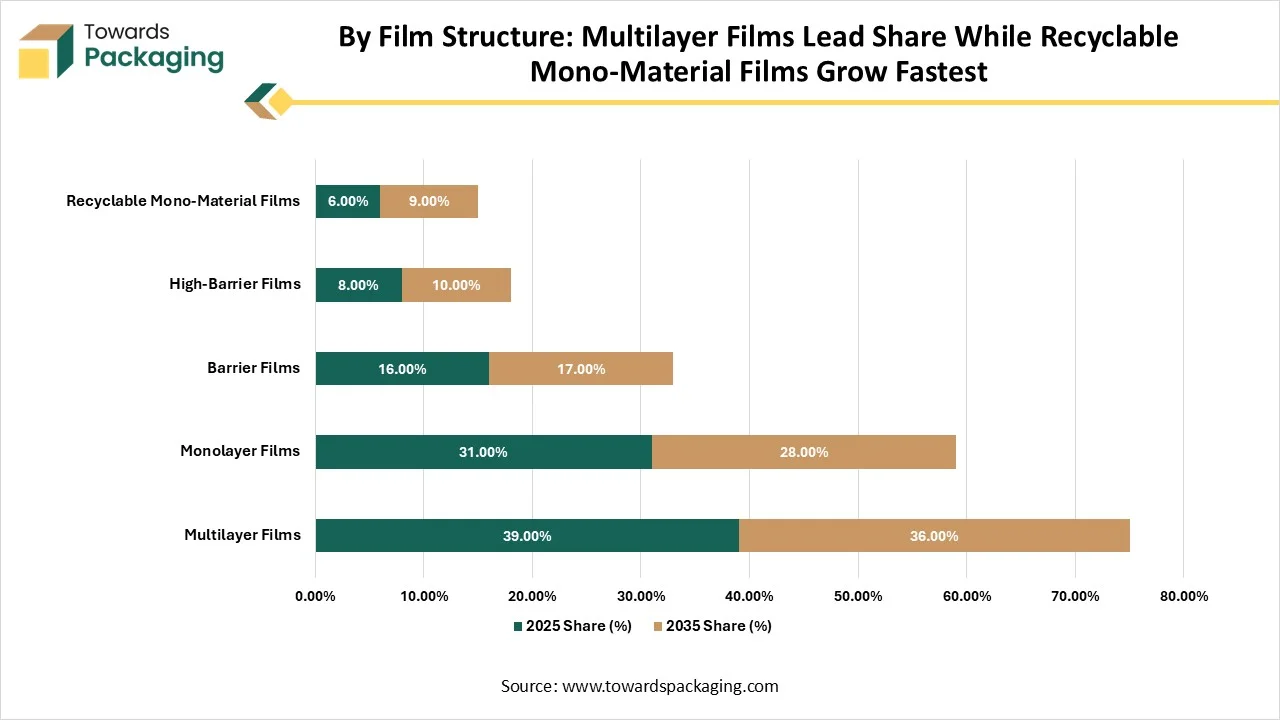
Multilayer films dominated the Europe thermoforming films industry with a 39% share in 2025. Multilayer films are compatible with large industrial thermoforming packaging helps with expansion. The growing specialized polymer blending and focus on maintaining puncture resistance increase the use of multilayer films. Monolayer films held a 31% share in the market in 2025. The rise in skin packaging and circular-economy integration increases the use of monolayer films. The streamlined recycling, cost savings, and shelf-life maintenance in monolayer films boost the growth. Recyclable mono-material films are expected to grow at the fastest 8.6% CAGR during the forecast period. The focus on avoiding hard-to-recycle materials and transitioning to single-polymer design increases the adoption of recyclable mono-material films. Its compatibility with standard sorting systems, better formability, and seamless processing support the overall growth.
Source: Towards Packaging Database
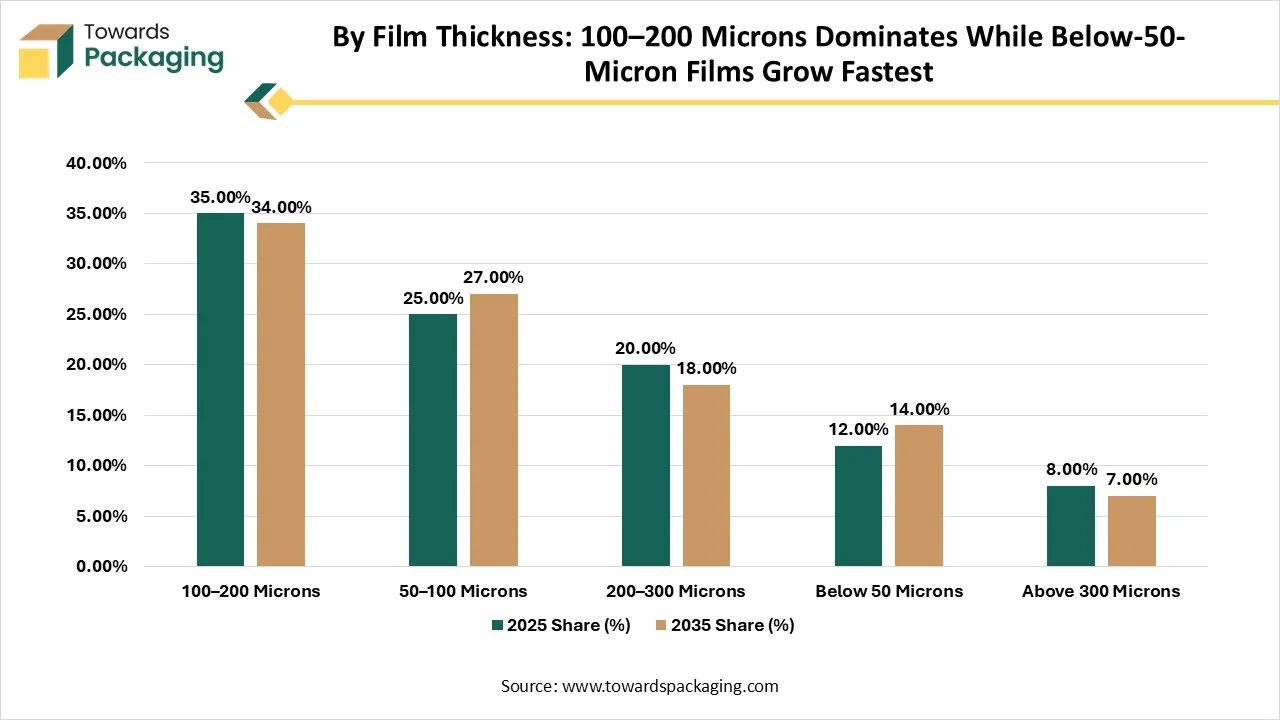
100-200 microns dominated the Europe thermoforming films industry with a 35% share in 2025. Surging cheese packaging and a focus on optimizing resin consumption are increasing the use of 100-200 microns. The rise in heavy-duty food trays and the production of containers increase the use of 100-200 microns. The deep-draw capability and excellent mechanical performance of 100-200 microns support the growth. 50-100 microns held a 25% share in 2025. The move away from rigid sheets and the need to keep dairy fresh increase the use of 50-100 microns. The minimized transport weight, strong shelf-life performance, and lightweighting of 50-100 microns support the growth. Below 50 microns is expected to grow with the fastest CAGR of 6% during the forecast period. The high use of non-recyclable formats and surging modern metallocene resin increases use of below 50 microns. The focus on maintaining packaging barrier performance and minimization of pallet sizes increases adoption of below 50 microns, boosting the growth.
Source: Towards Packaging Database
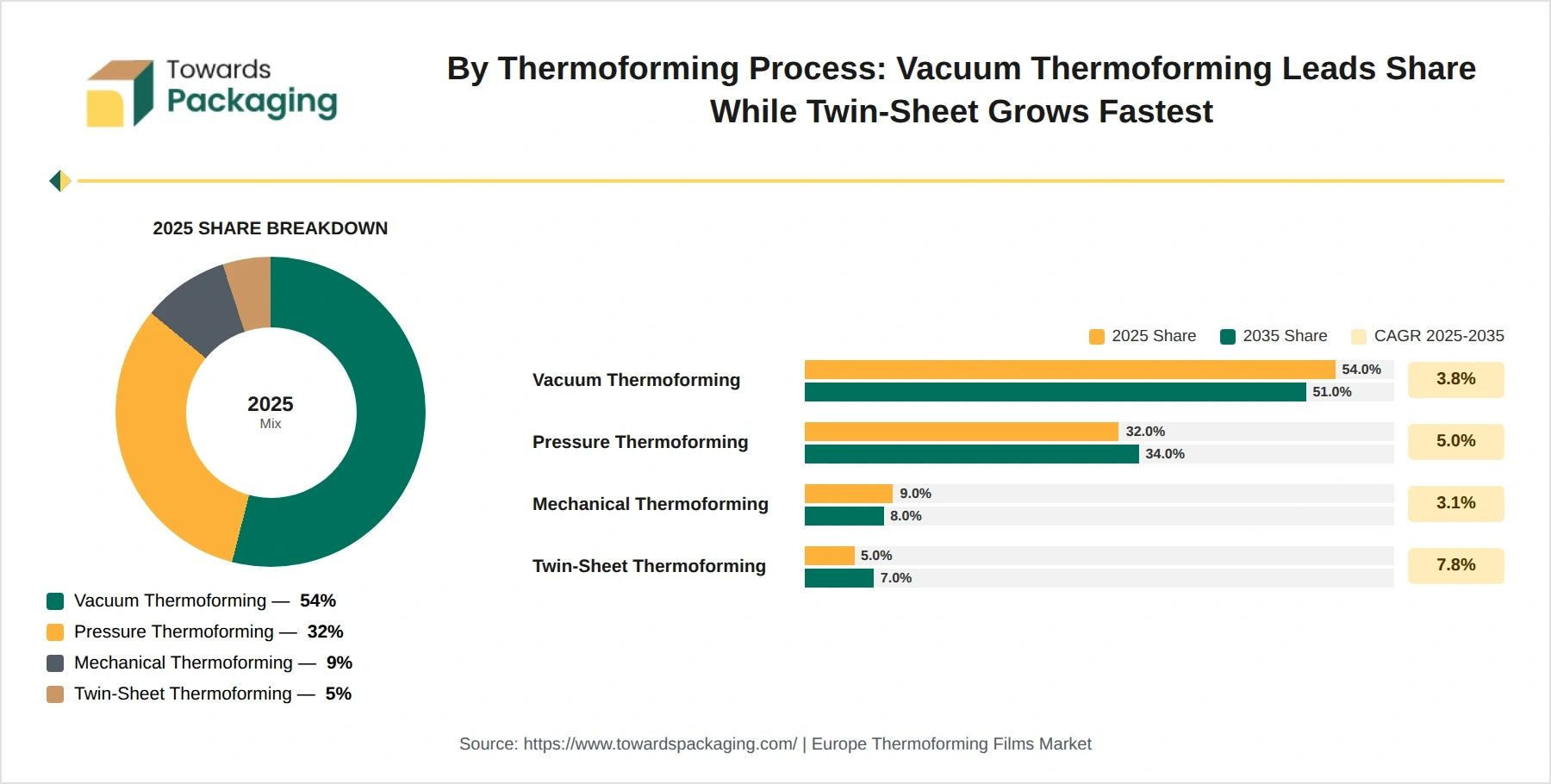
Vacuum thermoforming dominated the Europe thermoforming films sector with a 54% share in 2025. The interest in contaminant-resistant packaging across the beverage industry and seamless incorporation with MAP systems increases the use of vacuum thermoforming. The manufacturing of lightweight automotive parts and high-volume manufacturing across end-use sectors supports the overall growth. Pressure thermoforming held a 32% share in the market in 2025. The manufacturing of sterile cleanroom packaging and the need for high-end electronic housing increase the use of pressure thermoforming. The complex textures, compatibility with recyclable polymer films, and cost-efficient tooling in pressure thermoforming boost the overall growth. Twin-sheet thermoforming is expected to grow with the fastest CAGR of 7.8% during the forecast period. Surging bio-based polymer sheets and the focus on avoiding secondary assembly steps increase the use of twin-sheet thermoforming. The high design flexibility, high fuel efficiency, and exceptional sound insulation of twin-sheet thermoforming drive the overall growth.
Source: Towards Packaging Database
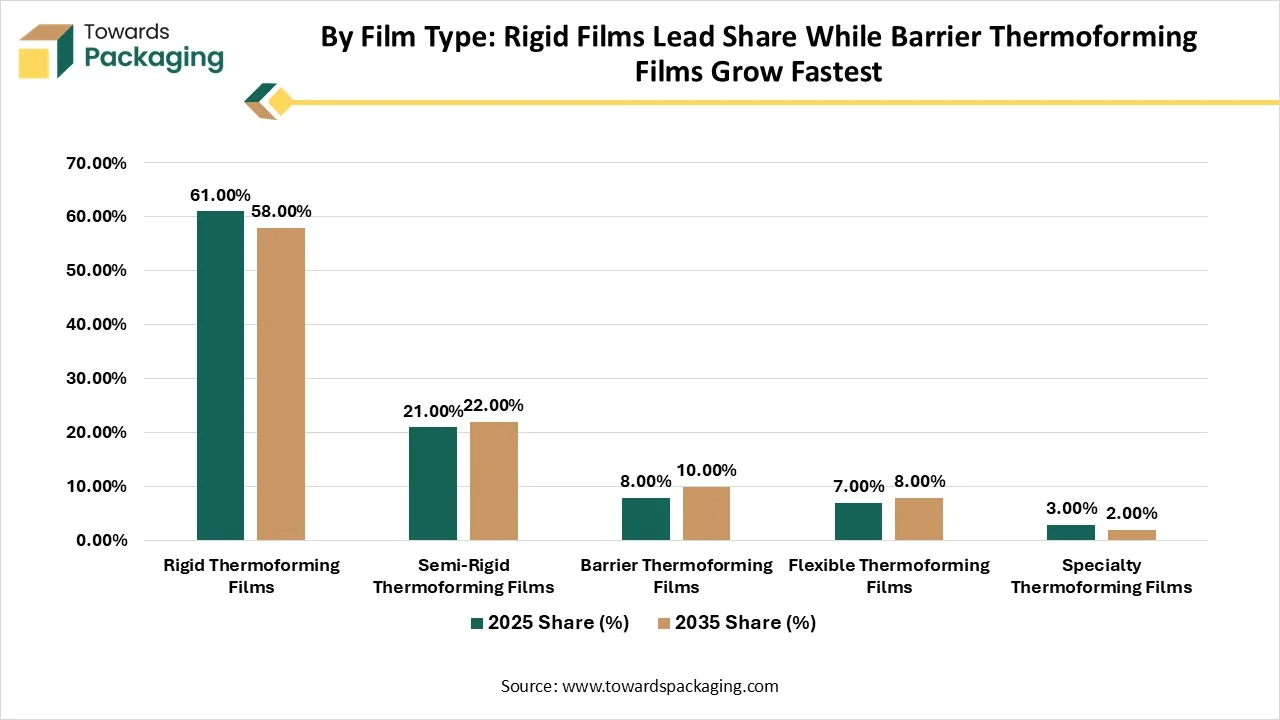
Rigid thermoforming films dominated the Europe thermoforming films industry with a 61% share in 2025. The preference for tamper-evident packaging in dairy sectors and the need for high-barrier protection in medical devices increase the use of rigid thermoforming films. The massive processed meat sector and long-distance logistics increase adoption of rigid thermoforming films. Semi-rigid thermoforming films held a 21% share in the market in 2025. The interest in modified atmosphere packaging for protecting perishable foods and the need to enhance supermarket presentation increase the use of semi-rigid thermoforming films. The optimized scrap production and the need to cut eco-modulation fees increase the use of semi-rigid thermoforming films. Barrier thermoforming films are expected to grow with the fastest CAGR of 6.8% during the forecast period. The focus on keeping food fresh for a long time and the prevention of food contamination increases the use of barrier thermoforming films. The expansion of the European medical devices industry and the elimination of rigid containers support the overall growth.
Source: Towards Packaging Database
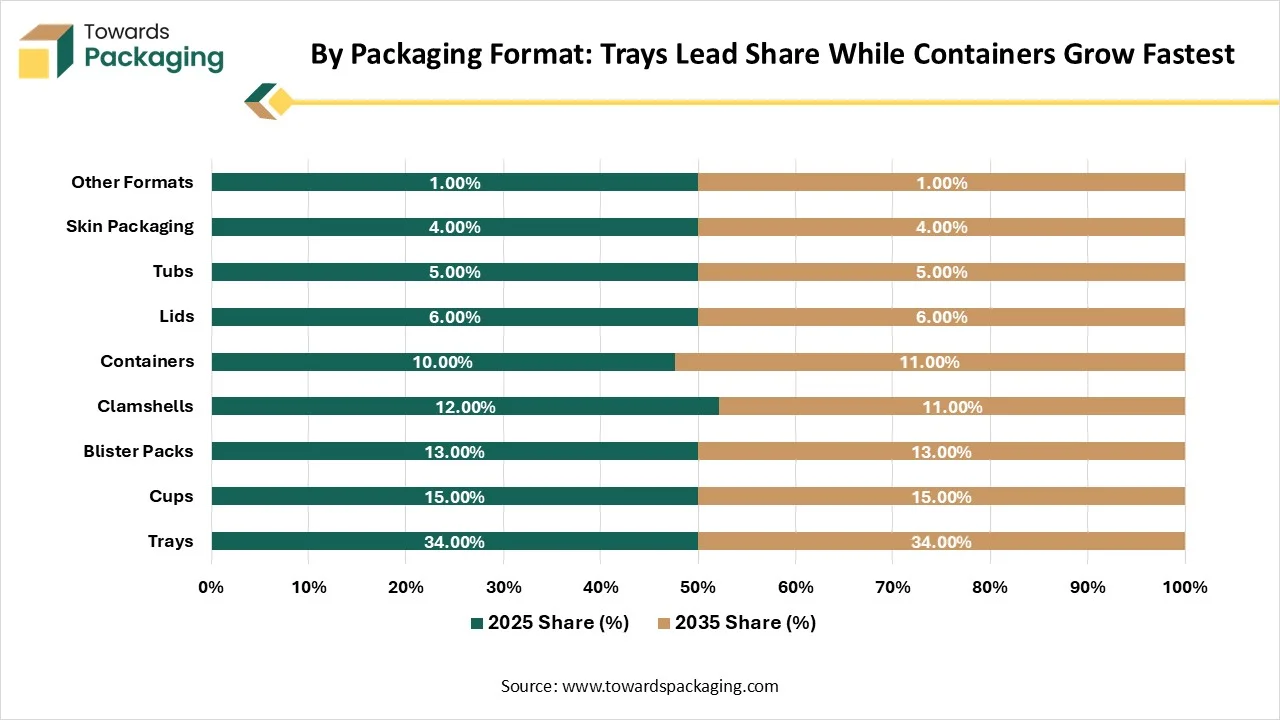
Trays dominated the Europe thermoforming films industry with a 34% share in 2025. The focus on maintaining the safety of ready meals and consumer preference for pre-packaged products increases the use of trays. The focus on surgical kit safety and the interest in stackable aesthetic presentation increase adoption of trays. Cups held a 15% share in the market in 2025. The expanding fast-casual food culture and the need for multilayer coatings in liquid foods increase use of cups. The burgeoning cafe culture and high production of chilled foods increase cup use. Containers are expected to grow at the fastest CAGR of 5.4% during the forecast period. Surging chilled meals and the focus on sealing fresh meat increase use of containers. The rise in e-commerce grocery shopping and the explosion of unit-dose pharmaceuticals increase container use.
Source: Towards Packaging Database
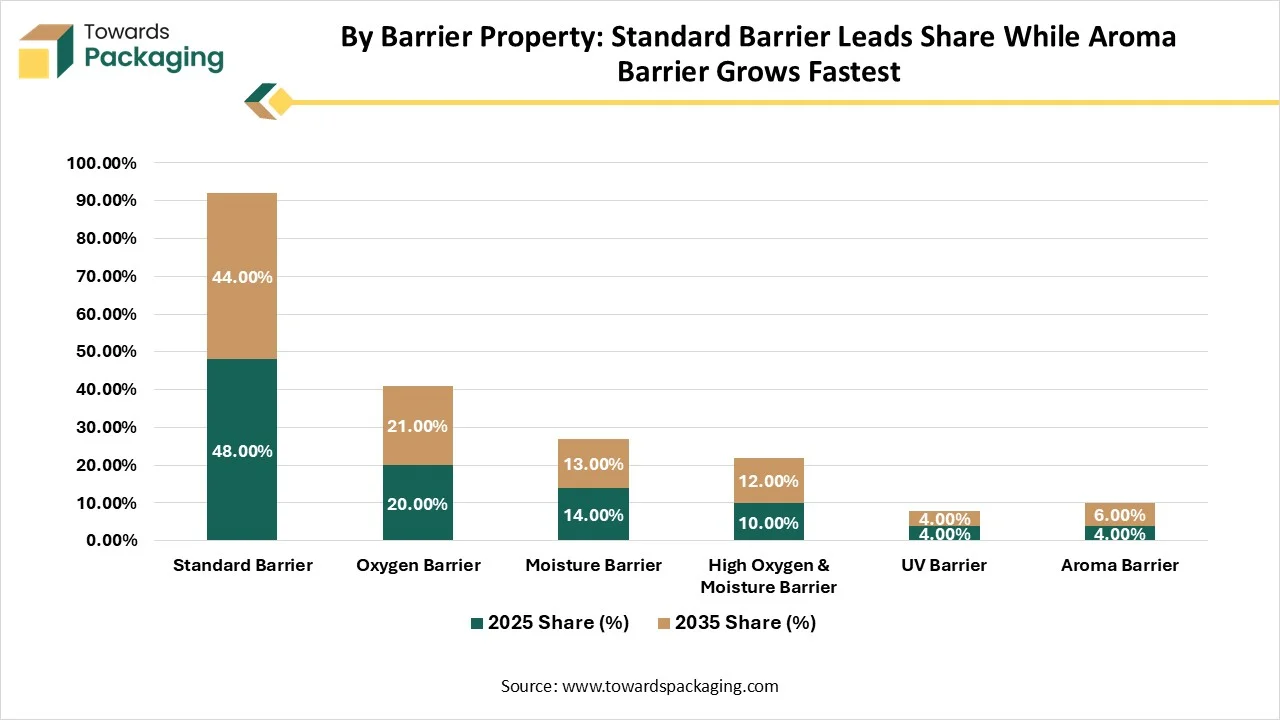
Standard barrier dominated the Europe thermoforming films industry with a 48% share in 2025. The expansion of European retail goods and the rise in general consumer goods increase the use of standard barrier. The short distribution cycles, balanced performance, and widespread utility of standard barrier drive the growth. Oxygen barrier held a 20% share in the market in 2025. The consumer demand for minimally processed foods and reducing flavor loss of food increases the use of oxygen barrier. The laws in pharmaceutical packaging and reduced spoilage of sensitive food increase the adoption of oxygen barrier. Aroma barrier is expected to grow with the fastest CAGR of 8.6% during the forecast period. Surging packaged meats and maintaining food product stability increase the use of aroma barrier. Thriving prepared meal kits and demand for premium fresh meats increase the use of aroma barrier, boosting the overall growth.
Source: Towards Packaging Database
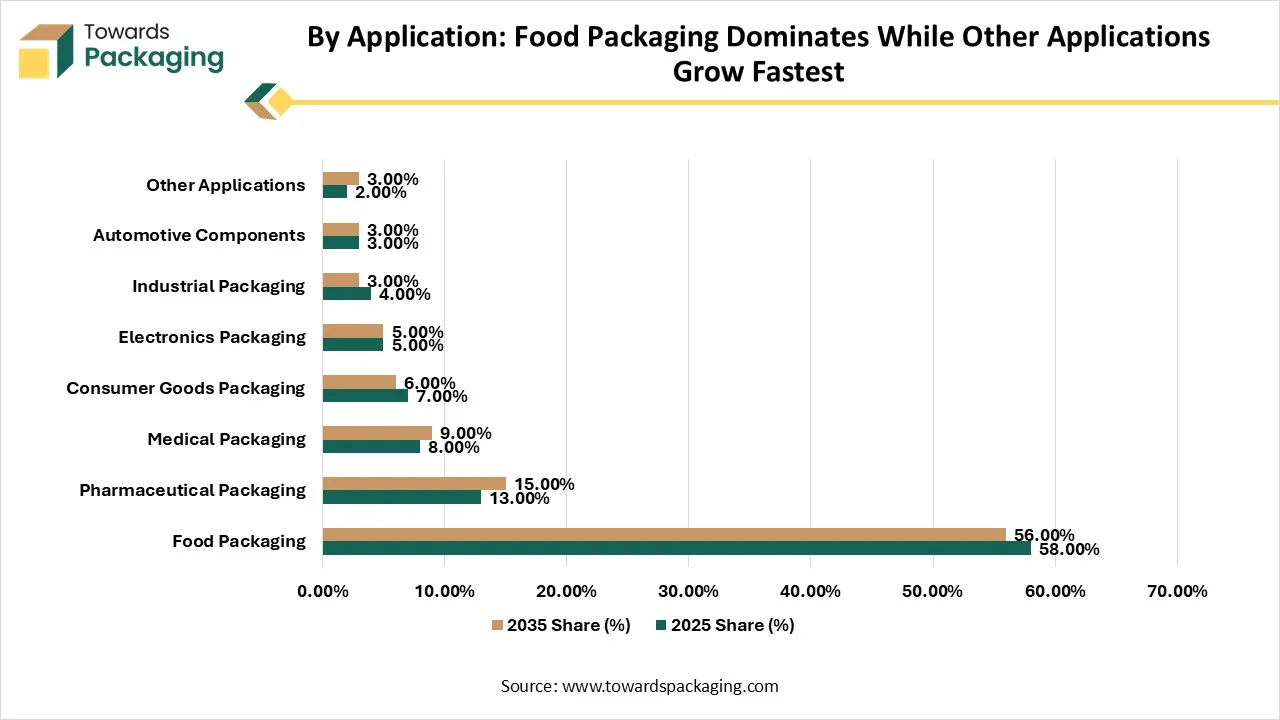
Food packaging leads the Europe thermoforming films industry with a 58% share in 2025. The shelf-life extension of fresh proteins and food brands' focus on cutting material use increases the adoption of thermoforming films. The preference for ready-to-cook foods and locking out external odors in foods increases the use of thermoforming films. Pharmaceutical packaging held a 13% share in the market in 2025. The high use of thermoformed blister formats in medicines helps with expansion. The availability of moisture-sensitive medications and high pharmaceutical consumption among the elderly boost the overall growth. Other applications are expected to grow with the fastest CAGR of 8.5% during the forecast period. Car manufacturers focus on cutting waste electronics protection increases use of thermoformed plastic sheets and custom thermoformed casings. The focus on securing non-retail goods and industrial lightweighting increases the use of thermoformed films.
Source: Towards Packaging Database
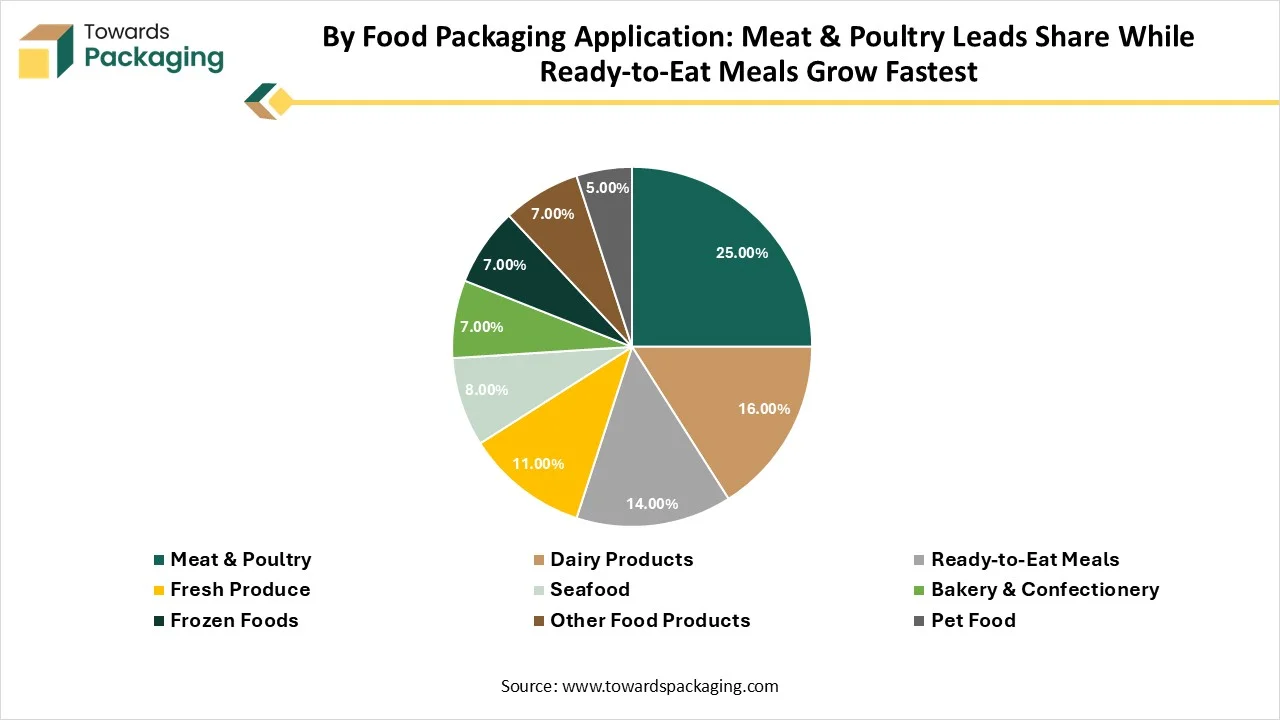
Meat & Poultry dominated the Europe thermoforming films industry with a 25% share in 2025. The long distribution cycles of meat products and increased inspection of meat quality increase the use of thermoforming films. Safety regulations in the poultry industry and the availability of fresh-cut meats in retail drive the growth. Dairy products held a 16% market share in 2025. The consumption of snack-sized dairy products and growth in perishable dairy items increase the use of thermoforming films. The high production of chilled dairy and the rise in sliced cheese products support the growth. Pet food is expected to grow with the highest CAGR of 6.5% during the forecast period. The demand for organic wet food for pets and the presence of perishable ingredients in pet food increase the use of thermoforming films. The surge in single-serve pet food and premium raw pet diets boosts the overall growth.
Source: Towards Packaging Database
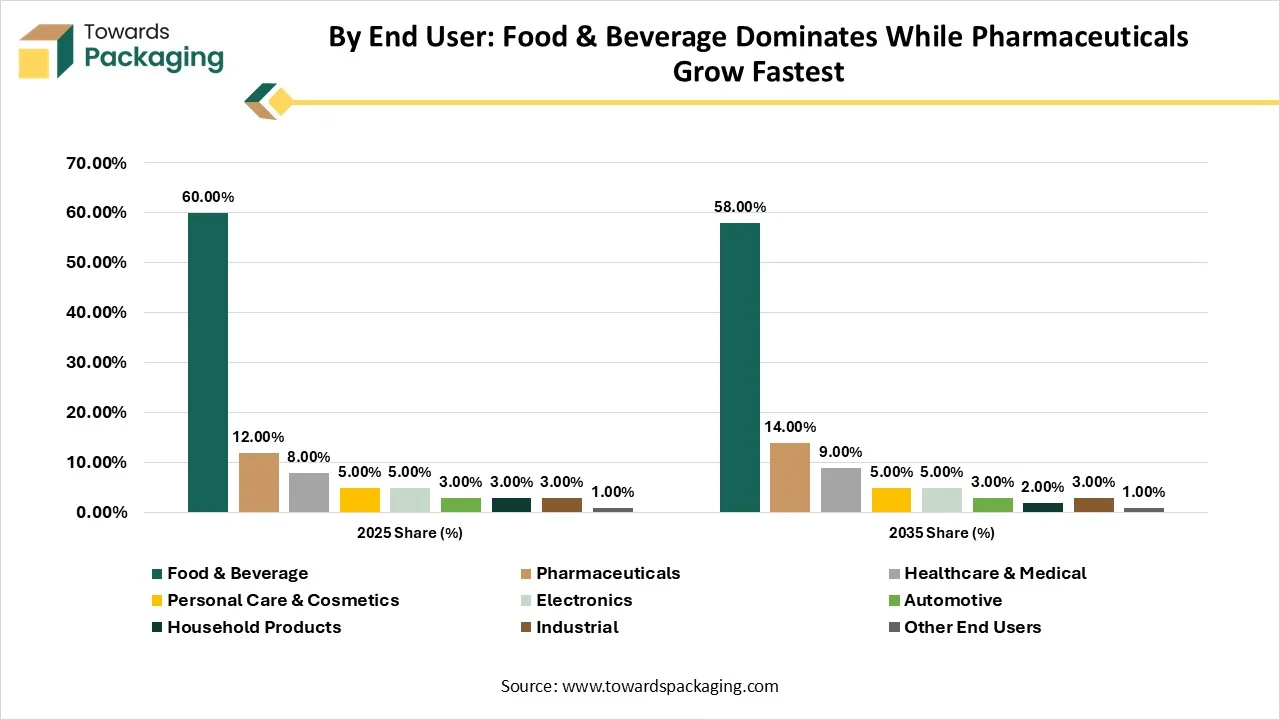
Food & Beverage dominated the Europe thermoforming films market with a 60% share in 2025. The focus on preventing the entry of airborne pathogens into food products and the preference for portion-controlled food increase the use of thermoforming packaging. The rise of pre-packaged meals in France & other countries and massive seafood production drive the growth. Pharmaceuticals are expected to grow with the fastest CAGR of 6% in the market during the forecast period. The major utilization of pharmaceutical blister packaging helps with expansion. The complex medication formulations and sensitive pharmaceutical production support the growth. Healthcare & medical held an 8% share in the market in 2025. Healthcare industry demand for preventing hospital-based infections and the preference for pre-packaged medical kits increase the use of thermoforming films. The high volume of chronic care and demand for home-health devices boost the overall growth.
Source: Towards Packaging Database
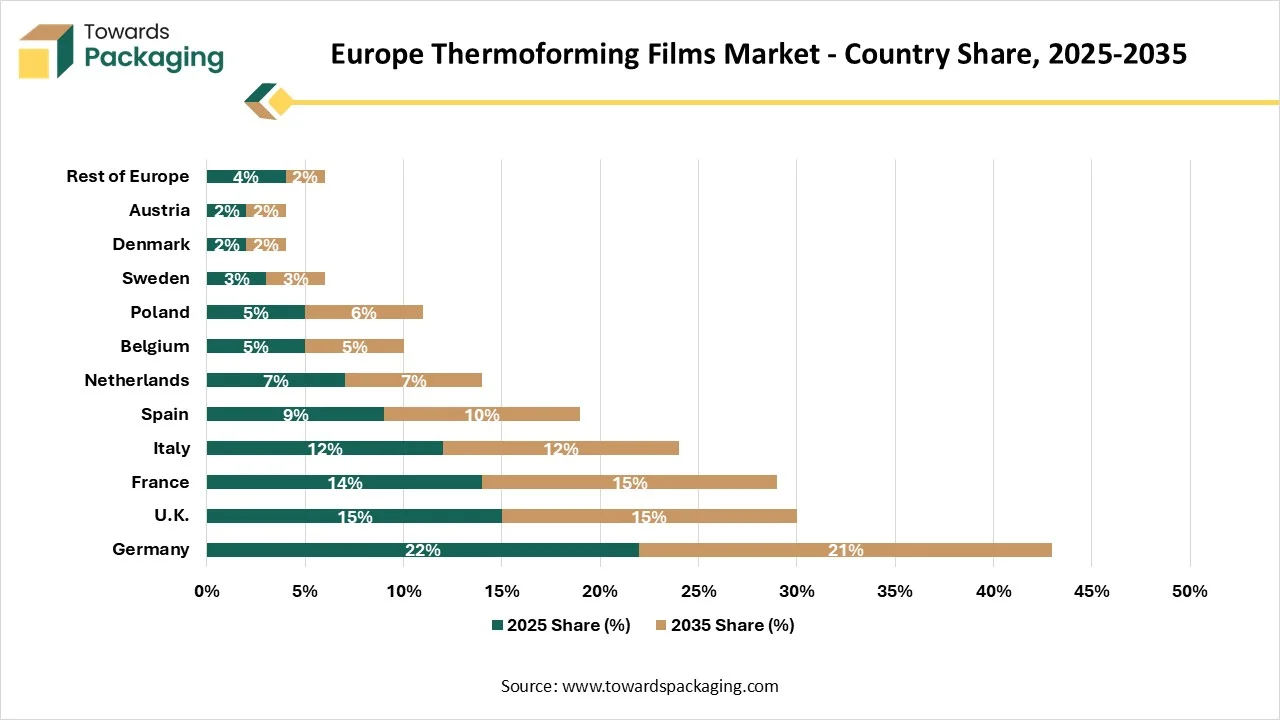
Germany dominated the Europe thermoforming films market with a 22% share in 2025. The largest food processing ecosystem and the adoption of smart factories increase demand for thermoforming films. German converters are transitioning to recyclable films due to EU regulations, and core distribution hubs are increasing production of thermoforming films. The rise in hygienic food packaging drives the overall growth.
The U.K. held the second-largest share of 15% in the market in 2025. Urban consumers' dependence on food products like ready meals and regulations like the UK Plastic Packaging Tax increase production of thermoforming packaging. The surge in D2C grocery distribution and the focus on medical device security increase the use of thermoforming films. The surging demand for vacuum-skin packaging boosts growth.
France held the third-largest share of 14% in the market in 2025. Retailers focus on keeping fresh produce safe, and stringent EU compliance increases production of thermoforming films. The demand for high-integrity medical packs and the use of damage-resistant packaging increase adoption of thermoforming films. The growing demand for injection molding alternatives drives the market growth.
Italy held a 12% market share in 2025. The robust safety requirements in the medical industry and local recycling ecosystem increase the production of thermoforming films. The advanced packaging machinery industry and food export industry increase the use of thermoforming films. The increased downgauging investment boosts the overall growth.
Spain held a % share in the market in 2025. The high rate of meat consumption and pharmaceutical manufacturing hub increases the use of thermoforming films. Local plastic taxes and the use of advanced co-extrusion increase the adoption of thermoforming films. Convenience food trends and technological advancements support the overall growth.
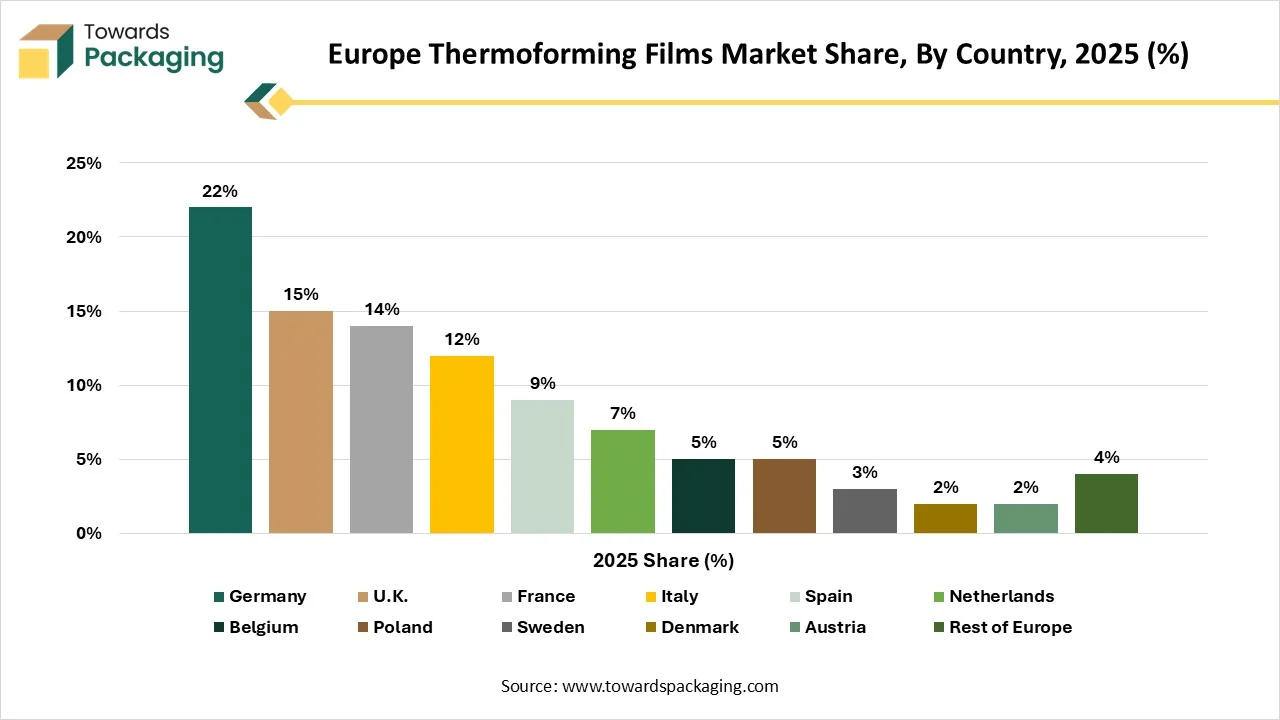
Germany held the highest share of 22% in the market due to the growing pharmaceutical cold-chain industry, retail scaling, and incorporation of precision machinery. United Kingdom held a 15% share in the market due to high sales in online retail and strong supermarket supply chains. France held a 14% share in the market due to the incorporation of AGEC regulation, thermoforming material innovation, and the production of fresh produce trays. Italy held a 12% share in the market due to the massive base of the specialty pasta sector, high machinery expertise, and online grocery growth. Spain held a 9% share in the market due to top exports of meat, sustainability frameworks, and strong packaging converters infrastructure.
Source: Towards Packaging Database
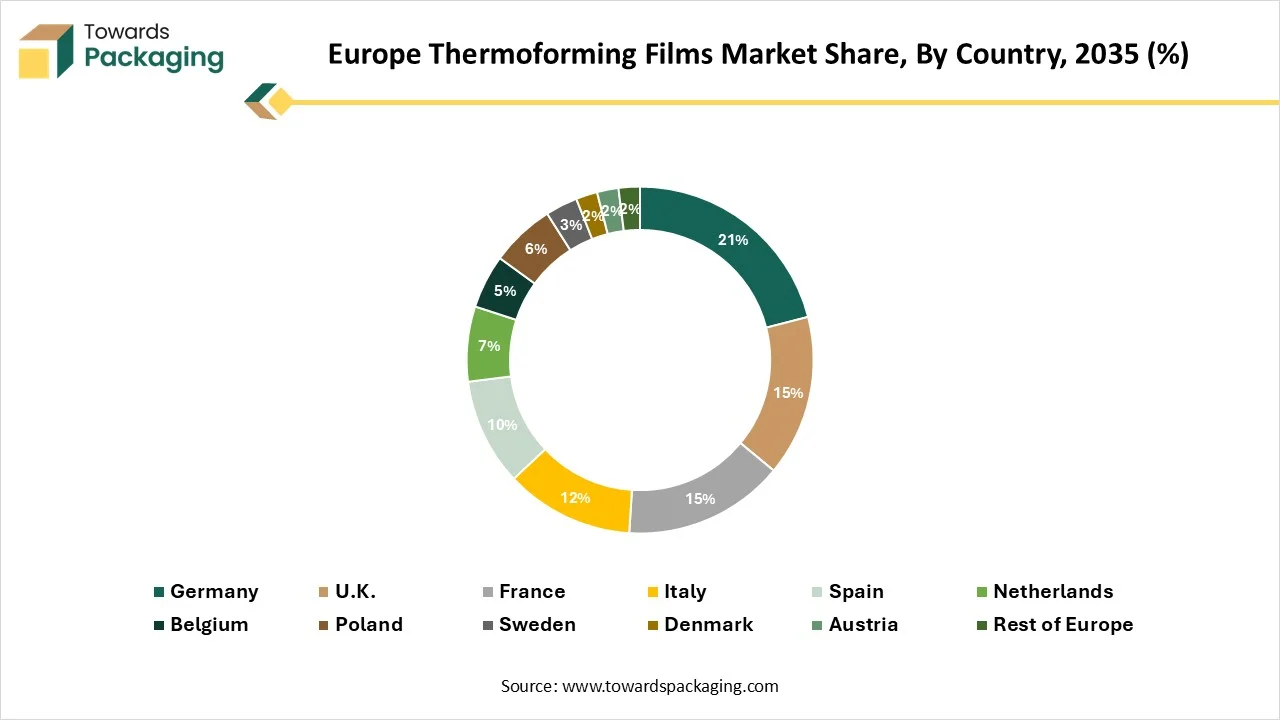
Germany is predicted to reach a 21% share in the market by 2035 due to the presence of advanced thermoforming systems and a large medical device sector. United Kingdom is predicted to reach a 15% share by 2035 due to innovations in sustainable thermoforming films, sterile pharma demand, and logistics growth. France is predicted to reach a 15% share by 2035 due to the focus on beverage product safety and robust healthcare manufacturing. Italy is predicted to reach a 12% share by 2035 due to huge production in the specialized food industry and the development of single-use medical packaging. Spain is predicted to reach a 10% share by 2035 due to strong poultry export performance, cosmetics manufacturer clusters, and regulations like Spanish national taxes.
Source: Towards Packaging Database
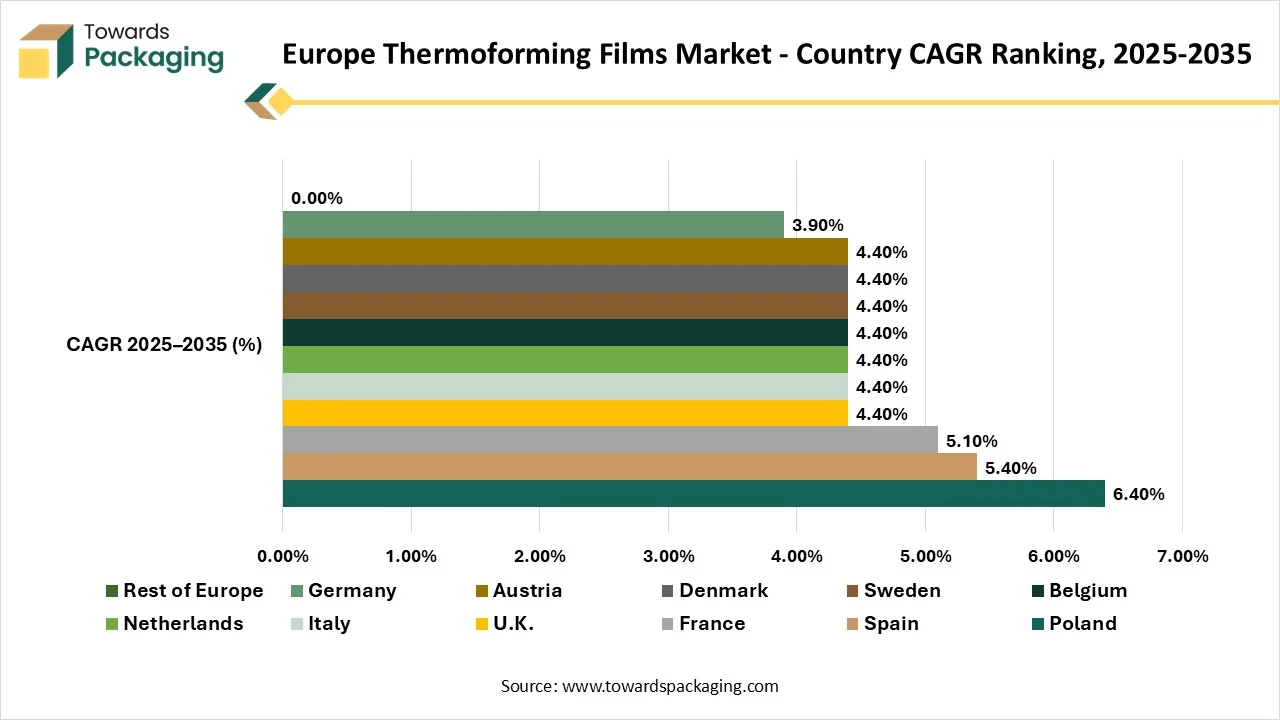
Poland is expected to grow with the fastest CAGR of 6.4% during the forecast period due to a large agricultural processing hub, use of automated thermoforming machinery, and focus on recyclable thermoformed structures. Spain is expected to grow with a CAGR of 5.4% during the forecast period due to high exports in areas like Cataluna, scaling cosmetic packaging, and upgrades in production infrastructure. France is expected to grow with a CAGR of 5.1% during the forecast period, driven by demand for medical sterile trays and a focus on better polymer designs. United Kingdom is expected to grow with a 4.4% CAGR during the forecast period due to online shopping penetration and the preference for fresh-sealed protein items. Italy is expected to grow with a 4.4% CAGR during the forecast period, driven by the rise in the specialty cheese industry, blister packaging growth, and advanced Italian packaging machinery.
Source: Towards Packaging Database
According to my research Europe thermoforming films market is growing at a notable rate due to circular economy goals, high pharmaceutical demand, lightweighting requirements, logistics efficiency, and food shelf-life expansion. Germany holds a dominant share in the market in 2025, and Poland is growing with the fastest CAGR across European countries. Tier 1 companies like Berry Global, Amcor plc, and Sealed Air Corporation supported the growth. Regional players like Klockner Pentaplast, Mondi Group, and Coveris are major contributors to the market.
Vidyesh Swar researches the current market size, country-wise shares, segmental shares, market forecasted size, and market CAGR.
Aman worked on recent developments, vacuum thermoforming costs, recyclable mono-material films, plastic resin prices, ASTM standards, EU PPWR regulations, and key companies.
Aditi performed quality analysis, corrected document errors, maintained consistency, identified inconsistencies, and made the document ready for publication.
By Material
By Film Structure
By Film Thickness
By Thermoforming Process
By Film Type
By Packaging Format
By Barrier Property
By Application
By Food Packaging Application
By End User
By Country





























Principal Research Analyst
Vidyesh Swar is a Senior Research Analyst at Towards Packaging, bringing over 4 years of dedicated expertise in market intelligence and strategic analysis across the dynamic world of packaging technologies and solutions.
Learn more about Vidyesh Swar

Reviewed By
Aditi Shivarkar, with 14+ years in packaging market research, specializes in food, beverage, and eco-friendly packaging. She ensures accurate, actionable insights, driving Towards Packaging Analytics & Consulting 's excellence in industry trends and sustainability.
Learn more about Aditi Shivarkar


Europe Thermoforming Films Market
 Table of Content

 Download Sample
 Schedule a Meeting