


The lidless closures for personal care market is projected to grow from USD 1.33 billion in 2026 to USD 2.28 billion by 2035, registering a CAGR of 6.2% during the forecast period. This report provides comprehensive insights including detailed market size data, segment-wise analysis, and regional performance across major geographies. It further covers key company profiles, competitive landscape, value chain analysis, trade data, and extensive information on manufacturers and suppliers, offering a complete view of industry dynamics driven by increasing demand for hygiene, convenience, and sustainable packaging.
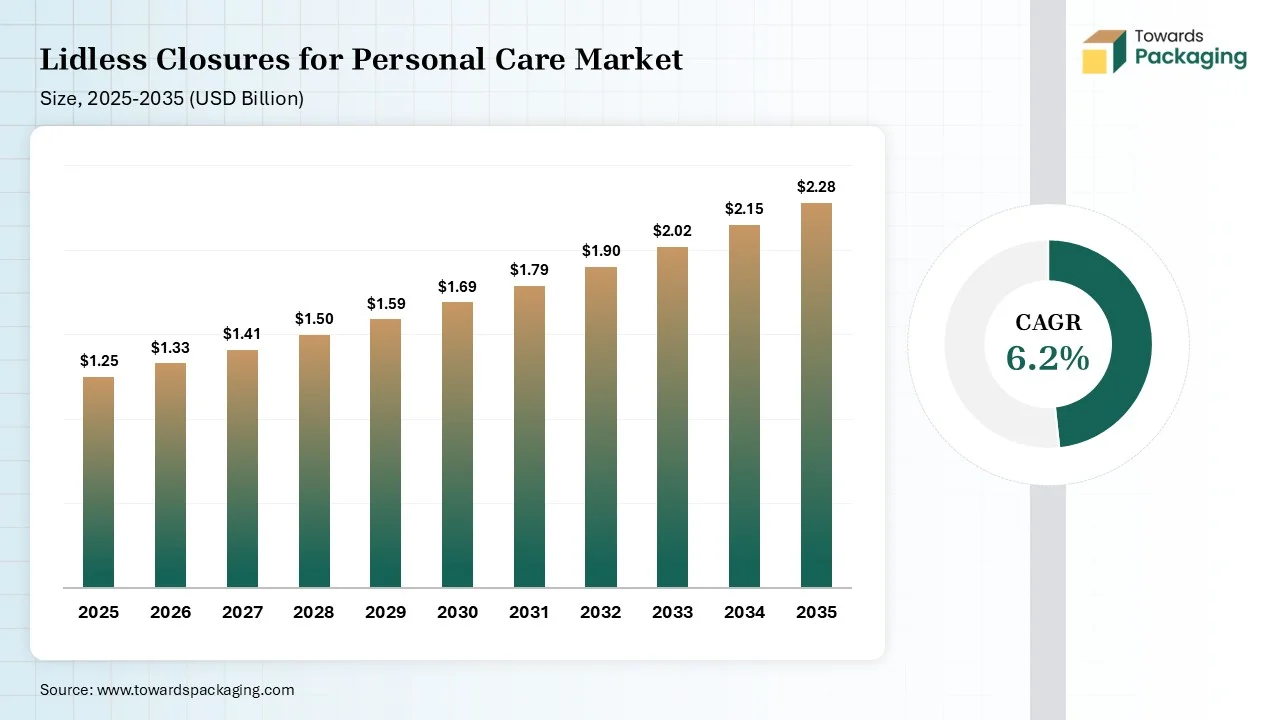
Market Size (2025): USD 1.25 Billion
CAGR (2025–2035): 6.2%
Market Volume (2025): 45.0 Billion Units
Volume CAGR (2025–2035): 5.5%
Lidless closures for personal care are high-level, inverted dispensing machines that avoid the demand for removable caps, separate or flip-top lids. Such closures are crafted to settle upside down on the bottles, which delivers “always-ready” status for single-handed dispensing. They usually have a self-sealing valve which opens under pressure when they are squeezed and automatically adjusts for closures when released, delivering controlled, clean, and hygienic dispensing.
Generative AI displays the further evolution in delivering real-time, personalized beauty experiences that link deeply with users. It goes far from actual personalization, which crosses boundaries by storing content in the latest advancements. Current personalization includes several data factors, which include lifestyle factors, skin analysis, personal choices, and environmental conditions. Such an overall strategy makes tailored beauty regimens that accept updating scenarios and demands.
Additionally, artificial intelligence develops product development by expecting ingredient communication, reducing the demand for huge physical testing, and improving stability. This potential allows faster time-to-industry while developing formulation success.
Aptar’s Group has discovered lidless simply squeezing closures, which have currently stretched from pet care into beauty and personal care, hair care, and home care. This implements the importance of invention in dispersing packaging and convenience as an opportunity to serve medicine delivery systems.
Currently, the packaging that is utilized by several cosmetic brands depends excessively on virgin resources, mined metals, and fossil-fuel-derived plastics. The manufacturing of such materials is not only energy-intensive but also includes resource depletion, carbon emissions, and habitat loss. When recycling is done properly, it mainly lowers the impact.
Cosmetic warehousing differs mainly from generic FMCG storage because of different needs that urge tailored management. Beauty products highlight unique high SKU counts per share, strong expiration dating principles, and zero tolerance for pollutants, which directly affect inventory management.
The polypropylene (PP) segment dominated the lidless closures for personal care market with a 52% share in 2025, as they are well-known for their mechanical power and thermal resistance, which makes them perfect for airless packaging systems, cream jars, and serum pumps. Its popularity in terms of high-end skincare has developed in recent years, which has specifically resulted in airless technology that protects fragile ingredients. They are utilized in high-accuracy parts such as closures, pumps, and airless containers.
The polyethylene (PE) segment held 23% of market share in 2025 because they are one of the most widely used materials for personal care and cosmetics packaging because of its lightweight nature, clarity, and recyclability. Such precise, clear looks display the product from inside, which are perfect for luxury or colorful formulations. In the case of durability, the lightweight nature of these materials is strong. They are conveniently recyclable, which makes them an environmentally friendly choice.
The PET segment held 15% of the market share in 2025 because these bottles are convenient to classify. Polyethylene terephthalate (PET) is usually clear in nature and excessively glossy, which shows off the texture and color of the formula present inside. PET is widely utilized in this industry due to its cost, power, and appearance. Several shampoo PET bottles are crafted for brands that need to feature ingredients such as pearly formulas and botanical extracts.
The flip-top lidless snap closures segment dominated the lidless closures for personal care market with 40% share in 2025, as they are also known as flip-top caps or flip-flap caps, which are a kind of plastic closure that is utilized for bottles and containers. They are known as “flip-top” closures due to the layout that can be conveniently closed and opened by snapping and flipping them quietly. They are applied for packaging and a huge range of products, from food products to liquids to personal care items.
The disc top closures segment held 25% of the market share in 2025, as glossy disc top caps that have effective functioning can create a great packaging product for any skincare products. One can utilize disc top caps for skincare purposes of lotions, serums, sunscreen, face wash, and exfoliants. The cap enables convenient dispensing and one-handed closure availability to avoid disturbance. With a perfect high-effect resistance and moisture barrier, the disc top caps for skincare are reliable and a perfect choice for a developed shelf life of products.
The pump-integrated lidless closures segment held 20% of the market share in 2025, as pump-integrated lidless closures are used for packaging machines that integrate a liquid dispensing system, which are directly present with a self-sealing office, active, and avoiding the demand for a flip-top, separate lid or a protective overlap. Such mechanisms are excessively used in the personal care, beauty, and home care industry to serve single-handed and mess-free dispensing.
The hair care segment dominated the lidless closures for personal care market with a 35% share in 2025, as development is present inside the caps and closures of shampoo bottle containers. Non-drip valves, lockable pumps, and tamper-evident closures deliver convenience and safety. Inventions such as airless pump bottles and twin chamber bottles are enabling products in one container, which protects against infection, and are receiving attention. Such advanced-level technology solutions are crucially being valued in top-rated haircare, which focuses on product purity and reliability.
The skin care segment held the market with 28% share in 2025 because dropper pipettes are conveniently classified by their respective rubber bulb and a narrow tube. Adjusting a bulb makes a vacuum that captures liquid into the tube, which releases it in liquid format in terms of drops. Such products include hyaluronic acid serums, vitamin C and facial oils, diagnosis concentrates, and scalp treatments. Dropper pipettes lower the direct link with the product, which lowers the risk of pollution from fingers and remaining links. This type of closure is frequently linked with advanced-end skincare products, which adds a place of luxury and sophistication.
The cosmetics segment held the market with 18% share in 2025, as colored glass bottles in blue, amber, matte black, or green are not just aesthetically satisfying, but they are operationally adaptive for photosensitive contents. UV light impairs active content such as vitamin C, retinol, natural extracts, and peptides within a few weeks. Colored glass filters toxic wavelengths while enabling us to track product clarity for quality control.
The direct OEM/B2B sales segment dominated the lidless closures for personal care market with 55% share in 2025 because the personal care packaging industry depends excessively on invention. Lotions, shampoos, serums, and creams need closure that is both aesthetically attractive and functional. The feel and touch of a closure frequently affect how users perceive the product's overall quality. Producers in this category are increasingly shifting to recyclable materials and tailored closure which are constructed to appeal to eco-friendly conscious buyers.
The packaging converters & suppliers segment held 30% of the market share in 2025 because industry suppliers are increasingly utilizing post-consumer recycled (PCR) resins and creating recyclable closure systems, which is aligned with circular economy goals. This move assists in lowering the eco-friendly effect of packaging while tracking cost efficiency and performance. The outcome is a more responsible strategy to link the application that assists the further growth of the plastic packaging sector. The polymer sector is witnessing a shift in terms of environmentally friendly materials, which is being driven by both user expectations and regulations.
The retail/aftermarket segment held 15% of the market share in 2025 because, in the current state of the beauty scenario, retailers are more than just a product that is stored on shelves in supermarkets. Beauty retailers check shape discovery, brands, and change trends across the industry and excessively check which one lags behind with assistance and reveals further stage of growth. Several DTC brands are planning to mainly develop their wholesale growth in the upcoming years, which classifies it as the main amount of growth and reaching a huge user base.
The injection molding segment dominated the lidless closures for personal care market with 70% share in 2025 because personal care injection molding generates caps, closures, fitments, and dispensing systems, which are personalized for user packaged goods, including conditioners, shampoos, cosmetics, skincare, and lotions. Such elements should complete balance usability, aesthetics, and be integral with repeated and leak-tight outcomes. In personal care, closures should effectively communicate with brand identity, which serves as a luxury consumer experience and protects the product.
The compression molding segment held 15% of the market share in 2025 because several personal care and cosmetic products like lotions, shampoos, and deodorants need good-quality caps with an attention-grabbing design. Compression molding ensures that such caps align with both functional and aesthetic needs, that deliver a protective seal and convenient opening for consumers. Compression molding is perfect for use where the durometers are low and tolerances are fixed, in which the cost of injection molding is an issue.
The multi-component/co-injection molding segment held 15% of the market share in 2025, as in the overall beauty industry, packaging is frequently as crucial as the product itself. Injection molding enables the making of luxury finishes and in-depth designs that capture user attention. Such procedures are used excessively for rigid packaging elements, such as flip-top dispensing pumps and caps need complicated internal geometries to work accurately.
Asia-Pacific held a major market share of 36% in 2025 and is expected to grow at the fastest CAGR of 7.5% in the foreseeable future. Constant development in this region is assisted by the development of further technologies and the growing application of high-performance solutions in significant healthcare and industrial uses. Current research and development spending, which is integrated with digital modernization initiatives, is developing product competitiveness and potential. Furthermore, growing focus on advanced manufacturing, operational efficiency, and solutions.
Trend of Lidless Closures for Personal Care Market in India
The digital shifts of the personal care industry are in undefinable-commerce stages that have become a main sales source for beauty products, which has more users choosing to purchase online instead of brick-and-mortar stores. The trend of home delivery, which is linked with access to a huge range of detailed reviews and products, has created an online shopping choice. In terms of lidless closures, beauty companies are also upgrading on social media platforms like YouTube and Instagram to develop with users and market their products.
North America held the second-largest market share of 28% in 2025, as it is being driven by developing demand for easy packaging solutions in industries such as beverages, food, personal care, and pharmaceuticals. The market is predicted to grow because of growing user convenience for tamper-evident, user-friendly, and sustainable options. Main trends count on developments in innovative designs and material technologies to develop functionality. The competitive scenarios have highlighted the main players in concentrating on strategic partnerships and product classification.
Trend of Lidless Closures for Personal Care Market in the United States
The U.S. cosmetics industry is one of the most inventive and competitive globally. With excessively educated users, strong FDA regulations, and a fixed influx of latest product releases, cosmetic claims have played a complicated role in buying decisions and marketing methods. The user's point of view encourages the buying decisions and brand positioning methods worldwide. Quality branding has driven luxury pricing and the market growth possibilities for producers.
By Material
By Closure Type
By Application
By Distribution Channel
By Manufacturing Technology
By Region



Principal Research Analyst
Vidyesh Swar is a Senior Research Analyst at Towards Packaging, bringing over 4 years of dedicated expertise in market intelligence and strategic analysis across the dynamic world of packaging technologies and solutions.
Learn more about Vidyesh Swar

Reviewed By
Aditi Shivarkar, with 14+ years in packaging market research, specializes in food, beverage, and eco-friendly packaging. She ensures accurate, actionable insights, driving Towards Packaging Analytics & Consulting 's excellence in industry trends and sustainability.
Learn more about Aditi Shivarkar


Lidless Closures for Personal Care Market
 Table of Content
 sales@towardspackaging.com
 +1 804-441-9344
 Download Sample
 Schedule a Meeting