


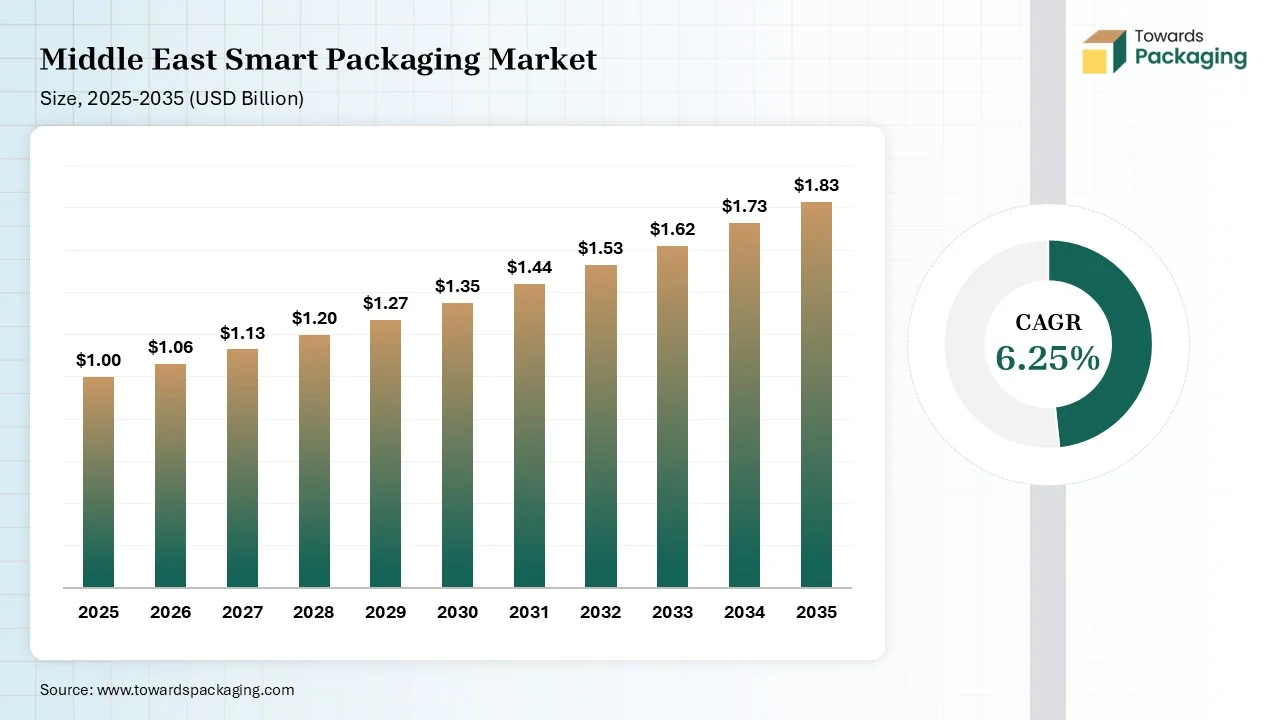
The Middle East smart packaging market is projected to grow from USD 1.06 billion in 2026 to USD 1.83 billion by 2035, registering a CAGR of 6.25% during the forecast period. The report provides a complete overview of market size, detailed segmentation by technology such as indicators, sensors, and RFID tags, and regional insights across key Middle Eastern countries. It also includes comprehensive company profiles, competitive analysis, value chain evaluation, trade data, and detailed information on manufacturers and suppliers, offering a full view of the industry landscape.
One of the initial developments in smart packaging is RFID (Radio Frequency Identification), which allows automated data capture and management without demanding the direct line-of-sight, unlike regular barcodes. With the assistance of RFID, every product can manage a different identifier, which enables it to be tracked from manufacturing to delivery, providing real-time data that improves accuracy and smoothness. Alike regular barcodes, which need manual scanning and are restricted in the information that can be stored, RFID tags carry and transmit in-depth data automatically. Such automation lowers the labor costs and minimizes issues linked with manual penetration. Furthermore, RFID technology assists in quicker and multiple-product scanning that saves valuable time in distribution and warehouse centers.
Package Design and Prototyping: A smart packaging design includes several elements, from how they are created to how it appears. If each of the factors of smart packaging design is not aligned, there can be a danger gap in the path as the package grabs the attention, which is perfect, but as they are not regular and hard to use, users will be much less likely to purchase the product again and suggest it to their family and friends.
Recycling and Waste Management: Smart packaging shows a strong transformation of digital technology, materials science, and sustainability. By expanding the shelf life, developing traceability, lowering waste, and lastly assisting the recycling, these inventions have the capability to redesign the role of plastics in a circular economy. The next platform of development will need minute attention to cost, design, environmental effect, and scalability.
Logistics and Distribution: Smart packaging develops perfect management, as it has been particularly meant to lower food waste, ensure the quality of such products, and develop food safety. However, despite their unavoidable benefits, their current amount is holding them back from becoming a huge spread solution. As such, packaging has become more famous, and both users and businesses will benefit. Likewise, supply chain tracking will be more effective and smoother, as logistics managers have all the information, they want to ensure accurate shipping and storage conditions.
In May 2025, Saudi Arabia and China held the Saudi Chinese Business Forum in Beijing, which culminated in the signing of a total of 57 agreements and memoranda of understanding (MoUs) totaling SAR 14 billion (USD 3.7 billion). It is led by the Saudi Minister of Environment, Water and Agriculture, named Abdulrahman AlFadley, a forum that has marked an achievement in Sino-Saudi Co-operation, specifically across food security, agriculture, and industrial supply chains.
The active packaging segment dominated the market in 2025 because it is a packaging machine that is well-managed to track and even develop the health factors, quality of the packaged food product, and organoleptic characteristics, hence it expands the shelf life. It was made as a response to the urges of current users, who demand fresh products that are convenient to use and frequently semi-made. Active packaging has emitter systems and absorbers that avoid unwanted materials like ethylene, extra moisture, oxygen, and particular smells and tastes. Emitters, on the other hand, release anti-microbial substances such as ethanol and carbon dioxide.
The intelligent packaging segment is expected to grow at the fastest CAGR in between 2026 and 2035 in the market, as they are “smart packaging” points to packaging machines that are filled with communication, sensory, or other technological workings apart from their regular packaging role. Such working can range from developing safety, tracking freshness, and growing convenience, to even playing an important role in the complete product experience. For example, a food product’s intelligent packaging can update color when the ingredients are no longer safe to consume, or a wine bottle can consist of a chip that communicates with the user about its ageing procedure, origin, and even demands food pairings.
In February 2026, the Mohammed Bin Rashid Innovation Fund (MBRIF), a program revealed by the Ministry of Finance to assist the UAE’s invention and entrepreneurship ecosystem, disclosed rising demand for environmentally friendly packaging solutions in the UAE served by Avani Eco Middle East, which is a member of the Mohammed Bin Rashid Innovation Fund (MBRIF) Guarantee Scheme.
The food & beverages packaging segment dominated the market in 2025 as the dairy industry is beginning to utilize intelligent packaging to track things such as expiration dates, product temperature, and storage conditions. Active product packaging, such as antimicrobial coatings and moisture-control films, is being used to store poultry and meat fresh and to protect them from pollutants. Implanted sensors are also being used to manage other crucial elements, which can stretch the shelf life of food and beverage items and protect against product loss. Additionally, the smart packaging goal is to develop buyer and seller experience by stretching shelf life, developing product and user safety, and developing product safety to lower food waste and product loss, which also delivers distributors a real-time response on the exact location of their investment.
The pharmaceutical packaging segment is expected to grow at the fastest CAGR between 2026 and 2035 in the market, as smart pharma packaging is the absorption of technology into pharmaceutical packaging, which has developed tracking, product identification, and patient engagement. This packaging at the origin stage consists of embedding technologies like Bluetooth Low Energy (BLE) and RFID (radio frequency identification (RFID) into pharmaceutical containers. Such technologies help assign a unique digital ID to every package, which allows serialization, making it complicated for traceability and tracking across the worldwide supply chain. Such digital IS enables stakeholders, right from producers to pharmacists and patients, to check a drug’s authentication at each step for its entire journey.
Saudi Arabia has dominated the Middle East smart packaging market in 2025, as consumer awareness of product checking and food safety is transforming the packaging needs across Saudi Arabia. The Kingdom’s developing FMCG and pharmaceutical industries experience growing pressure to use anti-counterfeiting measures and ensure product reliability.
Smart packaging solutions that have tamper-evident, authentication features, and traceability can become compulsory for big-value products. The fast development of digital retail and e-commerce in Saudi Arabia is driving the main urge for smart packaging solutions. The Kingdom’s National Transformation Initiative for 2020 and Vision 2030 has developed digital commerce acceptance.
UAE expects fastest growth in the market during the forecast period, the United Arab Emirates (UAE) plays a pivotal role in the Middle East smart packaging market as a hub for innovation, logistics, and advanced technology adoption. Key sectors like food and beverages, pharmaceuticals, and luxury products rely heavily on smart packaging for quality assurance, anti-counterfeiting, and enhanced consumer engagement. The rapid growth of e-commerce further accelerates demand for interactive and traceable packaging. Alongside this, government initiatives promoting sustainability and stricter packaging regulations encourage the integration of eco-friendly materials with smart technologies.
By Type
By Application
By Country








Principal Research Analyst
Vidyesh Swar is a Senior Research Analyst at Towards Packaging, bringing over 4 years of dedicated expertise in market intelligence and strategic analysis across the dynamic world of packaging technologies and solutions.
Learn more about Vidyesh Swar

Reviewed By
Aditi Shivarkar, with 14+ years in packaging market research, specializes in food, beverage, and eco-friendly packaging. She ensures accurate, actionable insights, driving Towards Packaging Analytics & Consulting 's excellence in industry trends and sustainability.
Learn more about Aditi Shivarkar

Middle East Smart Packaging Market
 Table of Content

 Download Sample
 Schedule a Meeting