


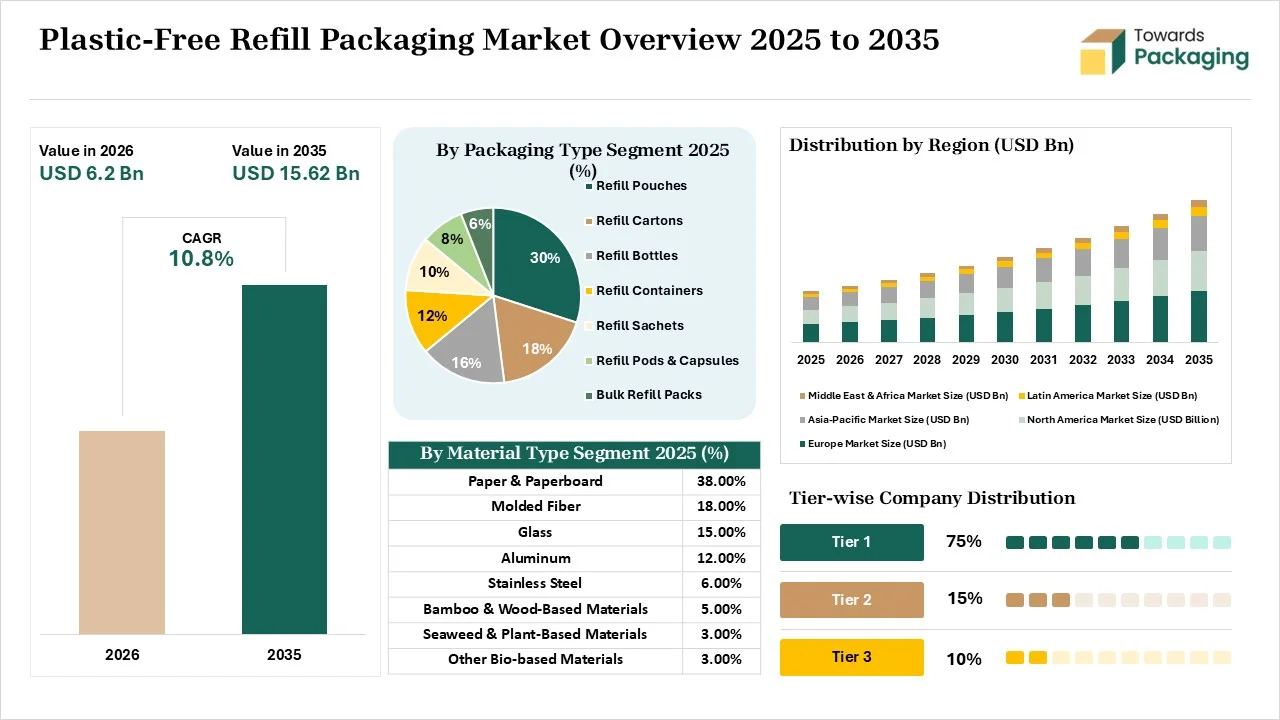
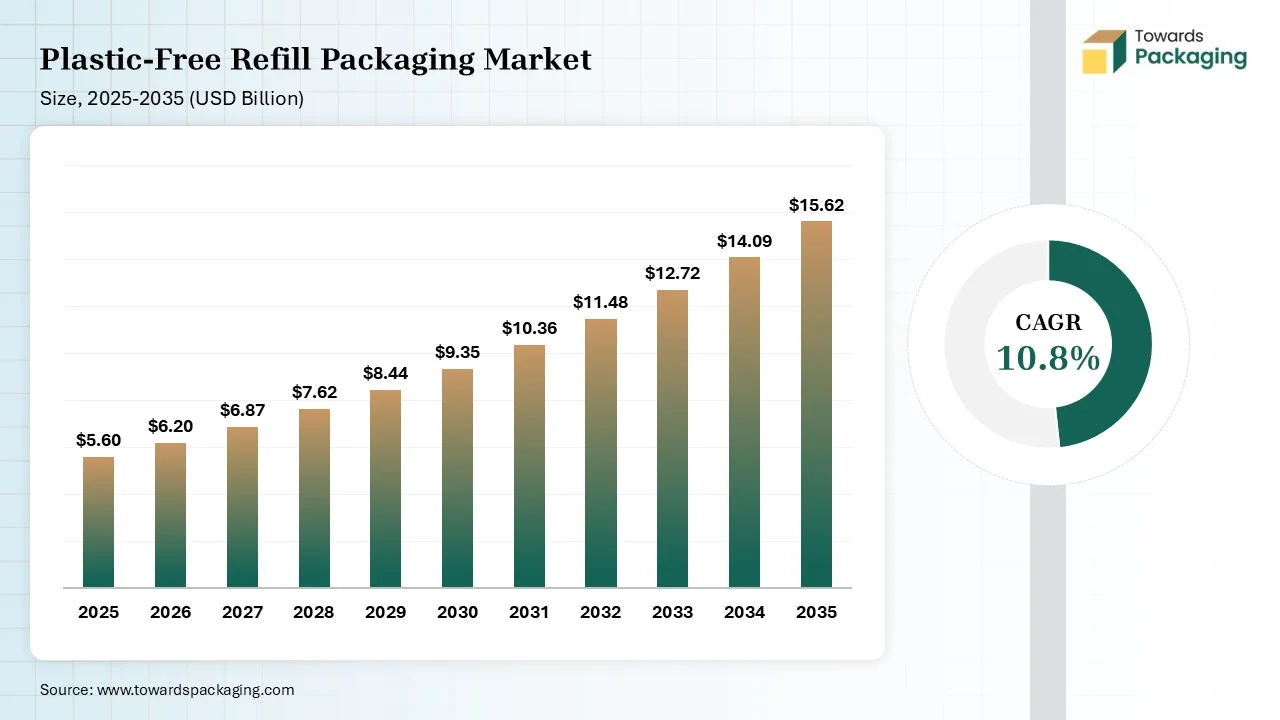
According to Vidyesh Swar, the global plastic-free refill packaging market size was estimated at USD 5.6 billion in 2025 and is predicted to increase from USD 6.2 billion in 2026 to approximately USD 15.62 billion by 2035, expanding at a CAGR of 10.8% from 2026 to 2035. The market growth is driven by factors like government regulations, an expanding eco-conscious consumer base, brands' ESG commitments, increasing demand in the F&B industry, rising use of refillable glass in the personal care industry, burgeoning in-store refill stations, rise in smart packaging tracking, minimization of long-term procurement, and adoption of biodegradable materials. The packaging industry is moving away from single-use plastics due to global government regulations, carbon reduction demand, and recycling limitations. Reusable and refillable solutions offer benefits like environmental conservation, smoother supply operations, customer loyalty, and cost-effectiveness.
Plastic-free refill packaging is packaging that uses environment-friendly material for the refilling of products. The packaging uses materials like aluminum, cellulose, plant fiber, metal, glass, paper, and others. It offers benefits like waste reduction, chemical-free products, cost savings, lower GHG footprint, and efficient transport. The plastic-free refill packaging is made up of biodegradable materials, whereas conventional refill packaging is made up of plastic materials. The plastic-free refill packaging lowers carbon dioxide emissions, whereas conventional refill packaging increases emissions. According to research, the consumer goods industry uses reusable vessels, paper-based pouches, dissolvable tablets, pump dispensers, and metal pods.
Pre 1950, consumers followed a traditional return-to-retail policy. In this, consumers returned their used bottles and other packaging formats directly to the retail stores. The disposable era of packaging started in 1960 with a public shift to single-use convenience. The era mainly focused on corporate profitability and hygiene. From 2000 onwards, awareness of plastic pollution has grown, and focus on lowering wastage has increased. Then consumer started bringing their own containers for buying groceries and other items, which helped in achieving zero waste. The prohibitions on plastic use started from 2020, and then consumers started using refill systems. Consumers started prioritizing sustainability, which increased demand for refills. In this era, Refill-at-Home and Return-from-Home are mainly used by consumers.
According to the research, the market boundaries mainly focus on the end-use sectors, material constraints, and business models. The major constraint of the market is completely avoiding fossil-based plastics. The market covers materials like paper & paperboard, molded fiber, glass, aluminum, stainless steel, bamboo & wood-based materials, and plant-based materials. The market covers refill packaging formats like refill pouches, refill bottles, refill sachets, bulk refill packs, refill cartons, refill containers, and refill pods & capsules. The market covers distribution models like in-store refill systems, subscription refill programs, retail refill packaging, bulk dispensing systems, and D2C refills. The market includes end users like consumer goods manufacturers, food & beverage companies, retail chains, healthcare companies, personal care brands, household care manufacturers, and the hospitality industry. The plastic-free refill packaging covers geographic regions like Asia Pacific, Europe, Latin America, North America, and the Middle East & Africa.
Consumers are giving preference to buying refillable products like refillable beauty, and the consumer retention strategies in brands increase the use of refill strategies. The presence of refill reminders and the availability of lightweight refill formats in FMCG increase the use of plastic-free refill packaging. The FMCG demand for minimization of transportation pollution and the rising transportation of product concentrates increases the use of plastic-free refill packaging. The burgeoning bulk-refill stations help with the expansion. FMCG brands like Nestle, Giorgio Armani, Unilever, Lakme, and Algramo use refill strategies. The growing refill strategies in FMCG are a driver for market growth.
The smaller production volume of plastic-free alternatives and specialized paper alternatives increases the initial cost. The manufacturing processes like thermoforming, metal forming, and blow film extrusion increase the initial cost. The need for high investment in R&D and the need for new infrastructure increase the cost. The need for premium raw materials and specialized tooling increases the initial cost. Factors like material redesign and new production infrastructure increase the cost. The high initial cost is a restraint for market growth.
The various government regulations, like France’s reuse law and the explosion of reusable models, increase the adoption of refill-as-a-Service models. The increased consumer engagement with brands and the transportation of concentrated refills increases the use of refill-as-a-Service models. The rise in direct-to-home subscription models and the multiple brands offering standardized containers helps with the expansion. The stricter recycling targets in brands increase the use of refill-as-a-service models. Brands like Siklus and Smart Refill help with expansion. The growing refill-as-a-service models create opportunity for market growth.
The circular economy ecosystem focuses on material sourcing, dispensing, reverse logistics, and processing. The consumer goods producers collaborate to manufacture paper-based alternatives. Government regulations like FSSAI focus on the development of refill-friendly materials. Retailers integrate bulk dispensing machines to provide refill options. The waste handlers focus on end-of-life processing.
For instance, AeroFlexx partnered with Aveda to introduce refillable packaging. The new packaging is developed using integrated airframe structures, and it lowers plastic consumption. The packaging follows design-for-recyclability commitments.
The shipment volume trends depend on factors like policies, infrastructure, material innovation, consumer behaviour, and legislation. The production of plastic-free refill packaging is growing due to stricter regional regulations and awareness about plastic pollution. The F&B industry mainly uses refillable packaging. The demand for plastic-free refill packaging will grow in 2035 due to the growing plastic-to-paper transitions. Factors like the Indian clean beauty boom and FMCG commitments are responsible for the growth.
The food & beverage industry is the highest consumer of plastic-free refill packaging due to the dependence on disposable containers and sustainability favors. The consumer preference for F&B brands prioritizing sustainability and the growing microplastic health concerns increase the consumption of plastic-free refill packaging. Factors like enacting outright bans, landfill pollution, availability of bagasse trays, and fluctuating plastic prices are responsible for the growing adoption of plastic-free refill packaging in the F&B industry.
The large presence of the food & beverage industry across the Asia Pacific region increases demand for plastic-free refillable packaging. The strong informal recycling sector and rapid urbanization increase demand. Packaging formats like bottles and flexible pouches are widely used in Asia Pacific. Europe is growing due to the strong B2B logistics industry and EU mandates. Packaging formats like glass bottles, pallets, and IBCs are used in Europe. North America is expanding in the market due to the bulh-refill stations availability. The region widely uses supermarket bulk-refill stations.
The manufacturing cost of plastic-free refill packaging depends on factors like tooling, customization, testing, material, barrier properties, and weight. The raw material selection accounts for 30-50%. For example, raw materials like molded fiber take $0.15 to $0.40 per unit. The overall setup & tooling utilization takes up to 15-25%, the manufacturing & conversion process takes up to 25-35%, and coating treatments account for 5-15%.
The average manufacturing price depends on the manufacturing process, regulatory factors, material type, and total volume. According to USD 0.22 per unit, raw materials like agricultural byproducts, bioplastic polymers, and others take $0.08, the manufacturing and tooling process accounts for $0.06, coating application & printing takes $0.04, quality checks & labor account for $0.03, and certification & regulations take $0.01.
The average selling price depends on feedstock fluctuations, logistics, material used, certifications, and production methods. According to USD 0.36 per unit, raw materials account for $0.13, conversion methods & manufacturing process accounts 0.09, customization & selection of design takes $0.05, certifications require $0.04, and storage & transportation take $0.05.
The future pricing depends on factors like government taxes, consumer demand, raw materials, durability of packaging, and transport logistics. Sustainability regulations like Digital Product Passports, EPR, and others will affect the pricing. The pricing trends are high initial investment, regulatory cost changes, and capital surcharges decide the pricing of plastic-free refill packaging.
Raw materials like molded pulp, mycelium, plant-based bioplastics, bio-films, recycled paper, and bagasse are required.
The stage includes feedstock preparation, material processing, and conversion. The conversion includes molding, extrusion, and coating.
Design includes ideation, rapid prototyping, performance validation, and logistical validation. Prototyping focuses on functional mechanics, supply chain viability, material stress validation, and consumer experience.
The paper & paperboard segment dominated the market with a 38% share in 2025. The high purchasing rate of environmentally conscious products and the shift away from heavy packaging formats increase the use of paper & paperboard. The brands' shift to compliant paper packaging and the innovations in water-based coatings help with the expansion. The interest in right-sized packaging inserts and the demand for heavy glass alternatives increases the use of paper & paperboard. The superior branding and logistical efficiency of paper & paperboard drive the segment growth.
The molded fiber segment held a 18% market share in 2025 and is expected to grow at the fastest CAGR of 12.3% during the forecast period due to its compatibility with established organic waste streams. The demand for green-credential solutions and the advancing organic coatings increase the use of molded fiber. The drastic policy changes and the guilt-free packaging disposal demand increases use of molded fiber. The excellent brand perception and exceptional product protection of molded fiber support the segment growth.
The refill pouches segment dominated the market with 30% share in 2025. The increased replacement of heavy glass bottles and the need to lower freight fuel increases use of refill pouches. Packaging technology innovation and the EU reuse targets increase adoption of refill pouches. The brand's focus on increasing recurring purchases increases use of refill pouches. The excellent brand loyalty, lower footprint, e-commerce adaptability, and affordability of refill pouches drive the segment growth.
The refill pods & capsules segment held an 8% market share in 2025 and is expected to grow at the fastest CAGR of 12.8% during the forecast period. The expanding use of disposable plastics and the increased buying of bulk refills increase adoption of refill pods & capsules. The preservation of product performance and the increased rejection of aluminum packaging increase the use of refill pods & capsules. The refill pods integration with single-serve hardware and the rise in refill-at-home support segment growth.
The personal care & cosmetics segment dominated the market with 34% share in 2025. The consumer transition to more luxurious lifestyles and the robust growth in online beauty sales increase demand for plastic-free refill packaging. The brands' focus on improving product value and focus on the recyclability of beauty products increases the use of plastic-free refill packaging. The growing personal grooming awareness and the high consumption of haircare products drive the segment growth.
The household cleaning products segment held a 24% market share in 2025 and is expected to grow at the fastest CAGR of 12.2% during the forecast period. The popularity of waterless formulations like detergent sheets and the reengineering of cleaning products increases the use of plastic-free refill packaging. The rising availability of eco-friendly cleaning products and the development of non-toxic chemical formulations increase the use of plastic-free refill packaging. The expanding closed-loop refill stations and the rise in dissolvable cleaning tablets support the segment growth.
The retail refill packaging segment dominated the market with a 33% share in 2025. The daily usage of home care products like cleaning agents and ambitious reusability targets increases adoption of retail refill packaging. The modern consumer is spending on eco-friendly goods, and the rising interest in pouch-return programs increases adoption of retail refill packaging. The expansion of the physical bulk-refill base and the rise in smart dispensing machines drive the segment growth.
According to Vidyesh Swar, the in-store refill systems segment held a 20% market share in 2025 and is expected to grow at the fastest CAGR of 12.5% during the forecast period. Brands' demand to meet public reuse quotas and the focus on avoiding ocean waste increase the use of in-store refill systems. The growing plastic-free retail demand and the incorporation of refill models in supermarkets help with the expansion. The growing personal care shopping increases the use of in-store refill systems. The rise in IoT-based dispensing stations supports the segment growth.
The consumer goods manufacturers segment dominated the market with a 30% share in 2025. The demand for circular packaging models in consumer goods brands and the increased boycotting of non-sustainable products increase the use of plastic-free refill packaging. Voluntary corporate goals and flexible pouch utilization help with the expansion. The rise in durable refill stations and bio-based adhesives increases adoption of plastic-free refill packaging. The rise in fast-moving goods drives the segment growth.
The personal care brands segment held a 22% market share in 2025 and is expected to grow at the fastest CAGR of 12.4% during the forecast period. The companies focus on improving repeat-purchase mechanics, and the increasing use of airless pump systems in personal care increases the adoption of plastic-free refill packaging. The rise in high-end beauty and the brands' demand for increasing CLV increases the use of plastic-free refill packaging. The increased use of returnable jars and the heavy fines on non-biodegradable personal care packaging support the segment growth.
According to Vidyesh Swar, the supermarkets & hypermarkets segment dominated the market with a 34% share in 2025. The growing everyday shopping from supermarkets and the increased weekly grocery shopping help with growth. The demand for large-scale dispensers for products like liquids and the growing sustainable trial programs increase the use of supermarkets & hypermarkets. The growing app-based grocery deliveries and the interest in standardized refill models drive the overall growth of the segment.
The e-commerce segment held a 21% market share in 2025 and is expected to grow at the fastest CAGR of 12.6% during the forecast period. Cosmetic ordering through online platforms and the Gen Z demand for plastic-free delivery increase adoption of e-commerce. Consumers' priority to brands providing refillable formats and the rise in auto-replenishment models help with the expansion. The digital tracking systems and the integration of IoT help with expansion. The availability of global beauty brands on e-commerce supports the segment growth.
Europe dominated the plastic-free refill packaging market with a 36% share in 2025. Certain recycled content targets in the cosmetics industry and shoppers' preference for eco-friendly products increase the use of plastic-free refill packaging. Regulations like ESPR in Europe and the established mechanical recycling infrastructure increase utilization of plastic-free refill packaging. The presence of deposit-return schemes for packaging formats like containers and consumer preference for zero-waste products increases the use of plastic-free refill packaging. The adoption of in-store refill stations by major retailers drives the market growth.
Germany
Germany dominated the market in 2025. The increased registration of refill concepts and the Pfand system increase the use of plastic-free refill packaging. The increased integration of zero-waste vending machines and the growing public's eco-consciousness help with expansion. The incorporation of bulk dispensing machines in German grocery stores and the plastic pollution concerns support the overall market growth.
United Kingdom
The United Kingdom is expected to grow at the fastest CAGR in the market during the forecast period. The retailers' commitment to circular systems and the transition away from single-use grocery items increases the adoption of plastic-free refill packaging. The consumer shift to zero-waste lifestyles and the surge in rapid grocery models increases the use of plastic-free refill packaging. The innovations in smart dispensing machines support the market growth.
According to Vidyesh Swar, North America held a 28% market share in 2025. The government forcing companies to shift to refillable packaging systems and the demand to cut the use of virgin plastics increase the adoption of plastic-free refill packaging. The high volume of retail shopping and the growth in bulk refill stations increase the use of plastic-free refill packaging. The innovations in paper-boarding and the expansion of circular subscription services increase adoption of plastic-free refill systems, driving market growth.
United States
The United States held the largest share in the market in 2025. The major transition to refillable formats and the growing zero-waste packaging in personal care increase the adoption of plastic-free refill packaging. The advanced packaging infrastructure and the investment in sustainable supply chains increase the use of plastic-free refill packaging. The innovations in upcycled materials and expanding bulk refill stations support the market growth.
Canada
Canada is expected to grow at the fastest CAGR in the market during the forecast period. The pollution prevention plans and the transition to reuse models increase the use of plastic-free refill packaging. Shoppers transition to package-free options, and the investment in reuse-refill systems increases the use of plastic-free packaging. The zero-waste goals in the Canadian region and the expansion of circular logistics startups increase the adoption of plastic-free refill packaging, boosting market growth.
Asia Pacific held a 25% share in the plastic-free refill packaging market in 2025 and is expected to grow at the fastest CAGR of 12.5% during the forecast period. The awareness of plastic pollution and the focus on lowering dependence on long-term containers increase the use of plastic-free refill systems. The rise in D2C refill subscriptions and the interest in easy-to-store refill solutions increase the use of plastic-free refill packaging. The advancements in compostable films and the rise in automated bulk-dispensing machines help with the expansion. The retail innovations drive the market growth.
China
China dominated the market in 2025. The increased production of trackable materials and the domestic focus on enhancing green design increase the adoption of plastic-free refill packaging. The popularity of reusable pallets and the plant-based biopolymer innovations increases the production of plastic-free refill packaging. The increased investment in waste management networks and the rise in sustainable branding support the market growth.
India
India is expected to grow at the fastest CAGR in the market during the forecast period. The reverse logistics systems in FMCG and strong local food processors increase the use of plastic-free refill packaging. The increased development of refillable container models and the preference for low-waste purchases increase the use of plastic-free refill packaging. The interest in refillable lifecycle products boosts the segment growth.
Latin America held a 6% market share in 2025. Consumer demand for low-waste shopping and the availability of sugarcane-based polyethylene increase the production of plastic-free refill packaging. The expansion of large refill pouches and the surging sustainable branding strategies increase the use of plastic-free refill packaging. The focus on eliminating plastic pollution in industries like personal care drives the overall growth of the market.
Brazil
Brazil dominated the plastic-free refill packaging market in 2025. Initiatives like Boti Recicla and the robust forestry industry increase demand for plastic-free refill packaging. The expansion of refillable grocery products and the interest in refillable pouches help with growth. The rise in zero-waste grocery and large pulp production capabilities increases the production of plastic-free refill packaging. The strong Waste Pickers ecosystem supports the market growth.
Chile
Chile is expected to grow at the fastest CAGR in the market during the forecast period. The expansion of major consumer producers and the popularity of disposable beverage bottles increase the use of plastic-free refill packaging. Increased buying of shampoo and lower-income households increase the use of plastic-free refill packaging. The Chilean Plastics Pact and the expansion of pantry staples boost market growth.
According to Vidyesh Swar, the Middle East & Africa held a 5% market share in 2025. The increased incentives in circular packaging and the burgeoning personal care brands increase the use of plastic-free refill packaging. The upgradation in recycling infrastructure and the well-established global converters increase the use of plastic-free refill packaging. The plastic pollution consciousness in countries like South Africa and the expansion of refill-based retail formats drive the market growth.
UAE
The UAE held the largest share in the plastic-free refill packaging market in 2025. The prohibitions on plastic shopping bags and the growth in dedicated refill hubs increase adoption of plastic-free refill packaging. The demand for cruelty-free products and the popularity of compostable fibers increase the development of plastic-free refill packaging. The surge in flexible refill pouches supports the overall growth of the market.
Saudi Arabia
Saudi Arabia is expected to grow at the fastest CAGR in the market during the forecast period. The massive waste-reduction targets and the increased buying of sustainable consumer goods increase the demand for plastic-free refill packaging. The green packaging infrastructure and the rise in localized delivery services increase the use of plastic-free refill packaging. The cosmetics shift to plastic-free packaging boosts the overall market growth.
The plastic-free refill packaging is competitive due to the demand to meet regulatory mandates. The companies are divided into DTC models, compostable packaging, returnable container systems, and bulk refill stations. Factors like stringent mandates and corporate sustainability pledges increase the concentration. The leading players include Mondi, Tetra Pak, Amcor plc, and DS Smith.
| Company | Annual Production Capacity | Sustainability Initiatives | Geographic Reach |
| Tetra Laval | Over 174 billion cartons or refill packages | NetZero GHG Emission |
|
| Sonoco Products Company | The company annually produces 1.8 million tons of uncoated recycled paperboard. | Emission Reduction and Responsible Sourcing |
|
The competitive positioning depends on factors like logistical simplicity, price competitiveness, material innovation, and brand loyalty. The competitive positioning evaluates factors like circularity metrics, user experience, scalability, and B2B partnerships. The leading players are Smurfit WestRock, Tetra Pak, Huhtamaki, Notpla, Sonoco, Mondi, Sealed Air Corporation, Berry Global, and EcoEnclose.
| Company Overview | The Switzerland-based company specializes in rigid and flexible packaging solutions. |
| Manufacturing Footprint | China, India, United States, Germany, Malaysia, Canada, Ireland |
| Product Portfolio |
|
| SWOT Analysis |
Strength
Weakness
Opportunity
Threats
|
| Company Overview | They manufacture recyclable mono-material solutions and support FMCG brands to lower packaging waste. |
| Manufacturing Footprint | Germany, United Kingdom, South Africa, Egypt, United States, Morocco, Turkey, Slovakia, Poland |
| Product Portfolio |
|
| SWOT Analysis |
Strength
Weakness
Opportunity
Threats
|
| Company Overview | They offer paper-based barrier technology and advanced bottle washing machines. |
| Manufacturing Footprint | Poland, UK, United States, South Africa, Germany, North Africa, Austria |
| Product Portfolio | EvoBLOW & X-Lite Still Returnable PET- Still Water RePETable Solutions |
| SWOT Analysis |
Strength
Weakness
Opportunity
|
| Company Overview | The company manufactures refill packaging for industries like home care, beauty, and personal care. They develop metal-free designs of packaging. |
| Manufacturing Footprint | Asia, North America, Africa, Europe, South America, and Australia |
| Product Portfolio |
|
| SWOT Analysis |
Strength
Weakness
Opportunity
Threats
|
According to Vidyesh Swar, the plastic-free refill packaging market is expected to grow significantly during the forecast period due to consumer demand for zero-waste packaging and corporate cost savings. The food & beverage industry is a key contributor to the growth due to the growing use of hygienic packaging. Paper & paperboard materials are widely used in the F&B industry. Factors like massive demand for waste bottles, increased dry goods refilling, interest in reusable cups, and demand for takeout containers are responsible for the growth. F&B companies like The Coca-Cola Company, SodaStream, and Unilever are major consumers of plastic-free refill packaging. Asia Pacific region is rapidly expanding in the market due to rapid urbanization. Factors like growing conscious consumers, strong reverse logistics infrastructure, and the largest production base are responsible for the growth. Asia Pacific companies like The Body Shop, Refillables Hoi An, Lush, and barePack contribute to the growth. Packaging manufacturers like Tetra Pak and Amcor are major contributors, whereas consumer brands like CK and Unilever increase the use of plastic-free refill packaging.
By Material
By Packaging Type
By Product Category
By Distribution Model
By End User
By Distribution Channel
By Region








Principal Research Analyst
Vidyesh Swar is a Senior Research Analyst at Towards Packaging, bringing over 4 years of dedicated expertise in market intelligence and strategic analysis across the dynamic world of packaging technologies and solutions.
Learn more about Vidyesh Swar

Reviewed By
Aditi Shivarkar, with 14+ years in packaging market research, specializes in food, beverage, and eco-friendly packaging. She ensures accurate, actionable insights, driving Towards Packaging Analytics & Consulting 's excellence in industry trends and sustainability.
Learn more about Aditi Shivarkar

Plastic-Free Refill Packaging Market
 Table of Content

 Download Sample
 Schedule a Meeting