


The solid board for food packaging market is expected to increase from USD 2.97 billion in 2026 to USD 3.88 billion by 2035, growing at a CAGR of 3% throughout the forecast period from 2026 to 2035. The overall demand for the solid board in food packaging is developing because of its eco-friendliness (biodegradable/recyclable), cost-effectiveness, moisture resistance, and the potential to develop brand image through luxury printing.

Solid board is extremely perfect for the packaging of frozen and fresh products, as it shows its integrity and capability even in refrigerated and humid surroundings. This makes it a terrific choice for organizations that need reliable packaging for sensitive goods. Sectors such as food packaging and retail have an advantage from the solid board’s resistance to moisture.
The material is recyclable, food safe, and cost-effective, which makes it an eco-friendly selection for organizations that find sustainable packaging solutions.
Artificial Intelligence is updating this sector by allowing organizations to update their packaging procedure and inventory levels, which leads to main operational efficiencies and cost savings too. AI-linked analytics serve the potential to process huge amounts of data with respect to supply chain logistics. This data analysis can distinguish trends and designs, which allows businesses to experience urgency, track the inventory more smoothly, and lower the risks associated with overproduction or stockouts.
Raw Material Sourcing: The raw material sourcing of solid board undergoes production of the paperboard from wood pulp, which is integrated with water to create a slurry. This slurry is then distributed onto screens and pressed into the sheets. The paperboard is folded, cut, and scored to make a particular packaging shape, such as cartons and boxes. The paperboard then experiences further diagnosis, like coating for protection or to improve print quality. Printing is completed to add item information nd branding. Then, sustainable practices like using recycled materials are frequently included in the procedure.
Component Manufacturing: Solid board contains a grey inner layer, which has been created from cardboard and recycled paper. The complete manufacturing procedure goes through pulping, pulp refinement and cleaning, sheet formation, pressing and drying, coating and finishing, and finally cutting & packaging.
Logistics and Distribution: Solid board’s ingenuity counts in transporting frozen and fresh products while protecting their quality during transportation. Its compressed design makes sure that the packaging stays strong and provides strong protection for different items. The design of the big or short side of the packaging plays an important role in developing protection and stability during transportation. Solid board packaging is perfect for both sensitive food products and durable foods.
| Board Type Segments | Market Share 2025(%) |
| Folding Boxboard (FBB) | 45% |
| Recycled Solid Board | 35% |
| Solid Bleached Board (SBB) | 15% |
| Others | 5% |
The folding board segment has dominated the solid board for food packaging market in 2025, as it is a high-grade paperboard that is initially made from bleached chemical pulp. It is manufactured through a single or multi-layer procedure after effectiveness. As compared to regular paper, FBB is stronger, thicker, and smoother with perfect printability and whiteness. It is greatly used in gravure printing, offset printing, digital printing, and flexographic printing, which makes it more adaptable to paperboard grades.
The recycled solid board segment is expected to experience the fastest CAGR during the forecast period. Paperboard that comes from post-consumer or post-industrial waste paper is referred to as the Board. This board is created by repurposing and processing recycled paper instead of using virgin pulp from trees. This process lowers the energy usage and then lowers the demand for deforestation. There are various grades available in recycled board, like fully recycled kraft board, clay-coated news back, and greyback.
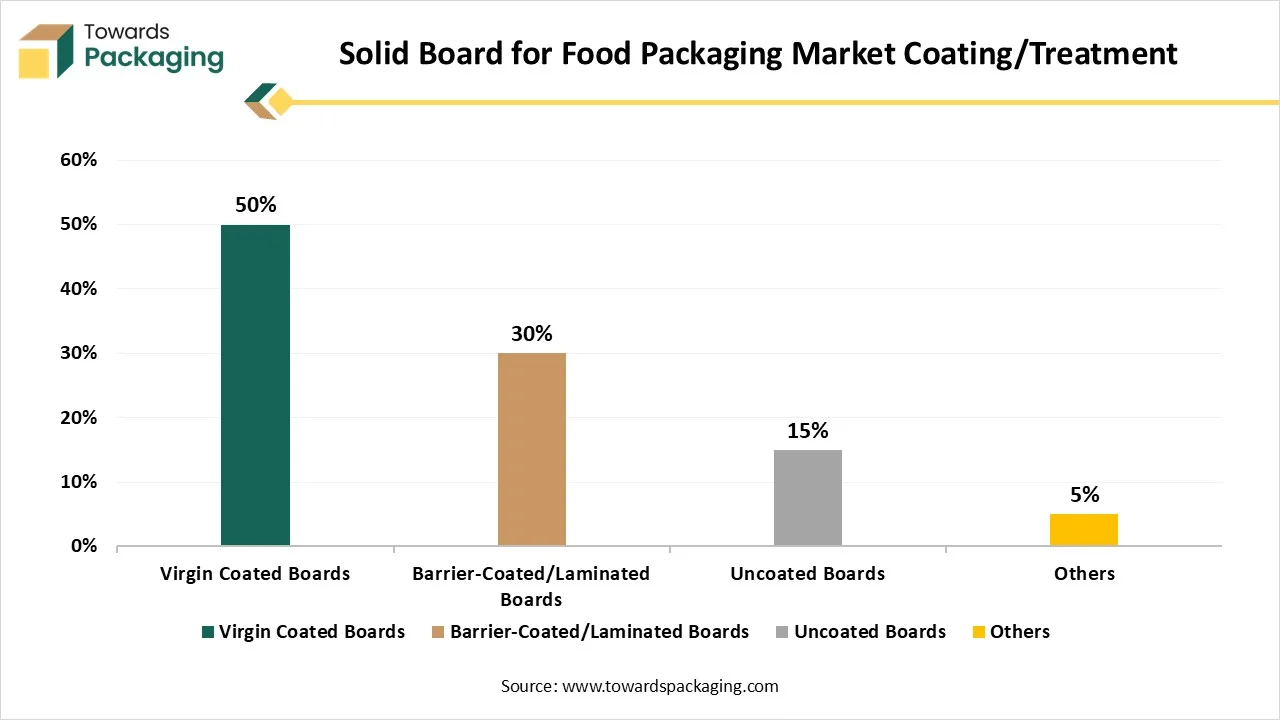
The virgin coated boards segment dominated the market in 2025 because it is basically made from fresh wood pulp, mainly sourced from trees. It looks more uniform and cleaner, but it requires utilising many natural resources and energy. Additionally, 100% virgin wood pulp initially comes from sustainably tracked forests and consists of international certifications such as FSC ( Forest Stewardship Council) and the PEFC ( Programme for the Endorsement of Forest Certification). The current forestry sustainability structure ensures forest redevelopment and ecological balance while also developing the quality of the paper products.
The barrier-coated/laminated boards segment is predicted to experience the fastest CAGR during the forecast period. Barrier board is a board that has barrier characteristics to protect the packaged elements from external factors like grease, moisture, heat, light, and oxygen. By applying a coating or lamination, for instance, it expands the shelf life or protects the product quality. The correct match of barrier coating and cardboard distributes high-quality packaging material, as it guarantees an optimal result, simplifies the manufacturing steps, and saves material too.
| Thickness Segments | Market Share 2025(%) |
| Medium Boards (250–400 gsm) | 45% |
| Heavyweight Boards (>400 gsm) | 25% |
| Lightweight Boards (<250 gsm) | 20% |
| Ultra-Heavyweight Boards (>500 gsm) | 10% |
The medium boards (250-400gsm) have dominated the solid board for food packaging market in 2025, as medium boards in this thickness are a very prevalent selection for retail, secondary, and food packaging, which serves a perfect balance of luxury feel, durability, and excellent printability too. The most common types are Duplex board and Solid bleached board (SBS). Medium board range serves enough power in order to protect products like soaps, cosmetics, light beverage multipacks, and small electronics too from damage during showcase and handling. The material is particularly crafted to be cut, creased, and folded into a complicated carton shoe without cracking, which gives the structural integrity for items on a shelf.
The heavyweight boards (>400 gsm) segment is predicted to experience the fastest CAGR during the forecast period. Heavyweight boards above the 400 gsm are strong, reliable, and serve maximum power, which makes them perfect for luxury and heavy-duty packaging uses in which protection and a quality feel are necessary. They are utilised for packaging of cosmetics, perfumes, jewellery boxes, and high-end electronics, in which the quality and weight of the board determine the gained value of the product. They are used in luxury beverage packaging and the heavy-duty cartons with a frequent coating for moisture opposition.
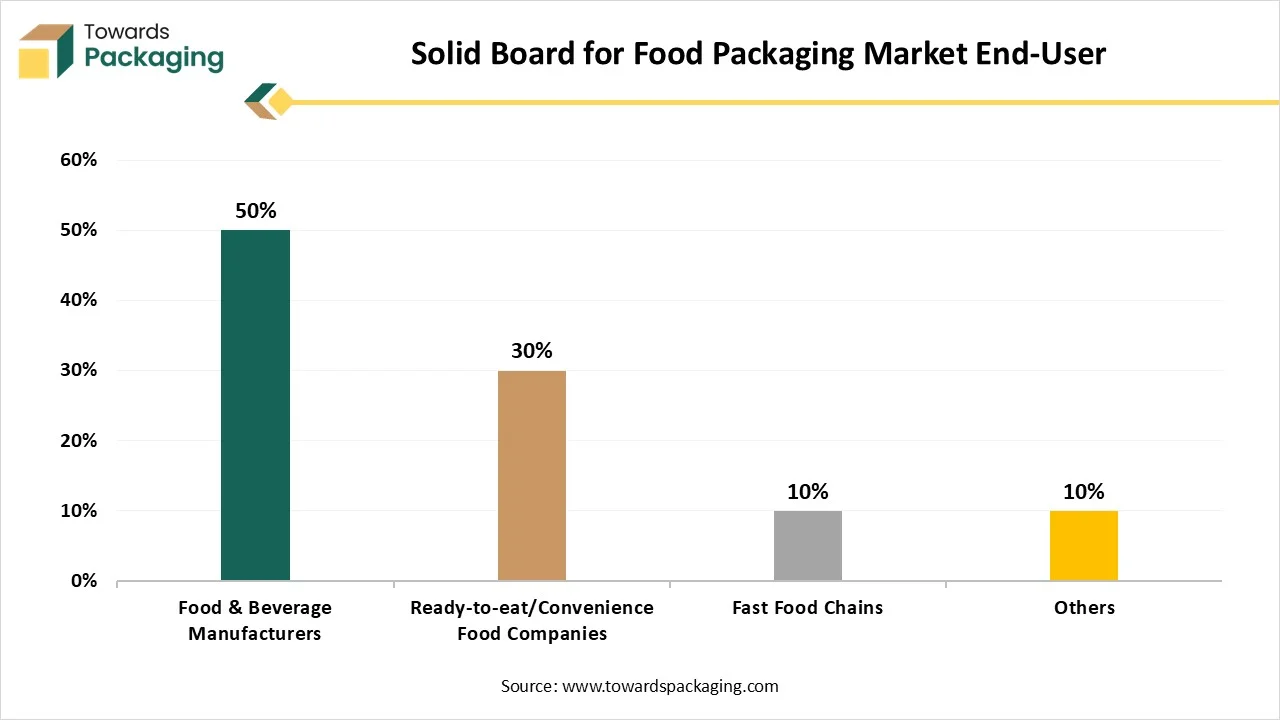
The food and beverage Manufacturers have dominated the solid board for food packaging market in 2025 as they serve a durable, high-quality solution that is primarily used in the frozen and fresh sectors. Like corrugated packaging, solidboard packaging is a strong and flexible cardboard selection that retains its power and rigidity when frozen and chilled. It is specifically perfect for heavy-duty applications that provide perfect stability and protection.
The ready-to-eat/convenience food companies segment is predicted to experience the fastest CAGR during the forecast period. Solid boards are initially used in the ready-to-eat (RTE) food sector as the packaging materials for presentation, shipping, and containment. They serve structural protection, assistance, and a surface for branding and are frequently laminated or coated to serve necessary barrier characteristics for food safety. They are exceptionally used in takeout containers, like for pasta, pizza, and general fast food, due to their moisture resistance and durability.
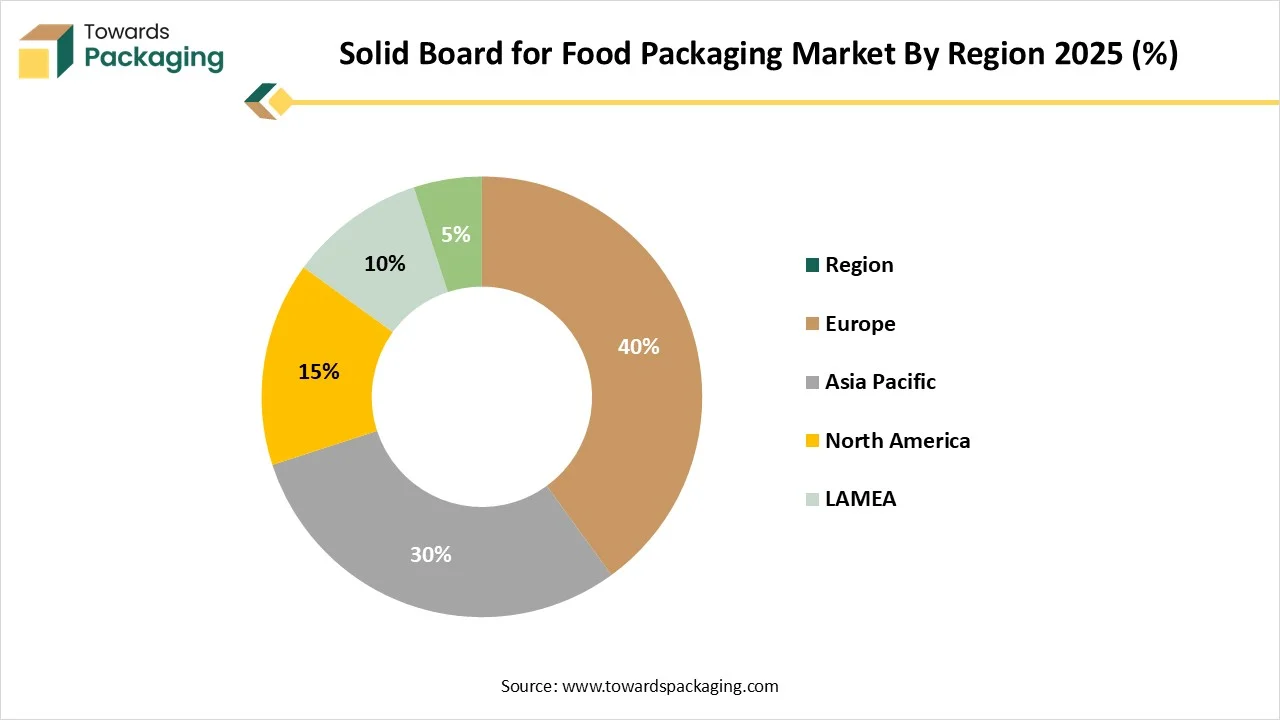
The Europe dominated the market in 2025, as the initial trend is the move away from plastic packaging towards fiber-based solutions that have made a solid board a go-to alternative option. European consumers and organizations are shifting towards materials that are designed from recycled fibers to lower the environmental impact. The latest EU regulations are making the application of recycled content and recyclable packaging mandatory.
German users and retailers are heavily appreciating paper-based packaging, which counts solid board over the plastic alternatives because of its recyclability and the usage of renewable raw materials, which has a positive effect on the C02 balance. The encouragement for a circular economy perfectly meets the solid board’s characteristics. The growth of e-commerce and the urge for frozen and chilled ready meals has updated the demand for protective, robust, and still lightweight packaging.
Asia Pacific expected to be the fastest growing in the market in 2025. This industry is a quickly developing trend in the Asia Pacific food packaging industry, which is initially driven by the rigid sustainability initiatives, growing user demand for eco-friendly solutions, and the e-commerce boom. The fast development of online retail in countries like India and China has made a compulsion for lightweight, reliable, and cost-effective packaging for safe transportation. Hence, a solid board serves as a protective layer and is widely used for secondary and tertiary e-commerce packaging.
The fast development of online food delivery and e-grocery services makes collusion for the strong but lightweight packaging that can stand firmly within the complicated logistics chain. Solid board packaging is very cost-effective and durable for shipping because of its lightweight nature, and serves enhanced product protection, which makes it perfect for the e-commerce industry’s secondary and tertiary packaging demands.
The demand for this sector is witnessing demand due to growing eco-friendly alertness and strict government regulations against plastic waste which are the main drivers that encourage producers towards paper and paper-based solutions like solid board. Solid board is created significantly from recovered waste paper and is completely meeting with these sustainability goals.
The United States solid board for food packaging market is experiencing steady growth driven by increasing demand for sustainable and recyclable packaging solutions, especially as brands seek to reduce reliance on plastics and meet environmental commitments. Solid board made from paper-based materials is valued for its eco-friendly nature, rigidity, and lightweight properties, making it well suited for food cartons, trays, and premium product boxes where both protection and shelf appeal are important.
The Solid Board For Food Packaging Market in the Middle East & Africa (MEA) region, as the urban retail demand and the growing disposable incomes in countries such as the UAE, South Africa, Saudi Arabia, and lastly Nigeria are developing the demand for ready-to-eat and packaged foods, which in turn develops the solid board industry. Producers are funding the latest technologies to develop solid boards, such as making water-based barrier coatings, which expand the shelf life and enable the packaging of chilled or moist foods even in humid surroundings.
The food and beverage industry is the biggest end-user of paper packaging in the UAE. The growth of single-person households, a developing tourist population and refugees, and a growth in the online food delivery and meal kit services are increasing the urge for effective, safe, and often single-use food packaging, too. Also, substantial funding in the food protection programs by the UAE government also needs strong packaging and logistics solutions that advantage the solid board market.
In South America, the Solid Board For Food Packaging Market is growing steadily, as the initial driver is the developing user awareness and the regulatory pressure to accept the eco-friendly and recyclable packaging solutions. Solid boards, which are frequently created from recycled fibers, are a popular choice for brands that seek to align with sustainability compulsions and lower their environmental impact. In nature, the South American solid board for the food packaging industry is stretching constantly, driven by the pairing of a strong food sector, an unavoidable push for fibre-based and sustainable solutions over plastics.
The fast-paced lifestyles and urbanization are driving an urge for single-serve and packaged food solutions for which the solid world is a primary material (eg, fast food containers, snack boxes, and milk cartons). The Food delivery segment is also developing and assisting the demand for sacks and cardboard.
By Board Type
By Coating / Treatment
By Thickness / Grade
By End-User Industry
By Region





Research & Advisory Analyst
Yogesh Kulkarni is an experienced Research Analyst specializing in the packaging sector, with a strong foundation in statistical analysis and market intelligence. He currently contributes his expertise to Towards Packaging.
Learn more about Yogesh Kulkarni

Reviewed By
Aditi Shivarkar, with 14+ years in packaging market research, specializes in food, beverage, and eco-friendly packaging. She ensures accurate, actionable insights, driving Towards Packaging Analytics & Consulting 's excellence in industry trends and sustainability.
Learn more about Aditi Shivarkar

Solid Board for Food Packaging Market
 Table of Content
 sales@towardspackaging.com
 +1 804-441-9344
 Download Sample
 Schedule a Meeting