Artificial Intelligence (AI) in the Packaging Design Market Size, Trends, Share, Trends, Segments, and Regional Insights (NA, EU, APAC, LA, MEA)

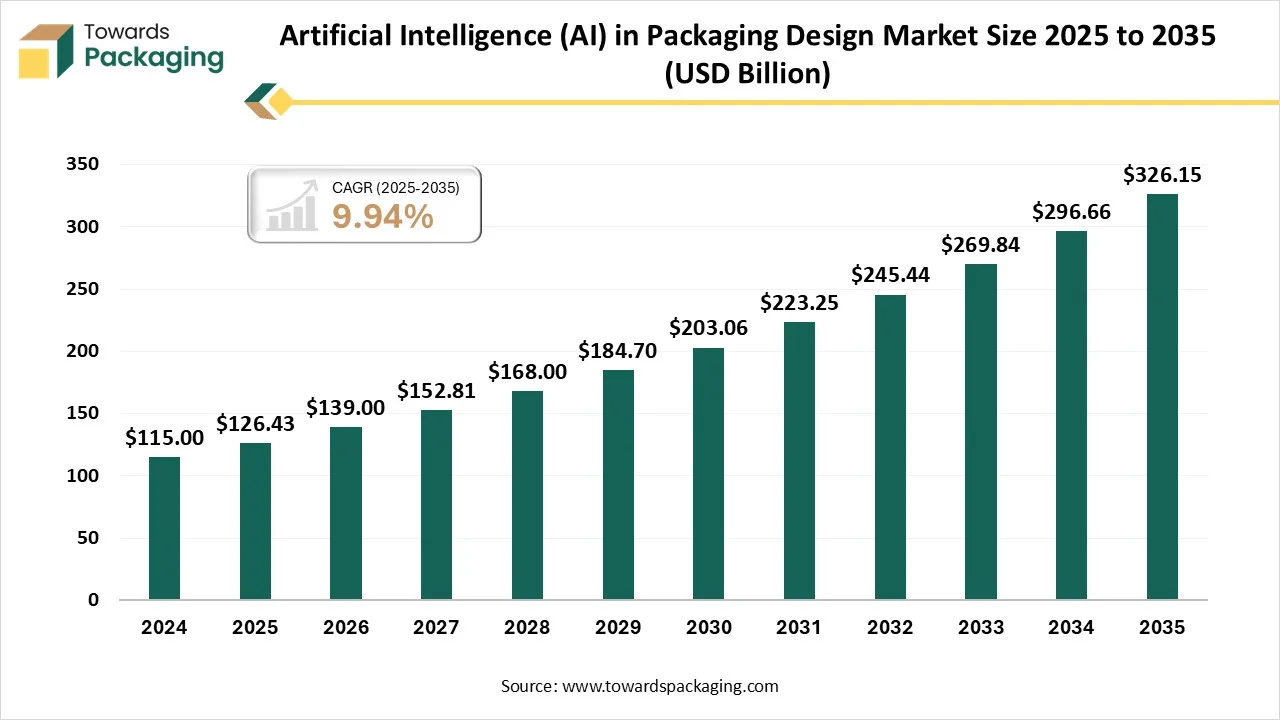
The global artificial intelligence (AI) in the packaging design market, valued at USD 126.43 billion in 2025, is anticipated to reach USD 326.15 billion by 2035, growing at a CAGR of 9.94% over the next decade. In 2024, North America led AI in packaging design, with machine learning, structural design, paper materials, and food & beverages dominating, while Asia Pacific, generative design, personalization, bio-based materials, and e-commerce will grow fastest through 2035.

Last Updated: 21 November 2025 Category: Others Packaging Insight Code: 5890 Format: PDF / PPT / Excel

The artificial intelligence (AI) in the packaging design market is forecast to grow from USD 139 billion in 2026 to USD 326.15 billion by 2035, driven by a CAGR of 9.94% from 2026 to 2035. This market is experiencing robust growth, driven by rising demand for faster, data-driven, and highly customized packaging solutions that enhance brand impact while reducing design time and costs.

Artificial Intelligence (AI) in the Packaging Design Market Size 2025 - 2035

Key Takeaways

  • By region, North America has dominated the artificial intelligence (AI) in the packaging design market, having the biggest share of 36% in 2024.
  • By region, Asia Pacific is expected to rise at the fastest CAGR between 2026 and 2035.
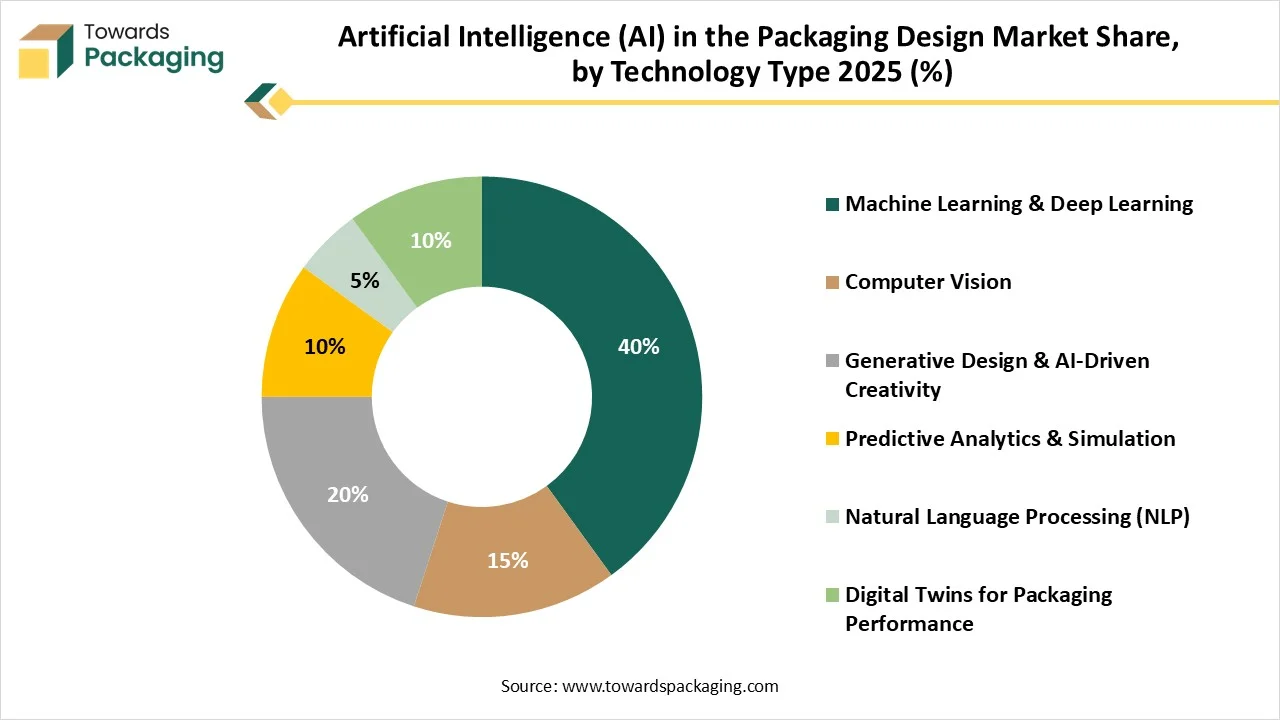
  • By technology, the machine learning & deep learning segment has contributed the largest market share of 38% in 2024.
  • By technology, the generative design segment will grow at the fastest CAGR between 2026 and 2035.
  • By application, the structural & material design optimization segment contributed the largest share of 32% in 2024.
  • By application, the personalization & customization segment will grow at an exceptional CAGR between 2026 and 2035.
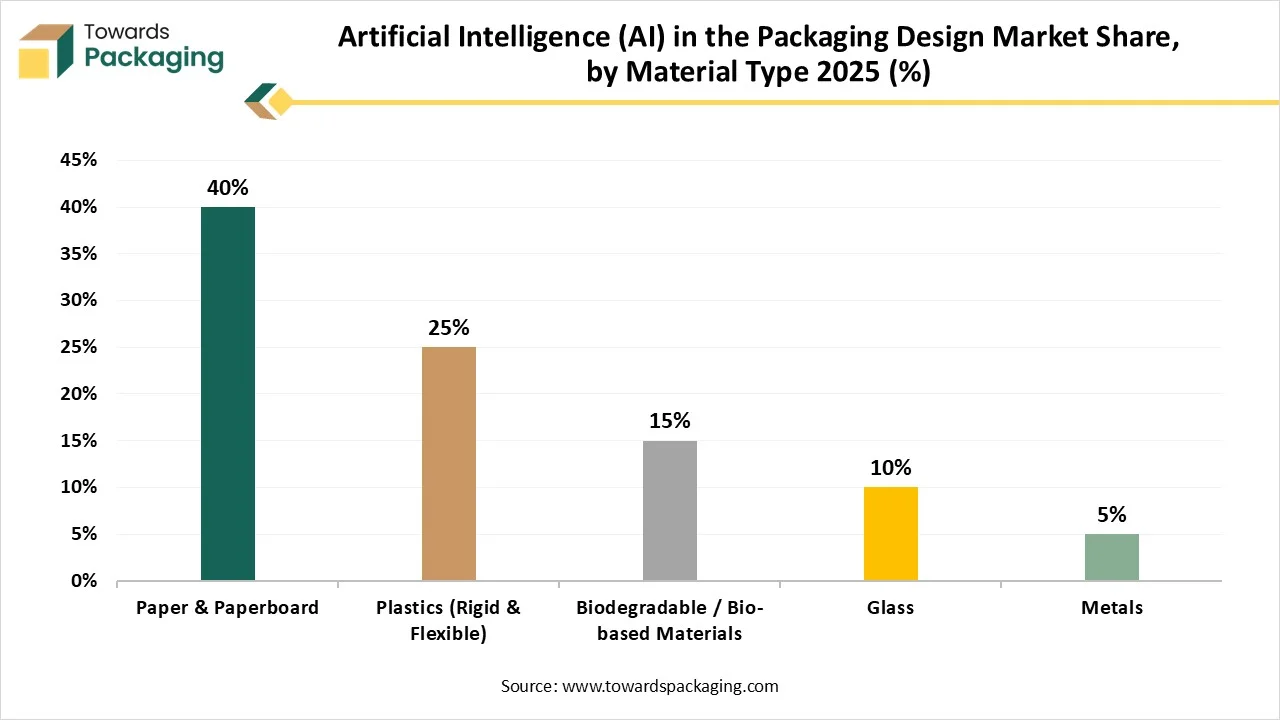
  • By material, the paper & paperboard segment contributed the largest share of 42% in 2024.
  • By material, the biodegradable and bio-based materials segment will grow at a notable CAGR between 2026 and 2035.
  • By end user industry, the food & beverages industry segment contributed the largest share of 35% in 2024.
  • By end user industry, the e-commerce & retail segment will grow at a notable CAGR of 25% between 2026 and 2035.

Market Overview

The artificial intelligence (AI) in the packaging design market is experiencing rapid growth because companies use AI technologies to produce more intelligent, customized, and eye-catching packaging. Businesses are using AI to predict trends, speed up prototyping, and optimize designs automatically. AI adoption is being accelerated by the growing demand for consumer-focused, economical, and environmentally friendly packaging. In general, intelligent design workflows that shorten time-to-market and boost brand competitiveness are becoming increasingly popular.

Market Outlook

  • Industry Growth Overview: As companies use AI tools to expedite design, cut costs, and produce more consumer-focused packaging focused the market for AI in packaging design is expanding. Rapid prototyping and AI-driven automation are enabling businesses to launch products more quickly.
  • Sustainability Trends: AI supports sustainability by optimizing material use, reducing waste, and guiding recyclable or eco-friendly packaging choices. Brands rely on AI insights to meet environmental goals more efficiently.
  • Startup Ecosystem: With generative AI design platforms and intelligent material selection tools, a thriving startup ecosystem is developing. These startups are accelerating investment and digital innovation in packaging design.

Key Technological Shifts in the Artificial Intelligence (AI) in the Packaging Design Market

Technological Shifts What’s Changing Impact on Packaging Design
Generative AI Design Auto-creation of multiple packaging concepts in seconds Faster prototyping, greater creativity, reduced design time
AI-Based Material Optimization Predicts the strength, cost, and sustainability of materials Lightweight designs, reduced waste, improved durability
Digital Twins for Packaging Virtual testing of designs before production Lower errors, faster iterations, better performance insights
Automated Structural Simulation AI evaluates stress, compression, and transport risk Stronger packaging, fewer failures during logistics
Personalization Engines AI tailors design for demographics or individual users More engaging packaging and targeted branding
Sustainability Algorithms AI recommends recyclable and low-carbon materials Supports ESG goals and eco-friendly strategies

Value Chain Analysis in the Artificial Intelligence (AI) in the Packaging Design Market

  • Material Processing and Conversion: AI is improving material processing by optimizing cutting, forming, and converting stages to minimize waste and boost production efficiency. It also helps manufacturers predict material performance and select the most cost-effective, sustainable inputs.
  • Key Players: Major players applying AI in material processing include Amcor, Mondi, Smurfit Kappa, and WestRock, all of which are integrating AI-driven material optimization and smart conversion systems. Tech providers like ABB, Siemens, and Rockwell Automation are also key contributors, offering AI-enabled industrial automation solutions.
  • Packaging designs and prototyping: Packaging Design and Prototyping: AI accelerates design workflows by generating quick packaging concepts, analyzing consumer preferences, and enabling faster design iterations. Predictive simulations further reduce prototyping time and help brands refine functionality and aesthetics.
  • Key Players: Leading companies using AI for design automation include Adobe, Esko, Canva AI, and HP, which offer AI-powered tools for packaging graphics and structure. Packaging giants like Tetra Pak, Avery Dennison, and DS Smith are increasingly adopting AI platforms to speed up design and reduce development cycles.
  • Logistics and Distribution: AI enhances logistics efficiency by optimizing packaging durability, reducing transport damage, and improving load and route planning. It also helps minimize shipping costs by predicting the ideal packaging weight and structure.
  • Key Players: Key innovators include DHL, FedEx, and UPS, which use AI-driven packaging optimization for safer, more efficient handling. Companies like Sealed Air, Pregis, and International Paper are also deploying AI tools to improve protective packaging and streamline distribution workflows.

By Technology

What Made Machine Learning & Deep Learning Dominate the Artificial Intelligence (AI) in the Packaging Design Market?

Machine learning & deep learning lead the artificial intelligence (AI) in the packaging design market with a 38% share, driven by their capacity to automate difficult design choices, forecast consumer trends, and analyze large datasets. These technologies are crucial for enterprise-level design automation and large-scale packaging workflows, enabling brands to optimize structures, materials, and aesthetics with high accuracy.

Generative design is the fastest-growing technology, with a 25% share, as it instantly produces a variety of design variations based on cost-performance and sustainability criteria. This market segment is growing as businesses use AI-driven creativity to drive packaging innovation, accelerate prototyping, and shorten development cycles.

Digital twins for packaging performance represent notable growth before physical prototyping. Businesses are increasingly using virtual replicas to model packaging durability, stress behavior, and shelf-life performance. By enabling teams to test material interactions, anticipate failure points, and improve designs digitally, this lowers development costs and speeds up decision-making. The technology is becoming more popular in sectors like food, pharmaceuticals, and industrial goods that have stringent performance or safety standards.

By Application

What Made Structural & Material Design Optimization Dominate the Artificial Intelligence (AI) in the Packaging Design Market?

Structural & material design optimization holds the largest share at 32% in the artificial intelligence (AI) in the packaging design market, as companies use AI to boost sustainability, reduce material waste, and increase packaging durability, thereby reducing costs, enhancing performance, and encouraging environmentally friendly decision-making. This application is widely used across industries.

Personalization & customization are witnessing the fastest growth, with a notable CAGR, driven by consumer-specific packaging, targeted branding, and short-run print designs. AI makes packaging more interactive, aesthetically pleasing, and consumer-focused by enabling brands to swiftly create a customized experience.

Sustainability & lifecycle assessment (LCA) represents a notable growth due to the growing pressure on brands to measure their carbon footprints and comply with environmental regulations. By quickly assessing materials, energy consumption, recyclability, and end-of-life impacts, AI improves LCAs and enables more intelligent eco-design decisions. AI-driven life cycle assessment (LCA) is becoming crucial for transparent sustainability reporting and more environmentally friendly product development as businesses move toward circular packaging systems.
By Material

What Made the Paper & Paperboard Segment Dominate the Artificial Intelligence (AI) in Packaging Design Market?

Paper and paperboard dominate the market with a 42% share because they align with global sustainability objectives, affordability, and recyclability. Brands across food, retail, and consumer goods prefer these materials to meet environmental targets and reduce plastic usage. Their versatility and low production cost also make them suitable for a wide range of packaging formats. By optimizing structure forecasting, material performance, and cutting waste during conversion processes, AI improves its use. Advanced analytics help manufacturers design stronger, lighter packaging, predict material behavior under different conditions, and reduce excess fiber consumption.

Biodegradable and bio-based materials are the fastest-growing, with a 24% market share, driven by increased demand for eco-friendly options. AI assists in assessing the lifecycle impact, durability, and barrier properties of these materials. Rapid adoption is being fueled by growing government incentives for environmentally friendly packaging.

Plastics (rigid & flexible) are experiencing notable growth because they remain essential for food consumer goods and healthcare packaging due to their longevity, adaptability, and affordability. By maximizing resin use, reducing thickness without sacrificing strength, and enhancing recyclability pathways, AI becomes more relevant. The industry is changing quickly despite sustainability concerns, thanks to AI-driven redesigns, enhanced barrier qualities, and improved recycling system compatibility.

By End User Industry

Why Did the Food & Beverages Industry Dominate the Artificial Intelligence (AI) in Packaging Design Market?

The food & beverages industry dominates with a 35% share due to large packaging volumes, stringent quality requirements, and the need for aesthetically pleasing, functional packaging. For perishables, AI enables real-time label checks, compliance checks, and structural optimization. This market is further strengthened by advancements in smart packaging and freshness indicators.

E-commerce & retail, with a 25% market share, are growing fastest as more people shop online, and there is a need for packaging that is efficient, lightweight, and protective. For online launches, AI helps optimize sizing, lower returns, and produce quick design variations. Demand for AI-supported packaging efficiency is also rising as last-mile delivery volumes increase.

Pharmaceuticals & healthcare are experiencing notable growth due to their strict regulatory requirements, the need for tamper-proof structures, and the demand for high-precision packaging. AI supports this segment by improving label accuracy, minimizing medication errors, enhancing serialization compliance, and ensuring sterile, protective packaging designs. The rising adoption of smart packaging, like temperature indicators and authenticity tags, further boosts AI integration in this industry.

By Region

What Made North America Dominate the Artificial Intelligence (AI) in the Packaging Design Market?

North America leads the market with a 36% share due to widespread use of artificial intelligence, sophisticated packaging automation, and the existence of top design tech firms. The area gains from significant investments in digital transformation and sustainability. Innovation in AI-enabled packaging design is still being driven by its established manufacturing ecosystem.

U.S. Artificial Intelligence (AI) in Packaging Design Market

The U.S. leads AI adoption in packaging design because of robust R&D, cutting-edge digital infrastructure, and strong demand from e-commerce food and beverage brands. Businesses use AI for personalization, sustainability modeling, and rapid design to increase productivity and customer engagement. The presence of large tech companies keeps the U.S. at the forefront of AI-driven packaging development.

Asia Pacific is the fastest-growing region, with 25% market share, propelled by rapid digitalization across industries, cost-effective production, and flourishing e-commerce. AI is increasingly used by businesses to enable intelligent, effective, and environmentally friendly packaging. Further stimulating regional growth is government support for smart manufacturing.

India Artificial Intelligence (AI) in Packaging Design Market

India is one of the fastest-growing e-commerce markets, and AI is being rapidly adopted by FMCG and manufacturing companies to design packaging that is both affordable and sustainable. AI is used by businesses to expedite prototyping, optimize materials, and cut waste. The nation's growth in AI-enabled packaging solutions is being aided by strong digitalization and government support for smart manufacturing.

Top Companies in the Artificial Intelligence (AI) in the Packaging Design Market

  • Adobe Inc. – Provides advanced creative software with integrated AI features (Adobe Firefly, Sensei) that automate design tasks, enhance visual creation, and support packaging artwork development.
  • Amazon / Amazon Web Services (AWS) – Offers AI, machine learning, and cloud infrastructure that help optimize packaging workflows, automate design processes, and improve supply chain efficiency.
  • Canva – Provides an intuitive online graphic design platform enhanced with AI-driven tools for quick creation of packaging visuals, templates, and branding elements.
  • Clarifai – Offers an AI platform with strong visual recognition capabilities used for analyzing packaging designs, improving QC, and automating cataloging and labeling processes.
  • Dassault Systèmes – Provides 3D design and product lifecycle management solutions (CATIA, SOLIDWORKS) with AI-assisted modeling for packaging engineering and simulation.
  • Esko-Graphics B.V. – Specializes in packaging pre-production software and hardware, offering AI-driven tools for artwork management, color processing, and structural design.
  • Fotor AI – Provides an AI-powered online editing platform used for rapid creation of packaging visuals, mockups, and promotional materials.
  • Google LLC – Offers cloud-based AI tools (Vertex AI) and optimization engines that support packaging design automation, supply chain analytics, and sustainability modeling.
  • IBM Corporation – Provides enterprise AI platforms (Watson) for design optimization, supply chain forecasting, and process automation within packaging operations.
  • Kittl – A graphic design platform featuring AI-based text-to-image generation and automated design assistance for packaging artwork and branding.
  • Microsoft Corporation – Offers AI capabilities through Azure and Copilot tools that enhance design workflows, automate visual tasks, and optimize packaging supply chains.
  • Midjourney – An AI image-generation platform used by designers for creative ideation, concept art, and highly stylized packaging mockups.
  • NVIDIA Corporation – Supplies GPUs and AI frameworks essential for high-performance design rendering, simulation, and machine learning applications in packaging innovation.
  • Oracle Corporation – Delivers cloud infrastructure, AI-enabled analytics, and supply chain management software that supports packaging optimization and automation.
  • PackageX Inc. – Provides AI-driven packaging software solutions for workflow automation, smart labeling, inventory management, and digital logistics.
  • Packify.ai – An AI-powered platform dedicated to packaging design, automation, material optimization, and cost-efficiency modeling.
  • Pacdora.com – Offers a browser-based 3D packaging design tool with AI features enabling instant mockups, dielines, and real-time visual previews.
  • Pixlr AI Image Generator – Provides AI-based editing and image-generation capabilities used for packaging visuals, product renders, and marketing assets.
  • SAP SE – Offers enterprise software with integrated AI for supply chain optimization, packaging material management, and workflow automation.
  • Siemens AG – Provides engineering technologies and AI tools for packaging machinery optimization, design simulations, and digital twin modeling.
  • Sourceful Ltd. – Supplies sustainable packaging solutions supported by AI-based tools for procurement, carbon analysis, and optimized material selection.

Recent Developments

  • In July 2025, Nestlé & IBM announced a generative AI tool for new high-barrier packaging materials. Nestlé R&D and IBM Research unveiled an AI system that suggests novel, more sustainable materials to improve packaging performance and food safety.
  • In September 2025, Pacdora launched AI AI-powered packaging design solution. Pacdora announced a full end-to-end AI platform to speed up design and marketing of packaging, transforming how creative packaging is produced.

Artificial Intelligence (AI) in the Packaging Design Market Segments Covered in the Report

By Technology

  • Machine Learning & Deep Learning
  • Computer Vision
  • Generative Design & AI-Driven Creativity
  • Predictive Analytics & Simulation
  • Natural Language Processing (NLP)
  • Digital Twins for Packaging Performance

By Application

  • Concept & Artwork Generation
  • Structural & Material Design Optimization
  • Sustainability & Lifecycle Assessment (LCA)
  • Consumer Behavior & Trend Prediction
  • Personalization & Customization
  • Cost & Supply Chain Optimization

By Material

  • Paper & Paperboard
  • Plastics (rigid & flexible)
  • Glass
  • Metals
  • Biodegradable / Bio-based Materials 

By End-User Industry

  • Food & Beverages
  • Consumer Goods (CPG)
  • Pharmaceuticals & Healthcare
  • Cosmetics & Personal Care
  • E-Commerce & Retail
  • Industrial & Electronics

By Region

  • North America
    • U.S
    • Canada
    • Mexico
    • Rest of North America
  • South America
    • Brazil
    • Argentina
    • Rest of South America
  • Europe
    • Western Europe
    • Germany
    • Italy
    • France
    • Netherlands
    • Spain
    • Portugal
    • Belgium
    • Ireland
    • UK
    • Iceland
    • Switzerland
    • Poland
    • Rest of Western Europe
  • Eastern Europe
    • Austria
    • Russia & Belarus
    • Türkiye
    • Albania
    • Rest of Eastern Europe
  • Asia Pacific
    • China
    • Taiwan
    • India
    • Japan
    • Australia and New Zealand,
    • ASEAN Countries (Singapore, Malaysia)
    • South Korea
    • Rest of APAC
  • MEA
    • GCC Countries
    • Saudi Arabia
    • United Arab Emirates (UAE)
    • Qatar
    • Kuwait
    • Oman
    • Bahrain
    • South Africa
    • Egypt
    • Rest of MEA

Tags

FAQ's

Answer : AI in packaging design refers to the use of machine learning, generative design, computer vision, predictive analytics, and digital twins to automate design creation, optimize materials, improve sustainability, and accelerate prototyping. It helps brands produce faster, smarter, and more cost-efficient packaging solutions.

Answer : The market is projected to grow from USD 139 billion in 2026 to USD 326.15 billion by 2035, expanding at a CAGR of 9.94% (2026–2035).

Answer : North America dominates with a 36% share in 2024, driven by strong AI adoption, advanced packaging automation, and major design technology companies.

Answer : Asia Pacific is the fastest-growing region (highest CAGR through 2035), supported by expanding e-commerce, cost-effective manufacturing, and government-backed smart industrialization.

Answer : Machine Learning & Deep Learning leads with 38% share in 2024, as enterprises rely on these technologies for trend forecasting, QC automation, and material optimization.

Answer : Generative design is expanding the fastest, as it instantly creates multiple packaging concepts, reduces manual design effort, and speeds up prototyping.

Answer : Structural & material design optimization holds the largest share at 32%, because companies use AI to reduce material usage, improve durability, and enhance sustainability.

Answer : Personalization & customization is the fastest-growing application, driven by demand for consumer-specific packaging, targeted campaigns, and short-run digital printing.
Share With : linkedin twitter facebook

Meet the Team

Yogesh Kulkarni is an experienced Research Analyst specializing in the packaging sector, with a strong foundation in statistical analysis and market intelligence. He currently contributes his expertise to Towards Packaging.

Learn more about Yogesh Kulkarni


Aditi Shivarkar, with 14+ years in packaging market research, specializes in food, beverage, and eco-friendly packaging. She ensures accurate, actionable insights, driving Towards Packaging 's excellence in industry trends and sustainability.

Learn more about Aditi Shivarkar

Related Insights

Artificial Intelligence (AI) in the Packaging Design Market
Updated Date : 21 November 2025   |   Report Code : 5890