


The automated bagging solutions market is projected to reach USD 4.9 billion by 2035, growing from USD 2.54 billion in 2026, at a CAGR of 7.6% during the forecast period from 2026 to 2035. This market is growing due to increasing demand for faster, cost-efficient packaging processes and rising adoption of automation to reduce labor dependency and improve accuracy.
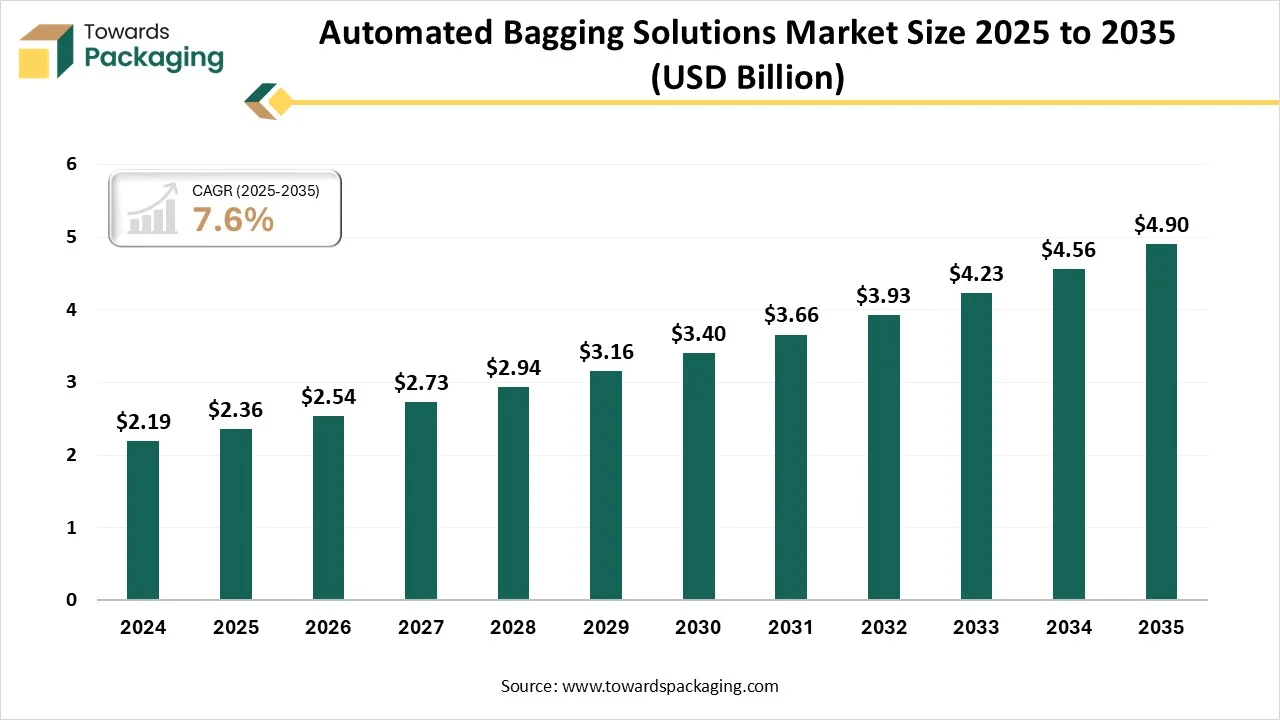
The automated bagging solutions market is witnessing rapid growth due to a focus on equipment and systems that automatically fill, seal, and label bags in a variety of industries, including manufacturing, food, pharmaceuticals, and e-commerce. The market is growing as businesses manage increasing production volumes while looking for faster packaging, consistent quality, and lower labor costs. Adoption of automated bagging systems is being aided by the growing demand for customizable and adaptable packaging formats. The efficiency and dependability of the system are also being improved by developments in robotics, smart sensors, and integration with digital production lines.
Manufacturers of automated bagging systems rely on a mix of steel, aluminum, electronic components, sensors, and robotic parts sourced from both global and regional suppliers, with sustainable sourcing gaining focus to reduce costs and carbon footprint; key players like ABB and Siemens help drive sensor and automation component innovation.
Automated bagging solutions are increasingly used by government agencies and airlines for secure, fast, and accurate baggage and cargo handling, requiring highly reliable systems that meet strict safety and traceability standards; key players such as Vanderlande and Siemens Logistics lead in airport and government automation deployments.
Aftermarket support is a major value driver with services like maintenance, software updates, retrofits, and training to ensure long-term reliability and reduced downtime; key providers like Bosch Packaging Technology and Rockwell Automation offer extensive service networks and upgrade options.
| By Product Type Segments | Market Share 2025(%) |
| Vertical Form Fill Seal (VFFS) Machines | 40% |
| Robotic Automated Bagging Systems | 25% |
| Other Product Types | 35% |
The vertical form of fill seal (VFFS) machines segment dominate the market with around 40% share in 2025, because they can handle a wide range of bag sizes and types, guarantee consistent product filling, and automate high-volume packaging. Their speed, efficiency, and dependability make them popular in sectors like food and pharmaceuticals production line automation is further improved by VFFS machines ability to integrate with labeling and coding systems.
The robotic automated bagging systems segment is expanding at the fastest CAGR during the forecast period, as businesses use cutting-edge automation to increase labor efficiency, accuracy, and flexibility. AI and smart robotics integration increases demand across industries by enabling customization and lowering manual intervention. Additionally, these systems increase versatility by enabling easy adaptation to various product shapes and packaging formats.
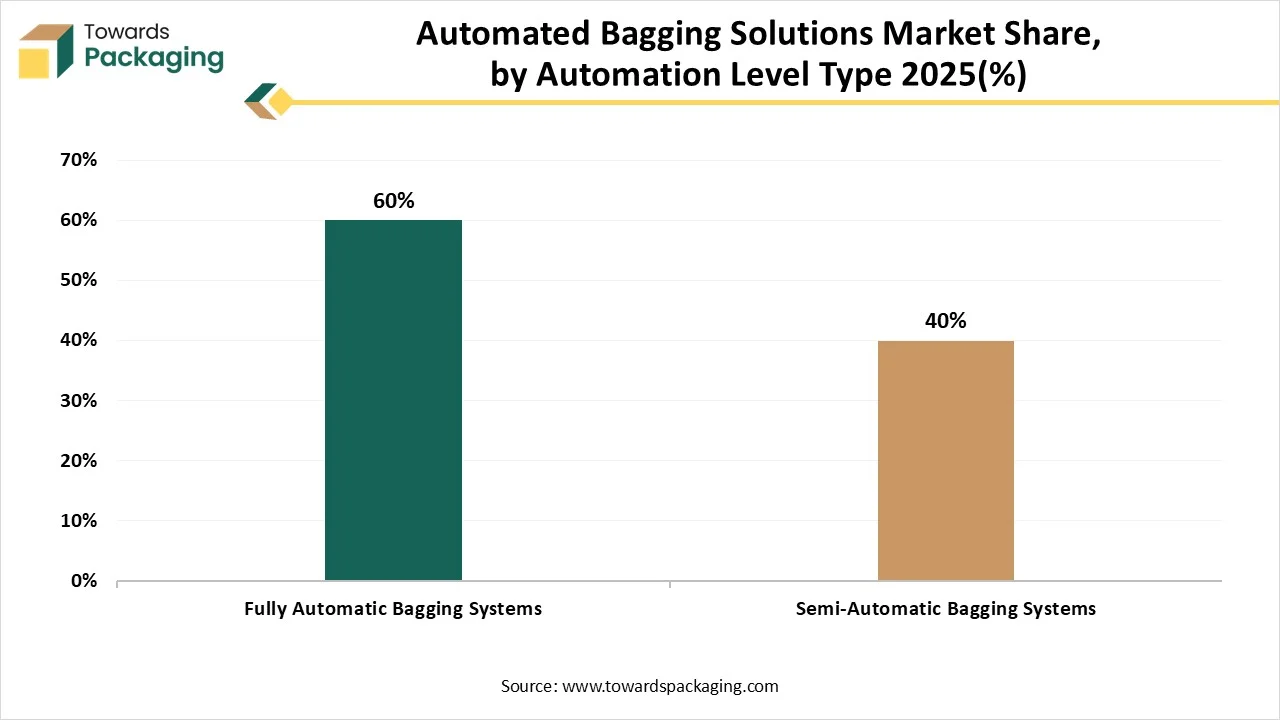
Fully automatic bagging segment systems hold an approximately 60% market share in 2025 because of their great productivity capacity to manage large quantities and lower labor needs. They are particularly well-liked in fast-paced production settings where consistency and dependability are essential. Market dominance is further reinforced by ongoing technological advancements, such as improved control systems.
The semi-automatic bagging systems segment is growing at the fastest CAGR during the forecast period, as small and medium enterprises adopt them to balance automation benefits with lower capital investment. These systems provide flexibility and cost efficiency for lower-volume or specialized packaging operations. Their compact design and easier maintenance make them ideal for a smaller facility and an emerging market.
| By Bag Type Segments | Market Share 2025(%) |
| Pillow Bags | 35% |
| Stand-Up Pouches | 30% |
| Other Bag Types | 35% |
The pillow bags segment dominate the market with around 35% share in 2025, favored for their straightforward design, effective packaging, and compatibility with a variety of goods such as powders, grains, and snacks. High customer acceptance and ease of production contribute to their popularity. Additionally, they work very well with automated bagging machines, guaranteeing constant throughput and quality.
The stand-up pouches segment is growing at the fastest CAGR during the forecast period, due to their superior appearance, ease of use, and resealability, all which appeal to contemporary consumer tastes. Their fast expansion is being driven by growing adoption in the food and beverage and cosmetic industries. Adoption is accelerated by the growing need for multi-layered, environmentally friendly packaging.
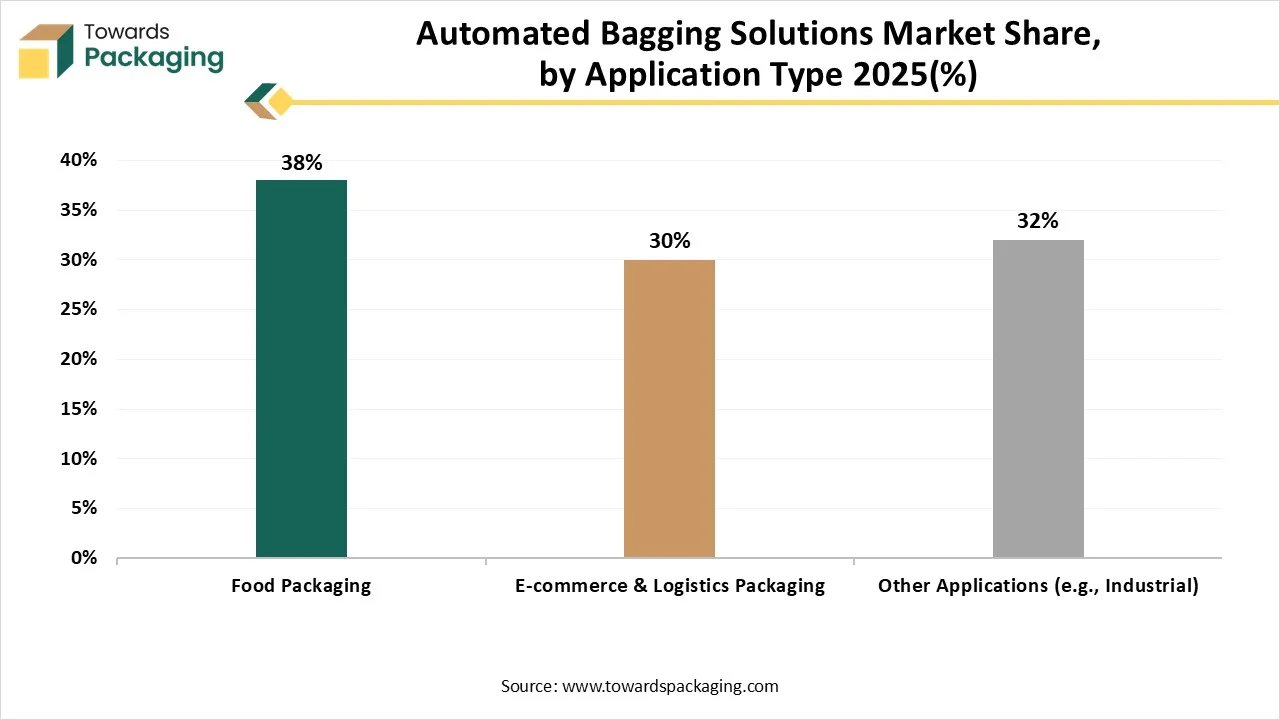
Food packaging segment dominates with around 38% share in 2025, driven by the widespread demand for quick, hygienic, and effective packaging options for grain snacks and processed food. This market is supported by strong demand in both developed and emerging markets. Growth in this category is further supported by the increase in packaged and ready-to-eat food items.
The e-commerce & logistics packaging segment is growing at the fastest CAGR during the forecast period, driven by the rise in online shopping worldwide and the demand for quick personalized packaging solutions. Automation helps handle a range of products and reduces shipping errors. Growing customer demands for accurate and timely deliveries are driving the adoption of automated systems.
| By End-User Industry Segments | Market Share 2025 (%) |
| Food & Beverage Industry | 40% |
| Retail & E-commerce | 35% |
| Other Industries (e.g., Industrial) | 25% |
The food & beverage industry segment dominates the market with 40% market share because of the high demand for quick, hygienic, and effective packaging solutions. Manufacturers can lower labor costs, maintain food safety regulations, and increase packing speed with automated bagging. This market dominant position is further reinforced by the rising consumption of packaged foods and ready-to-eat items.
The retail & e-commerce segment is growing at the fastest CAGR during the forecast period; automation is being used more by online retailers to increase order fulfillment accuracy and meet rising demand. Growth is being driven by the need for flexible, fast packaging solutions. Automation is essential for this industry due to seasonal demand fluctuations and growing trends in online shopping.
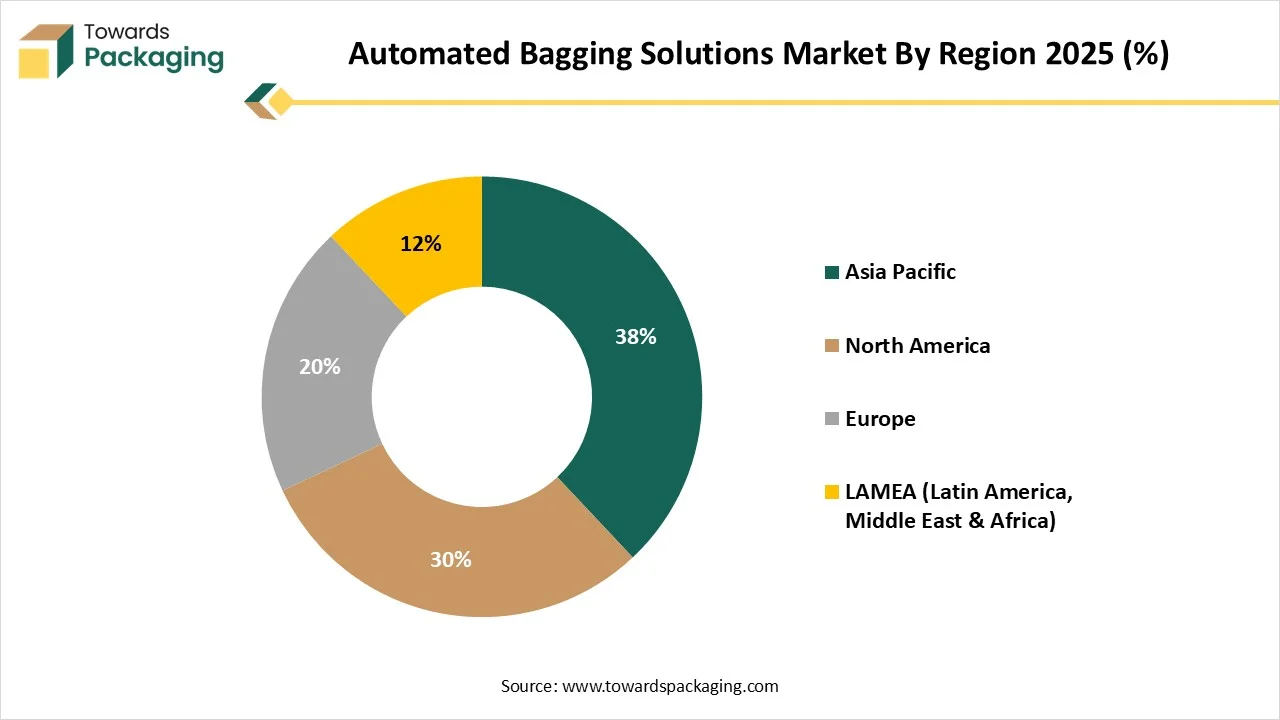
Asia Pacific dominates with around 38% market share due to its growing manufacturing base, strong demand from the food and beverage industries, and rising automation adoption in nations like China and India. Market leadership is reinforced by cost advantages and large production facilities. The market is further strengthened by government assistance with infrastructure development and industrial automation.
India Automated Bagging Solutions Market Trends
In India automated bagging solutions market is growing steadily, driven by the quick growth of the food processing industry, the increase in packaged food consumption, and the growing use of affordability and suitability for high-volume snack and grain packaging. Vertical form fill seal (VFFS) machines are the industry standard; however, small and mid-sized manufacturers are starting to adopt semi-automatic systems. Market adoption across manufacturing hubs is being further supported by government initiatives like Make in India and the increasing demand for e-commerce fulfillment.
North America expects the fastest growth in the market during the forecast period, driven by e-commerce packaging growth, robotic bagging solutions for widespread use, and technological advancements. The emphasis on sustainability, efficiency, and customization is fostering quick expansion. Regional expansion is also fueled by rising investments in Industry 4.0 programs and smart factories.
U.S. Automated Bagging Solutions Market Trends
In the U.S. market, demand centers on high-speed data-driven automation that integrates with smart factories and warehouse management systems. Companies prioritize precision, uptime, and software to enable customization to support omnichannel distribution and same-day delivery models.
Europe is a dominating market for automated bagging solutions, driven by the food, pharmaceutical, and industrial packaging industries robust demand for high automation standards. The regions emphasis on effective quality assurance and environmentally friendly packaging methods encourages the extensive use of cutting-edge bagging systems. Market leadership is further reinforced by ongoing improvements to the infrastructure and logistics.
Germany Automated Bagging Solutions Market Trends
Germany is dominating the market, propelled by a strong emphasis on industrial automation and a highly developed manufacturing ecosystem. Large manufacturers of industrial goods, chemicals, and food processing contribute to the ongoing need for accurate and fast bagging systems. Efficiency, consistency, and adherence to stringent packaging regulations are given top priority by German manufacturers, who also promote ongoing equipment upgrades.
MEA demand is shaped by imports of dependent food supply chains and the need for durable packaging systems suitable for harsh operating conditions. Automated begging is increasingly used to improve consistency and reduce wastage in food, cement, and bulk material packaging.
UAE Automated Bagging Solutions Market Trends
The automated bagging solutions market in the UAE is supported by the country strong role as a regional trade and logistics hub. To increase packaging accuracy and speed, food processing facilities and high-volume distribution centers are implementing automated bagging systems. Demand is increasing throughout the packaging value chain because of ongoing investments in industrial automation and smart warehouses.
South America is a notable market for automated bagging solutions, supported by growing automation in consumer goods, packaging, agriculture, and food processing. Manufacturers are being pushed to switch from manual to automated systems by increasing production volumes and the need to increase packaging efficiency. Due to growing industrial and export-oriented packaging activities, nations like Brazil are at the forefront of adoption.
Brazil Automated Bagging Solutions Market Trends
Brazil is a notable and fast-developing market for automated bagging solutions, bolstered by its sizable consumer goods, food processing, and agricultural sectors. The nations robust demand for retail and bulk packaging for processed foods, sugar grains, and coffee is driving the transition from manual to automated systems. Export-focused packaging specifications aid in the expansion of the market.
Other Players
By Product Type
By Automation Level
By Bag Type
By Application
By End-User Industry
By Region





Research & Advisory Analyst
Yogesh Kulkarni is an experienced Research Analyst specializing in the packaging sector, with a strong foundation in statistical analysis and market intelligence. He currently contributes his expertise to Towards Packaging.
Learn more about Yogesh Kulkarni

Reviewed By
Aditi Shivarkar, with 14+ years in packaging market research, specializes in food, beverage, and eco-friendly packaging. She ensures accurate, actionable insights, driving Towards Packaging Analytics & Consulting 's excellence in industry trends and sustainability.
Learn more about Aditi Shivarkar

Automated Bagging Solutions Market
 Table of Content
 sales@towardspackaging.com
 +1 804-441-9344
 Download Sample
 Schedule a Meeting