


The China flexible packaging market is projected to grow from USD 46.79 billion in 2026 to USD 81.44 billion by 2035, expanding at a CAGR of 6.35% during 2026-2035. Our report explains the market in simple and practical terms, covering detailed segment data by material type, product format, and end-use industries such as food, pharmaceutical, and e-commerce packaging. It also provides regional demand insights across major Chinese provinces, along with analysis of leading companies, manufacturers, and supplier networks. In addition, the study includes competitive landscape evaluation, value chain analysis, production trends, and trade data, giving a complete understanding of how the market is developing.
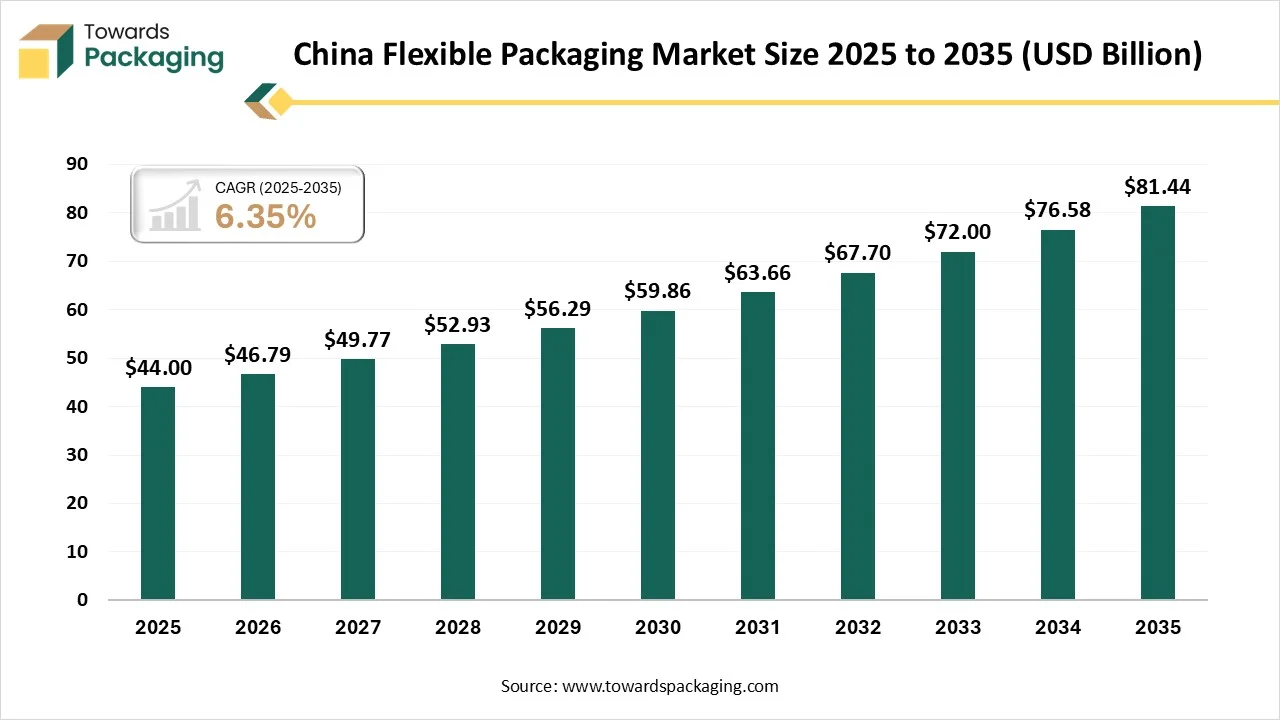
China flexible packaging states to the rapidly increasing, multibillion-dollar sector in China producing adjustable, lightweight, and cost-operative packaging options such as films, pouches, and bags mainly for pharmaceutical, personal care, food and beverage industries. This sector is majorly influenced by the rising demand for sustainable resources, and it is shifting in the direction of environment-friendly, biodegradable choices and progressive, enhanced-barrier plastics to increase product shelf life and fulfil e-commerce requirements. These are majorly used for food, and it is also famous among producers of pharmaceutical items, nutraceutical, household, cannabis, personal care, cosmetics, and vitamins. Moreover, flexible packaging has several industrial usages, mainly in the chemical and agricultural market sectors.
By the time, traditional approaches are shaping into new advancements, welcoming upgraded processes and solutions to the market. The new technology leaves a great impact on the potential areas, sharpening the practices and encouraging customization to support personalized packaging designs. This is a smart strategy to win the e-commerce game, enabling startups and existing market leaders to compete in the long run in the market. The intelligent and eco-friendly materials are promoting the use of AI that helps these growth aspects to enhance recycling and establish biodegradable materials.
The AI-sponsored systems are a saviour of machine maintenance that enhances the OEE. The regional AI pilot policies are a force for the supply chain area that encourages accurate resource unification in the state-owned company and tech markets. The role of AI-powered robots is popularizing the automation growth factor.
Technological transformation in the China flexible packaging market plays a significant role with the development of recyclable content for packaging purpose. Incorporation of post-consumer recycled resins as an eco-friendly substitute in the packaging industry has raised the demand for expansion of this market. Development of enhanced barrier and compostable materials with advanced technology for monitoring the integrity of the packaging. Acceptance of advanced packaging technology for real-time pursuing, product security, and, anti-counterfeiting.
The major raw materials utilized in this market are polyethylene terephthalate polypropylene, polyethylene, paper, aluminum. There is a huge demand for high-barrier and lightweight packaging materials.
The component manufacturing in this market comprises resealable strips, spouts, degassing valve, and zippers. Major companies are handling the complete procedure starting from raw materials to pouch converting, printing, and laminating.
This segment ensures one-stop-solution to meet the demand of the consumers for their convenience and enhance its distribution process. It comprises combined designing, production process and logistics for fast delivery.
The breathtaking contributions involve a green and clean approach, highlighting the GB 23350-2021 regulations. This introduced recycling procedures, biodegradable materials and impeccable bio-based polymers, focusing on sincere contribution to the environment. The alliances for the same concern are underlying the regional market leaders’ strategy. The growing number of food delivery and online shopping is paving the way for more opportunities for the regional packaging line.
Most of the brands invest in sustainable lightweight bag packaging options to support both the ecosystem and consumers' demand. This simultaneously serves both with satisfaction. The flexography flexes the interest of the regional sector in the digital printing solutions.
The innovations are a main strength of the sector, involving digitalization and modern manufacturing growth. The popular use of MDOPE films and recyclable mono-material structures is the best-in-class sustainable alternative to the sector. The AI role and IoT-influenced manufacturing are together accelerating the tech-driven trends. The use of RFID and QR codes is a great traceability innovation, promoting smart advancement for safety and promotion purpose. The brilliant investment, like Amcor, has brought laser scanners into the limelight to stand true to the environmental standards with more precision and care.
The innovation in the market is the use of flexible pouches due to the growing personal care and cosmetics sector demanding a sustainable packaging option suitable for recycling. The high-barrier solutions are a popular innovation driven by the export assignments' needs and regulatory mandates. The smart packaging is a ‘cherry on the cake’ for the market’s continuous development, which needs to promote updates via accessibility to raise awareness of the product and packaging.
The utilization of smart films and anti-counterfeiting is a safety measure for the product, highly encouraged by the growing electronic, pharmaceutical, and food sectors. The advantage of traceability and freshness protection/monitoring systems for the sensitive health-related goods is fuelling the momentum of awareness and modern development in the market. Robotics are the extended hands for production facilities.
The perfection of bio-plastics and sustainable coatings is unlocking the potential of the R&D sector and gaining some responsible traction in the market growth. While the AI unified intelligent manufacturing is driving tech-driven revenue to the market, leading to valuable expansion in the various popular sectors.
Advancements in this market are promoting the modern adhesives featuring the transformation in water-related and solvent-free adhesives. The advancements are a robust combo featuring the excellence of each approach, marking its dominant impression on the market, be it active packaging or sustainability, enhancing the pitching of the material. While the customization and digital printing stay at the heart of the market, highlighting some of the colorful packaging experience for the manufacturers to learn and consumers to enjoy.
The green and clean transitions are driving valuable investments in recycling technologies and bioplastics. The local R&D and digitization are featuring the capacity and idea of domestic product development. This resolves the disturbance in the packaging line. The modernizing changes are drawing popular sectors' attention towards the advanced automation for a great packaging outcome.
Following this, the massive investment and acquisitions for the tech-savvy expertise and technologies themselves are bolstering the market. The popular Amcor expansion motivated the eco-friendly solution, such as heat recovery systems, to further support the market’s future endeavours.
The plastic segment dominated the market with highest share in 2025 due to its moisture barrier, toughness, and excellent flexibility properties. These are considered as suitable packaging option for a wide range of industries. These are widely used for packaging of fragile products to avoid any damage while transporting. These materials are widely available and cost effectiveness which has enhanced the adoption of this segment.
The bioplastic and compostable material segment is expected to grow at the fastest CAGR during the forecast period. This segment is growing due to increasing ecological concern among huge number of consumers. Rising corporate sustainability goals to reduce the utilization of plastics has influenced the demand for such bioplastic material. Rapid growth of e-commerce sector has which has enhanced the demand for biodegradable and compostable packaging. Enhanced investment in production capacity for biodegradable resources.
The bags and pouches segment dominated the market in 2025 due to rising expansion of e-commerce and food & beverage sector. These are considered as convenient as well as portable packaging for consumers and also comes with zipper lock. It offers huge production scalability which is making them suitable for mass-market usages. Strict government guidelines have pushed the utilization of such packaging to reduce the wastage of raw materials. It helped in extending the shelf life of the packaged products.
The sachets segment is expected to grow at the fastest CAGR during the forecast period. This segment is growing due to suitability, single-serve convenience and cost-effectiveness. It allows lesser-income customers and those living in lesser-tier cities to entree first-class products and international brands through inexpensive, smaller shares. It required less raw materials for manufacturing which led to low wastage of materials. Rising concern for personal care has pushed this product type of packaging. Single-serve convenience has raised the demand for this segment.
The food segment dominated the market with highest share in 2025 due to increasing food delivery platforms. Rising concern for food safety and preservation has led to rising production demand of this packaging service. These films offer crucial barrier shield against contaminants, moisture, and oxygen. The rapid shift towards recyclable packaging has fuelled the for this flexible packaging industry. These are cost-effective solution available for the packaging of the food products. These packaging are widely used for the packaging of perishable products to enhance their shelf life.
The personal care and cosmetics segment is expected to grow at the fastest CAGR during the forecast period. This segment is growing due to its sustainability, lightweight, and cost-effectiveness. There is a huge demand for customization in this sector such as pouch packaging, sachet, and tubes with enhanced barrier protection potential. These are widely utilized for the packaging of products such as lotions, creams, and serums. Increasing demand for premium packaging in this personal care and cosmetics industry has pushed the demand for innovation in such packaging industry.
The flexography segment dominated the market with highest share in 2025 due to its versatile nature, cost-effectiveness, and high-speed. The rapid change towards UV-curable, environment-friendly, and water-based inks makes flexography printing technology highly ideal for sustainability commands in China. The printing technology manages a wide variety of resources, comprising aluminum foil, plastic films, and paper which are important for bag and pouch production. Its capability to utilize environment-friendly inks, print on varied substrates, and fulfil urgent, huge-volume demands influenced its leadership.
The digital printing segment is expected to grow at the fastest CAGR during the forecast period. This segment is growing due to increasing demand for personalized packaging and small-batch production process. Rapid expansion of e-commerce sector has raised the utilization of this segment for unique brand image establishment. It decreases setup times and permits for short-run manufacturing, which supports brands to reduce inventory charges and quick respond towards changes in the market. Digital technology outshines in offering flexible data printing for customized branding.
China witnessing rapid growth in the market, due to presence of huge manufacturing raw materials. Rapid shift in the direction of environment-friendly, smart, and high-performance materials, comprising biodegradable choices to fulfil new and stricter ecological guidelines. Rising demand for on-the-go and frozen products necessitating focused, convenient, and sustainable packaging. Major drivers comprise huge demand from the e-commerce, food, and pharmaceutical industries which is combined with cost-effective, high-volume manufacturing and rapid acceptance of progressive as well as sustainable technologies. China needs huge quantities of durable, cost-operative, and lightweight flexible resources.
By Material Type
By Product Type
By End-User Industry
By Printing Technology








Principal Research Analyst
Vidyesh Swar is a Senior Research Analyst at Towards Packaging, bringing over 4 years of dedicated expertise in market intelligence and strategic analysis across the dynamic world of packaging technologies and solutions.
Learn more about Vidyesh Swar

Reviewed By
Aditi Shivarkar, with 14+ years in packaging market research, specializes in food, beverage, and eco-friendly packaging. She ensures accurate, actionable insights, driving Towards Packaging Analytics & Consulting 's excellence in industry trends and sustainability.
Learn more about Aditi Shivarkar

China Flexible Packaging Market
 Table of Content

 Download Sample
 Schedule a Meeting