


The fiber-based caps market is projected to grow from USD 1.2 billion in 2026 to USD 2.18 billion by 2035, registering a CAGR of 6.9% during the forecast period. This report provides comprehensive insights including detailed market size analysis, segmentation by material and end-use, regional performance across key geographies, and in-depth company profiling. It further covers competitive landscape evaluation, value chain analysis, trade data, and detailed insights on manufacturers and suppliers, offering a complete view of the evolving market dynamics driven by sustainability trends.
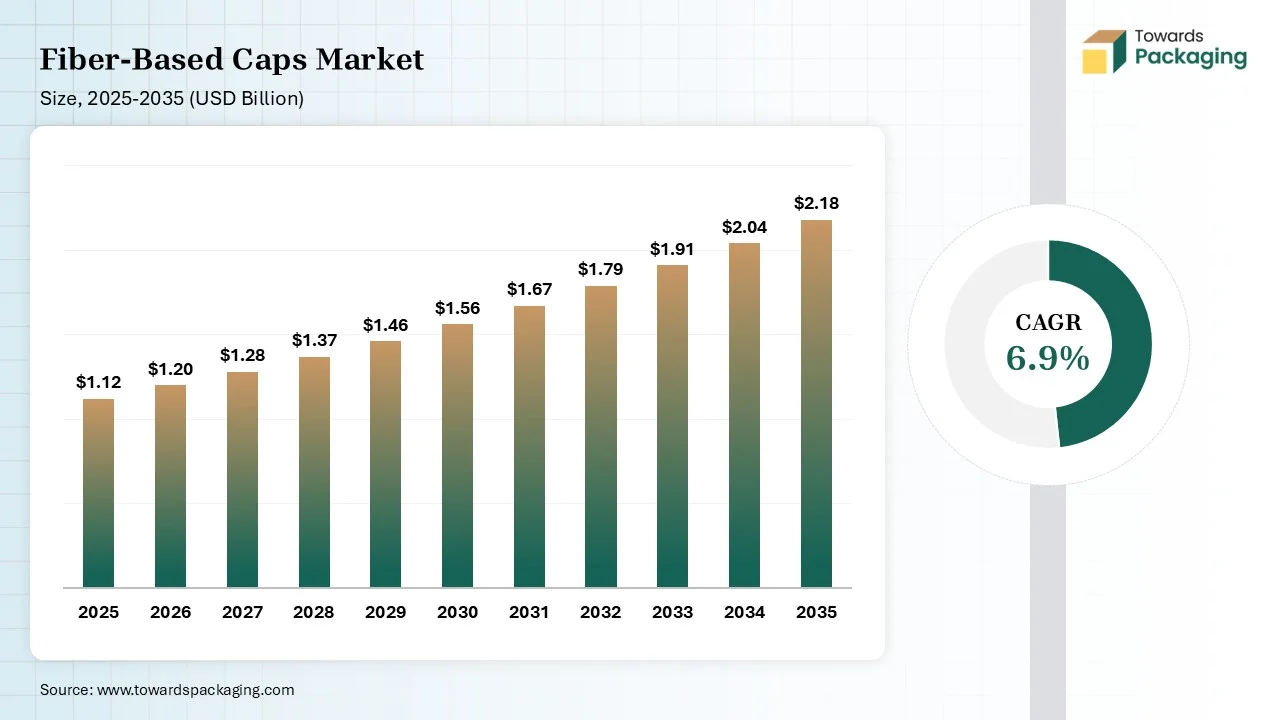
Market Size (2025): USD 1.12 Billion
CAGR (2025–2035): 6.9%
Market Volume (2025): 48.6 billion Units
Market Volume CAGR (2025–2035): 6.2%
Pricing Data (2025):
Fiber-dependent caps are recyclable, sustainable closures that are produced from wood-based cellulosic and renewable fibers instead of plastic. Created from a vacuum press or dry molding, these kinds of caps serve as rigid, functional choices that are crafted to copy plastic link sealing and engagement reliability while mixing smoothness into current paper recycling procedures.
The current fiber-based caps are crafted to serve a tangible experience as compared to plastic. Packaging achievements are not only about sustainability analysis but also about tracking or developing consumer experience. By receiving such a balance, fiber-based caps can grow acceptance across several industries that include cosmetics, food, beverages, and household items.
Brands are increasingly adopting fiber-based caps to reduce plastic waste and improve environmental sustainability.
Manufacturers are focusing on recyclable, compostable, and renewable raw materials for cap production.
Advanced coatings are improving moisture resistance, durability, and product protection in fiber caps.
Beverage and packaged food companies are using fiber-based closures to meet eco-friendly packaging goals.
Flexible paper solutions have frequently dominated headlines, as rigid fibre-based packaging, which includes containers, trays, and secured elements, is driving some of the perfect and exciting inventions in the industry. Its request lies in the recyclability, power, and the potential to include barriers that completely protect against grease, moisture, and oxygen.
Fiber-based packaging is more than just a demand in industry, as they are an unavoidable change for the circular economy. With constant cutting-edge inventions in molding technologies, PFAS-free barrier solutions, and recyclability, fiber packaging is perfectly suited to substitute plastics in several applications. Partnerships between start-ups, industry leaders, and research companies such as CPI will be complicated to create, and such moves will be sustainable and scalable in nature.
Screw caps segment dominated the market with 38% share in 2025, as they are made of cellulose fibers. Additionally, they have good-quality biodegradable, biobased paper products and recyclables, and also a cost-effective nature that is scalable in low-volume manufacturing methods, which are meant for high volumes. In terms of advantages, they are functional and sustainable, making them a perfect possibility for primary acceptors as a sustainable cap.
The snap-on-caps segment held the 24% market share in 2025 because fiber-based snap caps have developed as a crucial invention in the scenario of disposable products, which has updated the path to safety and convenience. Small but significant elements provide a multitude of goals across various industries from medical supplies to food packaging. In the food and beverage sector, snap caps develop packaging by ensuring product freshness while delivering ease of use.
The dispensing caps segment held the 21% market share in 2025 because fiber-based dispensing caps have moved from regular design choices to strong legislative and technical demands. Closures such as lotion pumps, flip-tops, and trigger sprayers are totally dependent on multi-material assemblies such as plastic caps, which are perfect with internal steel springs or silicone valves that are totally impossible to recycle smoothly. Current sustainable dispensing caps solve such issues by using post-consumer recycled resins (PCR) and bio-based choices.
Virgin fiber segment dominated the market with 46% share in 2025. It is made from raw materials instead of recycled ingredients. Such fibers are manufactured by chemically or mechanically pulping plants, frequently wood, but also from non-wood plants like sugarcane residue, bamboo, rice husks, and wheat straw. Virgin fibers are sourced from virgin materials, which point to cellulose fibers that are never utilized or even processed before. They come from plant links to generate constant paper pulp and qualities that are specifically insightful in sustainable food packaging uses.
The recycled fiber segment held the 34% market share in 2025 because wood-fiber plastic mixes plastic with wood fibers, such as wood pulp or recycled wood fibers. Such a mix makes a classified texture. Wood-fiber plastic cosmetic caps have felt cozy and more natural compared to smooth fossil-dependent plastics. In terms of cosmetic packaging, the overall feel of the product matters a lot. The raw material serves a matte look and “wood appearance” which differentiates it.
The hybrid fiber segment held the 20% market share in 2025 because it mixes organic and inorganic polymers and ceramics with micro-fibers to block oxygen, moisture, and heat. Such systems have filled the minute gaps sought in single-material coatings to mainly stretch substrate lifespans. Multi-layered mineral fillers have forced moisture and gas molecules into the biggest paths and suddenly cut complete permeation amounts.
The 30-50mm segment dominated the market with a 37% share in 2025, as they are standard in size and ideal for personal care and food packaging. Manufacturers have updated tooling machines for this size so that they accurately match several containers. Due to this, the FMCG industries have accepted them as a perfect size for closure.
Up to 30mm segments held the 29% market share in 2025 because they are widely utilized in pharmaceuticals and bottled beverages. Additionally, it has adjusted designs that have assisted mass manufacturing lines that urge constant demand across the FMCG sector. Its overall compact designs get adjusted for many applications and are hence used as a sustainable closure type.
The 50-70mm segment held 21% market share in 2025, as these closures are widely used in condiments and food storage that uses larger closures. It has demand in wide-mouth packaging that has driven the demand for various uses, so that these closure sizes are ready to serve quick-service restaurants and on-the-go meal consumption services. Consumers choose them for convenient packaging that has increased their acceptance.
The food and beverage segment dominated the market with 44% share in 2025, as the developing demand for fiber-rich items is being driven by the integration of scientific validation, user awareness, and lifestyle updates. Developed official research around gut health and the actual microbiome has delivered fiber into the spotlight, positioning it as a main element of daily nutrition instead of a main dietary demand. Currently, in many markets, nutritional labelling and regulatory frameworks are placing a higher importance on fiber content, which has further reemphasized its high importance.
The personal care & cosmetics segment held the 18% market share in 2025. Fiber-based packaging is the most reliable solution to plastic pollution, which is applicable to lip-care products and several other cosmetics that exist in fiber-based packaging, such as biodegradable paper tubes. Such materials have served mainly to develop an eco-friendly profile, as they are marine biodegradable, which means they will not contribute to microplastic pollution even if they penetrate the aquatic environment.
The pharmaceuticals segment held the 14% market share in 2025, with one of the driving areas of growth in sustainable pharmaceutical packaging is the application of biodegradable and bio-based materials. Such environment-friendly options are created from renewable links like plant-based, cellulose polymers, and compostable films, which are excessively used in applications that do not need direct link with medications.
For instance, this Tully Tube is constructed initially from responsibly linked cellulose fibers, which lessens dependency on petroleum-based plastics and assists in the renewable packaging supply chain. They are crafted to be conveniently recycled with the assistance of regular paper flows. The paper foundation of a Tully Tube has broken down in the surroundings, which delivers patients a solution to that.
The direct sales (B2B) segment dominated the market with a 52% share in 2025, as the feedback from users and retailers has been excessively positive. Shifting to an eco-friendly closure, which has led to a perfect response from customers, has opened the doors for the latest partnerships and development possibilities.
As companies have increasingly given environmental responsibility, fibre-based caps serve as a reminder that innovation in packaging can serve both commercial and ecological advantages. By using such solutions, the packaging sector has not only lowered its carbon footprint but also achieved sustainable commencement.
Distributors & Wholesalers segment held the 28% market share in 2025. Fiber-based packaging materials take advantage of natural elements of raw materials, such as bot recycled and fresh fibers, to make reliable packaging solutions, while using a lower amount of natural resources. Fresh fibers are more robust than recycled fibers and are used in more urgent supply chains, such as those involving heavy items that are transported overseas. To receive such exact power for fiber-based packaging, fewer fresh fibers are needed as compared to recycled fibers. This is the suitable solution for the products that shipped by air, by reducing the total weight.
The e-commerce segment held the 20% market share in 2025, as fiber-based caps, which include bottle screw closures and molded protective end caps, are quickly updating the e-commerce sector by matching the sustainability metrics with an overall cost-effectiveness. Single-use plastic caps have showcased a highly non-recyclable and fractured segment of e-commerce parcel waste. The move towards fiber engineering and advanced pulp enables online brands to gain a circular packaging system that aligns with the physical results of fossil plastics while lessening their total carbon footprint.
Europe dominated the market with 29% share in 2025 as the European Union will start implementing the latest packaging regulations beginning from August 12, 2026, as a part of broader efforts to reduce the packaging waste and market sustainability across its current member states. The principles, plotted in Regulation 2025/40 on Packaging and Packaging Waste (PPWR), will be incremental by the year 2040.
The regulation has revealed strong demands for labelling, sustainability, and conformity. One of the crucial goals is to make sure that every packaging kept on the EU industry is recyclable in an economic industry is stored by 2030. The principle's goal is to develop reuse and recycling rates, with a specific focus on reducing plastic wastage.
Trend Of Fiber-Based Caps Market In Germany:
Germany’s industrial scenario is defined by its leadership in Industry 4.0, rigid perfection to sustainability, and production excellence. The country’s actual digital transformation program allows producers to update the manufacturing procedure that lowers waste and implements fiber packaging solutions. Furthermore, Germany has given importance to circular economy rules and its rigid design for recycling and waste management to reinforce the acceptance of fiber-based packaging.
Asia Pacific held the market share of 25% in 2025 and expects the fastest CAGR of 7.8% during the forecast period, as the future of fiber-based caps remains highly promising, with growing demand for sustainable packaging solutions, growing industry uses, and technological inventions. Market companies are pushed to invest in research and development to make lightweight, biodegradable, and smart packaging options that are aligned with stringent environmental regulations and user expectations. Geographic development and step-by-step partnerships, particularly in growing markets, will be necessary for grabbing the latest growth possibilities.
Trend Of Fiber-Based Caps Market In India:
With developing environmental issues and strong plastic regulations, fiber-based caps are rapidly becoming a selected alternative for plastic packaging in India. Industries in the field like electronics, food packaging, agriculture, FMCG, AND E-commerce are moving towards recyclable and biodegradable packaging materials. The fiber-based caps industry in India is predicted to develop quickly in the future, which is being driven by plastic bans, sustainability trends, and the growing urge for e-commerce and the food service industry.
By Product Type:
By Material Type:
By Closure Diameter:
By End-Use Industry:
By Distribution Channel:
By Regions:








Research & Advisory Analyst
Yogesh Kulkarni is an experienced Research Analyst specializing in the packaging sector, with a strong foundation in statistical analysis and market intelligence. He currently contributes his expertise to Towards Packaging.
Learn more about Yogesh Kulkarni

Reviewed By
Aditi Shivarkar, with 14+ years in packaging market research, specializes in food, beverage, and eco-friendly packaging. She ensures accurate, actionable insights, driving Towards Packaging Analytics & Consulting 's excellence in industry trends and sustainability.
Learn more about Aditi Shivarkar


Fiber-Based Caps Market
 Table of Content

 Download Sample
 Schedule a Meeting