


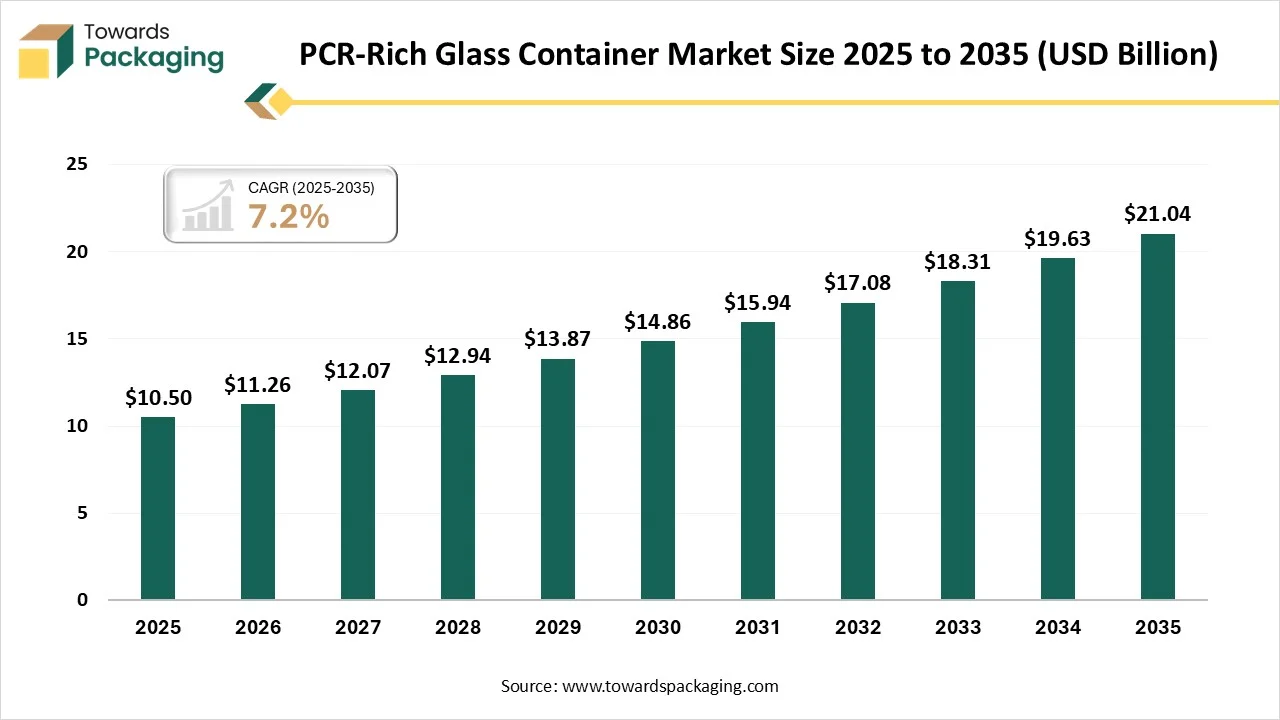
The PCR-rich glass container market is forecasted to expand from USD 11.26 billion in 2026 to USD 21.04 billion by 2035, growing at a CAGR of 7.2% from 2026 to 2035. The demand is due to the main benefit of a PCR packaging, which is its potential to change plastic waste from oceans and landfills, and standard user choice for sustainable options and ESG goals too.
PCR points to post-consumer recycled content, and it is saved from the end-user and then trashed, melted down, and used again. Post-consumer recycled or PCR-glass is created from cullet, which is actually a granular matter that results from crushed glass collected in recycling programs. Cullet, after collecting, gets mixed with the raw materials of glass (sodium carbonate, silica, carbon dioxide that comes from limestone, and lower amounts of other minerals too, in changing percentages, which is then melted and turned into the latest products.
The crossing of smart technology with cosmetic packaging serves as an exciting frontline. Strategies such as NFC tags for product information and checking, QR codes for refill instructions, and lastly smart sensors that manage usage or product freshness are being discovered. Additionally, the basic factors, hence, will stay in the physical containers known as the Cream Jar, which gets adjusted on a vanity, or the cosmetic bottle that is carried in hand. Producers who are constantly making corrections in these crucial products while using the latest trends in technology and sustainability are positioned for sustained leadership.
Package Design and Prototyping: PCR-recycled glass serves a level of satisfaction that plastic frequently cannot align with. Its clarity, weight, and soft result signal quality, which assist in clarifying the higher price amount, are perfect for a luxury skincare or an aromatherapy line.
Recycling and Waste Management: Recyclable cosmetic bottles created with a PCR are usually adopted in municipal recycling facilities, but their promising reuse relies on user participation and alertness. Packaging cleaning tips, such as rinsing items before recycling and classifying mixed materials, are necessary to make sure these products are processed accurately.
Logistics and Distribution: Digitization makes end-to-end transparency. Managing shipments, tracking manufacturing data, and checking the performance in real time enables fast feedback to disruptions. Automated systems also serve customers and regulators with relevant documentation.
The bottles segment has dominated the market in 2025 as several producers choose Thai glass bottles due to their several product integrity advantages. Like plastic bottles, glass bottles prevent oxidation. The growth of PCR-glass bottles has marked a major defining status in the beauty sector, with a move towards sustainability. They show more than just an aesthetic satisfaction, as they show a conscious effort to improve the globe without adjusting performance or quality.
The jar segment is expected to experience the fastest CAGR during the forecast period. Cosmetic brands that use PCR-rich glass containers signify a commitment to sustainable practices. This loyalty comes with users who have environmentally friendly values and discover a positive brand image with this. PCR materials constantly need less energy to generate, which lowers the production cost while matching the companies' green initiatives. On the other hand, these jars are prevalent and used to package different food and drink products. Sauces, beverages, and condiments taste better in terms of PCR-rich glass jars because of their nonporous feature.
The beverage industry segment has dominated the market in 2025 as the main benefit of these glass bottles is that they 100% recyclable in nature. The potential of glass, which is reused endlessly, makes it an effective material in the usage of sustainable development frames and policies. The PCr-rich glass bottles recycling process is also a closed loop, which makes no by-products, and it is one of the least materials that can be recycled without any loss of quality.
The cosmetics and personal care segment is expected to witness the fastest CAGR during the forecast period. PCR materials can be used to produce a huge series of cosmetic bottles, personal care, and skincare packaging. With the assistance of advanced material filtration, rigid purity control, and constant research and development, various brands serve cosmetic-grade PCR materials, which align with International standards for stability, safety, and aesthetics, too. For beauty users who give importance to environmental responsibility, PCR packaging quickly talks about a brand’s loyalty to sustainability.
The medium (250 ml-750ml ) containers segment dominated the market in 2025, as this is ideal for laboratory and commercial settings, such sizes are counted as optimal as they are big enough to carry the main product volume while staying manageable for labelling and handling. PCR glass is created from a cullet. Good-quality PCr glass opposes the exact dimensional capacity and breaks the resistance as a virgin glass.
The small-format premium jars and bottles segment is predicted to witness the fastest CAGR during the forecast period. Such jars are accessible in different outcomes to receive a luxury appearance, which includes frosted, clear, or an opaque colour such as black. Several cap styles and colors, for example, silver and gold, can further develop the brand aesthetic. Using the PCR packaging mainly lowers the environmental impact. Producing products from recycled plastics uses at least 79% less energy and reduces greenhouse gas emissions by at least 67% as compared to using virgin plastic.
Europe dominated the PCR-rich glass container market in 2025, as there is a developing demand for energy-efficient and sustainable building materials. There are regulations that market green building initiatives and strict energy performance standards that surround the low-emissivity (low-E) and insulating glass, too. Additionally, the urge for the PCR (Post-Consumer Recycled) glass in Europe is growing and developing, which is encouraged by strong EU regulations such as France’s polystyrene ban and a surer choice for premium and sustainable packaging.
Germany is using the PCR-Rich Glass Container Market crucially
The demand for post-consumer recycled glass in Germany is developing in the current year, which is driven by the national encouragement for circular economy practices and strong EU-wide sustainability compulsions. The EU’s Packaging and Packaging Waste Regulation (PPWR) and German national goals have a goal for 25% recycled raw material usage in terms of glass manufacturing, which are initially drivers for high-PCr glass acceptance.
The PCR-Rich Glass Container Market is developing rapidly in the Asia Pacific because this development usually shows a fast movement away from purely volume-driven growth, which has shifted towards value-encouraging, sustainable, and luxury-driven uses that can command higher margins. The region’s beverage manufacturers have generally underlined the foundation demand. Furthermore, the industry is being driven by the strong urge in terms of the food, beverage, and cosmetics industry that has regulatory pressure on PCR-glass containers.
The PCR-Rich Glass Container Market is growing in India, as modern users are becoming more eco-conscious than ever. For an essential oil brand, this is a possibility to align with predictions while expanding their identity as they are “nature-gifted”. The cosmetic and personal care industry in the Indian market is excessively competitive, with numerous brands that serve similar products. PCR-rich glass container packaging serves brands a different edge. Hence, a recycled glass bottle or a biodegradable outer box quickly conveys care for both the user and the planet.
By Container Type
By End-Use Industry
By Capacity / Weight Category
By Region


Principal Research Analyst
Vidyesh Swar is a Senior Research Analyst at Towards Packaging, bringing over 4 years of dedicated expertise in market intelligence and strategic analysis across the dynamic world of packaging technologies and solutions.
Learn more about Vidyesh Swar

Reviewed By
Aditi Shivarkar, with 14+ years in packaging market research, specializes in food, beverage, and eco-friendly packaging. She ensures accurate, actionable insights, driving Towards Packaging Analytics & Consulting 's excellence in industry trends and sustainability.
Learn more about Aditi Shivarkar

PCR-Rich Glass Container Market
 Table of Content
 sales@towardspackaging.com
 +1 804-441-9344
 Download Sample
 Schedule a Meeting