


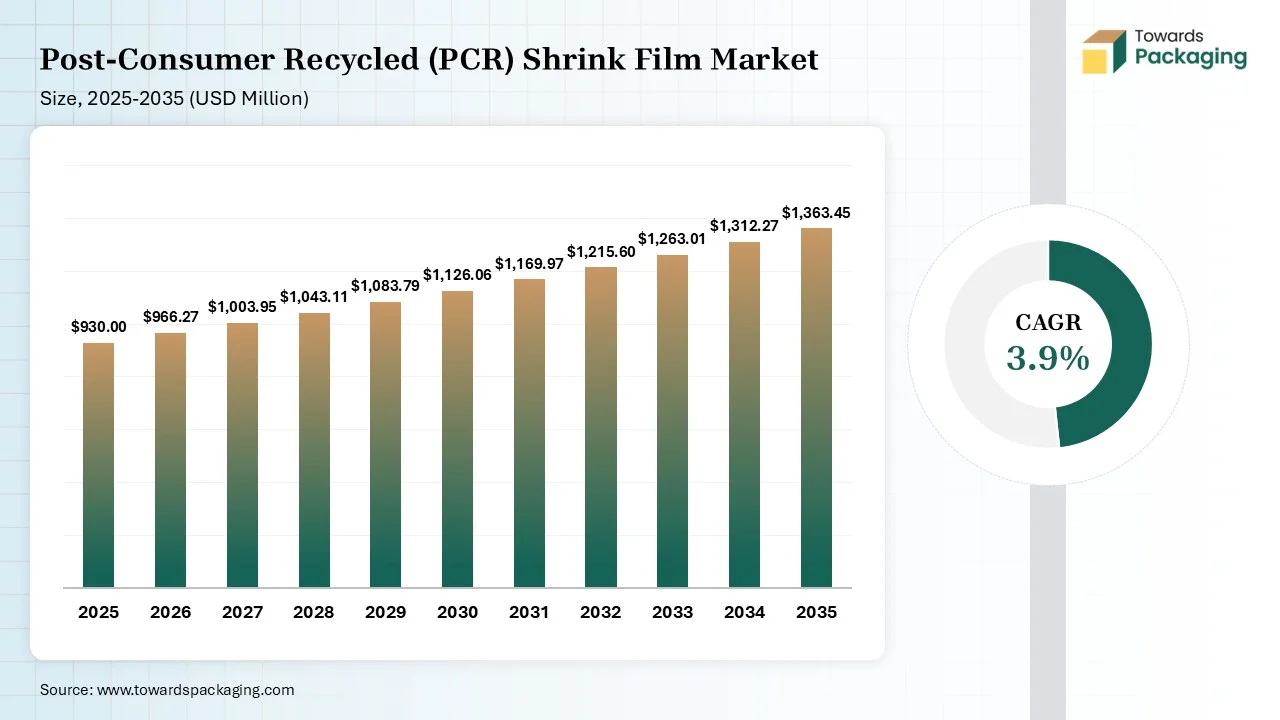
The post-consumer recycled (PCR) shrink films market is projected to grow from USD 966.27 million in 2026 to USD 1363.45 million by 2035, registering a CAGR of 3.9% during the forecast period. The report covers detailed segment data by material type, application, and end-use industries, along with regional insights across North America, Europe, Asia-Pacific, and other regions. It also includes company profiles, competitive analysis, value chain evaluation, trade statistics, and comprehensive data on manufacturers and suppliers, offering a complete view of market dynamics driven by sustainability goals and environmental regulations.
AI is a dedicated technology boosting the quality of the PCR shrink films aligned with the valuable inspection of recycled material to fit the regulatory rules. The AI-sponsored systems keep a close eye on defects, barrier consistency, and film thickness, which avoids misalignment with the packaging. The AI tools deal with the changes in the quality of recycled materials.
The AI models and algorithms are bolstering the recycling process and contribute largely to the operation and maintenance. The collected data by the AI models at the time of film conversion and extrusion. Alongside, it forecast the nature of the recycled resin blend. The monitoring of the production alters the downtime in facilities, creating advanced PCR content films.
Sustainability & Circular Economy Focus
Regulatory Pressure & Compliance
Brand & Consumer Awareness
Biodegradable shrink films are coming as an updated trend in the sector. Such inventive materials solve consumer issues about eco-friendly sustainability while serving results with more perfection than regular shrink film wraps. Food brands accepting such solutions often seek sustainable packaging to develop a brand point of view and cultivate customer commitment.
Apart from aligning with regulatory needs, such selections make measurable business value, which matches the surrounding responsibility with the profit insights. Additionally, E-commerce food packaging needs protection, accuracy, and shrink-wrapping technology, which has become necessary in making sure products come secure, fresh, and visually appealing. With the worldwide shrink wrap industry developing along with e-commerce, effective packaging has become a main factor in return rates, customer satisfaction, and brand reputation.
The polyethylene segment dominated the post-consumer recycled (PCR) shrink films market in 2025. Recycled PE, which is also known as recycled polyethylene, is a kind of plastic material that comes from post-consumer waste. They are prevalently used in the production of different products, such as containers, plastic bottles, and packaging materials. Recycled PE is manufactured by collecting utilized plastic products, cleaning and processing them, and then the melting procedure is used to make the latest plastic products. This procedure assists in lowering the amount of plastic waste that results in landfills and invests in a more eco-friendly and sustainable strategy to plastic manufacturing.
The polypropylene (PP) segment is projected to experience the fastest CAGR during the forecast period. Recycled polypropylene serves the main environmental advantages by reusing post-consumer and post-industrial plastic waste, by lowering the demand for new plastic manufacturing, and by reducing landfill disposal. Its reliability makes it perfect for a huge range of uses, which includes automotive parts, packaging, construction materials, and consumer goods, while investing in a more circular and sustainable economy. Several governing bodies around the world are making the use of recycled content in plastic products compulsory, particularly in packaging.
The secondary packaging / pallet wrapping segment dominated the post-consumer recycled (PCR) shrink films market in 2025, as PCR materials have protected plastic from penetrating waterways, landfills, and or incineration facilities. PCR makes an actuarial circular economy in which products complete their lifecycle and have the latest products. However, funding for accurate plastic materials that are demanded to be unpolluted contributes to the amount considerably. Manufacturing waste is generally uncontaminated, which makes it convenient to process into big-result products like Wrap stretch wrap.
The food and beverage packaging segment is expected to witness the fastest CAGR during the forecast period. PCRs are created from plastic waste that is collected from consumers, such as containers, bottles, and flexible films. Such material requires an expensive recycling procedure to avoid pollutants, which makes it a more complicated but necessary solution for lowering plastic waste in food packaging. The most typically checked material for food-contact uses a PCR PET, which is widely used for food containers and beverage bottles. HDPE is a rigid food-contact material that is specifically used in rigid packaging.
The medium gauge films segment dominated the market in 2025 as shrink film thickness is generally measured in miles, which is the same as one-thousandth of an inch. A higher mil thickness shows a stronger and thicker film. Shrink film is easily accessible in a series of thicknesses, from a range of 40 gauge (0.4 mil) to 12 gauge (12 mil). On the other hand, the 40-60 gauge is perfect for light-duty packaging for lighter and smaller products, such as small toys, DVDs, and CDs. 75–100-gauge range (0.75-1.0mil) is suitable for medium-duty packaging of products that are slightly bigger or heavier than those being packaged with a range of 40–60-gauge film. Instances count small electronics, cosmetics, and light tools, too.
The thin-gauge films segment is projected to experience the fastest CAGR during the forecast period. The weight and size of the product are being packaged, and this will encourage the thickness of the shrink film needed. Heavier or bigger items will surely need stronger and thicker film to serve the required protection. Products that are shipped for long distances or are meant for rough carrying may need a thicker film to deliver further protection during travel time. There are thickness ranges like 125-150 gauge, which are perfect for heavy-duty packaging of bigger and larger products such as industrial equipment, furniture, and automotive parts, and the second range, between 200-250, which is ideal for heavy-duty packaging of products like machinery and construction materials.
Europe dominated the post-consumer recycled shrink film market in 2025, as there is a developing demand for business continuity and operational agility. Companies are excessively accepting high-level machines to ensure unchanged operations and develop risk management. The growing complications of a business procedure are making smart and automated solutions necessary. Furthermore, the growing availability of the latest and tailored servings is lowering the acceptance barriers. As sectors continue to give importance to adaptability and smoothness, the urge for Europe's PCR films remains strong.
How is the Post-Consumer Recycled (PCR) shrink films Market Growing in Germany?
The German post-consumer recycled (PCR) shrink film is being designed by integrating regulatory assistance and growing user trends that have sustainability as their main focus. Government programs, such as tax breaks for organizations that accept recycled materials, are linked to regulations such as the EU’s Green Deal and Germany's Packaging Act, which are in favor of conditions for the development of recycled content packaging. Additionally, the move towards sustainable practices across sectors, particularly in the pharmaceutical and food industries, is growing the urge for foils and post-consumer recycled (PCR).
Food and beverage packaging has stayed in a dominant application industry for PET film worldwide. The material’s mixture of mechanical power, transparency, printability, and barricade elements makes it a selected substrate for a huge series of packaging designs, which includes laminates, pouches, lidding films, and labels. This move towards easy-to-eat and ready-to-eat food products is a trend that has developed in the urban markets across Asia and has further grown the urge for high-performance flexible packaging materials.
How is the Post-Consumer Recycled (PCR) Shrink Films Market Growing in India?
India’s post-consumer recycled (PCR) shrink films market is developing in India as they are experiencing main demand, which is driven by the developing urge for sustainable packaging solutions and eco-friendly regulations that promote recycling. The growing trends count on the development of biodegradable and biobased films as brands seek lower plastic wastage. Conventions in production procedures are developing the quality and elements of PCR PET firms, which makes them more competitive in terms of virgin plastics. Furthermore, the food and beverage industry is excessively accepting PCR PET films for the packaging to align with user choice for environmentally friendly products.
North America is considered to be a significantly growing area, due to its impeccable mono-material recyclable designs and downgauging technologies. The efforts of manufacturers are unifying a massive range of PCR in the shrink films. The smart alliances between film manufacturers and chemical industries are building a strong base of supply chains, helpful for market expansion. The modernized manufacturing is promoting the use of 5-layer extrusion lines that produce eco-friendly films featuring alternatives like recycle-ready and PCR.
U.S. Market Trends
U.S. trends in this market involve the need and demand of diversified sectors aiming for robust secondary packaging. The popular consumer products and beverages sector is driving demand for robust PCR shrink films. The participation of high-clarity polyolefin films follows the recyclable protocols with more dedication to the regional market trend. This film is suitable for the store drop-off recycling programs. While the constant transformation in polyolefin and PVC is accelerating perfection in the market.
The Middle East and Africa region is expected to grow at a notable CAGR in the foreseeable future, with its commendable exposure in the pharmaceutical companies addressing their need for PCR content in the perishable packaging. While the food and beverages sector is growing, with the demand for sustainable shrink films. This extended responsibility helps the market to explore the advanced potential in its operation. The valuable investments in the pharmaceutical production and molecular diagnostics are adding more value to the market dominance in the growing sectors.
Saudi Arabia Market Trends
Saudi Arabia’s trends are focusing on brand preferences and alternatives researches for replacing traditional plastics. The use of PCR-based materials is a popular benefit for the brands and an advancement for the market. The alliance trend for bolstering the local production to meet larger brands and consumers' needs is a spectacular idea for market growth.
By Material Type
By Application
By Thickness Type
By Region








Principal Research Analyst
Vidyesh Swar is a Senior Research Analyst at Towards Packaging, bringing over 4 years of dedicated expertise in market intelligence and strategic analysis across the dynamic world of packaging technologies and solutions.
Learn more about Vidyesh Swar

Reviewed By
Aditi Shivarkar, with 14+ years in packaging market research, specializes in food, beverage, and eco-friendly packaging. She ensures accurate, actionable insights, driving Towards Packaging Analytics & Consulting 's excellence in industry trends and sustainability.
Learn more about Aditi Shivarkar


Post-Consumer Recycled (PCR) Shrink Films Market
 Table of Content

 Download Sample
 Schedule a Meeting