


The semi-automatic stretch wrappers market is forecasted to expand from USD 1.09 billion in 2026 to USD 1.57 billion by 2035, growing at a CAGR of 4.1% from 2026 to 2035. The market is growing steadily as manufacturers and logistics firms adopt cost-effective, flexible pallet wrapping solutions to improve load stability, efficiency, and reduce labor costs. It’s driven by e-commerce, industrial automation, and sustainability trends, with strong demand in SMEs and expanding regions.
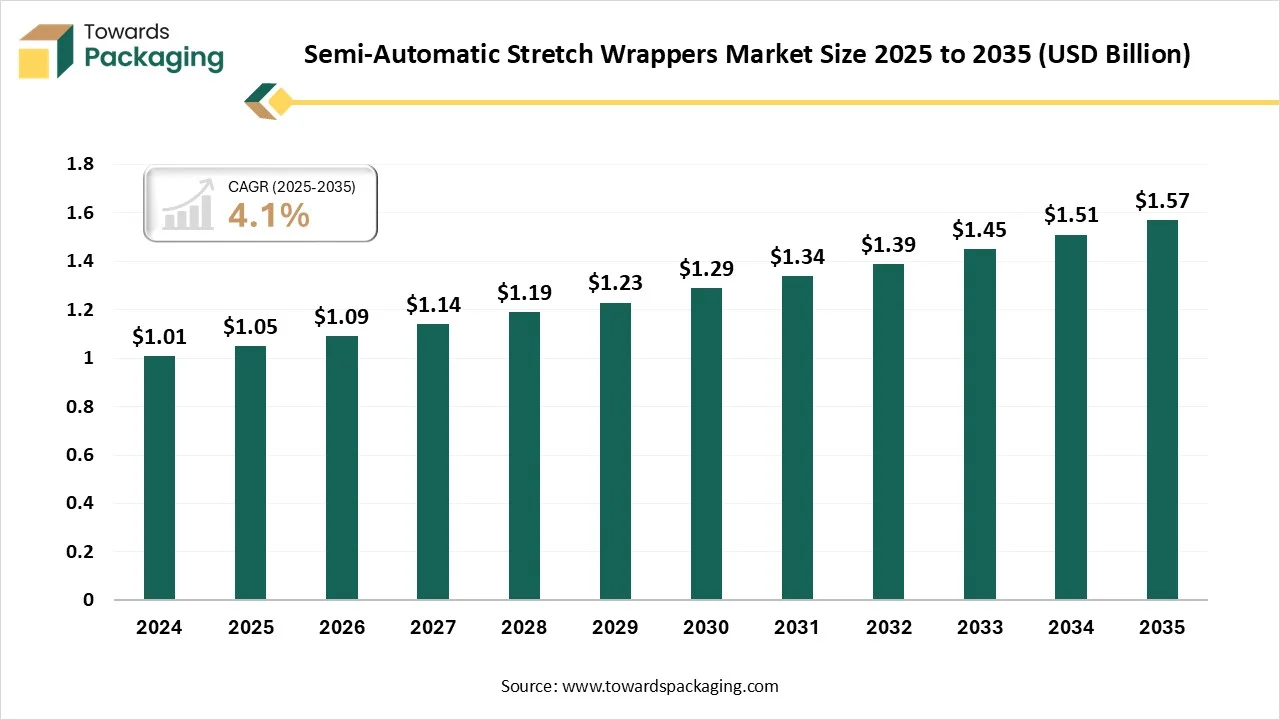
Semi-automatic stretch wrappers are packaging machines that wrap pallets with stretch film using partial automation, requiring manual loading while ensuring consistent, secure, and efficient load wrapping. The semi-automatic stretch wrappers market is growing due to rising demand for cost-effective packaging automation, increasing warehouse and logistics activities, expanding e-commerce, and SMEs seeking efficient pallet wrapping solutions that improve load stability, reduce labor effort, and minimize material waste.
Semi-automatic stretch wrappers are increasingly equipped with smart sensors and connectivity features that help operators track machine performance, identify maintenance needs early, and reduce downtime while improving overall packaging efficiency.
Manufacturers are designing machines that use stretch film more efficiently and support recyclable or eco-friendly materials, helping companies lower material waste, cut packaging costs, and meet growing sustainability and environmental compliance goals.
New models offer adjustable settings and modular components, allowing businesses to easily handle different pallet sizes, load weights, and packaging requirements without investing in multiple machines or extensive system upgrades.
Demand is rising for smaller, space-saving stretch wrappers that fit into warehouses with limited floor space, especially in urban logistics centers and small manufacturing units seeking efficient packaging without layout expansion.
Advanced pre-stretch mechanisms are being adopted to maximize film usage, ensuring better load containment while significantly reducing film consumption, material costs, and long-term operational expenses.
Manufacturers are prioritizing simple interfaces, touch-screen panels, and easy setup processes, enabling faster training, minimizing operator errors, and improving productivity even with less-skilled labor.
Semi-automatic stretch wrappers are increasingly designed to integrate smoothly with warehouse management and production systems, enabling improved workflow coordination, data tracking, and packaging process optimization.
Technological developments in the market include advanced film pre-stretch systems that reduce material use and improve load stability, smart sensors with IoT connectivity for real-time monitoring, and user-friendly touchscreen controls. Enhanced modular designs allow flexible adaptation to diverse pallet sizes, while integration with warehouse systems boosts automation. Safety features and energy-efficient drives further improve performance, reliability, and operational productivity.
Raw materials for semi-automatic stretch wrappers come from two sources: machine components like steel, motors, PLCs, and sensors supplied by industrial manufacturers, and stretch film materials made from LLDPE/LDPE resins sourced from petrochemical firms and converters.
The production of semi-automatic stretch wrappers relies on specialized plastic films, mainly LLDPE, which are processed and converted into rolls of suitable size for wrapping operations.
Package design for semi-automatic stretch wrappers aims to secure and stabilize products during transport using stretch film. The process includes prototyping and testing to ensure optimal film use and load integrity.
| Warehouse Aspect | Role of Semi-Automatic Stretch Wrappers | Key Benefit |
| Pallet Wrapping | Wraps palletized goods with consistent film tension | Improves load stability |
| Loading Area | Require manual pallet placement | Low equipment complexity |
| Packaging Speed | Faster than manual wrapping | Higher throughput |
| Labor Efficiency | Reduces physical effort for workers | Lower labor fatigue |
| Film Usage | Controlled film application | Reduced material waste |
| Space Utilization | Compact machine footprint | Fits small warehouses |
| Damage Prevention | Secure wrapping during transit | Lower product loss |
| Cost Efficiency | Lower investment than automatic systems | High ROI for SMEs |
| Segment | Market Share |
| Turntable semi-automatic stretch wrappers | 62.2% |
| Rotary arm semi-automatic stretch wrappers | 37.8% |
The turntable semi-automatic stretch wrappers segment holds the largest market share of 62.2% in 2025, because it offers a balance between cost and efficiency, making it ideal for small to medium-sized businesses. These machines require minimal manual effort while ensuring consistent load stability and reduced film usage. Their versatility, ease of integration into existing production lines, and lower investment compared to fully automated systems drive widespread adoption across logistics, manufacturing, and e-commerce sectors.
The rotary arm semi-automatic stretch wrappers segment is expected to grow at the fastest CAGR, due to its ability to efficiently wrap unstable or tall loads with minimal floor space. Its high-speed operation, consistent film tension, and ease of use make it ideal for industries like food & beverage, pharmaceuticals, and e-commerce. Growing demand for faster, space-efficient packaging solutions is driving adoption in both emerging and developed markets.
| Segment | Market Share |
| Standard height load wrappers | 72.3% |
| High-stack / tall load wrappers | 27.7% |
The standard height load wrappers segment led the market with a 72.3% share in 2025, because they efficiently handle the most common pallet sizes used across industries. Their versatility, cost-effectiveness, and ease of operation make them suitable for various sectors, including logistics, FMCG, and manufacturing. Additionally, these wrappers provide consistent load stability, reduce film waste, and integrate smoothly into existing packaging lines, driving their widespread adoption globally.
The high-stack/ tall load wrappers segment is expected to grow at the fastest CAGR during the forecast period, due to increasing demand for efficient packaging of taller and unstable loads in industries like e-commerce, food & beverages, and pharmaceuticals. These wrappers provide enhanced load stability, uniform film tension, and space-saving benefits, making them ideal for maximizing warehouse storage and transport efficiency. Rising adoption in emerging markets and growing industrial automation further accelerate their market growth.
| Segment | Market Share |
| Pre-stretch film systems | 64.4% |
| Non-pre-stretch film systems | 35.6% |
The pre-stretch film system segment held the highest market share of 64.4% in 2025 and is expected to grow at the fastest CAGR due to its superior material efficiency and cost savings. Pre-stretching film before application, it reduces film consumption while improving load stability and consistency. Industries such as logistics, manufacturing, and e-commerce increasingly prefer this technology for its ability to lower packaging costs, enhance productivity, and support sustainable packaging practices, driving strong adoption during the forecast period.
The LLDPE film segment contributed the largest market share of 56.8% in 2025, due to its superior stretchability, puncture resistance, and load-holding strength compared to other film types. LLDPE provides consistent wrapping performance while reducing material usage, making it highly cost-effective. Its compatibility with semi-automatic stretch wrappers, along with wide availability and recyclability, has driven strong adoption across logistics, manufacturing, and e-commerce industries.
The recycled/sustainable stretch film segment is expected to grow the fastest CAGR from 2026 to 2035, due to increasing environmental regulations and corporate sustainability goals. Companies are adopting eco-friendly packaging to reduce plastic waste and carbon footprints. Advancements in recycled resin quality and compatibility with semi-automatic stretch wrappers further support performance, cost efficiency, and broader acceptance across logistics, retail, and manufacturing sectors.
| Segment | Market Share |
| Food & Beverage | 38.8% |
| E-commerce & Retail | 23.0% |
| Pharmaceuticals & Healthcare | 15.0% |
| Automotive & Industrial | 10.0% |
| Consumer Goods | 13.2% |
The food & beverage segment dominated the market share of 38.8% in 2025, due to high packaging volumes and the need for secure palletization during storage and transportation. Semi-automatic stretch wrappers ensure product safety, hygiene, and load stability while handling diverse package sizes. Rapid growth in packaged foods, beverages, cold-chain logistics, and distribution networks further increased demand, driving higher revenue contribution from this segment compared to other end-use industries.
The e-commerce and retail segment is expected to grow at the fastest CAGR during the forecast period due to rising online shopping, increasing parcel volumes, and expanding fulfillment centers. Semi-automatic stretch wrappers support faster palletization, improved load stability, and cost-efficient packaging. Their flexibility and ease of use make them ideal for high-throughput, space-constrained warehouse operations, driving strong adoption across global e-commerce and organized retail supply chains.
The warehousing and distribution segment held the major market share of 54.4% in 2025 due to the growing need for efficient pallet handling and load protection across supply chains. Semi-automatic stretch wrappers help warehouses improve packaging speed, ensure load stability, and reduce labor dependency. Rising inventory movement driven by e-commerce, retail, and third-party logistics providers increased demand for reliable, cost-effective wrapping solutions, supporting strong adoption in warehousing and distribution facilities worldwide.
The third-party logistics (3PL) segment is expected to grow at the fastest CAGR during the forecast period due to rising outsourcing of warehousing, transportation, and fulfillment services. 3PL providers handle high shipment volumes and require flexible, cost-efficient packaging solutions to meet diverse client needs. Semi-automatic stretch wrappers offer quick deployment, consistent load stability, and lower operating costs, making them ideal for dynamic logistics environments and driving rapid adoption across global 3PL operations.
North America dominated the semi-automatic stretch wrappers market with 43.4% share in 2025 due to its well-established logistics and warehousing infrastructure, high adoption of packaging automation, and strong presence of manufacturing and e-commerce industries. The region benefits from early technology adoption, availability of skilled operators, and high focus on operational efficiency and workplace safety. Additionally, continuous investments in distribution centers and growing demand for cost-effective pallet wrapping solutions further supported market leadership in North America.
Why is the U.S. Accelerating Adoption of Semi-Automatic Stretch Wrappers Market?
The U.S. market is expanding due to rapid growth in e-commerce, large-scale warehousing, and advanced logistics operations. Companies are adopting semi-automatic systems to balance automation benefits with cost efficiency while addressing labor shortages. Rising demand for faster pallet handling, improved load stability, and reduced packaging waste, along with continuous investments in distribution centers and manufacturing facilities, is further driving market growth across the United States.
Asia Pacific is anticipated to grow at the fastest CAGR during the forecast period due to rapid industrialization, expanding manufacturing bases, and strong growth in e-commerce and logistics sectors. Rising investments in warehouses and distribution centers, especially in China, India, and Southeast Asia, are boosting demand for cost-effective packaging automation. Additionally, increasing adoption by small and medium enterprises, improving infrastructure, and growing focus on export-oriented manufacturing are accelerating market expansion across the region.
Why India Becoming a Key Growth Engine for Semi-Automatic Stretch Wrappers Market?
Indias market is expanding as businesses shift toward standardized palletized transport to reduce product damage during long-distance movement. Increasing use of third-party logistics, growth of cold storage facilities, and rising exports are encouraging the adoption of reliable wrapping solutions. Additionally, improved access to affordable machinery, growing automation awareness among small manufacturers, and demand for consistent packaging quality across industries are supporting steady market growth in India.
Europe is anticipated to grow at a notable rate during the forecast period due to increasing automation across the manufacturing and logistics sectors. Strict regulations on packaging efficiency and sustainability are driving the adoption of advanced stretch wrapping solutions. Growth in cross-border trade, expansion of distribution centers, and rising demand for consistent load protection, particularly in food, pharmaceuticals, and industrial goods, are further supporting steady market expansion across European countries.
Why is the UK Leading in Advanced Stretch Wrapping Solutions?
The UK is anticipated to grow at a notable rate during the forecast period due to increasing investment in modern warehousing and fulfillment infrastructure. Rising adoption of automation to address labor shortages and improve operational efficiency is boosting demand. Additionally, strong growth in e-commerce, focus on load safety during domestic and cross-border shipments, and adoption of cost-efficient semi-automatic packaging solutions are supporting steady market expansion in the UK.
The Middle East & Africa region is expected to grow at a significant rate due to rapid industrialization, expanding logistics and warehousing infrastructure, and increasing e-commerce activities. Growing investments in manufacturing, retail, and export-oriented operations are driving demand for efficient packaging solutions. Semi-automatic stretch wrappers help improve load stability, reduce labor costs, and ensure safer transportation, making them increasingly adopted across industries in the region.
Why is the UAE Emerging as a key Hub for Semi-Automatic Stretch Wrappers Market?
The UAE market is expected to grow significantly due to rising industrial and retail activities, expanding logistics networks, and growing demand for reliable palletization solutions. Businesses are adopting these machines to enhance load stability, reduce packaging time, and optimize operational efficiency, while the growth of e-commerce and distribution hubs further fuels the need for cost-effective and efficient semi-automatic wrapping solutions across the region.
What Driving the Surge of Stretch Wrappers in South America?
South Americas semi-automatic stretch wrappers market is projected to grow significantly as companies focus on improving export packaging standards and reducing product damage during transit. Rising demand in industries like beverages, processed foods, and consumer goods, along with the modernization of supply chains and distribution networks, is driving adoption. Semi-automatic solutions offer flexibility, faster pallet handling, and lower operational costs, making them increasingly preferred across emerging South American markets.
Why is Brazil Becoming a Fast-Growing Market for Semi-Automatic Stretch Wrappers Market?
Brazil market is poised for significant growth as manufacturers and logistics providers focus on optimizing packaging operations and minimizing material waste. Rising demand for faster pallet handling in sectors like food processing, beverages, and retail, combined with government initiatives supporting industrial automation, is driving adoption. The growing need for standardized, secure packaging for domestic distribution and export markets is further boosting market expansion in the country.
By Type
By Load Handling Orientation
By Wrapping Technology
By Film Type
By Application / End Use
By End User Industry
By Regions


Principal Research Analyst
Vidyesh Swar is a Senior Research Analyst at Towards Packaging, bringing over 4 years of dedicated expertise in market intelligence and strategic analysis across the dynamic world of packaging technologies and solutions.
Learn more about Vidyesh Swar

Reviewed By
Aditi Shivarkar, with 14+ years in packaging market research, specializes in food, beverage, and eco-friendly packaging. She ensures accurate, actionable insights, driving Towards Packaging Analytics & Consulting 's excellence in industry trends and sustainability.
Learn more about Aditi Shivarkar


Semi-Automatic Stretch Wrappers Market
 Table of Content

 Download Sample
 Schedule a Meeting