


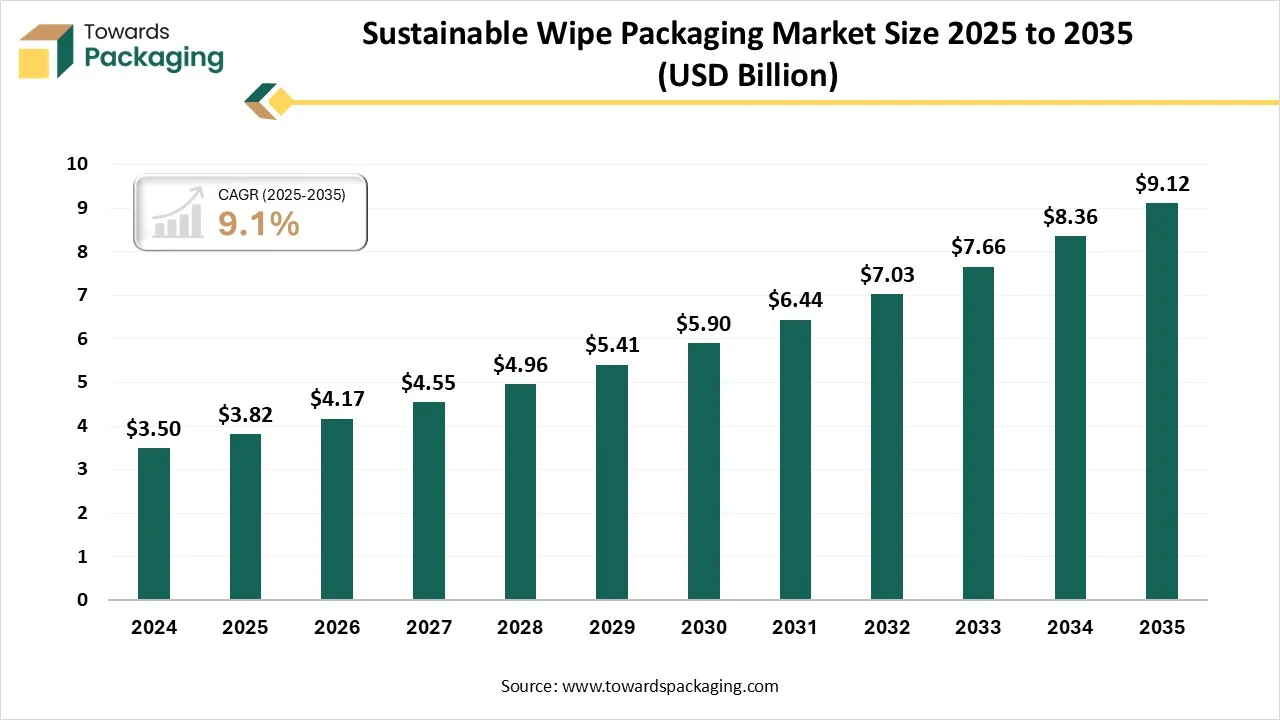
The sustainable wipe packaging market is forecasted to expand from USD 4.17 billion in 2026 to USD 9.12 billion by 2035, growing at a CAGR of 9.1% from 2026 to 2035. Growth is driven by regulatory pressure on single-use plastics, rising consumer demand for sustainable products, brand commitments to circular packaging, and expansion of premium and seco-certified personal care and household categories globally.
The global sustainable wipe packaging market comprises eco-friendly, recyclable, biodegradable, compostable, reusable or otherwise environmentally responsible packaging solutions for wet wipes (e.g., baby wipes, personal hygiene wipes, surface disinfecting wipes, makeup removal wipes, industrial wipes).
Sustainable packaging types include bio-based polymers, paper-based films, plant-derived resins, post-consumer recycled content, water-soluble films, and other innovation-led formats designed to reduce plastic waste, carbon footprint, and improve end-of-life disposal.
Intelligent packaging, or smart packaging, is changing the procedure of maintaining and checking items, such as wet wipes, at the time of their complete life proof. Intelligent packaging uses current technology which includes indicators, sensors and data carers to serve up-to-date information on the quality and state of the product which has therein.
Time-temperature indicators 9TTIs) are an important element of the intelligent packaging, which is also known as time-temperature indicators, which are compact devices or the labels that witness an color change with link to the time period and temperature conditions that is experienced by the product itself. Temperature Time Indicators serve a noticeable indication to both merchants and users about the safety and freshness of wet wipes, that are responsible for updates in temperature.
Both kinds of fibre which are created from wood or bamboo pulp ,are being extracted from the natural wood cellulose and changing the fibre molecules to receive cellulose fibres. They naturally have perfect absorption and power elements which are known for their freshness, softness , anti-static, good fastness, UV resistance and breathability too for dyeing and biodegradability to align with the demands of the human skin and they are frequently used in applications in border to protect the skin irritation.
Bioplastics and Compostable films are heavily using the bio-based polymers like PLA (Polylactic Acid) ,cellulose-based films and PHA which come from the sugarcane, cornstarch and the wood pulp. Patented technologies like InstaMelt uses an oil-dependent formulation which gets dissolved instantly in water.
Producers are using green distribution networks which are updating routes and utilising electric or hybrid vehicles to lower down transport emissions. Various distribution channels that count direct-to-consumer and tailored e-commerce that lowers down the dependency on high-effect regular retail paths.
The biodegradable polymers segment has dominated the sustainable wipe packaging market with approximately 35-38% share in 2025 as biodegradable wipes are the wet wipes created from the plant based materials like as bamboo, cotton, wood pulp and bamboo that broke down naturally over period through the microbial action just like regular wipes that has plastic fibers which truly are biodegradable options that uses the unbleached 100% cotton or other natural fibers with an less synthetic additives ,which makes them safer for both skin and surrounding.
The water-soluble & dissolvable Films segment is expected to experience the fastest CAGR during the forecast period. Water-soluble films develop a series of characteristics which make them suitable for hygiene and sanitation products. Initially they are made of polyvinyl alcohol , as such films gets dissolved up in contact with water that has not left any residue. This feature makes them perfect for single-sue uses in which disposable hygiene is necessary. One of the left out properties of water-soluble and dissolvable films is their capability to create a barricade against pollutants white being safe for the skin contact.
The flexible pouches segment has dominated the sustainable wipe packaging market with approximately 45% share in 2025 as these pouches for the sustainable wipe packaging concentrate on lowering plastic waste while tracking the moisture -barricade properties which is necessary for the product freshness. Such solutions have series from the single-use compostable films to reliable, durable cases which can avoid the demand for the disposable travel packs. Flexible pouches utilise 60% lesser plastic and need 50% less energy in order to generate rigid canisters. Also, their lightweight and space-saving nature lessens logistics releases and the fossil fuel usage per unit.
The refillable pouches segment is expected to experience the fastest CAGR during the forecast period. These pouches are made accessible from different online retailers and assist in storing pre-moistened wipes that are fresh for daily use and travel too. They are generally created from the flexible and durable materials like PVC or EVA and have protective closures to prevent drying out. There are convenience features like inventive flip-up zip-lock closure crafted for fast and one-handed availability while smoothly packaging n moisture to store wipes fresh for a long time.
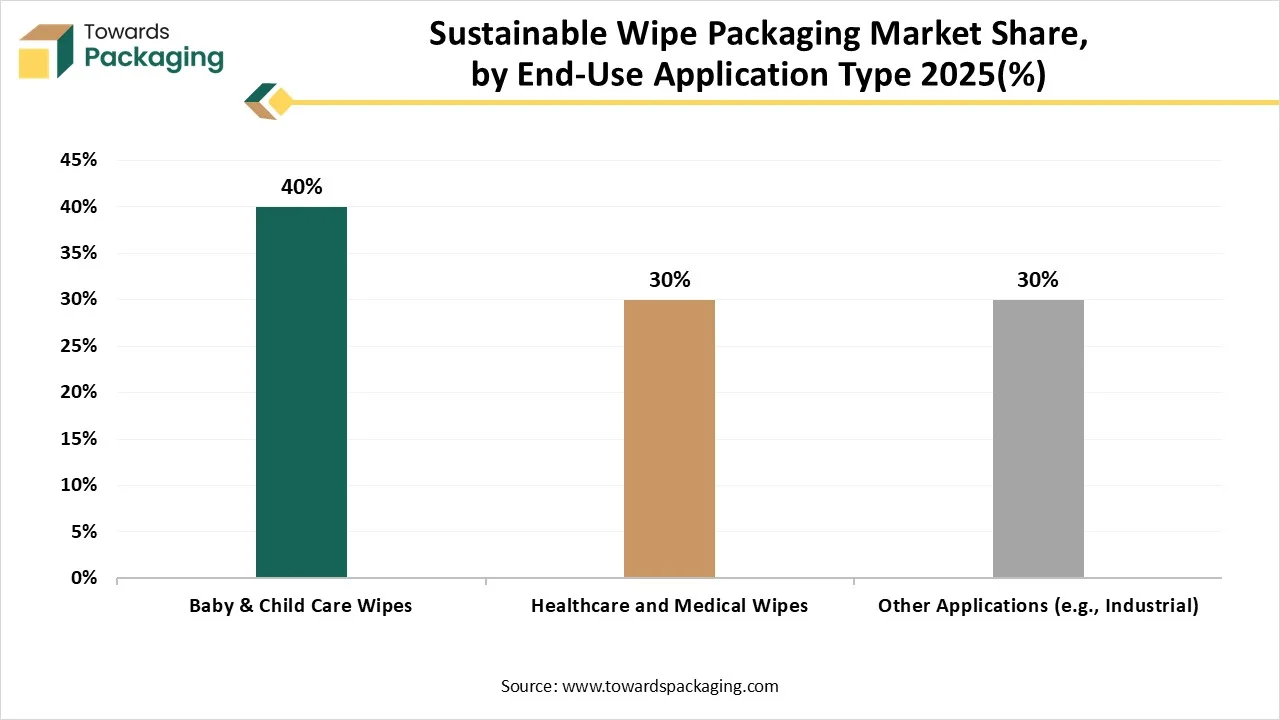
The baby & child care wipes segment have dominated the market with approximately 40% share in 2025. Parents are excessively finding the products which are free from toxic parabens, chemicals and synthetic fragrances. Such formulations frequently have plant-based cleaners and the naturally-oriented moisturisers which are clean smoothly till the smooth sensitive skin . Another hypoallergenic wipes which takes safety and a step further by leaving out prevalent irritants and dealing too, which are particularly popular among parents managing with the sensitive skin conditions.
The healthcare/ medical wipes segment is expected to experience the fastest CAGR during the forecast period. Medical wipes are heavily versatile, that delivers various aims from tracking the personal hygiene to disinfect machines and surroundings. In environments like hospitals or clinics, wipes are often used to disinfect the medical equipment which are stethoscopes, thermometers and the diagnostic tools. Before sterilization, initial cleaning with the medical wipes make sure that the medical devices are free of pollutants.
| Segments | Market Share 2025(%) |
| Supermarkets and Hypermarkets | 48% |
| Online and E-commerce Platforms | 52% |
The supermarkets and hypermarkets segment has dominated the market with approximately 48% share in 2025 as they sell sustainable wipes packaging by delivering a huge variety of the products which is made up of compostable, recyclable or the post-consumer recycled (PCR) materials and using the initiatives like as refill stations and the precise eco-labelling too. Also stores push different brands to use a clear eco-labelling ,like the How2Recycle system ,that has conveyed users accurately how to dispose of the packaging precisely.
The online/E-commerce platforms segment is expected to experience the fastest CAGR during the forecast period. E-commerce organizations sell the products with a sustainable wipes packaging by just accepting materials and methods across the complete product lifestyles, which is being driven by the rising user demand and the regulatory pressures. This counts by using the compostable, recyclable or reusable materials ,that lowered the packaging size and clearly communicated the disposable directions. Also, companies are using the materials such as mono-material PE or PP films (convenient to recycle) , post-consumer recycled and plant-based plastics in their packaging. For the wipe itself, materials like lyocell, bamboo fiber, organic cotton and hemp too which are used.
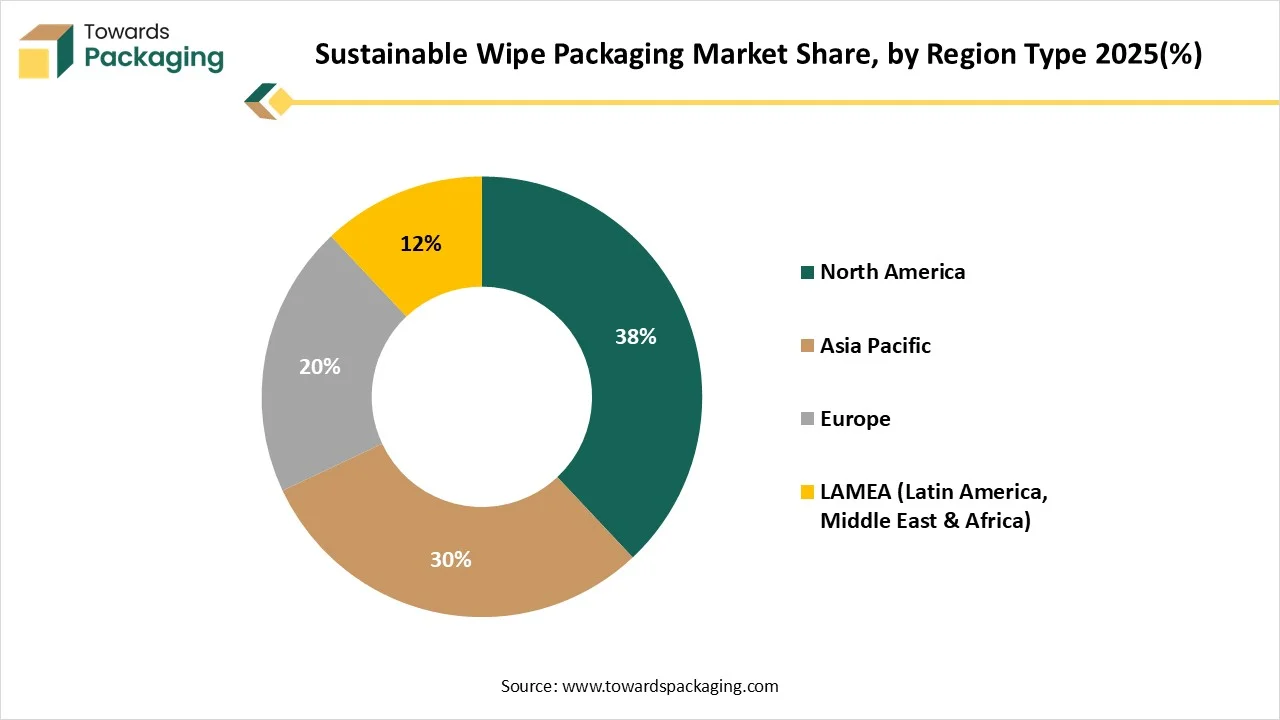
North America dominated the sustainable wipe packaging market with approximately 38% share in 2025 as AI effect management is crucial in tracking the surrounding footsteps and the regulatory support of the flushable wet wipes ,particularly within the context of North America strict surrounding standards. By using the AI models which manage lifecycle assessments, biodegradability measures and supply chain releases that can precisely pass their surrounding effect.
Such a data-driven strategy allows firms to check areas for improvement ,like as sourcing sustainable raw materials or updating the manufacturing procedure to lower the water and energy usage.
How is the Sustainable Wipe Packaging Market Growing in Canada?
The trend of the sustainable wipe packaging in Canada is developing as there is shift towards recyclable flow wraps, plastic-free materials and the certified “flushable inventions to combine surrounding waste. Inventions within the flexible packaging has led to mono-material cover (initially polyethylene ) which can be recycled in the standard flow. Current partnerships have disclosed packs in every wrap and the opening lid which are created from the same recyclable plastic.
Asia Pacific expects the fastest growth in the sustainable wipe packaging market in 2025 because the sustainable wipe industry is witnessing main moves due to growing eco-friendly alertness and the regulatory pressures. The acceptance of the biodegradable materials has become a complicated differentiator among the sector players, that boosts a more sustainable competitive scenario. Furthermore, growing user urge for the health-conscious and eco-friendly responsible items has allowed brands to develop fastly, that leads to a more competitive and dynamic environment.
Why is India using the Sustainable Wipe Packaging Market Importantly?
The sustainable wipe packaging industry in India is witnessing major development as transferring from regular single-use plastics to the eco-friendly and high -performance materials. It is being driven by the hygiene alertness and a rising demand for chemical -free and premium personal care, as the market is expected to develop mainly through upcoming years. Producers are accepting minimalist designs to lower the raw material usage and the shipping costs too.
The sustainable wipe packaging market in the European region is growing as brands are moving towards and mono-PE (polyethylene) flow covers. Acceptance of baby-wipe packs that have up to 50% recycled plastics is developing as Barbados seeks to lower the virgin plastic usage. Also, the paper-based and compostable wraps are growing in western and Northern Europe for a demand of paper-based and compostable flow wraps films, specifically for the organic and “clean-label” products.
Germany Sustainable Wipe Packaging Market Trend
The initial aim of penetrating the Germany sustainable wipes industry is to discover a rigid , sustainable presentation in an understandable and eco-friendly conscious user scenario. Also, Germany industry is being classified by growing demand for the environment -friendly and the health- conscious items ,which is driven by the growing alertness of surrounding issues and strong regulatory standards. The extensive aim is to protect a competitive position in the luxury or main segments ,that has developed commitment and receive sustainable development matched with Germanys surrounding loyalty and user choice too.
The Sustainable Wipe Packaging Market in the Middle East &Africa (MEA) region is growing quickly as nations like the UAE and Saudi Arabia are using strong plastic waste reduction policies. Growing hygiene alertness has led to big demand for the disinfectant and personal care wipes , but users are now mainly finding the plastic-free, compostable and biodegradable substrates and the packaging too. Also, the growth of online retail stages in the South Africa and GCC is making a demand for protective but sustainable packaging which can stand firmly in long-distance shipping while staying recyclable.
UAE Sustainable Wipe Packaging Market Trend
In the current year, the urge for the sustainable wipe packaging in the UAE is witnessing main development , which is driven by the integration of strict government surrounding regulations and a fast movement in the user choice towards eco-friendly products. The UAE Green Agenda on the plastic waste management rules make compulsion for the move towards recyclable and biodegradable materials. There are initiatives like Dubais single-use plastic ban which are forcing producers to accept the bio-based packaging solutions.
In South America, the sustainable wipe packaging market is growing steadily as there is a shift towards bio-based plastics like PLA and PHA , and recycled PET is developing specifically in Brazil. The flexible designs are the biggest-rising segment because of their lightweight pattern and the emergence of recycle-ready and the mono-material films. There is also developing industrialization in Peru and Brazil which is driving the urge for the industrial -grade wipes in big sustainable packaging.
Brazil Sustainable Wipe Packaging Market Trend
The Brazilian governments initiative is to market eco-friendly and sustainable products which are encouraging manufacturers to accept biodegradable materials and recyclable packaging. Additionally, user choice is heavily moving towards wipes with the natural ingredients that showcase a rising urge for the green solutions. The application of AI in product development is developing the smoothness of wipes, while IoT solutions are enabling users to manage and monitor cleaning usage in actual-time.
By Packaging Material
By Packaging Format
By End-Use Application
By Distribution Channel
By Region




Research & Advisory Analyst
Yogesh Kulkarni is an experienced Research Analyst specializing in the packaging sector, with a strong foundation in statistical analysis and market intelligence. He currently contributes his expertise to Towards Packaging.
Learn more about Yogesh Kulkarni

Reviewed By
Aditi Shivarkar, with 14+ years in packaging market research, specializes in food, beverage, and eco-friendly packaging. She ensures accurate, actionable insights, driving Towards Packaging Analytics & Consulting 's excellence in industry trends and sustainability.
Learn more about Aditi Shivarkar

Sustainable Wipe Packaging Market
 Table of Content
 sales@towardspackaging.com
 +1 804-441-9344
 Download Sample
 Schedule a Meeting