


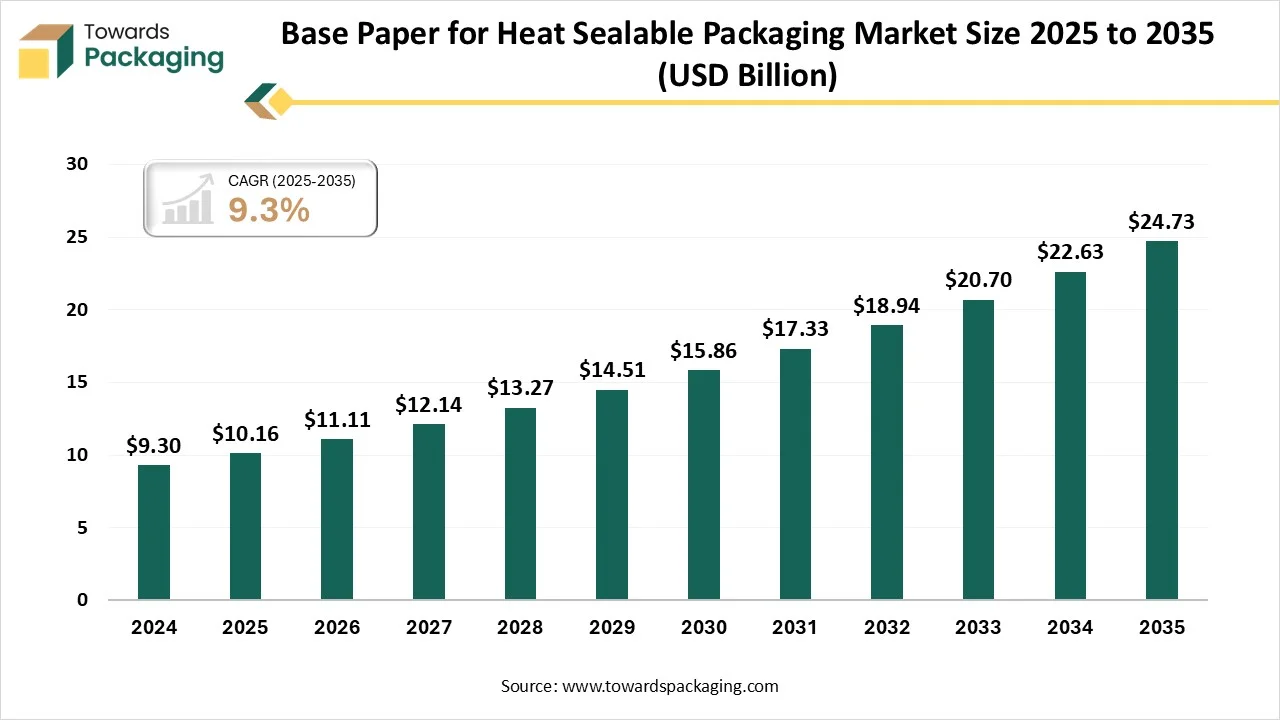
The base paper for heat sealable packaging market is forecasted to expand from USD 11.11 billion in 2026 to USD 24.73 billion by 2035, growing at a CAGR of 9.3% from 2026 to 2035. The urge for the base paper in heat-sealable packaging is initially being driven by the rigid encouragement for environmental sustainability, integrated with the regular advantages that paper serves as a base material.
Heat-seal coatings are the thin layers of adhesive material that are used for paper layers, which activate when exposed to pressure and heat. These coatings are crafted to create a link between two materials, generally paper-to-paper or paper-to-other substrates, like metal or plastic. This procedure is complicated in terms of packaging, in which the reliability of the seal ensures product freshness, protects against pollutants, and delivers tamper-evident security.
It operates by softening and becoming inappropriate when it gets exposed to heat. Once the heat is used, the coating bonds to another layer, and as it cools down, it gets updated, which creates a tight and durable seal. The bond is made rigid enough to firmly stand with different eco-friendly conditions, which include changes in moisture, temperature, and mechanical stress.
The inventions in heat sealing technology serve a bunch of advantages which are insightful to the packaging professionals, as the developments in heat sealing machines point out that they can run at greater speeds while tracking the accurate control over the sealing procedure. This results in lesser energy usage, less waste, and a more effective complete manufacturing line. With the assistance of temperature controls and automated sealing processes, the productivity of the seals is more constant. This is complicated for the items that need airtight packaging to ensure freshness or security, such as medical and food supplies, which are delivered.
Package Design and Prototyping: Base paper packaging design involves choosing the accurate paper material and structural form so as to protect the product, develop branding, and ensure sustainability, too. Main design considerations count barrier properties, material strength, functionality, and the printing potential too.
Recycling and Waste Management: Recycling starts with the collection and separation of the paper waste. It is crucial to collect paper separately from other kinds of waste in order to prevent pollution. Paper waste can be classified depending on its type and quality, as this affects the complete recycling procedure. Once they are collected, the paper is sorted into.
Logistics and Distribution: The logistics and the distribution of the base paper count on a highly tailored supply chain that concentrates on high-volume transport and moisture -sensitive carrying too. A specialized machine shifts these rolls as it needs forklifts filled with “roll clamps” in order to protect the sensitive outer layers from tearing or crushing.
The hot bar sealing segment has dominated the market in 2025, as these sealers utilise heated bars in order to make a seal by melting the packaging material and linking it collectively. Such machines are typically used for sealing pouches, bags, and tubes made of thermoplastic materials like polypropylene, polyethylene, and laminated films, too. Hot bar sealers are smooth and generate robust seals that are reluctant to leak or tamper with both.
The clamshell sealing segment is predicted to witness the fastest CAGR during the forecast period. It is a procedure of protecting the two halves of a hinged plastic container's ingredients from pollutants, tampering, or theft. A portable clamshell sealer is beneficial for small manufacturing operations. The sealer is being delivered to its running operator and temperature locations that match the flanges of the clamshell in between the jaws of the sealer. Also, the jaws are being clamped together and placed for the period as proposed by the producer.
The plastic segment dominated the market in 2025, as different types of packaging materials that can be used with heat sealing equipment, such as polyethylene (PE), polypropylene (PP), polystyrene (PS), and polyvinyl chloride (PVC). Such packaging materials are utilized in bags and pouches and are conveniently packed with a heat sealing machine to seal the ends or the plastic bag collectively. Two of the most prevalent types of polybag materials are manufactured from polyethylene and polyethylene terephthalate (PET). They are a lightweight material that can be heated up, fused together, and will cool down soon after avoiding the heating element. So, low-density polyethylene (LDPE) is specifically a perfect choice for the polybag material in order to be heat-sealed.
The multi-layer / composite materials segment is expected to experience the fastest CAGR during the forecast period. Multilayer film packaging is at the frontline of current packaging inventions, which gets updated on how products are protected, preserved, and displayed across sectors. As users' demands for the huge shelf life, sustainable solutions, and rigid product protection continue to develop, multilayer film packaging has emerged as a complicated technology that solves these demands.
The pouches segment has dominated the base paper for heat sealable packaging market in 2025, as flexible packaging, such as stand-up pouches, flat pouches, or flat bottom pouches, serves many advantages. They are particularly space-saving, attention-grabbing, and sustainable on the retail shelves. Additionally, they are exceptionally practical for filling -whether in person or with a machine. On the other hand, stand-up pouches (which are also known as Doypacks) that have a standard press-seal zipper, for very flat bottom pouches, are also capable of adding a so-called Pocket Zipper, which enables a big opening.
The flexible films segment is predicted to witness the fastest CAGR during the forecast period. Heat-resistant films are tailored in multi-layered polyolefin films created to withstand higher levels of heat. They are utilised over more regular shrink films in order to make a seal with extra power and tear resistance. The higher sealing temperature, along with the several layers of plastic, generally makes a sturdy closure that operates well in many packaging applications, such as pharmaceutical and food packaging, that need a higher level of security.
The food and beverages segment has dominated the base paper for heat sealable packaging market in 2025, as heat sealing is one of the most prevalent and reliable sealing procedures, particularly for the smooth, flexible packaging made of plastic foils or films. It operates by using heat and pressure on the packaging material, which causes the surfaces to fuse and melt together to make an airtight seal. This procedure is widely used for ready meals, snacks, and frozen foods as it smoothly protects moisture and air entry, thus protecting the freshness and extending the shelf life.
The pharmaceuticals & healthcare segment is predicted to witness the fastest CAGR during the forecast period. Heat seal machines make airtight and strong seals, which ensure product integrity, lower the risk of pollution, and prevent leaks or tampering, all of which are important for the particular pharmaceutical sector. Additionally, it avoids the demand for additional materials like staples or tapes, adhesives, and reduces the material costs. Pharmaceutical and healthcare packaging gets advantages from heat-sealable films, which are used to package capsules, pills, and other medicinal items.
Asia Pacific dominated the market in 2025, as the region is witnessing major development, which is driven by the growth of e-commerce, a move towards sustainable packaging, and growing demand in the food and healthcare sectors. There are strict eco-friendly regulations, and the Extended Producer Responsibility (EPR) laws in countries such as Australia, Japan, Thailand, and Vietnam are forcing an official move towards plastic-to-recyclable paper-based sealing materials.
Why is India using the Base Paper for Heat Sealable Packaging Market? Importantly?
The Indian base paper is initially being driven by the growing urge from the printing, packaging, and tissue paper sectors. Fast urbanization and economic development in developing economies are driving the usage of packaged goods, hence filling the demand for sustainable packaging solutions, such as base paper. There is technological growth in the paper manufacturing industry that develops cost-efficiency and products that attract more producers.
North America expects the fastest growth in the market during the forecast period as technological invention is an important element that encourages the updation of the North America-based paper, which affects everything from manufacturing smoothness to product quality. Developments in industry inventions count the growth of eco-friendly pulping procedures, such as waterless manufacturing techniques and chemical -free bleaching, which have mainly lowered the eco-friendly footprint. Further, digitalization and automation in production plants develop operational efficiency, improve product consistency, and reduce waste too.
How is the Base Paper for Heat Sealable Packaging Market Growing in Canada?
The stretched demand for food and beverage, logistics, and retail industry includes mainly market development that needs protective and cost-effective packaging selections. The technological growth in paper band manufacturing has enhanced durability and strength, and also developed acceptance. The regulatory pressure that supports recyclable and biodegradable packaging materials has further encouraged market development. Furthermore, the growing e-commerce sector in Canada makes it compulsory to have smooth packaging solutions that are easy to use and lightweight too.
The Base Paper for Heat Sealable Packaging Market in the European region is growing as RHOBARR barrier technology can be used by a large number of paper coating machines, which makes it attention-grabbing to converters, mills, and brand owners who seek to update to more sustainable packaging. This barrier technology serves solutions to a variety of demands, whether we are finding developed recyclability for the fibre -based on the shelf packaging and ultra-thin coatings for fast -delivered food uses, or convenient-to-recycle options for non-food user goods.
Germany Base Paper For Heat Sealable Packaging Market Trend
The implementation of nanotechnology and bio-based paper serves as a main possibility, leading to developed performance with a smaller environmental footprint. Also, the digital printing compatibility and the smart coating technologies are meant to update the market, which serves tailored and communicative packaging solutions. The market also has a competitive surrounding with main players that focus on strategic partnerships, sustainability initiatives, and technological growth to develop their market share.
The Base Paper for Heat Sealable Packaging Market in the Middle East &Africa (MEA) region is growing quickly, as the urge for this paper is initially being filled by a region-wide move from plastic to sustainable and paper-based flexible packaging. There are sustainability regulations that have strong bans on single-use plastics in Saudi Arabia, the UAE, and South Africa, and the UAE is forcing a transformation to paper-based alternatives for pouches and bags.
UAE Base Paper For Heat Sealable Packaging Market Trend
The UAE market is driven by sustained funding in the healthcare sector, developing regulatory emphasis, and technological developments in sustainability and safety, too. The acceptance of smart packaging solutions that include antimicrobial coatings and IoT-enabled tracking will further develop product classification and market entry, too. Industry players are predicted to concentrate on developing biodegradable and eco-friendly materials to match global environmental standards, which creates new opportunities for invention and luxury product services.
In South America, the base paper for heat sealable packaging market is growing steadily as it has rigid agricultural and export-linked food industries in dairy, meat, and produce, which are the main drivers, as it urges the high-barrier films and updated atmosphere pouches, which increase the shelf life. There is a growing urban demographic and on-the-go usage, which are moving towards tamper-evident and lightweight flexible designs, such as stand-up pouches, that are the fastest-developing product in this region.
Brazil Base Paper for Heat Sealable Packaging Market Trend
The Brazilian base paper for heat-sealable packaging has advantages from strict food safety regulations imposed by national bodies, which pushes the acceptance of relevant sealing technologies that expand the shelf life and lower the contamination risks. Furthermore, government incentives whose goal is to market sustainable packaging have developed R&D investments in environmentally friendly heat-sealable films, which match the growing choice for recyclable and biodegradable solutions.
By Sealing Technology / Type
By Material Type
By Packaging Format / Application
By End-Use Industry
By Region







Research & Advisory Analyst
Yogesh Kulkarni is an experienced Research Analyst specializing in the packaging sector, with a strong foundation in statistical analysis and market intelligence. He currently contributes his expertise to Towards Packaging.
Learn more about Yogesh Kulkarni

Reviewed By
Aditi Shivarkar, with 14+ years in packaging market research, specializes in food, beverage, and eco-friendly packaging. She ensures accurate, actionable insights, driving Towards Packaging Analytics & Consulting 's excellence in industry trends and sustainability.
Learn more about Aditi Shivarkar

Base Paper for Heat Sealable Packaging Market
 Table of Content

 Download Sample
 Schedule a Meeting