


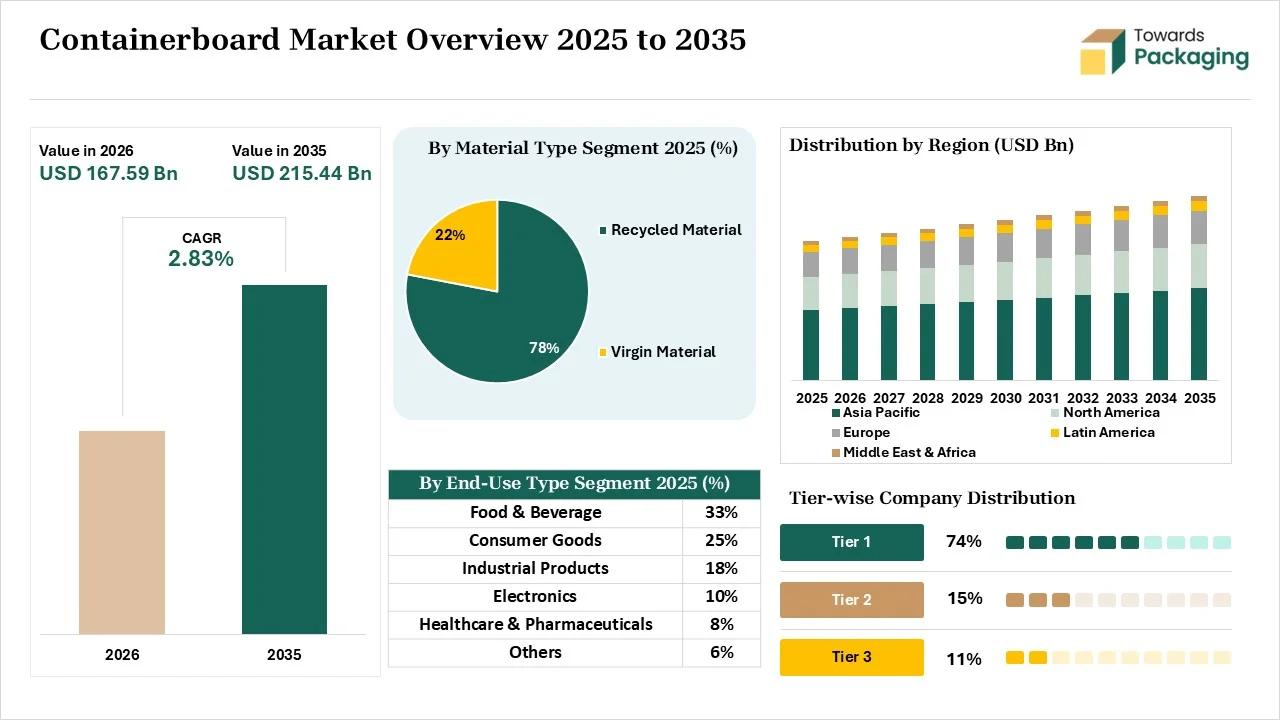
The containerboard market is forecasted to expand from USD 167.59 billion in 2026 to USD 215.44 billion by 2035, growing at a CAGR of 2.83% from 2026 to 2035. We cover full segmentation by material (recycled 78% share in 2025; virgin fastest-growing) and end-use (food & beverage 33% share in 2025; consumer goods fastest-growing), with regional data for North America (fastest growth), Europe, Asia Pacific (50% revenue share in 2025), Latin America, and Middle East & Africa.
The report delivers company profiles and benchmarking (International Paper, Nine Dragons, Smurfit Kappa, Mondi, WestRock, Oji, etc.), competitive analysis, value chain & cost structure, trade statistics and flows, and manufacturer/supplier databases with capacity and footprint mapping.
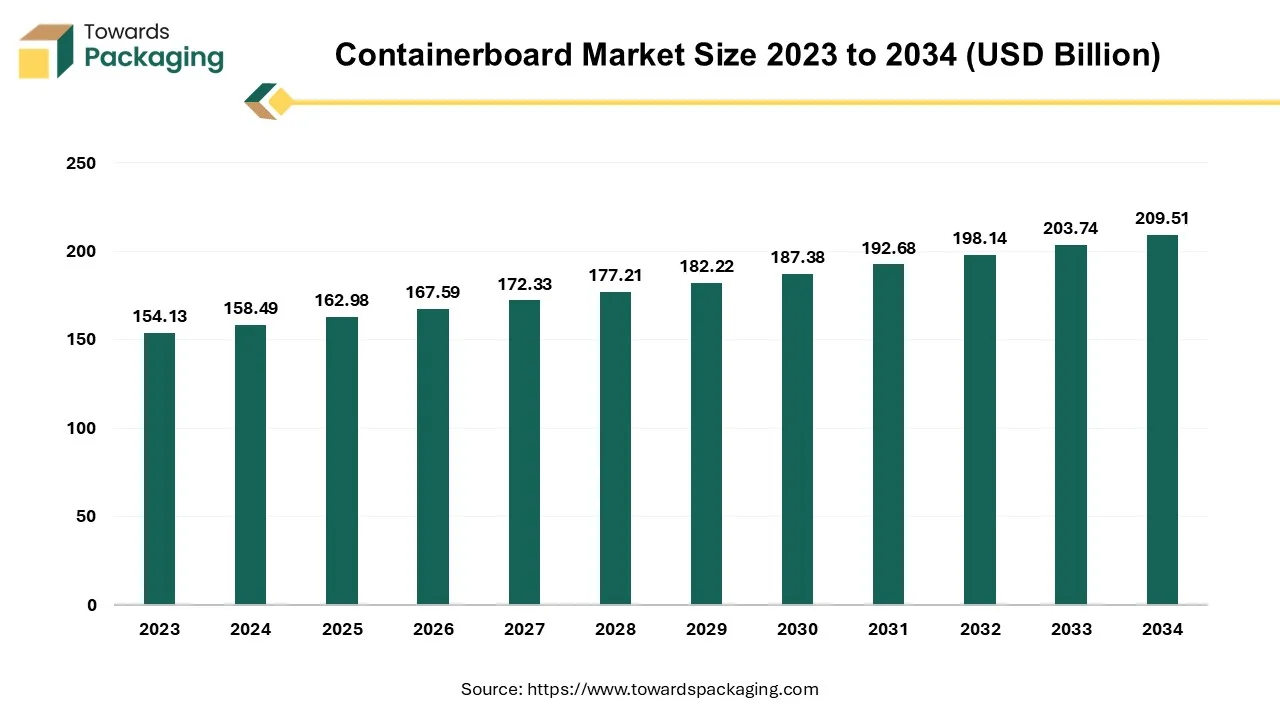
Containerboard is a type of paperboard designed for making corrugated fiberboard, essential in the packaging industry. It consists of multiple layers: a corrugated medium between two flat linerboards. The corrugated medium provides strength and rigidity, while the linerboards offer a smooth surface for printing and extra support. This composition makes container boards ideal for creating corrugated boxes and packaging materials used for shipping and storing goods.
There is a growing preference for sustainable and eco-friendly packaging solutions among consumers and companies. Containerboard, being recyclable and made from renewable resources, aligns well with this trend, boosting its demand. The future of the containerboard market looks promising with continued growth expected, driven by sustainable packaging trends, increasing e-commerce activities, and robust demand from various end-use industries. Innovations in manufacturing processes and recycling technologies will further support market expansion.
| Metric | Details |
| Market Size in 2025 | USD 162.98 Billion |
| Projected Market Size in 2035 | USD 215.44 Billion |
| CAGR (2026 - 2035) | 2.83% |
| Leading Region | Asia Pacific |
| Market Segmentation | By Material, By End-use and By Region |
| Top Key Players | International Paper, Oji Fibre Solutions (NZ) Ltd, Nine Dragons Paper (Holdings) Limited, Smurfit Kappa Group, Mondi Limited, WestRock Company. |
The growth of the food and beverage industry has raised the need for containerboard on a worldwide scale. The growing demand for packaged, frozen, and ready-to-eat goods as well as changing lifestyles have contributed to the growth of this industry. The market for containerboards is growing as a result. This industry is also being driven by the explosive expansion of e-commerce, since product-specific corrugated boxes are required to safeguard goods and guarantee safe delivery.
One of the top providers of packaging solutions, Saica Group, teamed up with one of the top producers of fast-moving consumer goods, Mondelez, in June 2024 to introduce a new paper-based product aimed at multipacks—goods for the chocolate, cookie, and confectionery industries. The novel paper-based packaging is appropriate for heat-sealing processes and is made to be recyclable in the paper waste stream.
The growing trend towards digitalization poses a challenge to the containerboard market. As communication and documentation increasingly shift to digital platforms, the demand for traditional paper usage declines. Also, Businesses and consumers are opting for digital alternatives for online advertising, electronic communication, and document storage. This preference for digital mediums reduces the demand for printed materials, which can impact the need for container boards in packaging applications.
The growth of digitization, especially e-commerce, often leads to a shift towards more efficient and less bulky packaging solutions, reducing the demand for traditional containerboard. With the rise of digital documentation, storage, and communication, there is a decreasing need for paper-based products, including containerboard, which is used extensively in office supplies and paper-based packaging.
The growing demand for innovative lightweight materials is a key trend shaping the global containerboard market. Manufacturers are providing more lightweight, high-performance corrugated materials to reduce costs, improve performance, and to make sure compliance with regulations. Lower material consumption during production also minimizes environmental impact. The packaging industry is witnessing numerous innovations in response to this trend.
Lightweight materials reduce the overall weight of packaging, leading to lower transportation costs. This is particularly important in the containerboard market, where shipping efficiency can result in substantial savings. Lightweight materials often have a smaller environmental footprint, requiring less energy and resources to produce and transport. This aligns with increasing regulatory pressures and consumer demand for sustainable packaging solutions.
Industrial sectors, particularly in developing regions, are increasingly adopting lightweight containerboard for packaging due to its cost-effectiveness and efficiency. This trend is expected to drive market growth as industries seek to optimize their packaging solutions. Lightweight containerboard offers advantages in global trade by reducing shipping costs and meeting international standards for sustainable packaging. This opens up new markets and export opportunities for manufacturers.
Asia Pacific dominated the containerboard market in 2025. The market growth in the region is driven by increasing industrial trade, growing rapid urbanization, increasing consumer expenditure, and increasing demand for containerboards. In addition, the increasing use of sustainable materials, growing e-commerce and retail sectors, and increasing demand for attractive, cost-effective, durable, and functional packaging solutions are further expected to drive market growth.
The strong presence of end-use industries such as food and beverage, consumer goods, and agriculture is driving the demand for containerboard in the region. Additionally, increasing consumer spending, rapid urbanization, industrial trade, and production in countries like India and China are further enhancing the need for packaging materials. The retail and e-commerce sectors have also experienced substantial growth in the region in recent years.
China is the world's largest manufacturing hub, producing a wide range of goods that require containerboard for packaging. The extensive use of containerboard in shipping and packaging manufactured products significantly contributes to the market's dominance. Significant investments in the paper and packaging industry in countries like China, Japan, and South Korea have led to the development of advanced manufacturing facilities. These investments enhance production capabilities and meet the growing regional and global demand for containerboard.
Countries in Asia Pacific are implementing extensive recycling programs to ensure the sustainability of packaging materials. For instance, China has set ambitious recycling targets and policies to support the circular economy, which benefits the containerboard market
Another major player in the containerboard market, this Hong Kong-based company has invested heavily in production facilities across China and other regions to cater to the increasing demand.
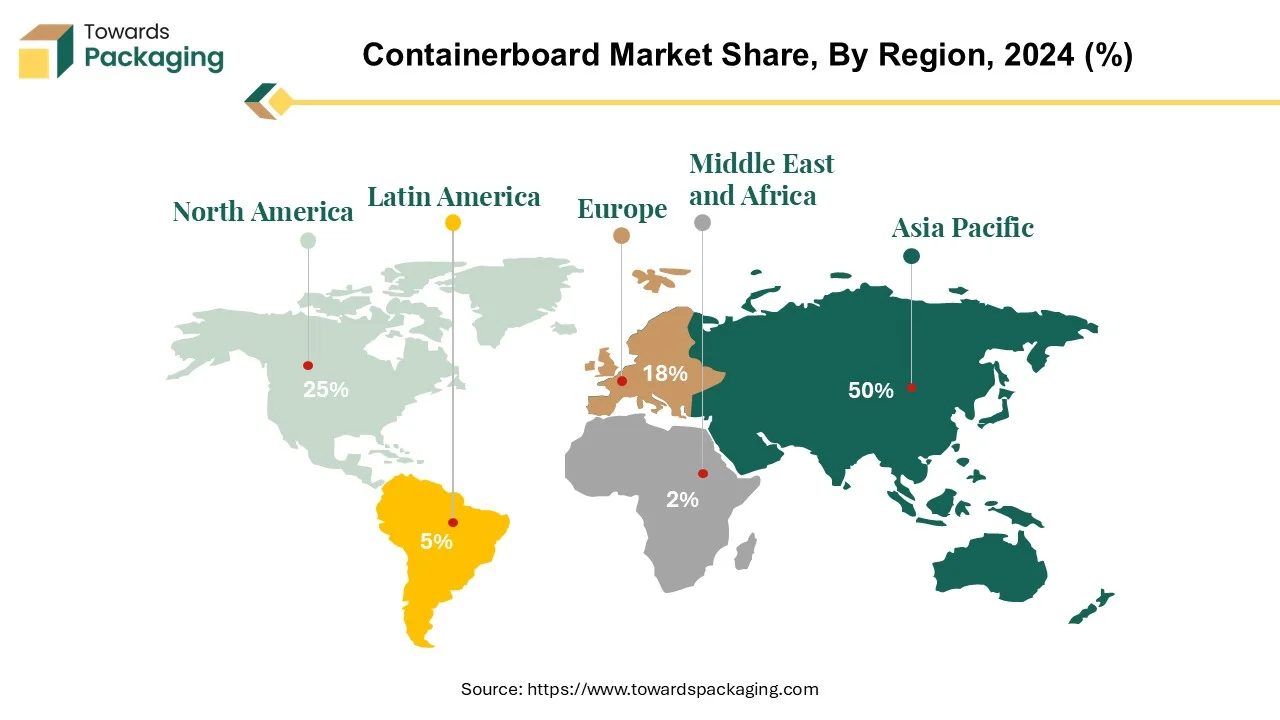
Asia Pacific dominated the containerboard market in 2025. The market growth in the region is driven by increasing industrial trade, growing rapid urbanization, increasing consumer expenditure, and increasing demand for containerboards. In addition, the increasing use of sustainable materials, growing e-commerce and retail sectors, and increasing demand for attractive, cost-effective, durable, and functional packaging solutions are further expected to drive market growth.
The continent has a high demand for packaging materials due to its large consumer market and industrial base, driving the need for containerboard products. Efficient transportation networks and infrastructure support the distribution of containerboard products across the continent and internationally, enhancing market reach and competitiveness.
North America is expected to grow at a notable CAGR in the foreseeable future. The growing demand for lightweight materials fuels the growth of the market, as they help lower shipping costs, optimize logistics, and support corporate sustainability goals. It also enables the industry in the region to replace heavier, traditional materials, such as wood and plastic, with high-strength, recyclable fiber-based packaging formats. Higher usage of refined fiber orientation and calendaring techniques allows the industry to produce lighter containerboards, further fueling the growth of the market. The growing expansion of e-commerce and automated fulfillment networks requiring packaging also fuels the market’s growth.
The U.S. has a major contribution to the growth of the market, mainly due to historic mill closures and capacity cuts. Growing online retail, along with growing manufacturing sectors such as electronics, automotive, and pharmaceuticals, also fuels the growth of the market. A major shift of the market from lightweight materials and highly recycled content to reduce shipping costs and meet ESG goals also helps to fuel the market’s growth.
Fahrenheit for more than 40 hours. It is a sustainable alternative to expanded polystyrene (EPS) foam boxes.
Europe’s containerboard market is majorly driven by e-commerce and strict regulations replacing plastic with fiber-based packaging. Strict environmental regulations and major corporate consolidation also fuel the market’s growth. Higher consumer demand for eco-friendly and sustainable options and strict EU sustainability policies, compelling industries to swap single-use plastics for fiber-based solutions, also propel the growth of the market. The industry association of the region has established clear circularity milestones helpful for energy efficiency, electrification, and biomaterial switchbacks to curb carbon costs, also propelling the growth of the market.
Germany has a major contribution to the growth of the market, which is mainly driven by the country’s robust export-oriented manufacturing and e-commerce sectors. The growth is also propelled by factors such as eco-friendly, lightweight, and recycled packaging solutions. The food and beverage sector and the industrial packaging sector also make a major contribution to the market’s growth. Higher adoption of technology in the region for sophisticated, multi-purpose packaging solutions across various industries also fuels the growth of the market.
The Middle East and Africa region is considered to be a significantly growing area, due to expanding e-commerce networks, growing demand for processed food, and regional plastic-reduction mandates. Slotted containers make a major contribution to the market’s growth as they are the primary choice for food and beverage shipments to maintain the food quality and to avoid spillage. Smartphone penetration in Gulf countries and other regions, propelling retail and e-commerce logistics channels, also fuels the growth of the market. The market’s growth is also influenced by sustainability and EPR.
Saudi Arabia Market Trends
Saudi Arabia has a major contribution to the growth of the market due to growing containerboard and cartonboard demand. Growing investments in sectors such as food processing, hypermarket expansions, and a broader FMCG production base, to maintain high, repeatable packaging consumption, also fuel the growth of the market.
| Rank | Company | Headquarters | Country | Why Relevant to This Market | Key Packaging Products/Services |
| 1 | International Paper | Memphis, Tennessee | USA | One of the world's largest containerboard and corrugated packaging producers | Kraft linerboard, corrugated packaging |
| 2 | Smurfit Westrock | Dublin | Ireland | Global leader in containerboard and corrugated packaging following industry consolidation | Containerboard, corrugated solutions |
| 3 | Georgia-Pacific | Atlanta, Georgia | USA | Major North American containerboard producer with integrated mill operations | Containerboard and corrugated products |
| 4 | Packaging Corporation of America | Lake Forest, Illinois | USA | Leading producer of containerboard and corrugated packaging in North America | Linerboard and corrugated packaging |
| 5 | Mondi | Weybridge, England | United Kingdom | Major global producer of containerboard and sustainable fiber-based packaging | Kraft paper and containerboard |
| Rank | Company | Headquarters | Country | Why Relevant to This Market | Key Packaging Products/Services |
| 1 | DS Smith | London, England | United Kingdom | Major corrugated packaging producer with strong recycled containerboard capabilities | Recycled containerboard |
| 2 | Nine Dragons Paper | Dongguan, Guangdong | China | One of the largest containerboard manufacturers globally | Recycled containerboard |
| 3 | Pratt Industries | Atlanta, Georgia | USA | Leading recycled paper and containerboard producer | 100% recycled containerboard |
| 4 | Klabin | São Paulo | Brazil | Latin America's largest integrated paper and packaging producer | Kraftliner and corrugated materials |
| 5 | Lee & Man Paper | Hong Kong | China | Significant producer of linerboard and corrugating medium | Containerboard products |
| Rank | Company | Headquarters | Country | Why Relevant to This Market | Key Packaging Products/Services |
| 1 | Rengo Co Ltd | Osaka | Japan | Major Asian corrugated and containerboard supplier | Corrugated board materials |
| 2 | SCG Packaging | Bangkok | Thailand | Leading Southeast Asian fiber-based packaging producer | Containerboard and corrugated packaging |
| 3 | Saica Group | Zaragoza, Aragón | Spain | European leader in recycled containerboard production | Recycled containerboard |
| 4 | Oji Holdings | Tokyo | Japan | Large paper and packaging producer with containerboard operations | Linerboard and packaging papers |
| 5 | Hamburger Containerboard | Vienna | Austria | Specialized European containerboard manufacturer within Prinzhorn Group | Recycled containerboard |
The recycled material segment dominated the containerboard market in 2025. The increasing environmental concerns are driving the use of sustainable packaging materials. Recycled fiber can be reused 6-7 times while maintaining durability, by reducing waste. Additionally, recycled materials are favored for their cost-effectiveness and compliance with government sustainability standards and regulations.
Producing containerboard from recycled materials is often more cost-effective compared to using virgin fibers. The recycling process typically requires less energy and water, leading to lower production costs. This cost advantage makes recycled containerboard an economically viable option for manufacturers, especially in price-sensitive markets.
There is a growing emphasis on environmental sustainability and reducing the carbon footprint in manufacturing processes. Recycled materials in containerboard production help conserve natural resources, reduce waste, and lower greenhouse gas emissions. This aligns with the global push towards more sustainable practices, making recycled containerboards more attractive to consumers and businesses alike.
The virgin material segment is expected to grow at the fastest rate during the forecast period in the containerboard market. In the containerboard market, the virgin segment pertains to containerboard made from entirely new and unused paper fibers. This segment highlights high-quality packaging materials, providing superior strength and printability. Current trends in the virgin segment emphasize sustainability through the responsible sourcing of raw materials and environmentally friendly production processes.
In 2024, the food & beverage segment dominated the containerboard market by holding the largest market share. this is because Packaged foods are in high demand due to their minimal preparation time. This demand is driven by a growing young population and an increasing number of working women, contributing to market growth. moreover, Food and beverage companies are using corrugated board packaging because it can withstand long delivery times and keeps moisture away from food products. Therefore, the food and beverage market is expected to account for a significant portion of the containerboard market.
The consumer goods segment is the fastest growing segment over the forecast period in the containerboard market. This can be attributed to Increasing purchasing power, higher living standards, and rapid urbanization in both developed and developing countries are expected to propel the consumer goods sector, and hence can drive the demand for containerboard. As competition in the consumer goods industry intensifies, the need for container boards for effective branding is anticipated to rise.
By Material
By End-use
By Region





Principal Research Analyst
Vidyesh Swar is a Senior Research Analyst at Towards Packaging, bringing over 4 years of dedicated expertise in market intelligence and strategic analysis across the dynamic world of packaging technologies and solutions.
Learn more about Vidyesh Swar

Reviewed By
Aditi Shivarkar, with 14+ years in packaging market research, specializes in food, beverage, and eco-friendly packaging. She ensures accurate, actionable insights, driving Towards Packaging Analytics & Consulting 's excellence in industry trends and sustainability.
Learn more about Aditi Shivarkar


Containerboard Market
 Table of Content
 sales@towardspackaging.com
 +1 804-441-9344
 Download Sample
 Schedule a Meeting