


As per Vidyesh Swar, who has 5+ years of market research experience and also specializes in fields like bioplastic packaging, seaweed bioplastic packaging, and the overall packaging industry. His research showcases new growth opportunities for the home-compostable seaweed bioplastic packaging market. The global home-compostable seaweed bioplastic packaging market size was estimated at USD 485 million in 2025 and is predicted to increase from USD 561.63 million in 2026 to approximately USD 2.1 billion, and is expected to grow at a CAGR of 15.80% during 2025-2035. Factors including regenerative growth, e-commerce flexibility, and focus on home compostability drive the growth. Major players such as Sway, LOLIWARE, FlexSea, and Notpla help drive growth.
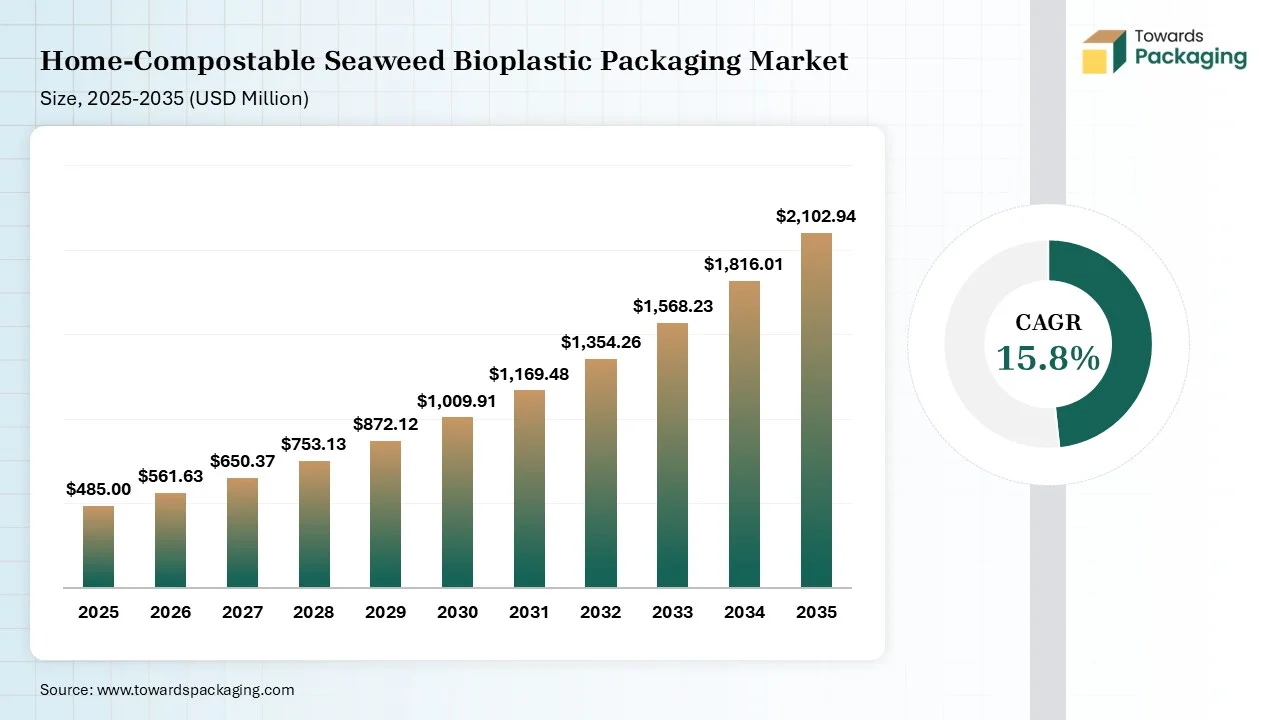
Home-compostable seaweed bioplastic packaging is a type of sustainable packaging made from seaweed that is easy to compost at home. It offers characteristics like translucent appearance, heat-sealability, tear resistance, and safe end-of-life. Its benefits are zero land use, zero microplastics, soil enrichment, no fresh water requirement, and home compostability. It is used in edible sachets, apparel polybags, product windows, cosmetics sample sachets, takeaway liners, and carrier bags. The home-compostable seaweed bioplastic packaging market reached USD 485 million in 2025. Factors like focus on minimizing carbon emissions in the supply chain, growing seaweed cultivation, regulatory push, rise in flexible packaging uses, brands' transformation to guilt-free materials, and easy disposal are responsible for the growth. Companies like ZerCircle, Notpla, and B’ZEOS are major contributors.
Source:- Towards Packaging Database
The market is expected to grow from USD 485M to USD 2.1B by 2035. The high environmental benefits, including home-compostability, no land requirement, and carbon-negative growth, will increase the adoption of home-compostable seaweed bioplastic packaging. The sustainability targets across the global corporate industry and plug-and-play manufacturing will increase the use. Seaweed transformation into robust packaging sheets and seaweed packaging's ability to enhance brand image will increase the production of home-compostable seaweed bioplastic packaging.
Source:- Towards Packaging Database
The home-compostable seaweed bioplastic packaging market is expected to grow at a CAGR of 15.80% during 2025-2035. The drivers for the market are zero use of freshwater, complete home compostability, high support for coastal livelihood, interest in edible formats, prohibitions on single-use, no ocean acidification, fast degradation period, and preference for dissolvable formats. Companies like B’ZEOS, LOLIWARE, Notpla, and Kelpi are major innovators. Mainstream packaging companies like Amcor and DS Smith are collaborating with specialized seaweed innovators for the development of new products.
Source:- Towards Packaging Database
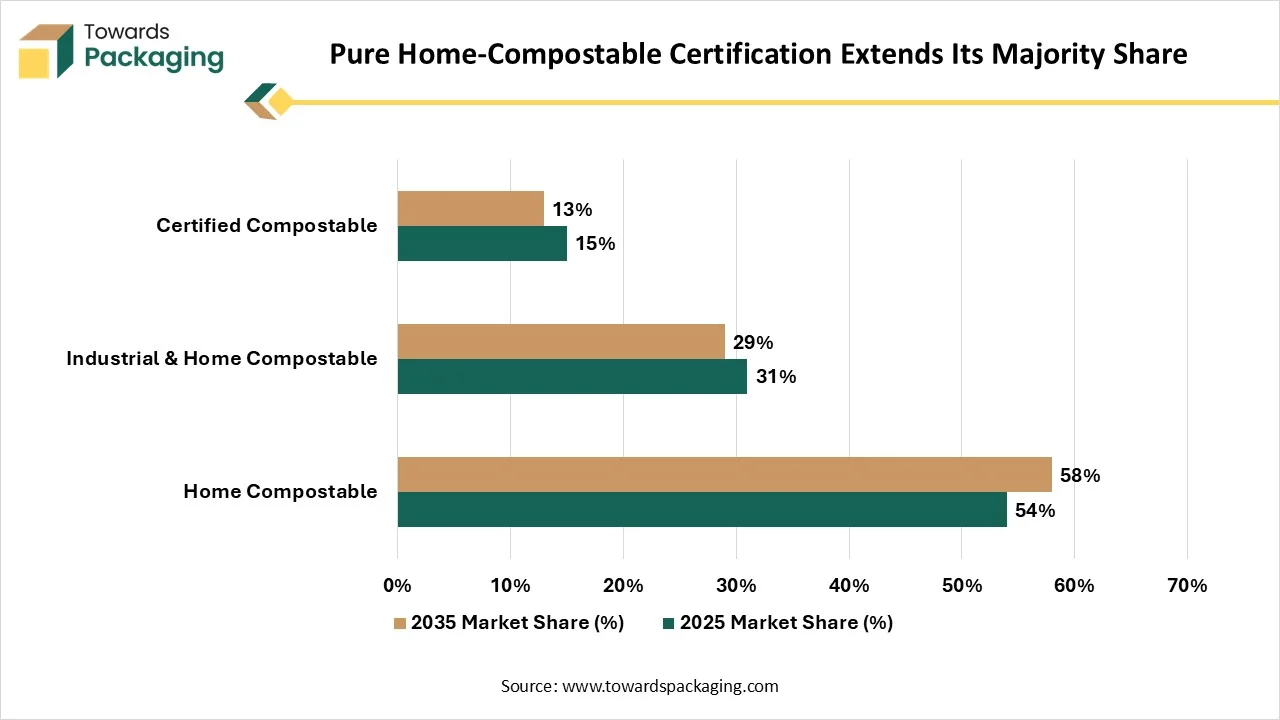
Certifications like certified compostable, home compostable, and industrial & home compostable are gaining traction. Home compostable held a 54% share in 2025 due to the lack of certified compostable packaging facilities & growing contamination fears, whereas expected to gain a share of 58% by 2025 due to consumer preference for infrastructure independence. Industrial & home compostable held a 31% share in 2025 due to infrastructure gaps and high capital cost and is expected to lose its share to 29% by 2035 due to performance trade-offs. Certified compostable held a 15% share in 2025 due to high certification costs & hurdles in the supply chain and is expected to decrease its share to 13% by 2035 due to evolving standards & high cost.
Source:- Towards Packaging Database
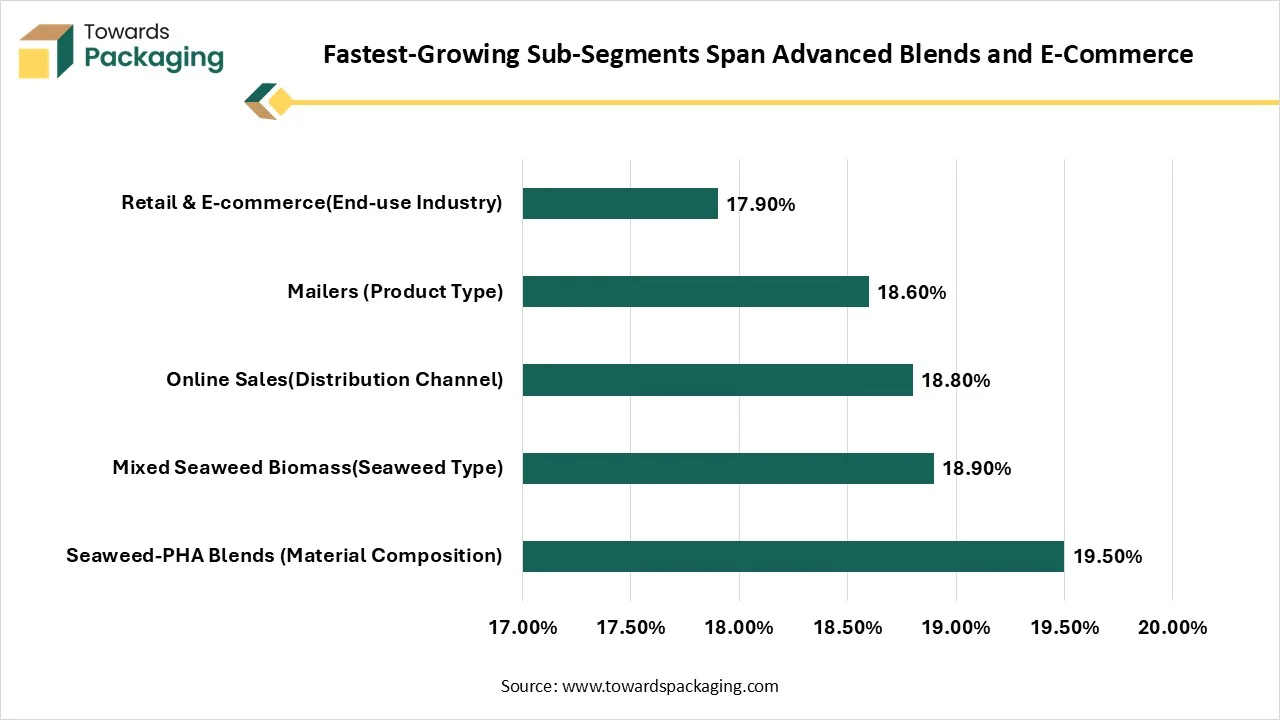
The fastest-growing sub-segments include seaweed-PHA blends, mixed seaweed biomass, online sales, mailers, and retail & e-commerce. Seaweed-PHA blends are expected to grow with a 19.5% CAGR during the predicted timeframe due to improved material strength and no requirement for industrial composting. Mixed seaweed biomass is expected to grow with a 18.9% CAGR during the forecast period due to low feedstock cost and higher demand for synergistic polymer blends. Online sales are expected to grow with a 18.8% CAGR during the forecast period due to their direct outreach and targeted accessibility. Mailers are expected to grow with a 18.6% CAGR during the forecast period due to their use in online retail shipping. Retail & e-commerce is expected to grow with a 17.9% CAGR during the predicted timeframe due to its compatibility with all formats and the focus on gaining buyers' trust.
Source:- Towards Packaging Database
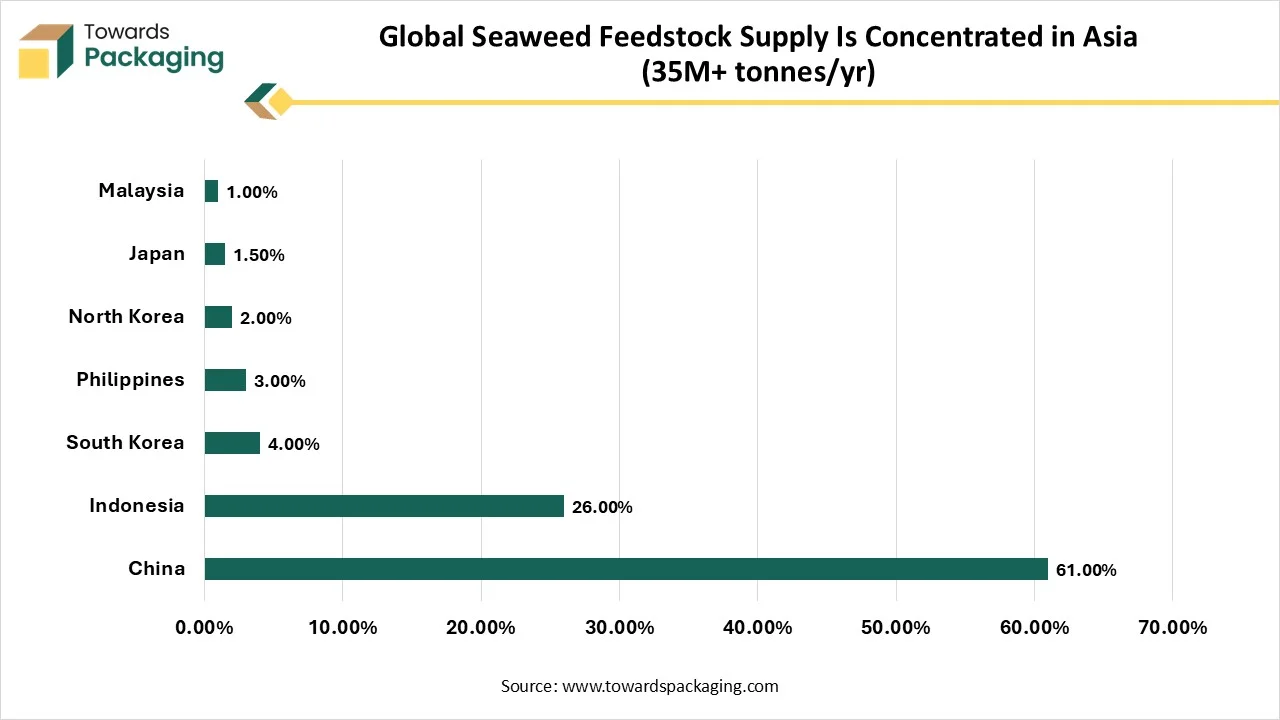
From 2019 to 2021, the seaweed produced globally was approximately 35 to 36 million tonnes. The seaweed production drivers are growing industrial demand and rapid aquaculture growth. Asia Pacific is the largest contributor to seaweed production. Asia Pacific held a 97-98% share in global seaweed production. APAC countries like China, Japan, South Korea, and Malaysia contribute to APAC dominance. China held a 61% share in global seaweed production, and Indonesia held a 26% share. China is a major seaweed producer due to advanced farming techniques, growing cultural demand, long coastal regions, and development of high-yield seaweed strains.
Source:- FAO (2022, 2023) seaweed production statistics, as cited in UNCTAD, "An Ocean of Opportunities" (2024)
TUV Austria offered OK compost Home certification. The certification was created due to consumer need, low temperatures, and a harder process. The key testing requirements are disintegration, chemical limitation, biodegradation, and ecotoxicity. The certificate focuses on material degradation of more than 90% within 12 months. The material breakdown of packaging is tested at 20-300 C. The certification is developed on EN 13432. Certifications like EN 17427 developed by Europe, Australia’s AS 5810, and France’s NF T 51800 are equivalent to TÜV Austria OK compost Home.
Source:- TÜV Austria (okcert.tuvaustria.com); ComplianceGate (Sept 2025); Atlantic Packaging Compostability Certifications Reference Guide (Jan 2026)
The UK-based Notpla company claims its seaweed-coated packaging takes approximately 4-6 weeks for composting at home. The composting does not produce toxic residues or microplastics. TUV Austria OK compost Home maximum period for composting is 52 weeks. European Union government validated the plastic-free coating of Notpla. The coating also meets the EU Single-Use Plastics Directive. Notpla seaweed packaging is approved by the FDA, BPI, FSC, and Food Contact BfR36. The packaging is compatible with home composting as well as paper recycling bins.
Source:- Notpla company website (notpla.com, 2025); Elliott Hygiene product page (Sept 2025) citing Notpla claims
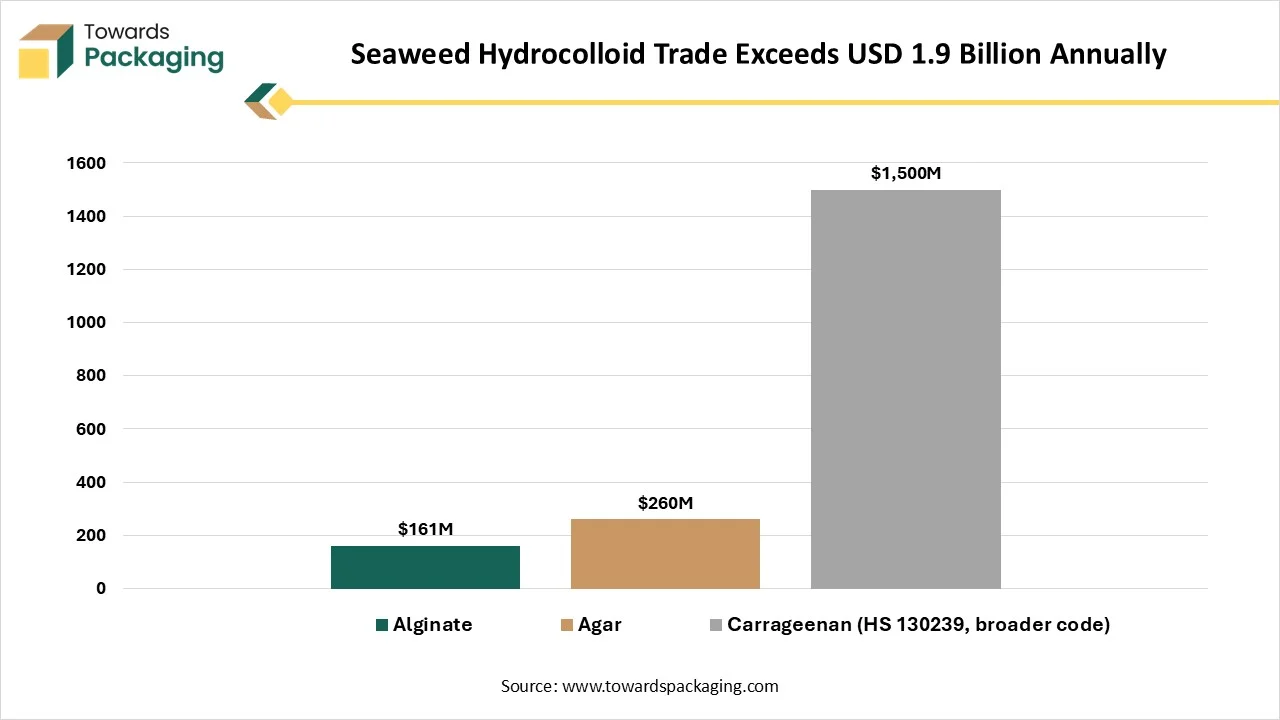
According to Aman’s research, the global export of carrageenan HS 130239, agar, and alginate is provided in the section. The highest exported products globally are carrageenan HS 130239. Carrageenan HS 130239 exported $1500 globally in 2021. The global agar exports in 2021 were $161M. The global agar exports in 2021 were $260M. Alginate is lower exported product among the other two products in 2021.
Source:- UN Comtrade (2023) data, as compiled in UNCTAD, "An Ocean of Opportunities" (2024)
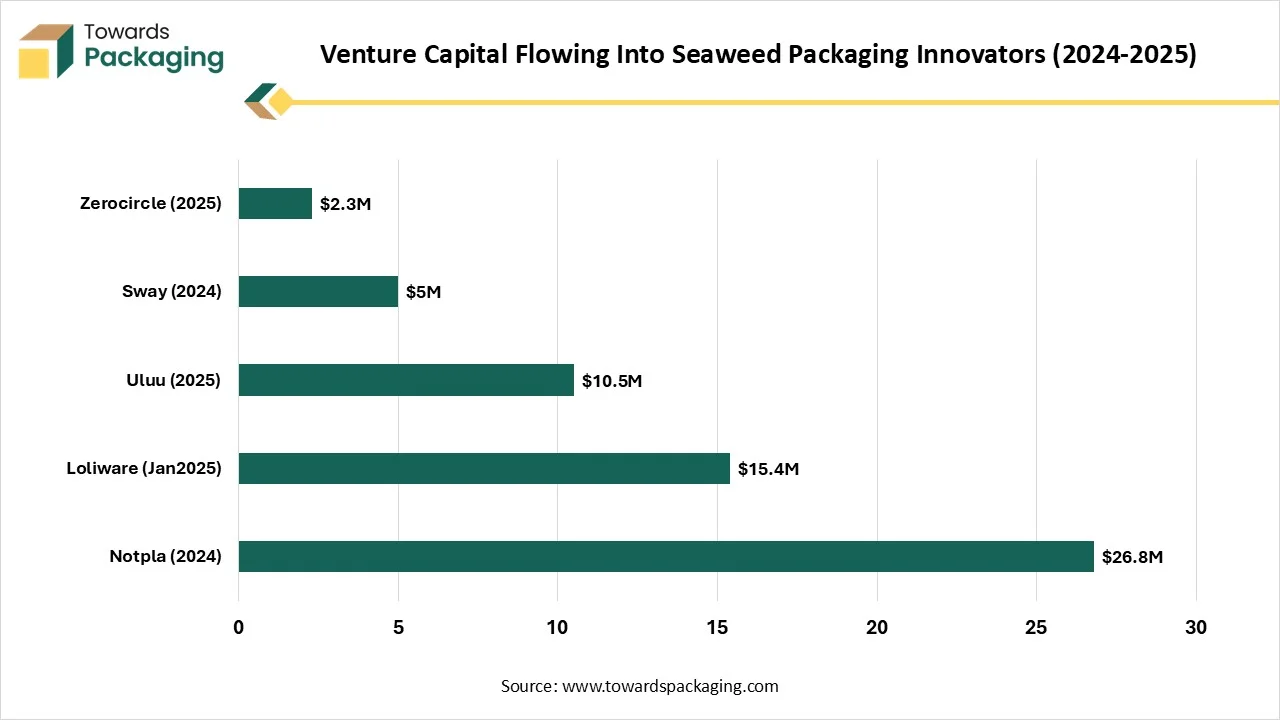
In series A+ funding, Notpla raised US$ 26.8M for the advancement of seaweed packaging in 2024. The main leader of funding is United Bankers, and the company used funds for expanding new industries. In pre-series A funding, Loliware got a $15.4 million investment for developing new seaweed-based products in 2023. Uluu company received a $10.5M investment for transforming seaweed into bioplastics in 2025. In seed funding, Sway got $5M for scaling manufacturing of seaweed-based packaging in 2024. In 2025, ZeroCircle raised a $2.3 million investment for scaling seaweed-based packaging. The company focuses on expanding its presence in the GCC and the European Union.
Source:- Phyconomy, "Seaweed in 2025: The Year in Review" (Jan 2026); Packaging Europe; AgFunderNews; Vegconomist (2024-2025)
Single-use plastic bags are fully restricted in some countries and partially in some other countries. Countries like Kenya, Morocco, Rwanda, New Zealand, and Bangladesh fully banned single-use plastic bags. Countries like France, Italy, China, Mexico, and India partially banned single-use plastic bags. Rwanda banned single-use plastic items like plastic carry bags, plastic cups, plastic cutlery, oxo-degradable plastic items, plastic bottles, plastic straws, and plastic food containers. New Zealand banned items like single-use plastic tableware, drinking straws, produce labels, produce bags, and others.
Source:- OECD Global Plastics Outlook
2.31 million tonnes bioplastic produced globally in 2025. Factors like companies' sustainability targets, increasing feedstock availability, packaging lead, agriculture expansion, government taxes, and enhanced polymerization techniques are responsible for increased bioplastic production. The global home-compostable seaweed bioplastic packaging market is estimated at USD 485 million in 2025. Factors like higher nutrient absorption, safe EOL profile, and incorporation of plug-and-play increase the production of home-compostable seaweed bioplastic packaging.
Source:- European Bioplastics Market Update (2025/2026); Towards Packaging Database
Seaweed types like red seaweed, mixed seaweed biomass, brown seaweed, and green seaweed are used in the production of home-compostable seaweed bioplastic packaging. Among all seaweed type, brown seaweed dominated the home-compostable seaweed bioplastic packaging market with a 44% share in 2025. The abundance of sodium alginate and the production of flexible food wrappers increase the use of brown seaweed. The excellent home compostability, seamless scalability, easy processing, and abundant supply of brown seaweed drive the growth. Mixed seaweed biomass is expected to grow with the highest CAGR of 18.9% during the forecast period. The focus on improving film performance and the need for soil enrichment increases the use of mixed seaweed biomass. The balanced biopolymers, resilient processing, no land use, and scalable availability of mixed seaweed biomass drive the growth. Red seaweed held a 28% share in the market in 2025. The focus on reversing ocean acidification and growing natural barriers demand increased use of red seaweed. The exceptional gelling, zero freshwater use, high structural stability, and high polysaccharide content boost the growth.
Source:- Towards Packaging Database
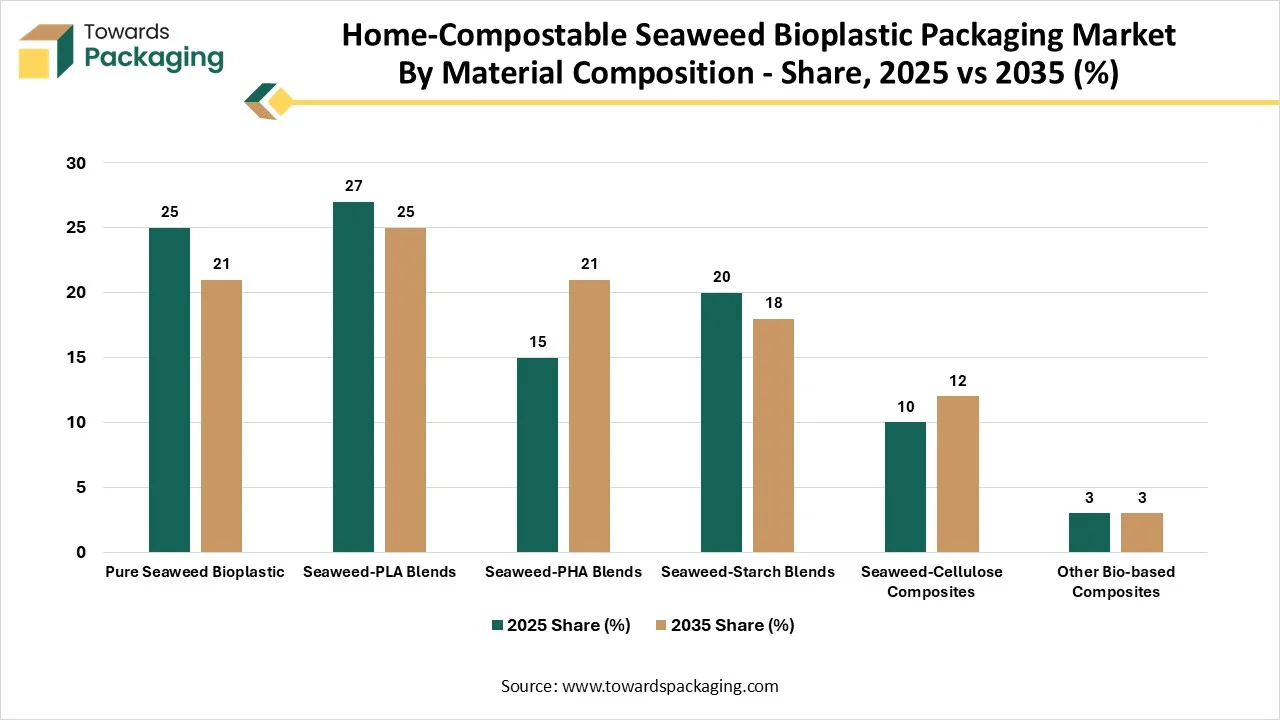
According to research, seaweed-PLA blends held a dominant position in the home-compostable seaweed bioplastic packaging market with a 27% share in 2025. The focus on enhancing the oxygen barrier performance of packaging and the availability of film-blowing equipment increases the use of seaweed-PLA blends.The surging commercial packaging and the need to speed up microbial breakdown increase adoption of seaweed-PLA blends. The easy home composting and balanced properties of seaweed-PLA blends drive the growth. Seaweed-PHA blends are expected to experience the fastest growth with a 19.5% CAGR during the predicted timeframe. The move away from starch-based bioplastics and focus on regenerative end-of-life increases use of seaweed-PHA blends. The growing commercial food packaging and interest in marine compostability increase use of seaweed-PHA blends. The zero-input resource and plastic-like durability of seaweed-PHA blends support the growth. Pure Seaweed bioplastic held a 25% share in the market in 2025. Thriving flexible pouches and shoppers' focus on zero toxic residues increase the use of pure seaweed bioplastic. The use of pure seaweed bioplastic in water-soluble pods helps with expansion. The fast degradation, rapid breakdown, and soil enrichment of pure seaweed bioplastic support growth.
Source:- Towards Packaging Database
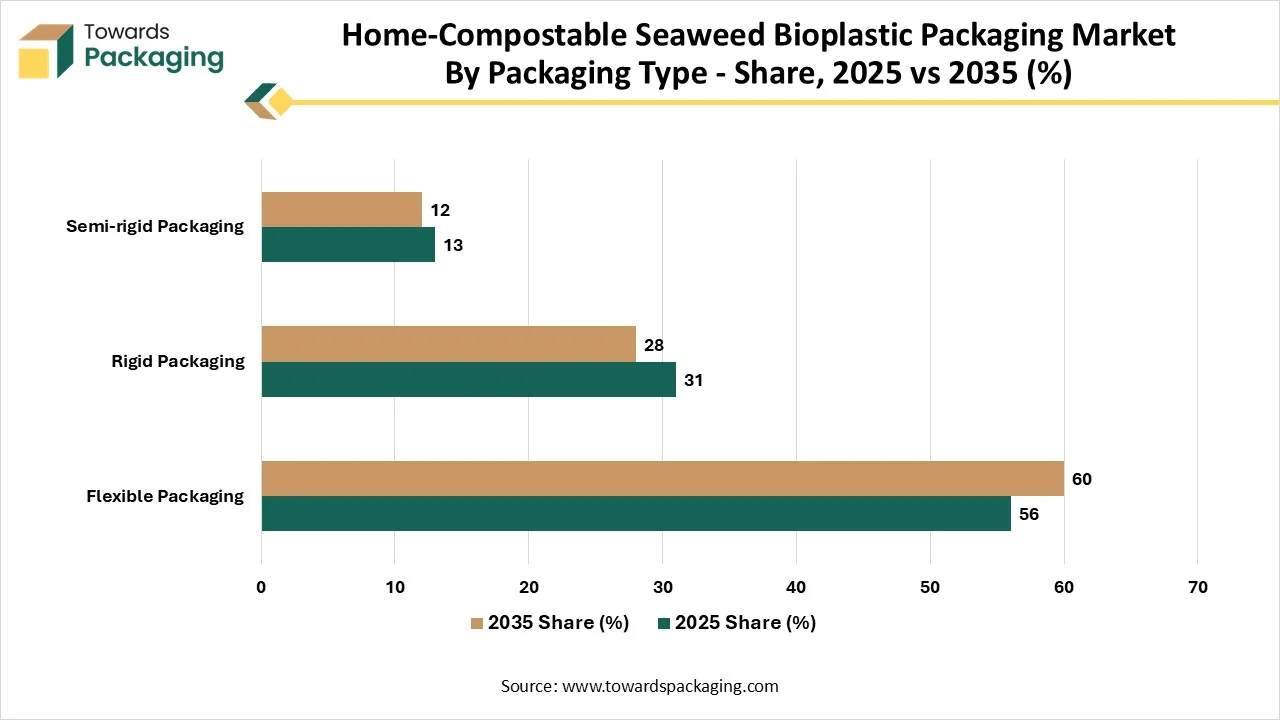
Flexible packaging held a majority share of 56% in the home-compostable seaweed bioplastic packaging market in 2025 and is expected to experience the fastest growth with a 17.2% CAGR during the forecast period. The lightweight flexible films and industries' dependence on sachets increase the use of flexible packaging. The development of single-use portions and compatibility with flexible extrusion helps with expansion. The high transportation efficiency and natural film formation in flexible packaging support the growth. Rigid packaging held a 31% share in 2025. Development of rigid packaging shapes and the requirement for protecting fragile goods increase the use of rigid packaging. Brands focus on achieving a carbon-negative profile, and the search for shelf-stable items increases the use of rigid packaging. The presence of advanced plasticizers supports the growth. Semi-rigid packaging held a 13% share in the home-compostable seaweed bioplastic packaging market in 2025. Broad government restrictions and the availability of compression molding increase production of semi-rigid packaging. The home-compostable compliance and structural protection of semi-rigid packaging drive the growth.
Source:- Towards Packaging Database
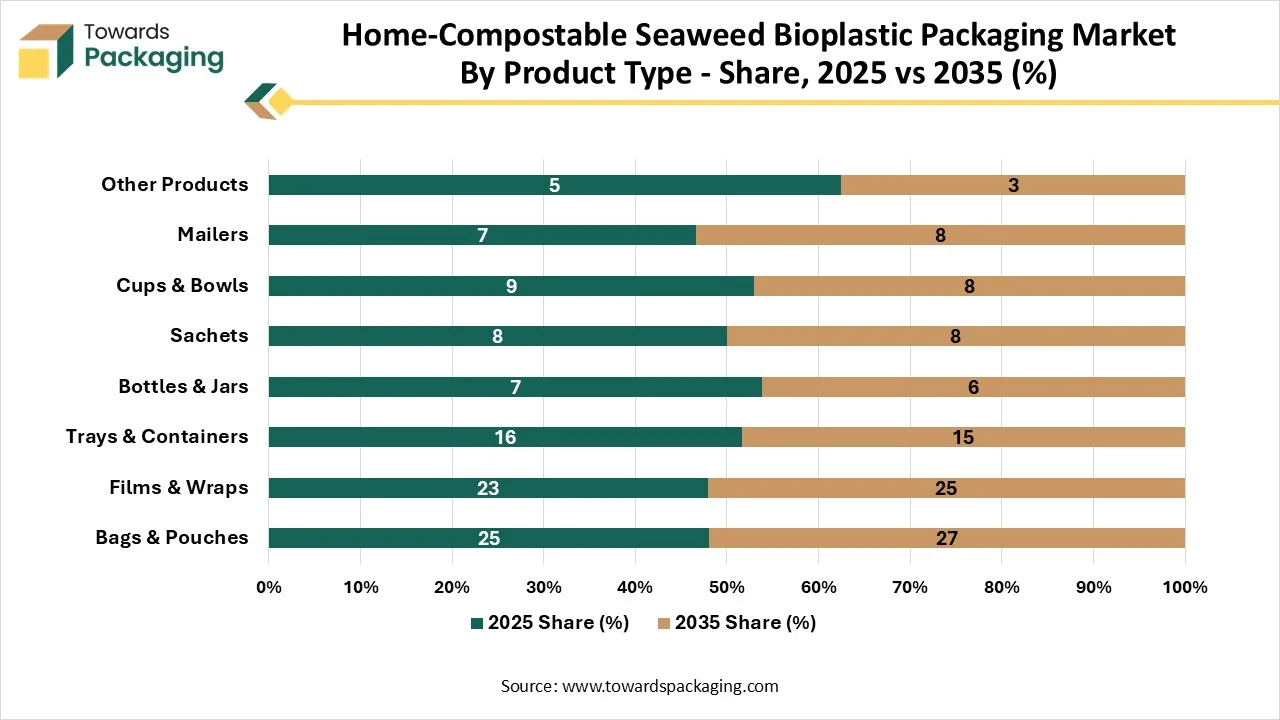
The bags & pouches dominated the home-compostable seaweed bioplastic packaging market with a 25% share in 2025. Consumer interest in petroleum-free choices and the shift away from plastic polybags increases adoption of bags & pouches. The e-commerce focus on minimal weight penalties and demand for grocery bags increases use of seaweed-based bags & pouches. The polymer flexibility, seal integrity, and supply chain adaptability of seaweed-based bags & pouches support the growth. The mailers are expected to grow with the highest CAGR of 18.6% during the forecast period. The preference for flexible mailer formats and e-commerce focus on producing zero arable land waste increases the use of seaweed-based mailers. The net-zero logistics goals drive the growth. Films & wraps held a 23% share in 2025 in the market. Freshness maintenance in perishable groceries and a surge in fast-food wrapping increase the use of seaweed-based films & wraps. The increasing demand for fresh-cut produce and innovative films boosts the growth.
Source:- Towards Packaging Database
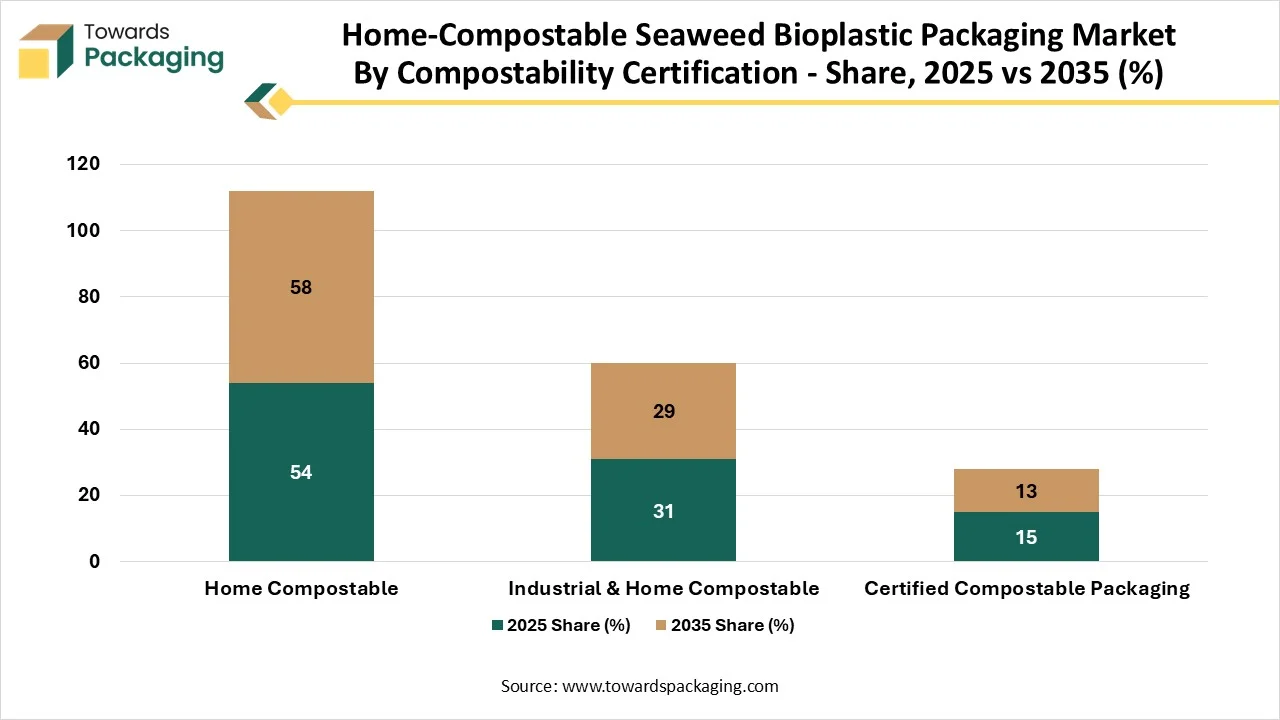
The compostability certification includes home compostable, certified compostable packaging, and industrial & home compostable. Among all these, home compostable led the home-compostable seaweed bioplastic packaging market with a 54% share in 2025 and is expected to grow with the fastest CAGR of 17.1% during the forecast period. The shift away from industrial-only compostables and the avoidance of toxic residue increases demand for home compostable certifications. The inherent material benefits and disposal convenience of home compostables drive the growth. Industrial & home compostable held a 31% share in 2025 in the market. The focus on mineralizing material naturally and the scarcity of industrial compost collection increases the use of industrial & home compostable certification. The high preference for dual certification and interest in regenerative growth boost the growth. Certified compostable packaging held a 15% share in the market in 2025. The consumer focus on exact breakdown timelines of packaging and low-impact materials increases adoption of certified compostable packaging. The growing infrastructure gaps and high brand trust boost the growth.
Source:- Towards Packaging Database
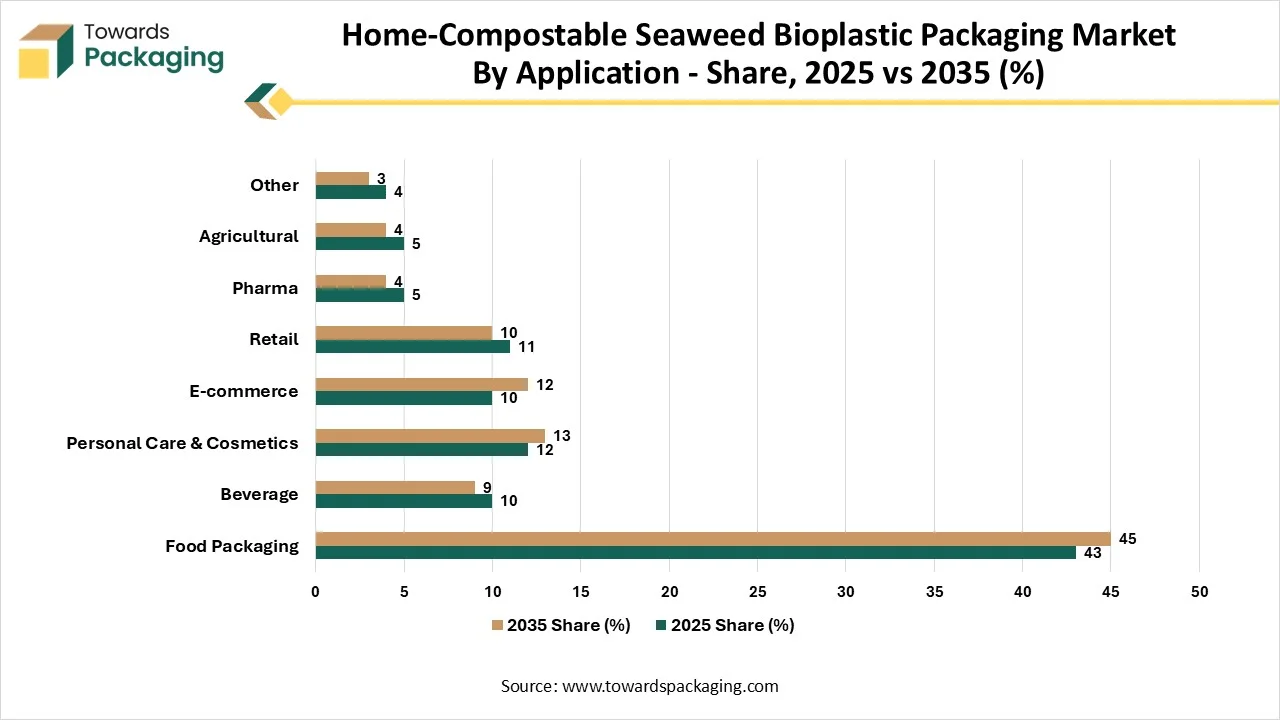
Food packaging dominated the home-compostable seaweed bioplastic packaging market with a 43% share in 2025. The high turnover of food waste and the explosion of paperboard takeaway boxes increase demand for home-compostable seaweed bioplastic packaging. The interest in food-safe packaging and the rise in condiment sachets help with expansion. The development of seaweed-based food service by Notpla drives the growth. Beverage packaging held a 10% share in the market in 2025. The rise in drink sachets and scarcity of freshwater reserves increases the use of seaweed-based beverage packaging. The interest in zero-waste beverage containers and the rise in replacement of edible liquid bubbles helps with growth. E-commerce packaging is expected to grow with a 18.4% CAGR in the market during the forecast period. The focus on minimizing e-commerce transport fuels and consumers' EOL convenience increases the use of seaweed-based e-commerce packaging. The high consumer expectations and flexibility of e-commerce boost the growth.
Source:- Towards Packaging Database
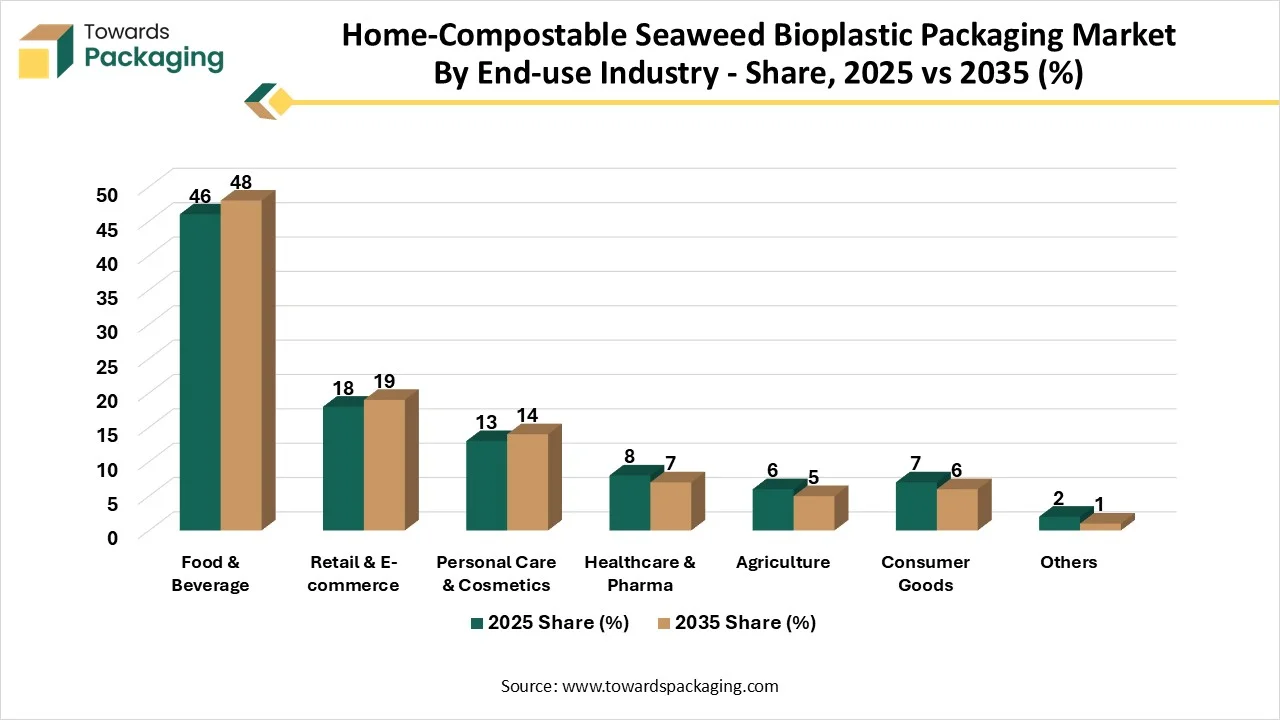
Food & beverage dominated the home-compostable seaweed bioplastic packaging market with a 46% share in 2025. F&B industry dependence on disposable items and focus on edible qualities increases use of home-compostable seaweed bioplastic packaging. Food brands shift to carbon-negative packaging, and constant demand for wraps drives the growth. Retail & e-commerce is expected to experience the highest growth with a 17.9% CAGR during the forecast period. The interest in online order fulfillment and the preference for sustainable unboxing experiences increases the use of home-compostable seaweed bioplastic packaging. The unique branding and consumer preference for a zero-waste lifestyle support the growth. Personal care & cosmetics held a 13% share in the market in 2025. Integration of home-compostable packaging in beauty brands and cosmetic companies focuses on showcasing their environmental care, increasing the use of home-compostable seaweed bioplastic packaging. The high demand for travel-size product pods supports the growth.
Source:- Towards Packaging Database
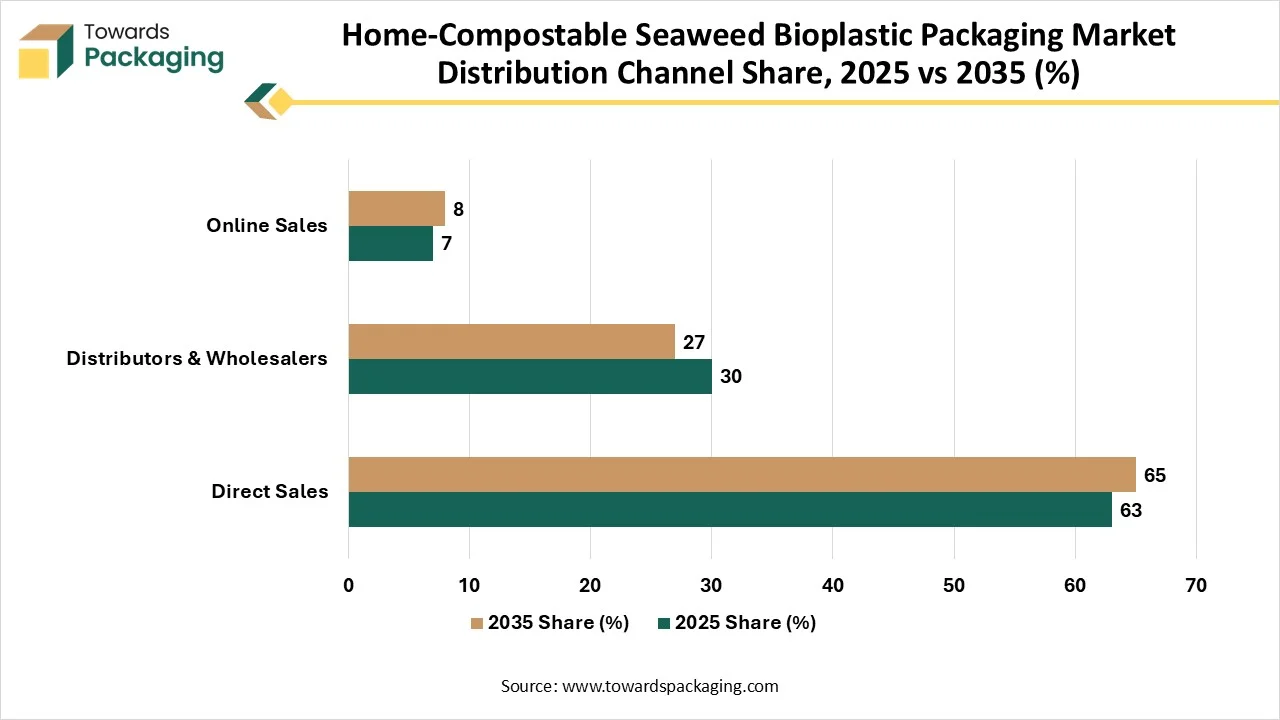
Direct Sales dominated with a 63% share in the home-compostable seaweed bioplastic packaging market in 2025. Consumer demand for clear communication related to disposal and the demand for specialized training increase the use of direct sales. The direct brand education requirement and stricter specification control increase the use of direct sales. The burgeoning B2B partnerships boost the growth. Online sales are expected to grow with the largest CAGR of 18.8% in the market during the predicted timeframe. The rise in small retail brands and local physical limitations increases the adoption of online sales. The detailed certification demand and easy D2C availability increase adoption of online sales. The targeted marketing supports the growth. Distributors & wholesalers held a 30% share in 2025 in the market. The immediate alternatives demand in retailers and medium businesses transitioning to sustainable packaging increases the use of distributors & wholesalers. The high compatibility with handling bulk orders and easy local reach in distributors & wholesalers boost the growth.
Source:- Towards Packaging Database
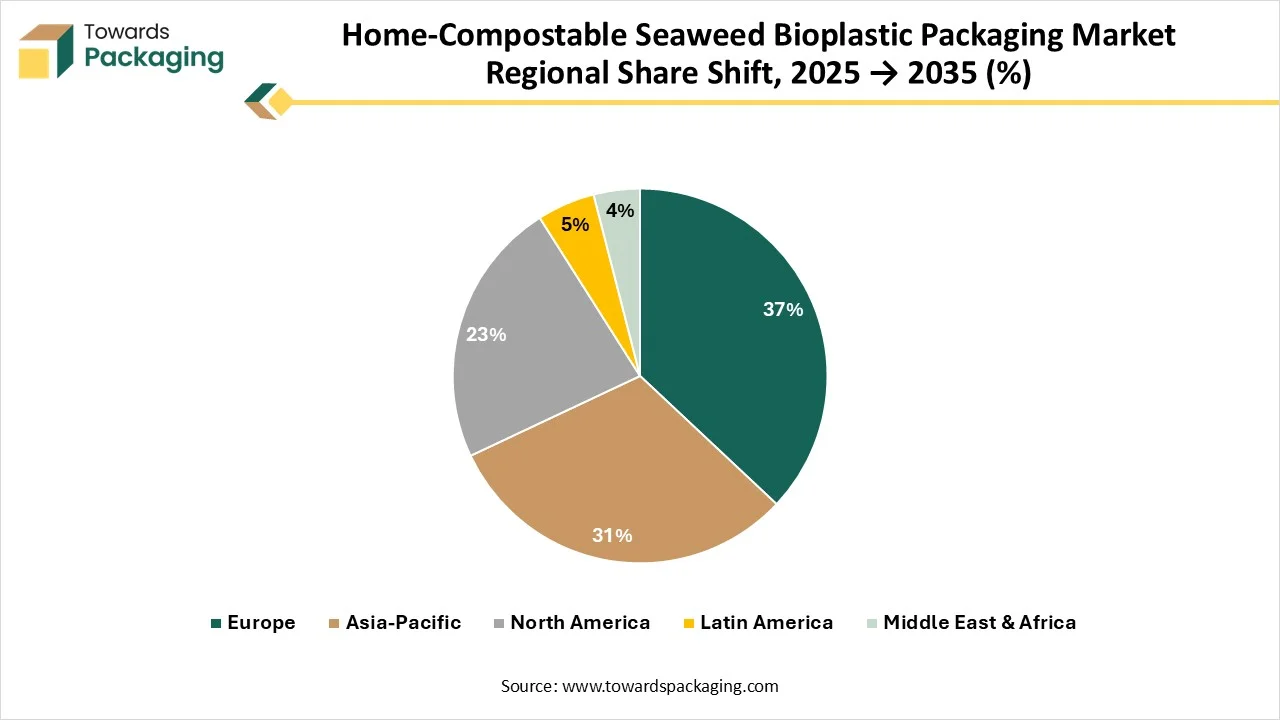
Europe held a 37% share in 2025 in the market due to standardized certification and EU directives. Europe is expected to decrease its share to 34% by 2035 due to high cultivation costs and innovative alternative materials. Asia Pacific held a 31% share in 2025 in the market due to an abundance of seaweed supply. Asia Pacific is expected to increase its share to 37% by 2035 due to availability of policy incentives and retail expansion. North America held a 23% share in 2025 the growing government grants. North America is expected to decline its share by 2035 to 21% due to higher production in Asia Pacific. Latin America held a 5% share in 2025 in the market and expected to maintain its consistent share by 2035 due to the waste crisis and corporate adoption. MEA held a 4% share in the market in 2025 due to the growing urban delivery. MEA is expected to decline its share to 3% by 2035 due to limited home-composting infrastructure.
Source:- Towards Packaging Database
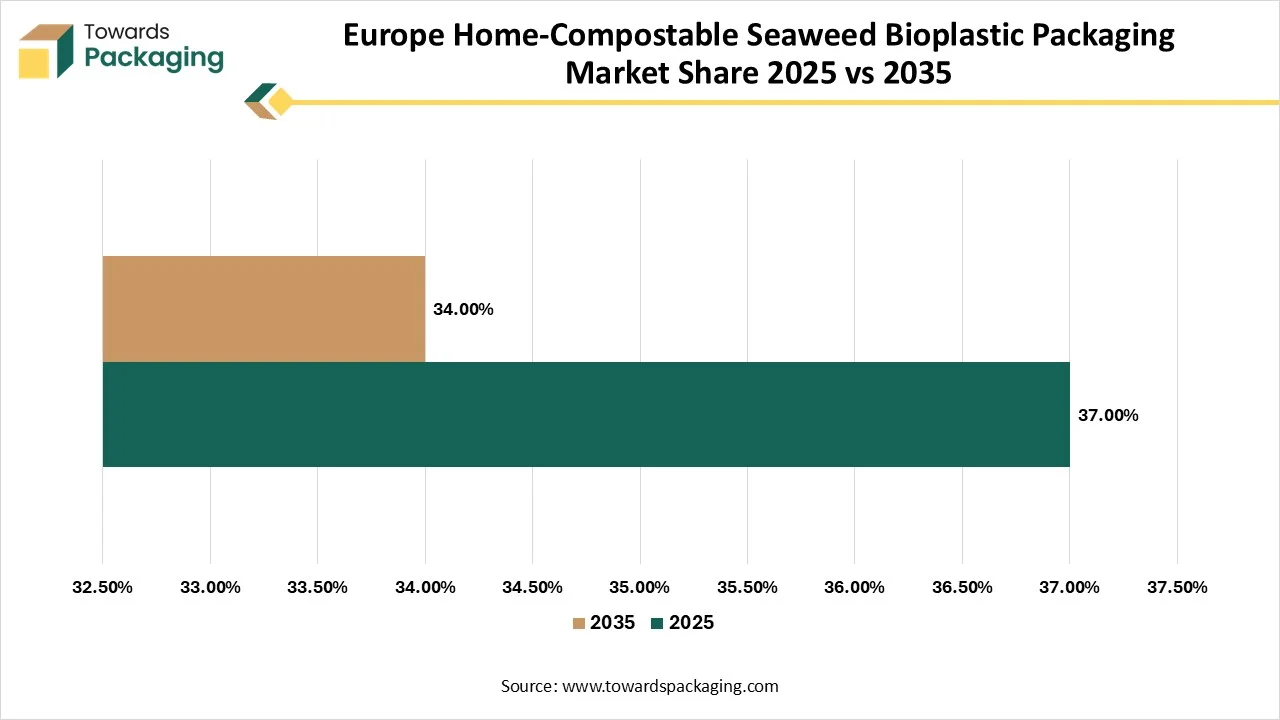
Europe dominated the home-compostable seaweed bioplastic packaging market in 2025 with a 37% share. The upcoming packaging regulations and high penalties on fossil-based PE increase demand for home-compostable seaweed bioplastic packaging. The high growth rate of seaweed and growing commercialization of seaweed-lined takeaway boxes help with expansion. The high eco-literacy and rise in cross-border collaboration drive the growth. Germany is a major shareholder in the market. The national climate goals and well-established organic waste streams increase the production of home-compostable seaweed bioplastic packaging. The focus on zero land footprint and growing startup-industry partnerships helps with the growth. The increasing takeaway sector adoption drives the growth.
Source:- Towards Packaging Database
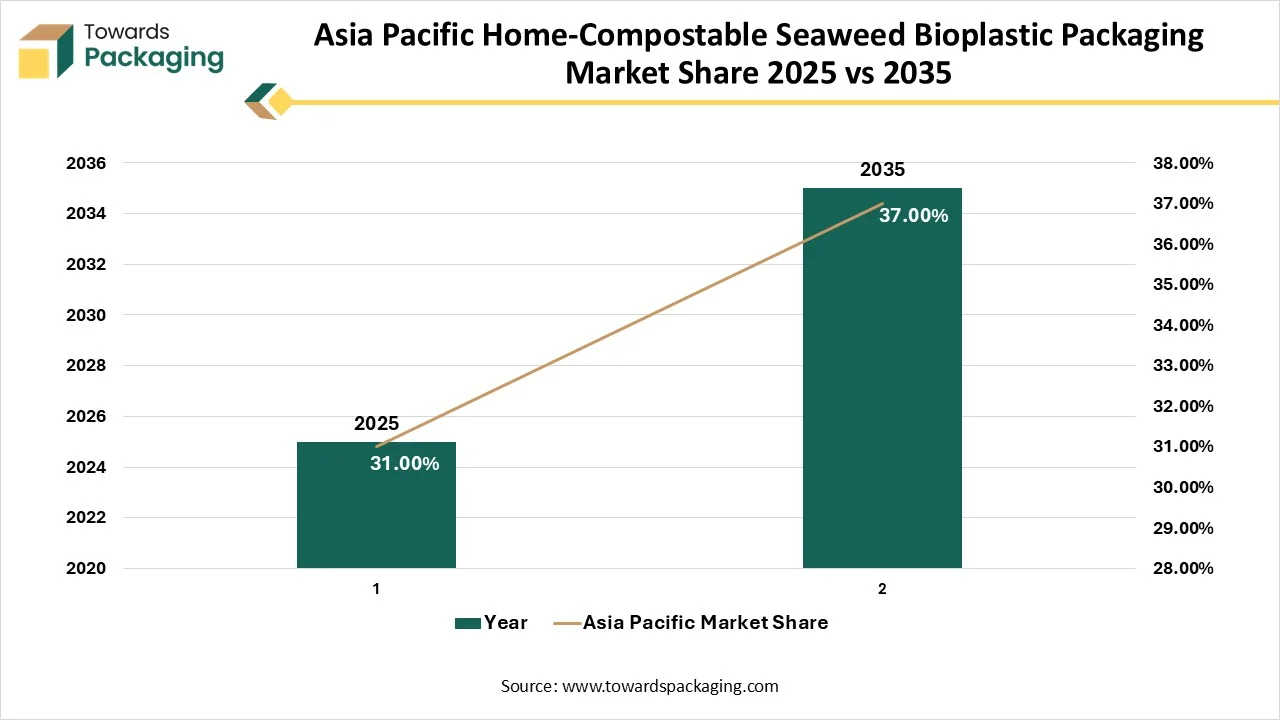
Asia Pacific held a 31% share in the home-compostable seaweed bioplastic packaging market in 2025 and is expected to experience the fastest growth with a 18.3% CAGR during the forecast period. Higher seaweed cultivation and no requirement for freshwater increase the production of home-compostable seaweed bioplastic packaging. The nation-level restrictions on plastics and booming online retail markets help with expansion. The expanding regional biotech firms and green tech startups focus on increasing development of home-compostable packaging, which helps with growth. India is rapidly expanding in the market. The nation focuses on finding legitimate packaging options, and the availability of high-temperature composting systems increases production of home-compostable seaweed bioplastic packaging. Growing companies like Zerocircle and an extensive coastline support the growth.
Source:- Towards Packaging Database
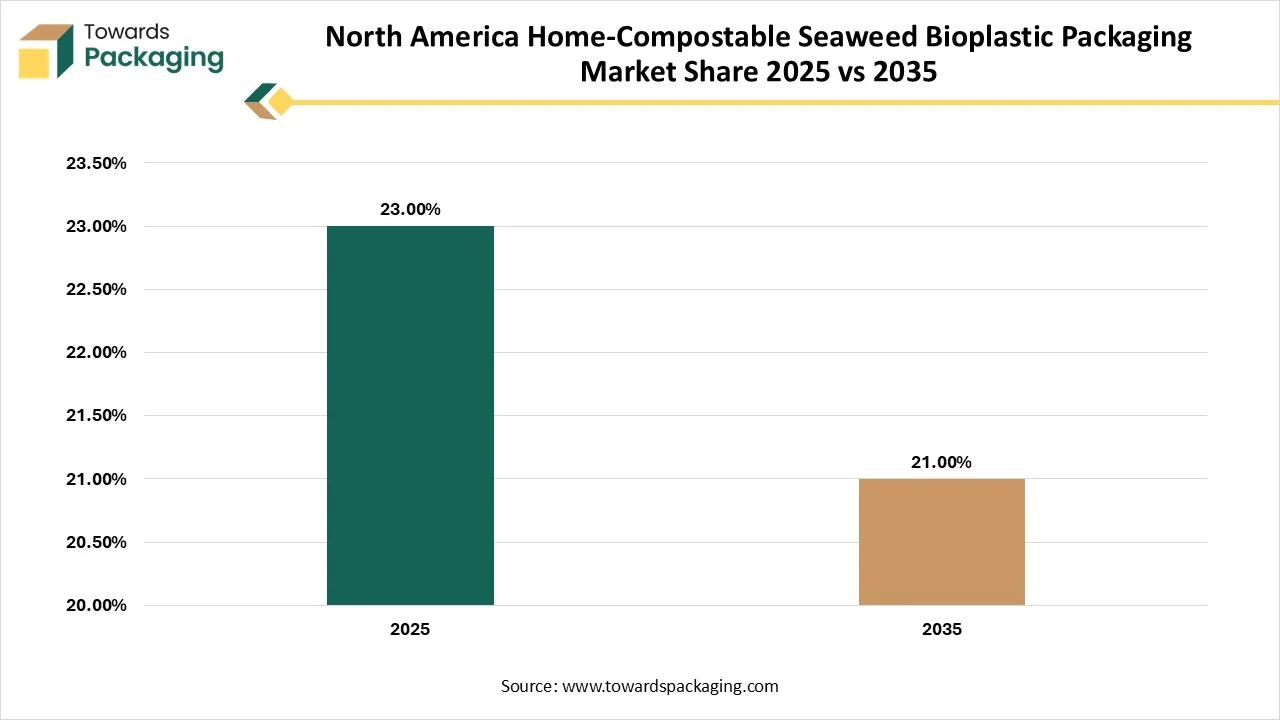
North America held a 23% share in the home-compostable seaweed bioplastic packaging market in 2025. Regulations like California’s EPR and ease of home compost increase use of home-compostable seaweed bioplastic packaging. The penalties on plastic by countries like Canada and demand for biodegradable verifications help with expansion. The increased commercialization of seaweed straws by Loliware drives the growth. United States is a key shareholder in the market. The rise in plastic-neutral pledges by major food companies and the interest in sustainable goods increases production of this packaging. The rising manufacturing of seaweed wraps and films helps with expansion. The material science company focuses on increasing the availability of seaweed resin, which supports the growth.
Source:- Towards Packaging Database
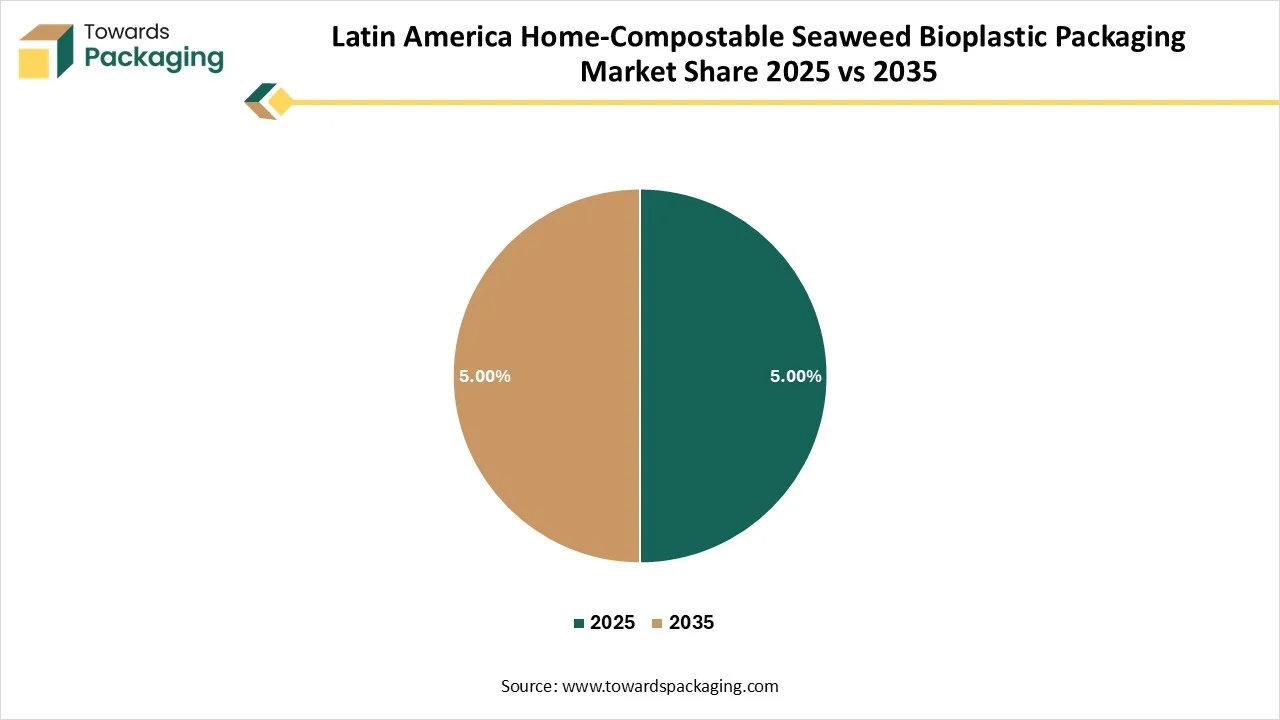
Latin America held a 5% share in the home-compostable seaweed bioplastic packaging market in 2025. The rise in food-service packaging and the rise in open dumps increases the use of home-compostable seaweed bioplastic packaging. The increased use of home-compostable films in beverage sectors and the presence of international brands help with expansion. The high raw material benefits support the growth. Brazil is robustly growing in the market. The biomass incorporation and the interest in home-compostability help with expansion. The focus on lowering terrestrial pollution and lack of industrial composting systems drives the overall growth.
Source:- Towards Packaging Database
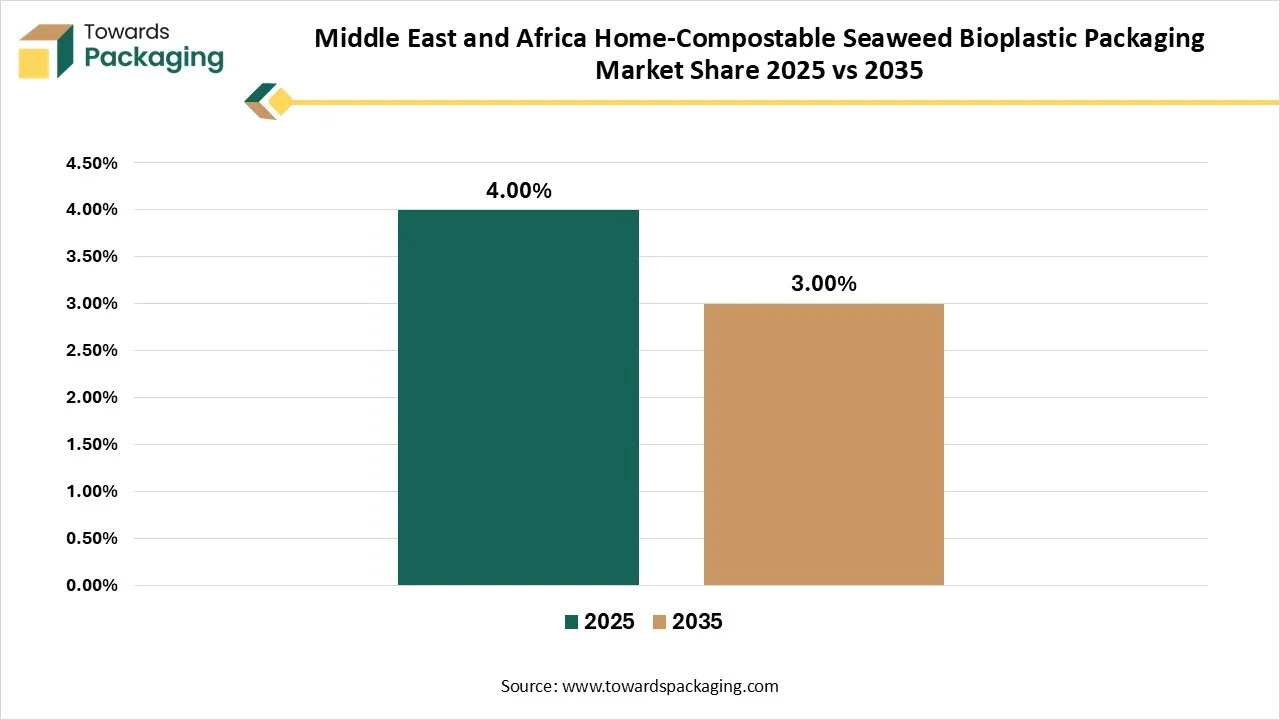
The Middle East & Africa held a 4% share in the home-compostable seaweed bioplastic packaging market in 2025. The growing retail businesses and severe water scarcity issues increase the production of home-compostable seaweed bioplastic packaging. The availability of certified materials and transition to seaweed-based solutions help with expansion. The high-end tourism industry and national green agendas drive the growth. Saudi Arabia is a robust contributor to the market. Saudi’s investment in green technology and the adoption of certified compostables increase the use of home-compostable seaweed bioplastic packaging. Urban centers shift to sustainable choices, and the presence of big retail brands supports the growth.
Source:- Towards Packaging Database
The home-compostable seaweed bioplastic packaging market adoption is growing. The expansion of biomass, high penalties on petroleum packaging, abundance of polysaccharides, expansion of coastal communities, high green tech funding, growing carbon sequestration, and no presence of agrochemicals increase the adoption of home-compostable seaweed bioplastic packaging. Major contributors are Kelpi, Zerocircle, B’ZEOS, Searo Labs, Notpla, Uluu, and FlexSea.
Vidyesh Swar executed primary research about market size, market CAGR, regional section, market segmentation, competition, fastest-growing sub-segments, global bioplastic production, and overall methodology development.
Aman researched seaweed feedstock trade, single-use plastic bans, key competitive players, companies' investment, OK compost Home Certification, and recent developments.
Aditi corrected inconsistencies, identified factual errors, performed quality checks, verified overall data accuracy, and ensured consistency in the report.
By Seaweed Type
By Material Composition
By Packaging Type
By Product Type
By Compostability Certification
By Application
By End-use Industry
By Distribution Channel
By Region




















Principal Research Analyst
Vidyesh Swar is a Senior Research Analyst at Towards Packaging, bringing over 4 years of dedicated expertise in market intelligence and strategic analysis across the dynamic world of packaging technologies and solutions.
Learn more about Vidyesh Swar

Reviewed By
Aditi Shivarkar, with 14+ years in packaging market research, specializes in food, beverage, and eco-friendly packaging. She ensures accurate, actionable insights, driving Towards Packaging Analytics & Consulting 's excellence in industry trends and sustainability.
Learn more about Aditi Shivarkar

Home-Compostable Seaweed Bioplastic Packaging Market
 Table of Content

 +1 804-441-9344
 Download Sample
 Schedule a Meeting