


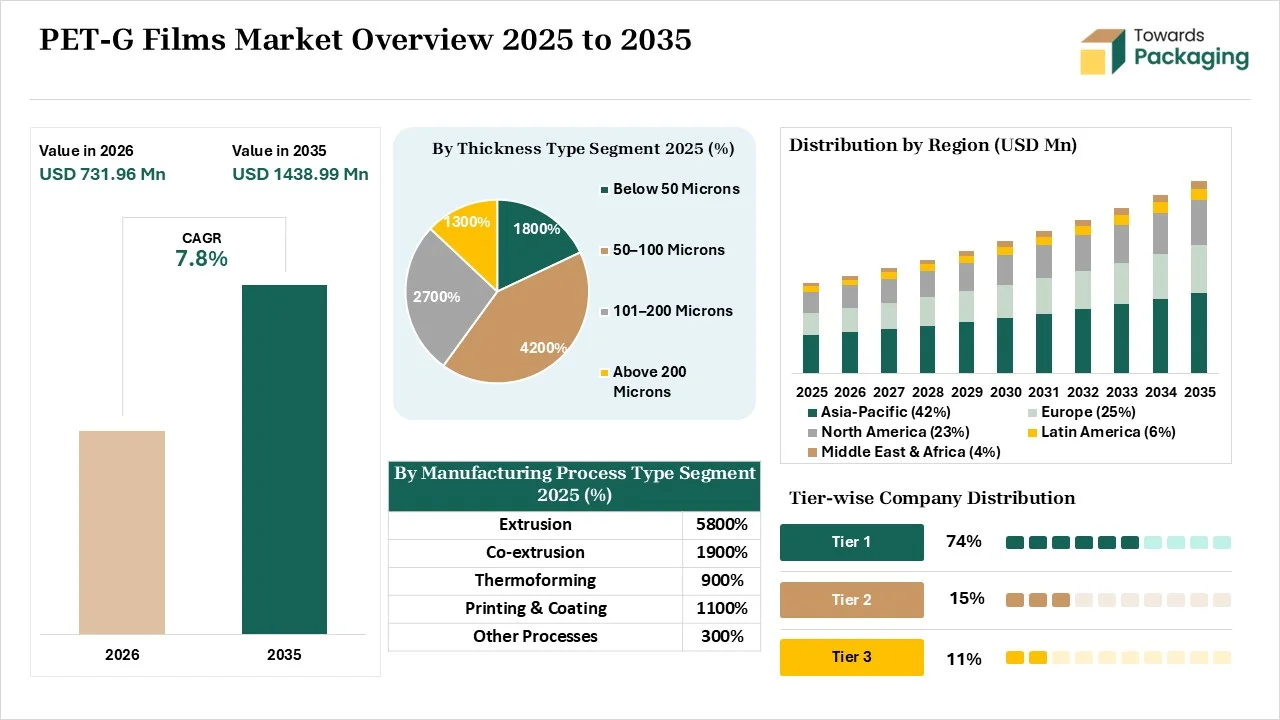
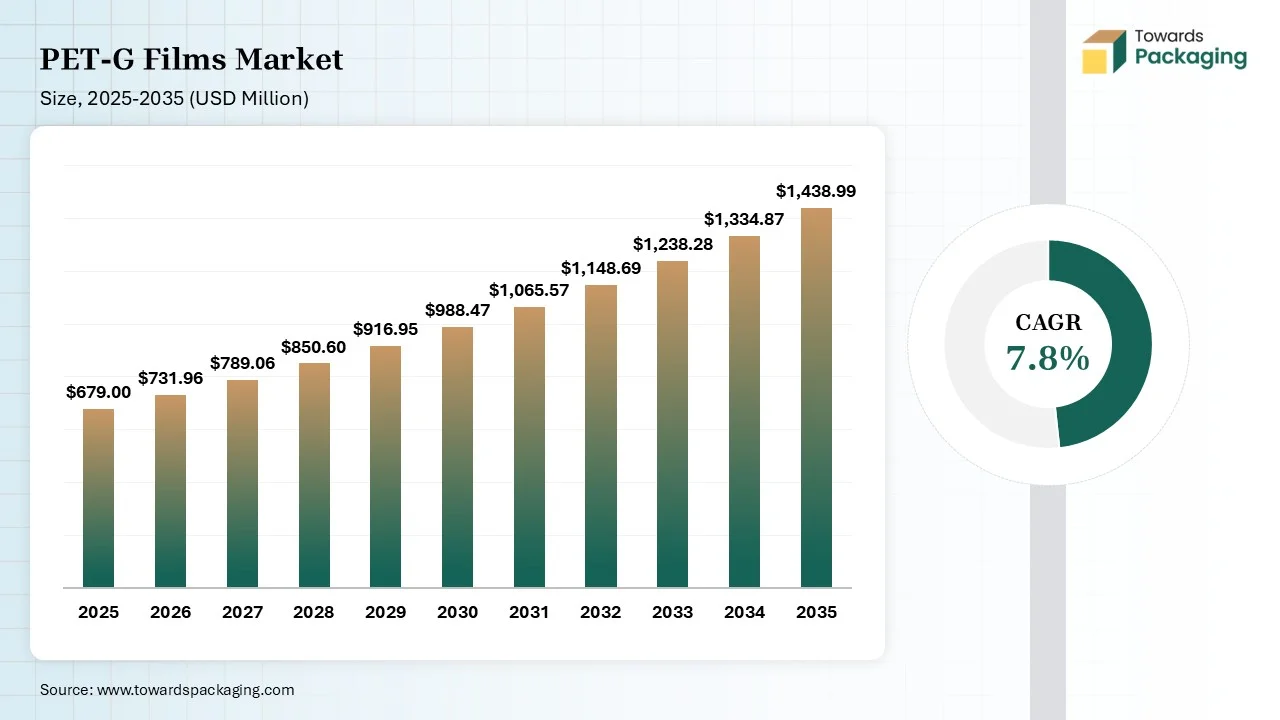
According to Vidyesh Swar, the global PET-G films market size was estimated at USD 679 million in 2025 and is predicted to increase from USD 731.96 million in 2026 to approximately USD 1438.99 million by 2035, expanding at a CAGR of 7.8% from 2026 to 2035. The key drivers are thriving medical blister packaging, attractive inner packaging demand in online retail, recyclability mandates, consumer goods growth, hazardous polymer restrictions, popularity of shrink sleeve labels, demand for beverage appeal, simplification of processing, expansion of point-of-sale marketing, and advancements in co-extrusion. The e-commerce industry uses PET-G films due to its complete recyclability and high-definition branding. The healthcare industry uses PET-G films for protective face shields & other medical packaging. The high optical clarity of PET-G films increases use in the electronics industry.
| Market Value (2025) | USD 679 Million |
| Forecast CAGR (2025-2035) | 7.80% |
PET-G films are tough plastic sheets developed from glycol-modified PET. The key characteristics include high transparency, superior toughness, high shrinkage, glycol modification, and excellent chemical resistance. Its benefits are non-toxicity, eco-friendliness, uniform shrinkage, and high impact strength. The PET-G film is suitable for labeling due to tamper evidence, 360-degree graphics, and excellent print quality. The PET-G film is suitable for packaging due to its eco-friendly profile, high transparency, and tough protection. PET-G film is widely used in product packaging, interior design, display, tamper-evident seals, and signage.
PET-G films are a great replacement for packaging materials like PVC. The packaging applications include product presentation, shrink sleeves, tamper-evident seals, and labels, increasing the use of PET-G films. It is FDA-compliant and easily recycled in PET recycling streams. The PET-G film offers more impact resistance and lower forming temperatures than PET. The PET-G film provides higher shrink capacity and gloss than PVC. The PET-G film offers higher heat tolerance and durability than PLA. It also provides extreme transparency, rigidity, and better chemical resistance than polyethylene.
In 1941, polyethylene terephthalate was established, which was designed for textile fibers. Crystallization issues occurred in the PET resins. The integration of cyclohexane dimethanol in the standard PET prevented unwanted crystallization. In 1950, PET was widely used across carbonated beverage bottle packaging and food packaging applications. The new PET-G formulation tackled sheet extrusion and thermoforming issues. The development of shrink-sleeve materials happened using PET-G films, which protected printed graphics on packaging. The production capacity of shrink sleeves increased to support wider applications like retail display cards & others. The modern era introduced specialized thermal management systems, advanced functional coatings, and recycling formulations in the industry.
The market covers film types, film thickness, application, packaging applications, end-use industry, manufacturing process, distribution channels, and geographic regions. The market covers film types including shrink films, blown films, co-extruded films, flat films, cast films, and specialty PET-G films. The thickness includes below 50 microns, 50-100 microns, 101-200 microns, and above 200 microns. Applications like labels & labeling, printing & graphics, electronics & electrical, decorative applications, packaging, medical & healthcare, and industrial applications are covered. The packaging applications include shrink sleeve labels, wraparound labels, pressure-sensitive labels, tamper-evident packaging, flexible packaging, and specialty packaging. The end-use industries covered in the reports are food & beverages, personal care & cosmetics, electronics, industrial manufacturing, pharmaceuticals & healthcare, consumer goods, chemicals, retail & e-commerce. The manufacturing process like extrusion, thermoforming, co-extrusion, and printing & coating included in the market. The distribution channel includes online sales, direct sales, and distributors & dealers. The regions like Asia Pacific, North America, MEA, Europe, and Latin America are covered in the report.
Growing Complex-Shaped Packaging
The growing social medical appeal, advanced molding technology, and the brand's focus on developing visual shelf impact increase the use of complex-shaped packaging. The cosmetics products like lipstick tubes and perfume bottles use PET-G films. The sterilizable trays and shaped counter display trays increase the use of PET-G films. The multi-dimensional contours and tailored-shaped household cleaning bottles increase the use of PET-G films due to its low-shrink stress and exceptional toughness. The growing complex-shaped packaging is a key driver for the market growth.
Volatility in Polymer and Energy Prices
The fluctuating prices of natural gas and crude oil directly impact the PET-G prices. The high energy needs in extruding polymer films and glycol modifications increase the cost. The volatility in the cost of UV blockers and recycled content increases the final cost. The high extrusion power and the use of high-capacity industry chillers increase the cost. The machine depreciation, high scrap rate, and high maintenance cost increase the overall cost. The volatility in polymer and energy prices is a restriction for market growth.
Growing Pharmaceutical Applications
PET-G films are used in several pharmaceutical applications like medical device trays, seal caps, and blister packs. The development of tablet covers for storing capsules and the expansion of supplement containers increase the use of PET-G films. The use of sterile packaging clamshells for syringes & other medical applications and the irregularity of medicine bottles increases the use of PET-G films. The development of small diagnostic tools and dropper containers increases the use of PET-G films. These films are used in pharmaceutical applications due to their sterilization resistance, non-toxic profiles, and easy thermoforming. The growing pharmaceutical applications create an opportunity for market growth.
The key feedstocks like MEG, DEG, PTA, CHDM, and NPG are required. The anti-block additives and slip agents are also required. The global patent holder provides CHDM. The pricing of PET-G resins depends on raw material prices.
Extrusion involves melting PET-G granules, shaping, and providing cooling control. Co-extrusion includes multi-layer combination and optimizing PET-G properties like printability & others. Specialty film producers create customized blends and focus on quality regulation.
The role of printing providers is surface treatment, color management, and reverse printing. The role of surface treatment providers is improving lamination, enhancing surface energy, and improving printability. The surface treatment providers offer chemical primers, corona discharge, and plasma activation. The coating providers' role is printability, adhesion promotion, and functional modifications. The finishing providers focus on dimension conversion, texturing, and functional coatings.
Conversion includes melt-extruding of PET-G resin, orientation into the transverse direction, graphics printing, seaming using solvent welding, creation of a tube, integration of inline perforators, and cutting into individual sleeves. The label conversion process includes pressure-sensitive format development and die-cutting. The specialty products conversion includes thermoforming, slitting, custom sheet creation, and tamper-evident bands production.
Industrial companies, food, cosmetics, and other industries increase PET-G demand due to manufacturing versatility and diverse packaging requirements. F&B industry mainly focuses on shrink labels, safety, and compliance. Healthcare focuses on biocompatibility & sterilization, whereas cosmetics focuses on chemical resistance & aesthetic appeal. Industrial companies & electronics focus on prototyping, retail displays, and protection.
The raw materials like terephthalic acid, 1,4-Cyclohexanedimethanol, slip agents, UV stabilizers, ethylene glycol, anti-block additives, and antistatic agents are required for the production of PET-G films. The supplier concentration is moderately high, and the major production region is Asia Pacific. The procurement risks are price volatility, inflation pressures, moisture sensitivity, specialized transport, and limited supplier concentration.
Film manufacturing includes resin selection, drying, melting, die extrusion, chill roll casting, preheating, longitudinal stretching, transverse stretching, heat setting, surface treatment, trimming rough edges, and winding. Film processing includes pellet drying, moisture control, melting, co-extrusion, flat-die shaping, chill roll, orientation, and winding.
Film conversion includes corona treatment, printing, slitting master film, rewinding, seaming, and sheeting. Label production steps are printing, seaming, slitting, and winding.
Direct sales target major brand owners, key enterprise converters, and OEMs. Distributors target regional industrial players and mid-sized converters. Dealers target sign-makers, regional end-users, and domestic print shops. Digital procurement mainly targets B2B buyers. Distribution focuses on lightweight shipping, lead times, and storage stability. Transit protection and end-use safety are the main aims in customer delivery.
The supply chain risks are petrochemical dependency, stricter shelf life, high production waste, specialized transport needs, moisture sensitivity, stringent storage, and recycling sorting friction. The risks include feedstock volatility, transcontinental trade, and environmental sensitivity. The resilience strategies are circular integration, dual-sourcing strategies, and localized buffer stock.
The shrink films segment dominated the market with a 48% share in 2025. The development of curved containers and the need to increase the shelf appeal of products increase the use of shrink films. The maximization of brand visibility and smooth protection of goods increases adoption of shrink films. The rise in tamper-evident seals helps with expansion. The crystal clarity, high shrinkage, chlorine-free safety, and superior aesthetics of PET-G films drive the segment growth.
The co-extruded films segment held a 9% market share in 2025 and is expected to grow at the fastest CAGR of 8.9% during the forecast period. The development of automotive interiors and the creation of tactile appeal increase the use of co-extruded films. The development of modern cabinets and chemical-resistant barriers increases the use of co-extruded films. The core-layer savings, surface protection, better barrier properties, and tough quality of co-extruded films help with the expansion. The high-definition labeling supports the segment growth.
The 50-100 microns segment dominated the market with a 42% share in 2025. The rise in pharmaceutical shrink sleeves and the need for clear print surfaces increases use of 50-100 microns. The focus on structural stability in blister packs and the expansion of electrical insulation layers increases the use of 50-100 microns. The high shrinkage, excellent process stability, exceptional handling, and protective qualities of 50-100 microns drive the segment growth.
The below 50 microns segment held an 18% market share in 2025 and is expected to grow at the fastest CAGR of 8.9% during the forecast period. The rise in contoured container labels and the growth in dairy wrapping increase use of below 50 microns. The expansion of clear labeling and confectionery packaging increases adoption of below 50 microns. The high-speed processing, shrink splicing, lighter footprint, and printability of below 50 microns support the segment growth.
According to my research, the labels & labeling segment dominated the market with a 46% share in 2025. Cosmetics companies focus on brand differentiation, and high production of beverage bottles increases the use of PET-G films. The increased perfume labeling and the companies' focus on maintaining clear visibility increase the use of PET-G films. The vibrant screen, exceptional gloss, and compatibility with digital printing of PET-G films drive the segment growth.
The medical & healthcare segment held an 8% market share in 2025 and is expected to grow at the fastest CAGR of 9% during the forecast period. The growing direct patient contact with medications and the focus on resisting chemicals in pharmaceuticals increase the use of PET-G films. The surge in disposable medical components and the growing device transport increases the use of PET-G films. The expansion of packaged medical instruments and the interest in tamper-evident tray covers support the segment growth.
The shrink sleeve labels segment dominated the market with a 59% share in 2025 and is expected to grow at the fastest CAGR of 8.6% during the forecast period. The adoption of luxury cosmetics containers and the expansion of spray bottles increases the use of shrink sleeve labels. The rise in full product labeling and the increasing use of skincare bottles increases the adoption of shrink sleeve labels. The high shrinkability, excellent resistance, high toughness, eco-friendly profile, and crystal-clear transparency of shrink sleeve labels drive the segment growth.
The wraparound labels segment held a 13% market share in 2025. The crisp graphics design needed in soft drinks packaging and premium designs of shampoos increase the use of wraparound labels. The durable outer labels needed in detergents and the expansion of OTC medicine bottles increase the use of wraparound labels. The 360-degree coverage, high functionality, and high-speed efficiency of wraparound labels support the segment growth.
The food & beverages segment dominated the market with a 36% share in 2025. The demand for full-body labels in soda bottles and the use of wraps in yogurts increases adoption of PET-G films. The rise in tamper-evident bands and the need for seals in trays increases use of PET-G films. The rising dairy packaging and the expansion of complex beverage containers increase use of PET-G films. The processing ease and crystal clarity demand in food & beverages drive the segment growth.
The pharmaceuticals & healthcare segment held a 11% market share in 2025 and is expected to grow at the fastest CAGR of 8.80% during the forecast period. The major sterilization techniques needed in pharmaceuticals and the easy medical device inspection increase the use of PET-G films. The focus on keeping medical trays safe and the rise in intravenous bags increases the use of PET-G films. The need for secure caps in liquid medicine containers and the testing strips packaging supports the segment growth.
According to my research, the extrusion segment dominated the market with a 58% share in 2025. The rigorous safety demand in retail signage and the need for 360-degree container labeling increase the use of extrusion. The expansion of sterile barrier pouches and the rise in home interior lamination increase demand for PET-G films. The thriving transparent retail packaging helps with expansion. The amorphous nature and exceptional processing stability of extrusion drive the segment growth.
The co-extrusion segment held a 19% market share in 2025 and is expected to grow at the fastest CAGR of 10% during the forecast period. The expansion of IV bags and the need for sensitive drug protection increase the use of co-extrusion. The high-clarity shrink demand in lid stocks and protective window films increases the use of co-extrusion. The surface customization, enhanced performance, lower overall price, and combined material strength of co-extrusion support the segment growth.
The direct sales segment dominated the market with a 63% share in 2025. The customized specifications needed in medical thermoforming and the development of specialized film grades increase the use of direct sales. The preference for manufacturer-direct pipelines and the avoidance of intermediary handling risks increases adoption of direct sales. The focus on bypassing middlemen and fixed pricing stability drives the segment growth.
The online sales segment held a 7% market share in 2025 and is expected to grow at the fastest CAGR of 9.40% during the forecast period. The broader customer preference for eliminating traditional middlemen and growing industrial clients increases the use of online sales. The demand for damage-resistant materials and the expansion of digital portals help with expansion. The aesthetic customization and real-time checking in online sales support the segment growth.
According to my research, Asia Pacific held a 42% share in the PET-G films market in 2025 and is expected to grow at the fastest CAGR of 8.80% during the forecast period. The major production hubs and the popularity of smart devices increase the use of PET-G films. The rapid retail expansion and the higher need for electrical parts increase the use of PET-G films. The use of durable packaging films in beverage packaging helps with the expansion. The massive film manufacturing capacity and the expansion of premium functional films drive the market growth.
China
China dominated the market with the largest share in 2025. The easy availability of raw petrochemical inputs and the expansion of film extrusion increase the production of PET-G films. The explosion of China’s cosmetics industry and the rise in retail shipping increase the use of PET-G films. The high production volume of display panels supports the market growth.
India
India is expected to experience the fastest growth in the market during the forecast period. The growing demand for clear blister packaging and the expansion of supermarket culture increase the use of PET-G films. The strong transport networks and the utilization of recyclable specialty polymers increase the production of PET-G films. The interest in durable labels and faster film distribution supports the market growth.
Europe held a 25% market share in 2025. The availability of high-performance materials and the increasing use of transparent packaging in medical devices increase demand for PET-G films. The creation of premium retail displays and European waste reduction forces increases use of PET-G films. The development of clear product labels and the high volume of luxury item packaging increases use of PET-G films, driving market growth.
Germany
Germany held the largest share in the PET-G films market in 2025. The advanced chemical infrastructure and the growing precision engineering increase the use of PET-G films. The transition to recyclable films and easy supply of packaging films helps with the expansion. The robust medical technology and mature food production sector increase the use of PET-G films, supporting the market growth.
Netherlands
Netherlands is expected to grow at the fastest CAGR during the forecast period. The seamless chemical distribution infrastructure and the shift to recyclable polyester increase the production of PET-G films. The expanding demand for renewable energy and the premium hub for plastic product distribution increase the use of PET-G films. The expansion of high-clarity sterile films supports the market growth.
North America held the 23% market share in 2025. The interest in attractive container display and medical packaging expansion increases the use of PET-G films. The robust infrastructure for precision-engineered films and the preference for lightweight materials increase the use of PET-G films. The high shrink wrap consumption and the interest in protective shipping materials drive the market growth.
United States
United States dominated the market in 2025. The use of premium engineering materials in food packaging and the development of thermoformed blister packs increase the use of PET-G films. The high electronics consumption rates and the huge extrusion film processing capacity help with the expansion. The growing premium branding and the expansion of cosmetic display containers support the market growth.
Mexico
Mexico is growing in the market. The Northern border plants and the interest in durable blister films help with the expansion. The corporate eco-goals and the major film producers increase the production of PET-G films. The burgeoning medical device industry and the expansion of personal-care brands increase use of PET-G films, boosting the market growth.
Latin America held a 6% market share in 2025. The expansion of frozen goods and increased investment in the domestic supply chain increase the production of PET-G films. The development of rigid food containers and the need for protective face shields increase the use of PET-G films. The use of advertising graphics and meat sector expansion drives the market growth.
Brazil
Brazil held the highest revenue share in the market in 2025. The demand for advanced barrier films in diverse sectors and the interest in recyclable PET solutions increase the production of PET-G films. The high soft drinks consumption and the interest in aesthetic product packaging increase the use of PET-G films. The rise in complex container labeling supports the market growth.
Argentina
Argentina is growing in the PET-G films market. The use of blister-pack films in the domestic healthcare sector and changing trade policies increases the use of PET-G films. The expansion of the labeling industry and the utilization of specialty films in the food sector help drive the expansion. The rise in thermoformed healthcare packaging boosts the market growth.
The MEA held a 4% market share in 2025. Consumer spending on consumer goods and modernized hospital facilities increases the use of PET-G films. The interest in packaged cosmetics and requirement for stretch wraps increases adoption of PET-G films. The affordable raw resin supplies and expanding cites supports the market growth.
Saudi Arabia
Saudi Arabia holds the major share in the market. The domestic petrochemical giants and the industry's demand for PET packaging films increase the use of PET-G films. Consumer demand for dairy products and the established domestic packaging conversions increase production of PET-G films. The high national investments support the market growth.
South Africa
South Africa is expanding in the market. The utilization of recyclable mono-materials and the expanding local medical sector increases the use of PET-G films. The presence of organized supermarkets in Cape Town and the growth in pharmaceutical blister packs increase the use of PET-G films. The trend of eye-catching packaging boosts the market growth.
The market features regional distribution players and tier-1 industry players. The competition is high in the market due to the demand for technical barriers and sustainable packaging. The multinational chemical companies like Klockner Pentaplast Group, Eastman Chemical Company, and SK Chemicals dominate the market. The Japan-based C.I. Takiron Corporation is a major manufacturer of PET-G films in the Asia Pacific region, whereas Bonset America Corp is a key manufacturer in the North America regions. The entry barriers are green rules and high initial cost. The differentiation factors are shrink uniformity, transparency, optical clarity, regulatory approvals, and print receptivity.
| Sr. No. | Company Name | Product Range | Production Facilities | Sustainability Initiatives |
| 1 | Eastman Chemical Company | Eastar Copolyester, Provista Copolymer, Spectar Copolyester, Cristal Copolyester |
United States, China, Malaysia, India, Netherlands, France, Germany, Spain |
Net-Zero Targets, Energy Initiatives |
| 2 | Klockner Pentaplast | Pentaform High-Yield Films, Pentalabel Roll-Sleeve Films, Pentacard Rigid Films, Pentamed, Pentaclear Box Films |
United States, Canada, Brazil, Argentina, Germany, France, China, India, Italy, Spain, Portugal, Thailand, Belarus |
Carbon Reductions, Landfill Diversions |
| Company Name & Films | Eastman Easter Copolyester | Pentaclear Box Films | Cosmo’s PETG Films |
| Key Properties |
Exceptional Impact Toughness, |
Excellent Folding Ability, High Surface Gloss, Excellent Printability |
Greater Ink Anchorage, Uniform Heat Activation |
| Applications | Medical Device Packaging, Cosmetics Packaging |
Retail Folding Cartons, Decorative Gift Packaging, Window Boxes |
Shrink-Sleeve Labeling, Cosmetic Container Packaging, Pharmaceutical Packaging |
SK Chemicals
| Company Overview | The eco-friendly chemical enterprise manufactures PET-G films for medical and packaging applications. |
| Manufacturing Footprint | South Korea |
| Product Portfolio | SKYGREEN P-SF, SKYGREEN SF 200, SKYGREEN S2008, SKYGREEN P-SF2, SKYGREEN JN100/ KN200 |
| SWOT Analysis |
Strength Chemical Recycling Infrastructure Commercialization Weakness High Capital Expenditure Opportunity Replacement of Toxic PVC Films Threats Volatility in Energy Prices |
Bonset America Corporation
| Company Overview | The North Carolina-based company manufactures diverse film materials for container labeling and shrink sleeve applications. |
| Manufacturing Footprint | United States, Uruguay |
| Product Portfolio | Bonpet Standard Clear Grades, Bonpet 7G, Bonpet 8D, Bonpet WI, Bonpet 7M, Bonpet Renew |
| SWOT Analysis |
Strength Strong Manufacturing Infrastructure Weakness High Dependence on American Markets Opportunity Recycle-Friendly Developments Threats Volatility in Resin Prices |
Cosmo First Limited
| Company Overview | The company specializes in BOPP films and provides films for applications like industrial, flexible packaging, and labeling. |
| Manufacturing Footprint | India |
| Product Portfolio | High-Shrink Clear PET-G Films, White Opaque PET-G Films, Low Shrink Force Films |
| SWOT Analysis |
Strength Excellent Film Spectrum Weakness Limited Installed Capacity Opportunity FMCG Growth Threats Raw Material Cost Volatility |
According to my research, the PET-G film market is massively expanding due to the growing end-use industry demand and superior shrinkability. The higher demand for shrink films, expanding medical use, and high performance benefits increase the use of PET-G films. The shrink films hold the major share due to the growing PVR replacement, non-toxic film demand, and enhanced aesthetics focus. The food & beverage industry is a major consumer of PET-G films due to the growing demand for visual appeal, tamper evidence, barrier protection, and contour shrinkage. F&B brands like Coca-Cola, Monster Beverage, PepsiCo, Knorr, and Nestle are major consumers of PET-G films. Asia Pacific holds the dominant position in the market due to the cost-efficiency, manufacturing base, and high packaging demand. Asia Pacific companies like Lotte Chemical, SK Chemicals, and Cosmo First Limited are major producers. The leading players in PET-G films are SK Chemicals, Covestro, Eastman Chemical Company, Plaskolite, SK microworks, and Klockner Pentaplast.
By Film Type
By Thickness
By Application
By Packaging Application
By End-Use Industry
By Manufacturing Process
By Distribution Channel
By Region



Principal Research Analyst
Vidyesh Swar is a Senior Research Analyst at Towards Packaging, bringing over 4 years of dedicated expertise in market intelligence and strategic analysis across the dynamic world of packaging technologies and solutions.
Learn more about Vidyesh Swar

Reviewed By
Aditi Shivarkar, with 14+ years in packaging market research, specializes in food, beverage, and eco-friendly packaging. She ensures accurate, actionable insights, driving Towards Packaging Analytics & Consulting 's excellence in industry trends and sustainability.
Learn more about Aditi Shivarkar

PET-G Films Market
 Table of Content
 sales@towardspackaging.com
 +1 804-441-9344
 Download Sample
 Schedule a Meeting