


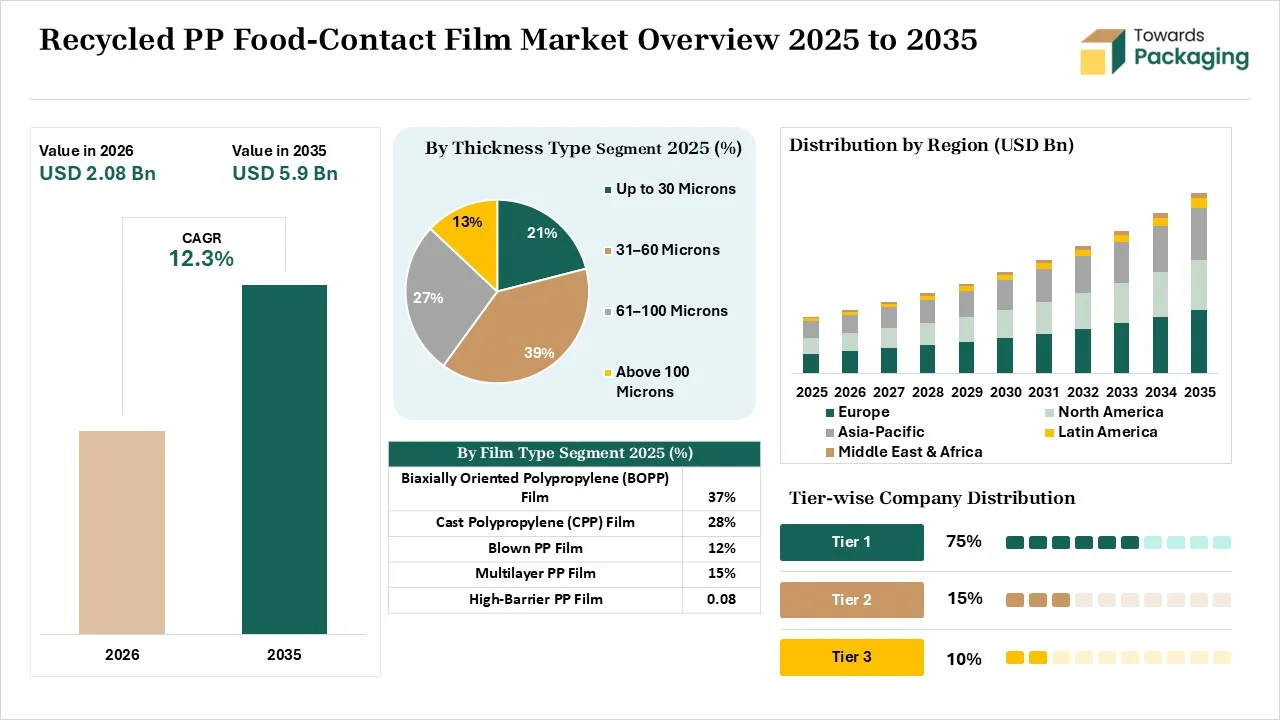
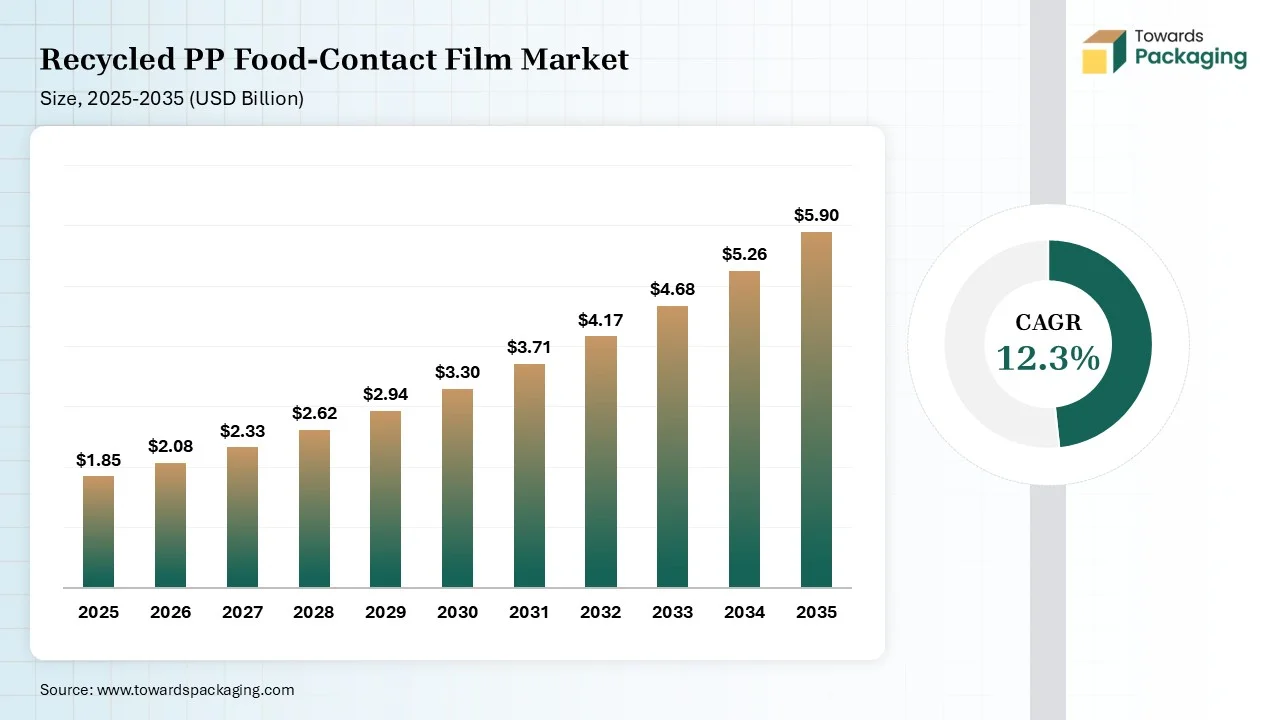
According to Vidyesh Swar, the global recycled PP food-contact film market size was estimated at USD 1.85 billion in 2025 and is predicted to increase from USD 2.08 billion in 2026 to approximately USD 5.9 billion by 2035, expanding at a CAGR of 12.3% from 2026 to 2035. Factors like global plastic waste bans, rise in food-safe certification, chemical recycling growth, rise in thin-film tech, consumer eco-awareness, collaborations between supply chain & retailer, high flexible wraps demand, advancements in decontamination technology, e-commerce expansion, and stricter mandates for recycled content are drivers for the market growth. Food-grade recycled PP films are important due to their resource efficiency, freshness barrier, low footprint, and lightweight transport.
| Market Size (2025) | USD 1.85 Billion USD 1.85 Billion |
| Market CAGR (2025-2035) | 11.4% |
| Market Volume (2025) | Approximately 612 Thousand Metric Tons |
| Market Volume CAGR (2025-2035) | 12.3% |
| Average Manufacturing Price (2025) | USD 2,460 per Metric Ton |
| Average Selling Price (2025) | USD 3,020 per Metric Ton |
| Pricing CAGR (2025-2035) | 1.7% |
Recycled PP food-contact film is a specialized flexible packaging sheet made from recycled polypropylene. It has high traceability, strong heat resistance, comparable strength, safety certification, and high clarity. It is a mono-material design that lowers emissions. It offers benefits like functional sealability retention and higher product protection. Food-grade certifications like EFSA and FDA are required. Recycling technologies like closed-loop recovery, advanced mechanical decontamination, and chemical recycling are used for recycled PP food-contact film. Its role in sustainable packaging is low landfill waste, food freshness preservation, and advanced decontamination. Recycled PP food-contact film is used in lamination layers, flexible food packaging, and product labels.
In the early period, recycled PP was prohibited in applications like non-contact crates, garden furniture, and many other applications. In the same era, flexible films faced issues in adopting recycled content. The regulatory authorities restricted the use of post-consumer polyolefins in applications like food packaging due to the presence of deep-seated chemical content on the washing lines. After some years, advanced decontamination came into the market that helped in achieving food-safe standards. Post-consumer PP achieved FDA and European standards. The blending of high-content materials started without losing functional properties. Regulations like EU PPWR and others are major drivers for the adoption of recycled PP food-contact film.
The scope is driven by regulatory compliance and advanced decontamination. The market includes recycling technologies like advanced recycled PP and mechanical recycled PP. The market covers film types like BOPP film, blown PP film, high-barrier PP film, CPP film, and multilayer PP film. The packaging formats like flexible pouches, flow wrap films, bags, lamination films, lidding films, sachets, and shrink films are covered. The market includes end users like food & beverage manufacturers, retail & supermarkets, foodservice companies, packaging converters, QSRs, and e-commerce food retailers. The distribution channel, such as e-commerce procurement, packaging distributors, packaging converters, and direct sales covered in the report. The regional coverage in the report is MEA, Asia Pacific, Europe, Latin America, and North America.
Growing Sustainable Food Packaging
The growth in eco-conscious food brands and the high taxes on traditional plastic containers increase the use of sustainable food packaging. The explosion of delivery apps like Zomato and the availability of agricultural feedstock increase the production of sustainable food packaging. Shoppers' demand for earth-friendly materials and the growth in on-demand apps increase adoption of sustainable food packaging. The recycled PP food-contact films help in source reduction, minimizing carbon impact, and lightweight logistics. The growing sustainable food packaging is a driver for market growth.
The need for advanced super-clean technologies and high tracing of hazardous materials increases the processing costs. The difficult feedstock sorting process and expensive stabilizing additives increase the cost. The food-grade standards and the use of specialized deodorization steps increase the cost. The complexity of mechanical processing and the need to recover optical transparency increase the cost. Factors like mixed streams, advanced sorting, extensive testing, and thermal instability are responsible for the high cost. The high processing cost restricts market growth.
The high volume of complex waste and low contamination tolerance in traditional recycling increase the use of chemical recycling. The diversion of waste from landfills and stringent hygiene regulations increase adoption of chemical recycling. This technology processes complex packaging solutions and overcomes degradation limits. Enhancing chemical recycling capacity helps in building brand partnerships that support sustainability targets. Chemical recycling processes hard-to-recycle waste and creates new B2B alliances. The expansion of chemical recycling capacity creates an opportunity for market growth.
The government's regulatory frameworks ensure recycled content-specific percentages in the packaging. Technology providers have developed advanced technologies like decontamination innovation, mechanical sorting, & others. Recyclers provide high-grade rPP films. Brand owners create partnerships to transform rPP films into required packaging formats. Retailers sell the final products and support collection initiatives.
In July 2026, PureCycle and Mitsui announced strategic partnerships with RM Tohcello to integrate recycled BOPP films in Japan's flexible packaging. The films suitable for applications like consumer goods, food packaging, and labels.
Raw materials include purified rPP regranulate, anti-block masterbatches, and stabilizers.
Processing involves collection of plastic, sorting, shredding into flakes, washing, decontamination, melting clean flakes, and pelletizing. Conversion includes formulation blending, extrusion, and casting.
Design focuses on polymer blends, multi-layer co-extrusion, gauge reduction, and functional additives. Prototyping focuses on extrusion prototyping, challenge testing, NIAS testing, and sealability validation.
The mechanical recycled PP (rPP) segment dominated the market with a 69% share in 2025. The high cost of chemical depolymerization plants and the focus on lowering film converters' costs increase the use of mechanical recycled PP. The need for sorting food-grade PP and the need to remove particulate residues increases the use of mechanical recycled PP. The government rules for acquiring circular materials help with expansion. The customized additive modification, improved washing, affordability, and high scalability of mechanical recycled PP (rPP) drive the segment growth.
The advanced (chemical) recycled PP segment held a 31% market share in 2025 and is expected to grow at the fastest CAGR of 13.7% during the forecast period. The focus on eliminating prior smells and the production of thin flexible wraps increases the use of advanced recycled PP. The preference for certified circular polymers and the production of flexible pouches increases the use of advanced recycled PP. The compatibility with multilayer film processing helps with expansion. The high performance retention, virgin-like purity, and sustainability of advanced recycled PP support the segment growth.
The biaxially oriented polypropylene (BOPP) film segment dominated the market with a 37% share in 2025. The food protection from water vapor and the need to enhance visibility of the product increase the use of BOPP film. The shift away from PVC wraps and the surging high-speed printing increase the use of BOPP film. The eco-design laws and the need to maintain package strength increase the use of BOPP film. The high mechanical strength, excellent sealing, and strong barriers of BOPP film drive the segment growth.
The multilayer PP film segment held a 15% market share in 2025 and is expected to grow at the fastest CAGR of 12.6% during the forecast period. The demand for safe functional barriers and the need to block food aromas effectively increases the use of multilayer PP film. The growing commercial industry and high-temperature processing in medical products increase demand for multilayer PP film. The high barriers, mono-material structures, and excellent shelf-life extension of multilayer PP film support the segment growth.
According to my research, the flexible pouches segment dominated the market with a 31% share in 2025. The growing food items storage and the minimization of warehouse storage space increase the use of flexible pouches. Consumer interest in standard pouch formats and growing microwaveable food applications helps with the expansion. The advanced decontamination, logistics savings, and material efficiency of flexible pouches drive the segment growth.
The lamination films segment held a 9% market share in 2025 and is expected to grow at the fastest CAGR of 12.8% during the forecast period. The stringent food-safety thresholds and safety framework updates increase the use of lamination films. The development of PP mono-material solutions and the rise in flexible food packaging increase the use of lamination films. The need for transparency in food branding and the expansion of laminated rPP structures support the segment growth.
The 31-60 microns segment dominated the market with a 39% share in 2025. Growing quick-commerce shipments and the increased wrapping of dry foods increase the use of 31-60 microns. The rise in food lidding applications and shelf stability preservation increases adoption of 31-60 microns. The high surface area, mechanical compensation, balanced flexibility, and moisture barrier integrity of 31-60 microns drive the segment growth.
The 61-100 microns segment held a 27% market share in 2025 and is expected to grow at the fastest CAGR of 12.2% during the forecast period. The need for defect-free commercial processing and the company's focus on meeting legal targets easily increase the use of 61-100 microns. The rise of multi-layer lamination in food packages and the development of food-contact films increase the use of 61-100 microns. The uniform structural integrity, lower tear-offs, and high puncture resistance of 61-100 microns support the segment growth.
The fresh food packaging segment dominated the market with a 24% share in 2025. The management of gas exchange in fresh fruits and the expansion of fresh produce increase demand for recycled PP food-contact film. Fresh protein storage and the high consumption of fresh meats increase the use of recycled PP food-contact film. The need to maintain quality of fresh goods drives the segment growth.
The ready-to-eat meal packaging segment held a 11% market share in 2025 and is expected to grow at the fastest CAGR of 12.9% during the forecast period. The expanding RTE meal trays and the integration of circular packaging by the RTE industry increase demand for recycled PP food-contact film. The rise in microwave heating of RTE meals and the demand for single-serve items increases adoption of recycled PP food-contact film. The development of RTE pouches supports the segment growth.
The food & beverage manufacturers segment dominated the market with a 43% share in 2025. The growing ready meals industry and regulations like EFSA food-contact compliance increase the use of recycled PP food-contact film. The large food enterprises and heat resistance demand in the food industry increase the use of recycled PP food-contact film. The surging demand for dairy items' convenience packaging and sustainability adoption in key beverage enterprises drive the segment growth.
The quick-service restaurants (QSRs) segment held an 8% market share in 2025 and is expected to grow at the fastest CAGR of 12.8% during the forecast period. The explosion of food takeaway and mono-materials goals in QSRs increases the use of recycled PP food-contact film. The development of hot wraps and QSRs' focus on maintaining loyalty increases the use of recycled PP food-contact film. The increasing number of QSRs adopting green packaging and modern dining habits supports the segment growth.
The direct sales segment dominated the market with a 48% share in 2025. The manufacturers' focus on monitoring the cleaning process and transparent sourcing increases the use of direct sales. The complex technical customization and direct accountability increase the use of direct sales. The maintenance of direct vendor relationships and the focus on lowering cumulative markups increase the adoption of direct sales, driving the segment growth.
According to my research, the e-commerce procurement segment held a 10% market share in 2025 and is expected to grow at the fastest CAGR of 13.4% during the forecast period. Buyers focus on comparing specifications, and the rise in auditable digital channels increases the use of e-commerce procurement. The real-time tracking interest and preference for buying verified grades increases the use of e-commerce procurement. The expansion of automated vendor platforms and the interest in more transparent sourcing supports the segment growth.
Europe dominated the recycled PP food-contact film market with a 35% share in 2025. The European Union food-contact safety regulations and novel mechanical breakthroughs increase the use of recycled PP food-contact film. Municipal sorting infrastructure and retailers shifting to mono-material PP increase adoption of recycled PP food-contact film. The Nestle brand presence and the investment in advanced mechanical recovery drive the overall growth of the market.
Germany
Germany dominated the market in 2025. The penalties on hard-to-recycle packaging and the incorporation of circular-economy principles increase the use of recycled PP food-contact film. The high-technological sorting infrastructure and Germany’s large beverage production infrastructure increase the use of recycled PP food-contact film. The local investment in chemical recycling hubs and the interest in flexible barrier films support the market growth.
United Kingdom
United Kingdom is expected to grow at the fastest CAGR during the forecast period. The kerbside collection schemes and the rise in in-store labeling increase the use of recycled PP food-contact film. The growing food-contact approvals and swift shift to circular structures increase the use of recycled PP food-contact film. Innovations like high-purity decontamination and the rising incorporation of BOPP films support the market growth.
Asia Pacific held a 29% share in the recycled PP food-contact film market in 2025 and is expected to grow at the fastest CAGR of 13.2% during the forecast period. The high volume of online-delivered food items and the growing purification innovations increase the use of recycled PP food-contact film. The increased adoption of certified recycled content by converters and the interest in packaged convenience foods increase the use of recycled PP food-contact film. The massive polymer manufacturing bases and the abundance of raw material feedstocks drive the market growth.
China
China held the largest revenue share in the market in 2025. The abundance of post-consumer PP plastic and the modernization of the recycling ecosystem increase the production of recycled PP food-contact film. The easy raw material access in hubs like Zhejiang and high-efficiency processing infrastructure increases the production of recycled PP food-contact film. The investment in multi-layer extrusion and export-based manufacturing supports the market growth.
India
India is expected to grow at the fastest rate in the market during the forecast period. The focus on reusing recycled content and a better sorting ecosystem increases the use of recycled PP food-contact film. The Central Pollution Control Board rules and the expanding food delivery industry increase the use of recycled PP food-contact film. The expansion of regional polymers parks and high-volume commercial infrastructure boosts the market growth.
North America held a 28% market share in 2025. The brands' accountability for the packaging lifecycle and advancing chemical purification methods increase the production of recycled PP food-contact film. The availability of ultra-pure rPP grades and key consumer goods corporations increases the use of recycled PP food-contact film. The growing mechanical recycling advancements and shopper preference for mono-material packaging drive the market growth.
United States
According to my research, the United States held the dominant position in 2025 and is expected to grow at the fastest CAGR during the forecast period. The minimum recycled-content mandates and the advanced purification technology increase the use of recycled PP food-contact film. The presence of advanced recyclers and the rise in sustainable food packaging increase the use of recycled PP food-contact film. The expansion of food-grade recycled PP supports market growth.
Canada
Canada is growing in the market. The provincial frameworks for compostable packaging and the increasing use of chemical decontamination processes increase the use of recycled PP food-contact film. The high interest in recovered materials and the use of automated optical sorters increase the use of recycled PP food-contact film. The food safety standards support the market growth.
Latin America held a 5% market share in 2025. The acceleration in RTE foods and large regional food companies increases the use of recycled PP food-contact film. The investment in advanced washing systems and local packaged snack growth increases the use of recycled PP food-contact film. The multinational corporation integrating recycled content drives the market growth.
Brazil
Brazil dominated the recycled PP food-contact film market in 2025. The large local chemical production base and the high demand for flexible packaging increase the use of recycled PP food-contact film. The high online retail use and the high corporate sustainability pressures increase the use of recycled PP food-contact film. The ongoing investments in co-extrusion and sustainable resin support the market growth.
Argentina
Argentina is expanding in the recycled PP food-contact film market. The multinational food processors' presence and the advancements in odor-removal systems increase the use of recycled PP food-contact film. The increased wrapping of perishable foods and increased partnerships between packaging converters & retailers increase the production of recycled PP food-contact film. The increased use of BOPP films in baked goods packaging boosts the market growth.
According to my research, the MEA held a 3% market share in 2025. The transition beyond recycled PET and the investment in Saudi Arabia’s SIRC increase the use of recycled PP food-contact film. The use of compliant alternatives in brands and the local petrochemical expertise increase the production of recycled PP food-contact film. The sourcing of food-grade resins drives the market growth.
Saudi Arabia
Saudi Arabia held the highest revenue share in the recycled PP food-contact film market. The affordable polymer resin supply infrastructure and the targets for green transition increase the use of recycled PP food-contact film. The strong local food retail networks and the expanding consumer outlets increase the use of recycled PP food-contact film. The higher demand for food-contact flexible films supports market growth.
UAE
The UAE is expected to experience the fastest growth during the predicted timeframe. The growth in food-contact recycled packaging and high investment in AI automations help with the expansion. The use of sustainable film solutions and the emirate-level bans on non-recyclable plastics increase the production of recycled PP food-contact film. The well-established multi-stage extrusion facilities support the market growth.
The industry concentration is intense, dominated by collaborative industry initiatives and polymer processors. The global leading processors are Taghleef Industries, PureCycle Technologies, Innovia Films, and Scanfill. The key recovery networks are Prevented Ocean Plastic, PETMAN, NextLooPP, and Starlinger Viscotech. The leading global manufacturer is Tagleef Industries, and the leading Swedish manufacturer is Scanfill. Eurocast is a Poland-based leading manufacturer.
| Sr. No. | Company | Product Range | Production Facilities | Sustainability Initiatives |
| 1. | Innovia Films | White Cavitated BOPP, Encore Range, Mechanically Recovered Food-Safe rPP, P2G Fresh Produce Mono-Material PP, |
United Kingdom, Poland, Australia, Germany, Mexico, Belgium |
Emission Reductions, Recycled Content Integration |
| 2. | Scanfill | Scanfoil rPP POP | Kunshan, China, Ystad, Sweden |
Carbon Reduction, Resource Efficiency |
The market is highly fragmented and includes specialty film converters, massive polymer developers, & other players. The major industry players are Borealis AG, Berry Global, Braskem, and Amcor plc. The key recycled PP compounders are Borealis AG, Ravago Manufacturing, KW Plastics, Ultra Poly Corporation, and MBA Polymers. The leading waste-to-PP innovators are SABIC, Prevented Ocean Plastic, PureCycle Technologies, and LyondellBasell. The specialty film converters are Innovia Films, Tagleef Industries, and Jindal Films.
| Company Overview | The company is a key producer of advanced plastic solutions and offers chemical recycling technologies. |
| Manufacturing Footprint | North America, Asia Pacific, and Europe |
| Product Portfolio | CirculenRevive, CirculenRecover, CirculenRenew |
| SWOT Analysis |
Strength Certified Circular Product Base Weakness Limits in Feedstock Sourcing Opportunity Expansion of Advanced Recycling Ventures Threats Food Safety Compliance |
| Company Overview | They offer advanced material solutions and manufacture a recycled portfolio for food-contact film. |
| Manufacturing Footprint | Austria, Finland, Italy, Brazil, United Arab Emirates, Germany, Sweden, Belgium, United States, Bulgaria, United States |
| Product Portfolio | Borocycle C, Full-PP Laminates, Bornewables, Borcycle M |
| SWOT Analysis |
Strength Advanced Technological Infrastructure Weakness Limited Availability of Pure Feedstocks Opportunity Mono-Material Growth Threats High Competition Between Companies |
| Company Overview | The company is a global manufacturer of polymers and focuses on recycled PP innovations. |
| Manufacturing Footprint | Brazil, Germany, United States, and Mexico |
| Product Portfolio |
Chemically Recycled Circular PP, |
| SWOT Analysis |
Strength Circular Product Portfolio Weakness Limited Blown-Film Outcome Opportunity Expanding Collaborations Threats High-Quality Waste Shortages |
According to my research, the recycled PP food-contact film market is expanding rapidly due to the growing laws on waste, eco-friendly choices, and the interest in earth-friendly packages. The market is growing due to safety barriers, retail appeal, high heat resistance, and the shift to mono materials. The BOPP film holds the major share in the market due to shelf-life protection, mono-material design, and brand compliance. The food & beverage manufacturers are a strong contributor to the market due to recyclability trends, strong aesthetics, gas barrier demand, lightweighting needs, and quality preservation demand. The F&B manufacturers like Danone and Mars Petcare use recycled food-contact film. Europe holds the dominant position in the market due to European Union pressures, food safety advantages, advanced de-inking, and demand for high barrier qualities. The leading rPP recyclers are Veolia, PureCycle Technologies, Berry Global, KW Plastics, LyondellBasell, REMONDIS, and SUEZ. The leading companies like Amcor plc, Innovia Films, SABIC, Borealis AG, Profol, Scanfill, and Eurocast support the market expansion.
By Recycling Process
By Film Type
By Packaging Format
By Thickness
By Application
By End User
By Distribution Channel
By Region



Principal Research Analyst
Vidyesh Swar is a Senior Research Analyst at Towards Packaging, bringing over 4 years of dedicated expertise in market intelligence and strategic analysis across the dynamic world of packaging technologies and solutions.
Learn more about Vidyesh Swar

Reviewed By
Aditi Shivarkar, with 14+ years in packaging market research, specializes in food, beverage, and eco-friendly packaging. She ensures accurate, actionable insights, driving Towards Packaging Analytics & Consulting 's excellence in industry trends and sustainability.
Learn more about Aditi Shivarkar

Recycled PP Food-Contact Film Market
 Table of Content
 sales@towardspackaging.com
 +1 804-441-9344
 Download Sample
 Schedule a Meeting