


According to Vidyesh Swar, who specializes in fields like eco-friendly packaging, wood-fiber packaging, and the overall packaging industry. His research indicates wood-fiber packaging market growth opportunities. The global wood-fiber packaging market size was estimated at USD 8.65 billion in 2025 and is expected to grow at a CAGR of 7.85% during the forecast period. The market size is forecasted $18.42 billion by 2035. Factors like plastic bans, e-commerce surge, high beverage demand, and wood-fiber packaging technical innovation drive the growth. Companies like Smurfit WestRock, Stora Enso, International Paper, and Mondi are wood-fiber packaging market leaders.
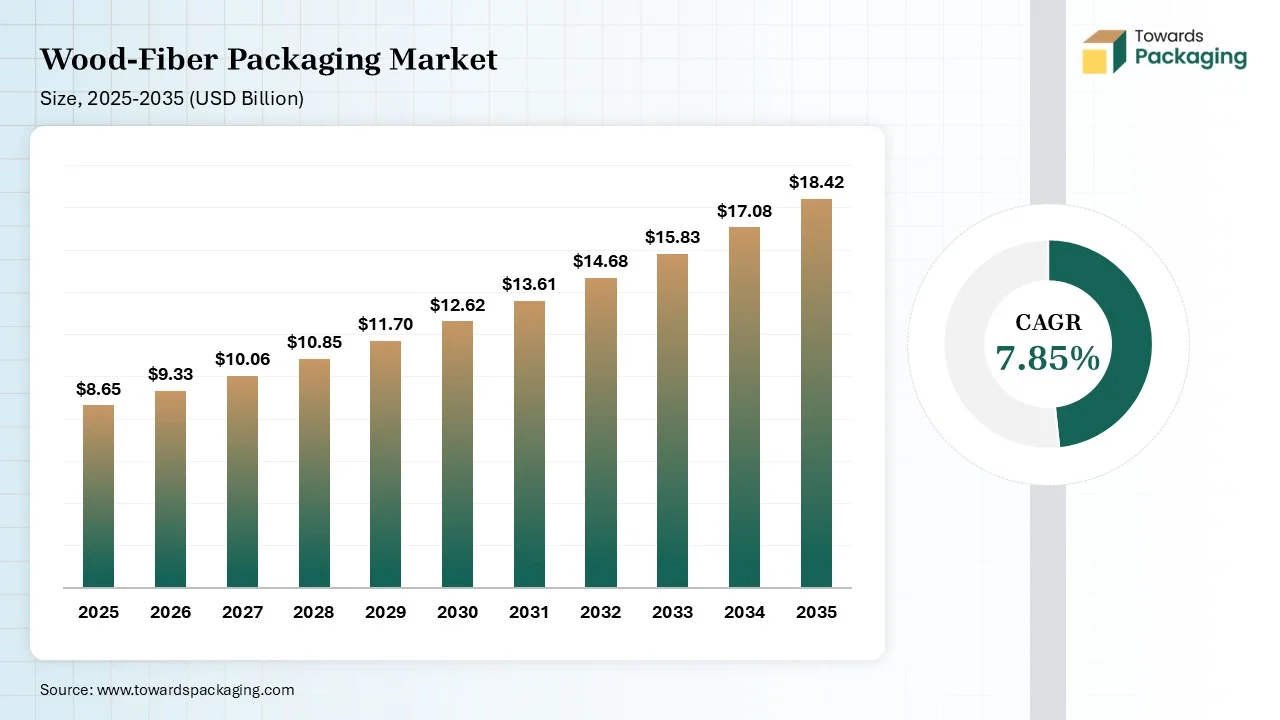
Wood-fiber packaging is a packaging form created using recycled paper products & pulp. Its benefits are renewable sourcing, plastic reduction, excellent shock absorption, biodegradability, and high thermal insulation. Materials like hybrid blends, virgin wood pulp, and recycled fibers are used. Common packaging formats are cellulose films, molded pulp, and kraft boxes. Wood-fiber packaging examples are fruit trays, cartons, cushioning pads, shipping boxes, cosmetic caps, and take-out containers. The global wood-fiber packaging market size was estimated at $8.65 billion in 2025 and is predicted to reach $18.42 billion by 2035. The market is growing at a 7.85% CAGR during 2026-2035. The market growth drivers are huge online shopping, development of wood-fiber coatings, expansion of smart designs, molded innovations, focus on healthcare safety, shift away from plastics, commitments to net-zero plastic waste, availability of municipal composting, and corporate focus on carbon pricing.
Source:- Towards Packaging Database
The market valued $8.65B in 2025 and is expected to grow with a 7.85% CAGR during the predicted timeframe. The wood-fiber packaging market growth is driven by factors like EPR mandates, corporate shift away from high-emission materials, shoppers' preference for renewable packaging, demand for hygienic takeaway packaging, expanding global export activities, surging AI-enabled packaging, expansion of enzyme-assisted processing, prohibiting use of plastic cutlery, growing paperization, and food sector growth.
Source:- Towards Packaging Database
The market size was $8.65B in 2025 and is expected to experience incremental growth to $9.77B. The market is forecasted to reach $18.42B by 2035. Phasing out plastics, preference for doorstep deliveries, plastic component replacement in FMCG, buyers' eco-preference, food-grade innovation, food service expansion, lightweighting initiatives, advancing barrier developments, advancements in thermoforming technology, and expanding urbanized areas will contribute to the growth.
Source:- Towards Packaging Database
On 11 February 2025, the EU PPWR entered into force. The PPWR goals are harmonization, recycling design, circularity, and waste reduction. The application of the rule started on 12 August 2026 in EU member states. The rules demand compostable packaging by 12 February 2028. Items like single-serve pods, produce labels, and others must be compostable. Rules demand recyclable packaging till 1 January 2030. The key actions are feed modulation, design for recycling, and harmonized labeling. From 2030, the application of minimum recycled content will start. The PPWR focuses on by 2030 packaging waste drop by 5%, by 2035 drop by 10%, and till 2040 drop by 15%. 2030 targets are recyclability grades, packaging minimization, recycled content in plastics, and single-use bans.
Source:- Regulation (EU) 2025/40; Baker McKenzie, Fieldfisher, and Greenberg Traurig legal briefings on the PPWR (2025-2026)
According to Aman’s research, United States e-commerce retail sales held a 15.8% share in quarter 3 of 2024. It held a 16.1% share in quarter 4 of 2024. It held a 16.4% share in quarter 1 of 2025. United States e-commerce retail sales held a 16.3% share in quarter 2 of 2025. In quarter 3 of 2025, it held a 16.4% share. In quarter 4 of 2025, it held a 16.6% share. E-commerce held a 16.4% share overall in 2025, compared to 16.1% in 2024. Sales increased in 2025 due to players like Amazon, Costco, and others. Spending on health, furniture, and beauty has grown in this period. Transition to mobile commerce and the presence of high-intent buyers support growth. The United States e-commerce sales were estimated at 316.1 billion in quarter 4 of 2025. The sale grown with 5.3% year over year. The social platforms expansion, high mobile use, and hyper-targeted marketing increased e-commerce sales.
Source:- U.S. Census Bureau, Quarterly Retail E-Commerce Sales reports (Q3 2024-Q4 2025 releases), U.S. Department of Commerce
The total wood pulp produced in 2024 was 189 million tonnes. The wood pulp production increased by 3% from the prior year. The packaging sector was responsible for the increase in wood pulp production. Countries like the United States and China were major contributors. The total international wood pulp exported in 2024 was 73 million tonnes. Sustainable packaging and tissue demand increased exports. Countries like Canada and the United States are major exporters. Worldwide recovered paper consumption reached 243 million tonnes in 2024. The consumption increased by 1% year over year. Countries like Brazil, Uruguay, China, and Chile held the highest share in the additional supply of recovered paper. The packaging demand, cost savings, and regulatory mandates increased recovered paper consumption.
Source:- FAO, Global Forest Products Facts and Figures 2024 (Rome, released Dec 2025); FAO Newsroom release, 24 Dec 2025
The overall paper recycling rate was 75.1% across Europe in 2024. The paper recycling rate is high due to eco-design initiatives, established collection systems, and growing industry collaborations. The recycling rate of paper in 2024 in North America was 68.2%. The recycling rate is growing due to growing demand for paper mills and reliable collection infrastructure. The paper packaging recycling rate in Europe was 83.1% in 2024. The paper recycling rate is high due to regulatory pressures and growing containerboard production.
Source:- European Paper Recycling Council (EPRC), 2024 Monitoring Report / Confederation of European Paper Industries (CEPI) press release, July 2025
Till the end of 2025, global FSC-certified forest areas reached 171 million hectares. It is growing more than 6% year by year. The FSC-certified forest areas are growing due to interest in sustainable standards and strict environmental regulations. The total PEFC-certified forest area in 2024 was 300 million hectares. The PEFC-certified forest area is growing due to demand for verified sustainable timber. The combination of both areas reached approximately 434 million hectares. In total global forest area, it takes roughly 11%. The double-certified area is about 63 million hectares. The double-certified area is growing due to a focus on corporate risk reduction and overlapping standards.
Source:- : Forest Stewardship Council (FSC), "Reflections on 2025 and looking to the year ahead" (January 2026); Programme for the Endorsement of Forest Certification (PEFC), "Facts and Figures" (accessed 2026)
The material type includes virgin wood fiber, kraft wood fiber, wood pulp fiber, recycled wood fiber, cellulose fiber, nanocellulose, MFC, and other wood fibers. Virgin wood fiber held a 34% share in the wood-fiber packaging market in 2025 due to its higher durability and predictable quality. The growing demand for luxury retail packaging and food contact compliance increases the use of virgin wood fiber. The longer polymer chains, contaminant-free nature, and superior printability of virgin wood fiber drive the growth. Recycled wood fiber held a 24% market share in 2025 due to the growth in custom molded packaging. Consumer demand for biodegradable packaging and EU deforestation regulations increase the use of recycled wood fiber. Nanocellulose held a 3% market share in 2025 and is expected to grow with a 13.2% CAGR during the forecast period. The plastic replacement goals and green materials demand increase the use of nanocellulose. The toughness, stronger barriers, and high strength-to-weight ratio of nanocellulose support the growth.
Nanocellulose is growing with the fastest CAGR of 13.2% during the forecast period. The replacement of synthetic plastics and demand for superior barriers increase the use of nanocellulose. The increased upgradation of low-recycled cardboard and brands' eco-based regulations increase the use of nanocellulose. Development of flexible paper pouches and coatings increases the use of nanocellulose. The MFC is growing with a 10.6% CAGR during the forecast period due to its high compatibility with paper recycling streams. The growing plastic elimination and advanced mechanical production increase the use of MFC. The recycled wood fiber is growing with a 9.1% CAGR during the forecast period due to the circular economy and resource efficiency. Development of food service trays and online retail demand increases the use of recycled wood fiber.
The virgin wood fiber reached $2.94 billion in 2025 due to its purity and use in high-end brands and is expected to reach $5.34 billion in 2035 due to its food safety standards. The recycled wood fiber reached $2.08 billion in 2025 due to technological upgrades and corporate targets. The kraft wood fiber reached $1.56 billion in 2025 due to retail expansion and sustainability. The cellulose fiber reached $1.04 billion in 2025 due to high material strength & sustainability rules. The MFC reached $0.35 billion in 2025 due to superior barriers and broad adoption. The nanocellulose reached $0.26 billion in 2025 due to raw material abundance. The wood pulp fiber reached $0.35 billion in 2025 due to high strength. The other wood fiber reached $0.09 billion in 2025 due to environmental regulations and rapid renewability.
Flexible packaging dominated the market with a 43% share and is expected to grow with an 8.4% CAGR during the forecast period. The demand for lightweight portable packaging and the development of films increase the use of wood-fiber flexible packaging. Factors like optimized shipping, high adaptability, convenience, and sustainability pressures increase the use of flexible packaging. Rigid packaging held a 40% share in the market in 2025. The strong demand for protection and growing modern thermoforming increases the use of rigid packaging. The molecule blocking, material savings, and biodegradability of rigid packaging drive the growth. The semi-rigid packaging held a 17% share in the market. The focus on e-commerce protection and the increased pauperization in companies increases the use of semi-rigid packaging. The lightweight efficiency, precision, and food service demand drive the growth.
Flexible packaging is growing at the fastest rate with an 8.5% CAGR during the forecast period. The growing regulatory push and minimization of total shipping weight increase the use of flexible packaging. The innovative bio-based coatings and strong preference for paper substrates support the growth. Semi-rigid packaging is growing with a 7.8% CAGR during the forecast period due to the growing aesthetic upgradation, development of premium compact packaging, and high utilization of cup lids. Rigid packaging is growing with a 7.3% CAGR during the forecast period due to increased molding into functional shapes and the higher adoption rate of paper-based packaging.
Flexible packaging reached $3.72B in 2025 due to expanding packaging capabilities in APAC & e-commerce efficiency and is expected to reach $8.29B by 2035 due to advancements in barrier technology & growing on-the-go consumption. Rigid packaging reached $3.46 B in 2025 due to strong wood pulp sourcing and is predicted to reach $7B by 2035 due to brand customization & water-resistant coatings. Semi-rigid packaging reached $1.47B in 2025 due to food industry demand and is predicted to reach $3.13B by 2035 due to EPS replacement & production efficiency.
Boxes & cartons dominated the wood-fiber packaging industry with a 24% share in 2025. The rise in omni-channel shipping and rise in algorithmic scorelines increases the production of wood-fiber boxes & cartons. The abundance of recycled corrugated containers and packaging of industrial items increases the use of boxes & cartons. The high structural protection and easy customization drive the growth. Paper bags & sacks held a 20% share in the market. The use of multi-wall paper sacks in agricultural goods helps with expansion. The quick commerce scaling and growing use of brown kraft in pet food supports the growth.
Molded fiber packaging is expected to grow with a 10.2% CAGR in the market during the forecast period. The expansion of recycled paper and increased replacement of protective electronic casings increase the use of molded fiber packaging. Raw materials like bamboo, waste newspapers, and others increase the production of molded fiber packaging. The high consumer spending on molded fiber packaging drives the growth. Pouches & wrappers are expected to grow with a 9.2% CAGR during the forecast period. The growing sustainable retail packaging and space utilization reduction increase the use of wood-fiber pouches & wrappers. The organic coating integration and expansion of custom paper pouches support the growth.
Boxes & cartons held $2.08B in 2025, driven by growing automated packaging and high parcel delivery. Boxes & cartons are expected to reach $4.05B by 2035 due to expansion of brand marketing. Paper bags & sacks held $1.73B in 2025. Pouches & wrappers held $1.38B in 2025 due to the industrial demand for heavy-duty multiwall sacks. The trays & clamshells held $1.04B in 2025 due to use in fragile fruit transportation & cloud kitchens. The cups & containers held $0.78B in 2025 due to takeout demand. The protective packaging held $0.69B in 2025 due to use in e-commerce shipping. The molded fiber packaging held $0.52 B in 2025 due to high production of clamshells & trays. The labels & sleeves held $0.26B in 2025 due to standardized branding. The other products held $0.17B in 2025 due to the expanding luxury goods industry & eco-regulations.
Softwood dominated the market with a 43% share in 2025 due to its excellent compatibility with e-commerce. The load-bearing integrity and high cellulose content of softwood help with expansion. Factors like long fibers, fast harvest cycles, and higher pulp yields drive softwood growth. Hardwood held a 29% market share in 2025. The focus on enhancing coatings in boxes and the growth in short-rotation plantations increase the use of hardwood. The high yield efficiency, excellent print quality, high density, and supply efficiency of hardwood drive the growth.
Recovered wood fiber is growing with the fastest CAGR of 9.4% in the market during the forecast period. The manufacturing of sturdy shipping boxes and disposable food trays increases the use of recovered wood fibers. The advanced recycling technologies, protective inserts development, and advancements in drying techniques increase the use of recovered wood fibers. Wood processing residues are growing with a 9.1% CAGR during the forecast period. The development of high-quality molded packaging and zero-waste targets increases the use of wood processing residues. The high material circularity and guaranteed availability of wood processing residues support the growth.
Softwood held $3.72B in 2025 due to corrugated demand & stable pricing and is expected to reach $7.37B by 2035 due to expansion of heavy-duty logistics & blending versatility. Hardwood held $2.51B in 2025 due to Asia Pacific scaling and fiber balance. The recovered wood fiber held $1.56B in 2025 due to supply chain maturity & performance blending. Wood Processing residues held $0.61B in 2025 due to scarcity of raw material. Forestry residues held $0.26B in 2025 due to premium pricing of prime wood.
Primary packaging dominated the wood-fiber packaging industry in 2025 and is expected to grow with an 8.5% CAGR during the forecast period. The growing interest in trays and utilization of compostable goods increases adoption of primary packaging. The abundance of wood pulp and the rise in direct contact with the product increase demand for primary packaging. The functional innovations support growth. Secondary packaging held a 31% market share in 2025. The focus on warehouse efficiency and renewable resourcing increases use of secondary packaging. The high number of online shopping consumers and cost benefits drive the growth.
Primary packaging is expected to grow with the fastest CAGR of 8.5% during the forecast period. Environmental bans and advancements in designs increase the use of primary packaging. The transition to clean-looking fiber solutions helps with growth. The expanding ready-to-eat segment drives the overall growth. Secondary packaging is expected to grow at 7.2% CAGR during the forecast period. The growing demand for natural breakdown packaging and availability of lightweighting technologies increase the use of secondary packaging. The high warehouse efficiency and strong circular economy for secondary packaging drive the growth.
Primary packaging held $4.5B in 2025 due to demand for hygienic enclosures in the food industry & rise in PFAS-free coatings, and is expected to reach $10.13B by 2035 due to higher use of molded fiber cups & regulatory bans. Secondary packaging held $2.68B in 2025 due to algorithmic efficiency and is expected to reach $5.34B by 2035 due to due to logistics demand & sustainability. Tertiary packaging held $1.47B in 2025, driven by automation demand, and is expected to reach $2.95B by 2035 due to logistics efficiency & EPR laws.
Uncoated held a 48% share in the wood-fiber packaging industry in 2025. The focus on eliminating extra chemical treatments and the high recyclability of unbleached pulp increases the use of uncoated barrier. The high structural strength, fast manufacturing, high breathability, and quick breakdown of uncoated barrier help with expansion. The growing use in folding cartons supports the growth. The water-based coated held a 19% share in the market in 2025. The focus on minimizing volatile emissions and blocking grease increases the use of water-based coated barriers. The high-performance protection and existing conversion line efficiency of water-based coated barriers drive the growth.
Other barrier treatments are growing with the fastest CAGR of 13.8% during the forecast period. The PFAS phase-outs and focus on moisture control increase the use of other barrier treatments. The need for shelf-life extension and brand sustainability targets increases adoption of other barrier treatments. The bio-based coated growing with a 12.1% CAGR during the forecast period. The expansion of modern bio-additives and transition to plant-derived polymers helps with growth. The focus on lowering Scope 3 emissions and the need to handle retail sealing stress increases the use of bio-based coated barriers, supporting the growth.
The uncoated held $4.1B in 2025 due to recycling compliance & focus on eliminating bleaching and is expected to reach $7.18B by 2035 due to simpler recycling & cost efficiency. Water-based coated held $1.64B in 2025 due to foodservice demand & recycling compatibility. Bio-based coated held a $1.04 B in 2025. The wax-coated held $0.69B in 2025 due to performance validation. The plastic-laminated held $0.86B in 2025 due to emerging substitutes and balanced performance. The other barrier treatments held a 0.26B in 2025 due to the abundance of mineral-blended formulas.
Food packaging dominated the market with a 35% share in 2025. The massive amount of food orders and restrictions on synthetic materials in food packaging increase the use of wood-fiber packaging. The focus on protecting eggs and the massive expansion of online grocery increase the use of wood-fiber packaging. E-commerce packaging held a 16% share in the market in 2025. Expanding DTC deliveries and a focus on elevating unboxing increase the use of wood-fiber packaging. The urban areas' preference for quick-commerce and transition to advanced containerboard supports the growth.
E-commerce packaging is growing with the fastest CAGR of 9.2% in the market during the forecast period. The plastic bans across e-commerce and eco-conscious e-commerce buyers increase the use of wood-fiber packaging. The demand for lightweight strength in e-commerce and the focus on integrating QR codes in e-commerce increase use of wood-fiber packaging. Personal care & cosmetics is growing with an 8.9% CAGR during the forecast period. Personal care brands shift away from conventional plastics, focus on protecting creams from damage, and creating a premium appeal of cosmetics products increases the use of wood-fiber packaging.
Food packaging held $3.03B in 2025 due to demand for fresh food protection & retail growth and is expected to reach $6.82B by 2035 due to a surge in RTE delivery. E-commerce packaging held $1.38B in 2025 due to right-sizing technologies & high internet penetration. Beverage packaging held $0.86B in 2025 due to a shift to fiber bottles by beverage manufacturers. Pharmaceutical packaging held $0.69B in 2025 due to higher demand for internal cushioning trays in pharmaceuticals.
Food & beverage dominated the market with a 43% share in 2025. The rise of packaged meals and rapid surge in QSRs increases use of wood-fiber packaging. The temperature fluctuations in food packaging, elimination of traditional foam, and the interest in molded pulp trays drive the growth. Healthcare & pharma held a 9% share in the market in 2025. The demand for medical device cushioning and expansion of e-pharmacy increases the use of wood-fiber packaging. The thriving temperature-sensitive vaccines and rise in cosmetic medical compacts increases use of wood-fiber packaging, supporting the overall growth.
Retail & e-commerce is expected to grow with the fastest CAGR of 9.1% during the forecast period. The consumer priority to green material brands and a focus on lightweighting freight costs increase the use of wood-fiber packaging. The custom fit expansion of green shipping options drives the growth. Personal care & cosmetics is growing with an 8.9% CAGR during the forecast period. Personal care brands transition to recyclable alternatives, and a rise in prestige beauty brands increases use of wood-fiber packaging. The transition minimal packaged beauty items drives the growth.
Food & beverage held $3.72B in 2025 due to online beverage ordering & high fresh fruits consumption and is expected to reach $8.29B by 2035 due to F&B brands focus on minimizing carbon footprints. Retail & e-commerce held $1.47B in 2025 due to mid-tier demand and right-sizing efficiency. Healthcare & pharma held $0.78B in 2025 due to non-toxic storage demand and ESG mandates for pharma companies.
Direct sales dominated with a 64% share in the market in 2025. The large food corporations' and large buyers' demand for customization increases the use of direct sales. The ethical sourcing certification demand, customization of custom molds, and shift away from intermediate converters increase the use of direct sales. Distributors & wholesalers held a 30% market share in 2025. The fast delivery needs and rise in small batch ordering increase the use of distributors & wholesalers. The green consolidations and preference for value-added services increase use of distributors & wholesalers.
Online sales are growing with the fastest CAGR of 10.2% during the forecast period. The continuous growth in e-commerce channels and tightening plastic rules increases the use of online sales. Consumer focus on design optimization and environmental footprint minimization drives the growth. Direct sales are growing with an 8.2% CAGR during the forecast period. The surge in DTC and rise in custom branding increase the use of direct sales. The demand for transparent sourcing and focus on margin control uses direct sales.
Direct sales held $5.54B in 2025 due to strong supply security & B2B customization across diverse industries and are expected to reach $12.16B by 2035 due to bulk cost efficiency. Distributors & wholesalers held $2.6B in 2025 due to growing regional variations & balanced margins. Online sales held $0.52B in 2025 due to B2B preponderance & expanded e-commerce.
Source:- Towards Packaging Database
Asia Pacific held a 34% share in 2025 in the wood-fiber packaging market due to the scaling of online retail and strong industrial manufacturing. Asia Pacific is expected to hold a 39% share by 2035 due to anti-plastic policies and booming e-commerce. North America held a 25% market share in 2025 due to growing consumer awareness and established industrial infrastructure. North America is expected to hold a 23% share by 2035 due to growing manufacturing in Asia Pacific. Europe held a 31% Share in the market in 2025 due to the EU Green Deal & availability of sustainably managed forests and is expected to hold a 29% share by 2035 due to wood products import restrictions & high energy costs. Latin America held a 6% share in the market in 2025 due to and is expected to hold the same share by 2035 due to advanced molding techniques & delivery growth. The Middle East & Africa held a 4% share in 2025 due to growing industrial development and is expected to hold a 3% share by 2035 due to high pulp import & transition to recycled fiber.
North America held a 25% share in the wood-fiber packaging industry in 2025. The plastic reduction mandates in Canada & other countries and preference for brands adopting biodegradable packaging increase the use of wood-fiber packaging. The key industry consolidations and barrier coatings advancements increase adoption of wood-fiber packaging. The protective packaging demand in e-commerce supports the growth. United States is a key player in the market. Local restrictions on polystyrene and strong QSR chains increase the use of wood-fiber packaging. The integration of molded fiber inserts in the electronics industry and abundance of recycled paper boost the overall growth.
Europe held a 31% share in the wood-fiber packaging market in 2025. The domestic plastic packaging taxes and online shopping expansion increase the use of wood-fiber packaging. Well-managed forests and advanced recycling systems help with expansion. Higher demand for egg cartons and preference for renewable wood-pulp packaging drive the growth. Germany is a major player in the market. The preference for circular packaging formats and the interest in lightweight shipping solutions increase adoption of wood-fiber packaging. The strong presence of green packaging technology and the strong commitments to industrial composting capacities support the growth.
Asia Pacific held a 34% share in the market in 2025. The strict regulations on plastics and the preference for biodegradable transit packaging increase the use of wood-fiber packaging. The strong local pulp resources and expansion of molded trays help with expansion. The electronic exports and cost-efficient raw materials boost the growth. China is a key contributor to the market. The restrictions on plastic use in the electronics industry and high logistic parcel volumes increase the use of wood-fiber packaging. The prohibitions on recycled fiber and the utilization of modern thermoforming drive the growth.
Latin America held a 6% share in the market in 2025. The rise in certified wood sourcing and the use of lightweight corrugated boxes increases the production of wood-fiber packaging. Retail brands shift away from traditional plastic, and a rise in packaging material substitution increases the use of wood-fiber packaging. The sustainability investment helps with growth. Brazil is a key contributor to the market. Government demand for adopting biodegradable paper and e-commerce growth increases the use of wood-fiber packaging. Advancements in pulp production lines and local self-sufficiency increase production of wood-fiber packaging. Companies like Klabin S.A. support the growth.
MEA held a 4% share in the wood-fiber packaging market in 2025 due to the growing regional food service. The national initiatives for plastic transition and expanding fresh produce increase adoption of fiber-based packaging. The replacement of plastic-based loose-fill materials with molded fiber helps with growth. Saudi Arabia is rapidly expanding in the market. Local authorities' regulations for recyclable materials and rising shopping delivery orders increase use of wood-fiber packaging. The need for compliant packaging solutions in the pharmaceutical industry boosts growth.
Asia Pacific is growing with the fastest CAGR of 9.3% during the forecast period. The high purchase of consumer electronics and multi-national brands is shifting to wood-fiber alternatives, increasing the use of wood-fiber packaging. High spending on food services and growth in electronics export hubs support the growth. Latin America is growing with a 7.9% CAGR through 2035 due to high plastic substitution and robust agricultural exports. Europe is growing with a 7.1% CAGR during the predicted timeframe due to PPWR targets and a rise in beverage packaging. North America is growing with a 7% CAGR during the forecast period due to e-commerce demand and strong local resources. Middle East & Africa is growing with a 6.4% CAGR during the forecast period due to manufacturing expansion and burgeoning grocery deliveries.
Asia Pacific held $2.94B in 2025 due to surging live-stream sales & logistics scaling and is expected to reach $7.18B by 2035, driven by strong export bases & heavy corrugated boxes demand. North America held $2.16B in 2025 due to high appliance manufacturing & strong local paperboard mills and is expected to reach $4.24B by 2035 due to the expansion of e-commerce logistics. Europe held $2.68B in 2025 due to a focus on certified specialty grades and is predicted to reach $5.34B by 2035 due to a corporate sustainability focus. Latin America held $0.52B in 2025 due to high manufacturing scale in Asia Pacific and is expected to reach $1.11B by 2035 due to sustainability rules & export expansion. MEA held $0.35B in 2025 due to steady growth in organized retail and is predicted to reach $0.55B by 2035 due to accelerated agricultural exports.
Source:- Towards Packaging Database
According to my research, the wood-fiber packaging market is expanding rapidly due to eco-friendly packaging demand. Factors like brands' eco-friendly commitments, food delivery scaling, advancements in processing, the explosion of producer responsibility mandates, and design optimization contribute to the growth. Companies like Stora Enso, Smurfit Kappa, Brodrene Hartmann, Huhtamaki, and International Paper contribute to the development of wood-fiber packaging.
By Material Type
By Packaging Type
By Product Type
By Fiber Source
By Packaging Format
By Barrier Type
By Application
By End-use Industry
By Distribution Channel
By Region







Principal Research Analyst
Vidyesh Swar is a Senior Research Analyst at Towards Packaging, bringing over 4 years of dedicated expertise in market intelligence and strategic analysis across the dynamic world of packaging technologies and solutions.
Learn more about Vidyesh Swar

Reviewed By
Aditi Shivarkar, with 14+ years in packaging market research, specializes in food, beverage, and eco-friendly packaging. She ensures accurate, actionable insights, driving Towards Packaging Analytics & Consulting 's excellence in industry trends and sustainability.
Learn more about Aditi Shivarkar


Wood-Fiber Packaging Market
 Table of Content

 Download Sample
 Schedule a Meeting