


The North America lightweight polyethylene terephthalate (PET) jars market is projected to grow from USD 4.49 billion in 2026 to USD 8.11 billion by 2035, registering a CAGR of 6.8% during the forecast period. The report provides detailed market size analysis, segment-wise revenue data, regional demand trends, company market shares, competitive analysis, trade statistics, manufacturer insights, supplier benchmarking, and value chain assessment. Growth is mainly supported by increasing demand for lightweight, transparent, durable, and cost-effective packaging solutions across food, beverage, pharmaceutical, and personal care industries.
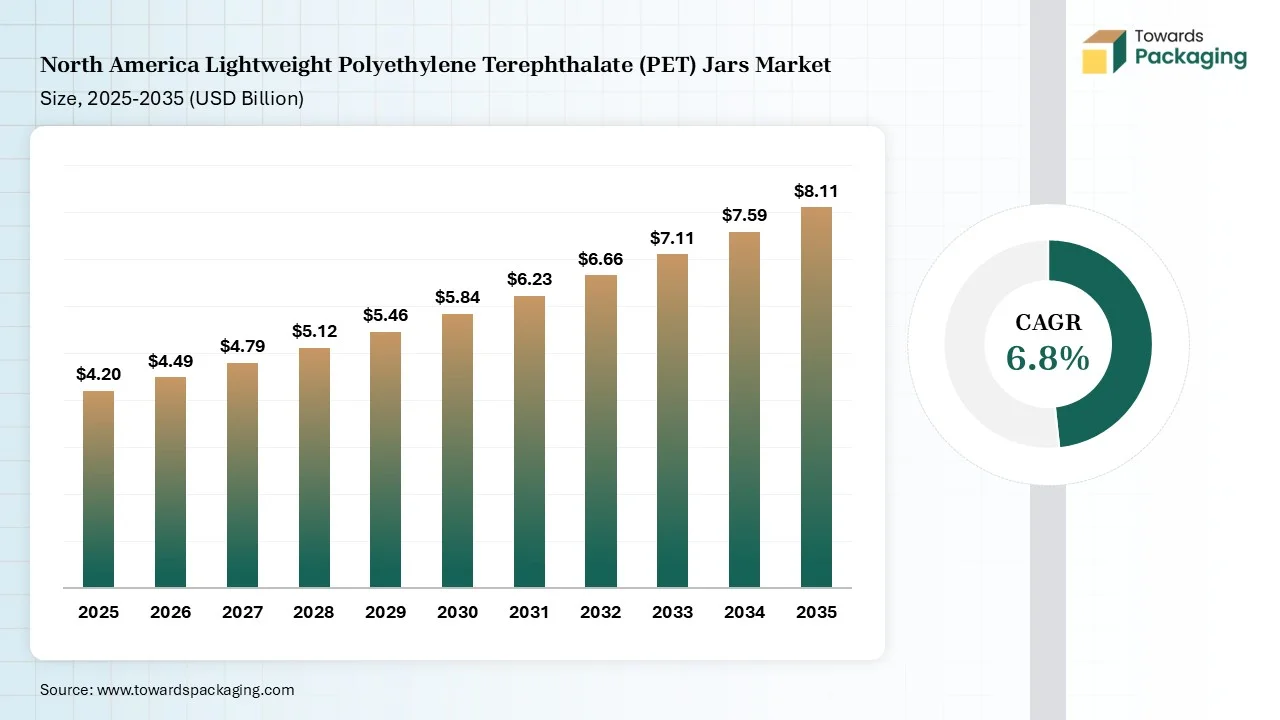
Market Size (2025): USD 4.2 Billion
CAGR (2025–2035): 6.8%
Market Volume (2025): 160 billion Units
Volume CAGR (2025–2035): 5.9%
PET (Polyethylene Terephthalate) is a thermoplastic polymer resin that belongs to the polyester family. The PET bottles point to containers that are manufactured from this kind of plastic, classified by the recycling code “1” inside the triangular recycling symbol present on the bottom side of the containers. Such material has transformed into one of the most widely used packaging materials globally due to its combination of elements. Like other packaging materials, such as aluminum or glass, PET delivers unavoidable versatility while tracking the product's integrity.
One of the biggest demands in PET bottle technology is the development of the application of recycled PET (rPET). As users and brands have become more eco-friendly, there is an encouragement for more sustainable packaging solutions. Using rPET in current PET bottles changes plastic waste from landfills and lessens the usage of virgin plastic. Current technologies have enabled the manufacturing of PET bottles with up to 100% rPET content while tracking the quality and outcomes. This is changing the PET battle sector towards a more circular economic design.
Such discoveries in PET bottle technology show how brands are giving feedback to update user demands that link to performance, sustainability, and product security.
Package Design and Prototyping: PET can be conveniently folded into various shapes at a lower cost than glass, which makes it easy for companies to have a different packaging design to classify and market their products, right from water to carbonated soft drinks and more products, and reliably assist the product classification on the store shelf.
Recycling and Waste Management: Recycled PET can be utilized to produce unlimited items. Packaging is meant for food applications that can only be produced from PET that has been recycled once in a lifetime. Prevalent items that are manufactured from recycled PET include new containers and bottles, carpets, furniture, textile fibers, and more.
Logistics and Distribution: For brands that depend on big-scale distribution, plastic bottles serve a substantial number of advantages. Plastic bottles frequently need less secondary packaging, such as dividers or cushioning, as compared to glass, which further lowers the cost. Bulk shipping benefits have more units that can be transported per container, which lowers the number of shipments needed.
| Rank | Company Name | Headquarters | Country | Why Relevant to This Market | Key Packaging Products/Services |
| 1 | Plastipak Packaging | Plymouth, Michigan | USA | One of North America's largest PET container manufacturers with advanced lightweighting expertise | Lightweight PET jars and containers |
| 2 | Berry Global | Evansville, Indiana | USA | Major rigid packaging supplier with extensive PET packaging operations | PET jars and lightweight packaging |
| 3 | Amcor | Zurich | Switzerland | Global leader in lightweight and sustainable rigid packaging | PET jars with recycled content |
| 4 | Pretium Packaging | Chesterfield, Missouri | USA | Strong North American PET container manufacturing network | Wide-mouth PET jars |
| 5 | Alpha Packaging | St. Louis, Missouri | USA | Leading supplier of PET packaging for food, nutraceuticals, and personal care | Lightweight PET jars and bottles |
| Rank | Company Name | Headquarters | Country | Why Relevant to This Market | Key Packaging Products/Services |
| 1 | Silgan Plastics | Chesterfield, Missouri | USA | Major rigid plastics supplier with PET packaging capabilities | PET jars and custom containers |
| 2 | Graham Packaging | Lancaster, Pennsylvania | USA | Large-scale rigid packaging producer with lightweighting initiatives | PET containers and jars |
| 3 | Altium Packaging | Atlanta, Georgia | USA | Strong presence in sustainable PET packaging | Lightweight PET packaging |
| 4 | Comar | Voorhees, New Jersey | USA | Specialty PET packaging for healthcare and nutraceuticals | PET jars and pharmaceutical containers |
| 5 | Cospack America | Miami, Florida | USA | Strong personal care and cosmetic PET jar portfolio | Lightweight cosmetic PET jars |
| Rank | Company Name | Headquarters | Country | Why Relevant to This Market | Key Packaging Products/Services |
| 1 | Berlin Packaging | Chicago, Illinois | USA | Supplies lightweight PET jars through extensive packaging network | PET jar solutions |
| 2 | MJS Packaging | Livonia, Michigan | USA | Strong custom PET packaging offerings | PET jars and closures |
| 3 | SKS Bottle & Packaging | Watervliet, New York | USA | Extensive PET jar catalog for multiple industries | Lightweight PET containers |
| 4 | Container and Packaging | Eagle, Idaho | USA | Customized PET packaging solutions | PET jars and containers |
| 5 | O.Berk Company | Union, New Jersey | USA | Diverse rigid packaging portfolio | PET jars for food and personal care |
Virgin PET segment dominated the market with a 62% share in 2025 as they are produced directly from petroleum with the assistance of terephthalic acid and ethylene glycol. As they are completely used by the latest raw materials, such resin receives extremely high purity and is virtually free of elements. Such characteristics make virgin PET the ideal choice for pharmaceuticals, food packaging, and medical products in which strong hygiene standards are needed. Virgin type makes sure stability in complicated items, while the recycled one markets sustainable development and circular economy practices.
The recycled PET (rPET) segment held the 28% market share in 2025 because these components are produced from post-consumer PET plastics, as they are most prevalently water bottles and remaining beverage containers that are cleaned, collected, and reused into current preform items. Such elements are then being molded into containers or bottles, similar to virgin PET, but which have substantially less eco-friendly effects. By using recycled PET, which assists various plastics from oceans and landfills, it creates a circular lifecycle for the packaging materials. Every rPET element manufacturing lessens the demand for current plastic production.
The hybrid PET blends segment held 10% market share in 2025 as they are fastest-developing trend in luxury product design, which mixes the structural strength and high clarity of polyethylene terephthalate (PET) with additional materials such as metals, paperboard, or bio-based plastics. Such a strategy serves the premium aesthetic and physical feedback that is needed for luxury branding while suddenly lowering plastic footsteps and growing the shelf appeal.
The medium (250-750ml) segment dominated the market with 45% share in 2025, as they are produced from good quality, BPA-free PET. Such jars are strong, lightweight, and aesthetically transparent. As their glossy layer gives a polished outcome, they develop shelf appeal and add a luxury touch to every product series. The jar’s medium-sized design serves versatility that is small for regular application but effective enough for potability. Salon, assisted by spa and beauty companies, demands jars that are ideal for tailored branding and private labelling.
Small (≤250 ml) segment held the 35% market share in 2025 as they are produced in a zero-pollutant production facility, as every product passes through an 15% and post-operative quality checking. This kind of bottle is created from polyethylene terephthalate (PET) and is marked with a resin identification code of 1. They have high clarity, effective resistance, a medium-strong nature, and ideal chemical resistance. Such bottles are extensively used to pack gummies, pills, supplements, soft gels, and capsules with other health-linked items.
Large (>750 ml) segment held the 20% market share in 2025 because they are high-quality containers produced from rigid PET plastic that deliver durability and are resistant to breakage. They have a transparent color that enables convenient visibility for the ingredients present inside, which makes them ideal for storing beverages, food products, and other products. Such jars have a large capacity of more than 750ml, which makes them a perfect choice for keeping large amounts of items.
Screw caps segment dominated the market with 55% share in 2025 because such plastic PET jars with aluminium screw caps are ideal for storing household and food cosmetic items. They are created from reliable PET material, which provides strength and clarity. This kind of transparent body enables convenient visibility of ingredients. The aluminum screw caps ensure a tight seal and assist in protecting products from contamination and moisture. They are easily available in various neck sizes, such as jars to assist with flexible packaging demands.
The tamper-evident caps segment held the 20% market share in 2025 because this packaging is any kind of packaging system crafted to display visible signs of communication. In the pharmaceutical sector, such cases are complicated as healthcare professionals, and patients should be able to check and classify whether a product has been changed or opened before application. Such types of highlights do not just develop security, but they have legally required the EU, FDA and worldwide health checkers.
Snap-on caps segment held 15% market share in 2025 because they are clear, effect-resistant containers that use a friction-ready lid instead of a threaded screw -on top. Such jars deliver ideal lightweight durability and product visibility. They are greatly used for food products like snacks and spices, and additionally in cosmetics, pharmaceuticals, and dry chemicals. They have highlighted in-hinge, which has a small flap without leaving the complete lid. Such caps frequently count pour spouts or sifter holes, which makes them perfect for salt, spices, and cosmetic powders.
The food & beverages segment dominated the market with a 40% share in 2025, as marinades, sauces, and dressings are being chemically complicated. Light exposure and oxidation can quickly shift from a luxury oil-dependent product into a waste product. It has even active and passive barriers, which have mainly lower oxygen transmission rates (OTR). They are important for condiments that have oils or natural fats, as they prevent oxidative rancidity and protect the “fresh-from-the-kitchen" taste.
The personal care & cosmetics segment held the 25% market share in 2025 because medium capacity polypropylene jars are crafted for luxury skincare packaging. Highlights such as perfect chemical resistance and soft outcome are compatible with a huge range of cosmetic formulations. It assists beauty producers who serve professional-grade packaging, which secures the product's integrity. Additionally, high-precision PET containers have strong potential for premium cosmetic applications.
The pharmaceuticals segment held the 15% market share in 2025 because they are specifically used as a plastic container for various products across several sectors. They can be utilized to make medicine containers, containers for dental products, medicines, toiletries, and even products such as tennis balls. Additionally, plastic PET bottles are frequently the most prevalent and well-known application for such plastic. This is specifically difficult to search for something that has a liquid without biological contamination and degradation.
The B2B industrial supply segment dominated the market with 60% share in 2025 because industrial-grade PET plastic bottles have become the selected standard in terms of commercial dispensing as they resolve the dual challenges of chemical preservation and logistical smoothness. Theta re is greatly accepted because of its lightweight nature, high effectiveness, and convenient transportation, while successfully shifting the stable nature of honey’s complicated physicochemical elements.
The e-commerce packaging suppliers segment held 25% market share in 2025 because the operation of PET bottles in terms of e-commerce packaging development is unavoidable. Their lightweight versatility, durability, and recyclability make them the actual go-to solution for brands that address the issues of online retail. At current times, the reliable nature of PET bottle labelling adhesives ensures that products come and seek informative, professional, and committed. As e-commerce continues to grow worldwide, PET bottles are being assisted by adhesive solutions and inventive labelling, which is at the forefront of packaging methods, assisting brands not just with items, but also with a long-lasting impression.
The retail packaging distributors segment held the 15% market share in 2025 because agencies across the world have shifted to precise amounts for extra sustainable practices, as PET packaging is developing to achieve such goals. Recycled PET (rPET) are now utilized to generate the latest bottles, which has lowered the eco-friendly effect of virgin plastic. Top PET bottle producers have kept money in invention and technology to market greener practices.
The injection molding segment dominated the market with 50% share in 2025, as they have received popularity because of its potential to generate accurate, complicated, and transparent spaces. The procedure involves injecting and heating the PET material into a mold cavity, in which it cools and forms into the desired shape. The outgoing parts serve ideal dimensional stability and mechanical elements, which makes them a selected choice in sectors such as medical, food and beverage, and household items.
The injection stretch blow molding (ISBM) segment held 30% market share in 2025 because they are standard production procedure that is utilized to generate hollow plastic containers classified by uniform wall thickness, accurate dimensions, and exceptional clarity. It mixes stretch blow molding and injection molding procedures into an integrated workflow and single configuration specifically for producing good-quality plastic containers and PET bottles.
The blow molding segment held the 20% market share in 2025, as this machine plays an important role in the production of containers and plastic bottles, particularly in the PET packaging industry. Its overall potential is to make lightweight, high-volume, and reliable packaging, which makes it unavoidable across different sectors, including pharmaceuticals, food and beverages, and personal care. An accurately crafted bottle blow molding machine should serve perfect management over the cycle period, temperature tracking, and pressure changes.
The United States has dominated the market because the packaging industry consists of various types, like pails, jars, trays, and clamshells, as they deliver different working and user demands. Producers choose PET over several plastic packaging demands as it lowers the loss of raw material within the production process. Their potential and recyclability to tailor them with various colors and designs make them an ideal choice for refillable products, which have developed a growing demand for products.
Canada expects the fastest growth in the market during the forecast period. Different efforts are underway to grow technologies in this region to make sure barrier materials seamlessly match the discovered recycling process and the quality standards. Several reasons businesses are actively solving the issues. While many items were regularly single-use bottles, brands are totally focusing on mixed recycled plastics to soften user issues. Inventions are developing, such as harnessing plastics recycled with the assistance of non-mechanical steps like chemical recycling, which can mainly lower the dependency on single-use plastic packaging.
By Material Grade:
By Capacity:
By Closure Type:
By Application:
By Distribution Channel:
By Manufacturing Process:








Principal Research Analyst
Vidyesh Swar is a Senior Research Analyst at Towards Packaging, bringing over 4 years of dedicated expertise in market intelligence and strategic analysis across the dynamic world of packaging technologies and solutions.
Learn more about Vidyesh Swar

Reviewed By
Aditi Shivarkar, with 14+ years in packaging market research, specializes in food, beverage, and eco-friendly packaging. She ensures accurate, actionable insights, driving Towards Packaging Analytics & Consulting 's excellence in industry trends and sustainability.
Learn more about Aditi Shivarkar

North America Lightweight Polyethylene Terephthalate (PET) Jars Market
 Table of Content

 Download Sample
 Schedule a Meeting