


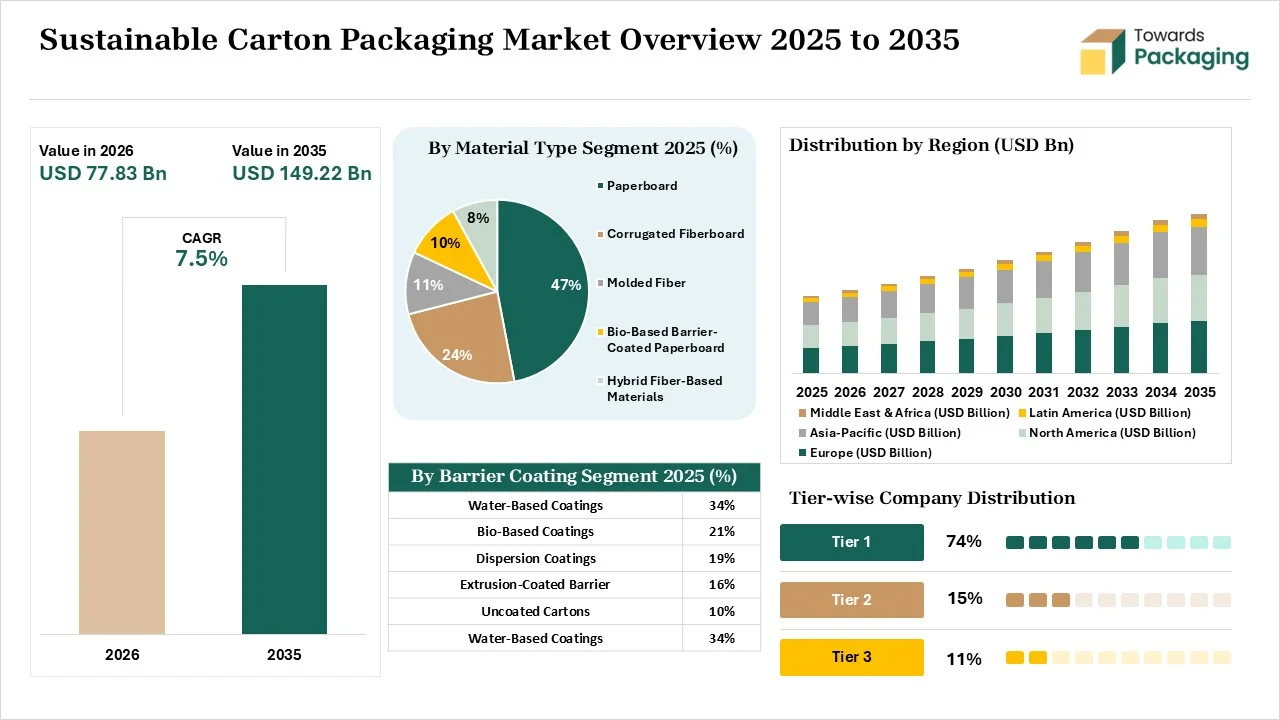
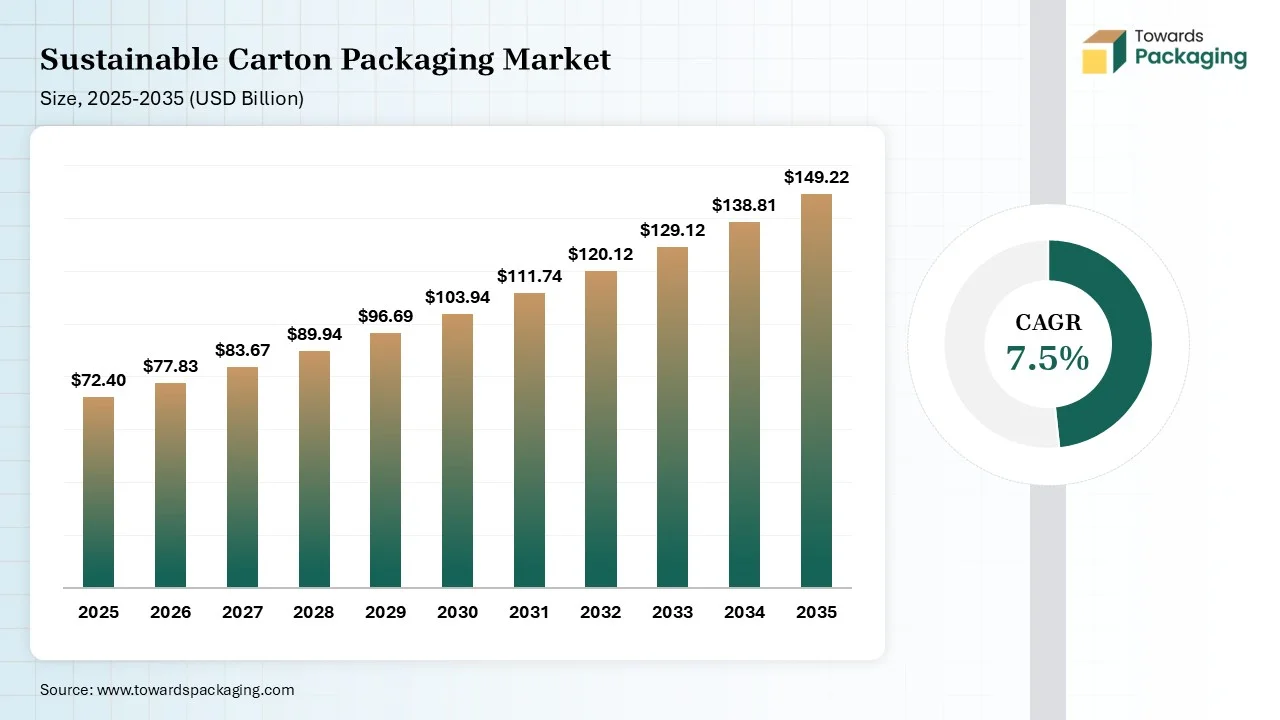
According to Vidyesh Swar, the global sustainable carton packaging market size was estimated at USD 72.4 billion in 2025 and is predicted to increase from USD 77.83 billion in 2026 to approximately USD 149.22 billion by 2035, expanding at a CAGR of 7.5% from 2026 to 2035. Factors like plastic bans, corporate targets, the beverage industry shift to sustainable packaging, barrier coating advancements, expanding recycling infrastructure, interest in easy-to-recycle cartons, expansion of recycled fibers, integration of digital prints, stronger paperboard development, expanding RTD liquids, and growing pulp recovery systems drive the market growth. The use of recyclable fiber-based carton solutions is growing due to new coatings, buyer demand, strict laws, and the circular economy.
Sustainable carton packaging is a sustainable packaging box designed using renewable paper materials. Its features are biodegradability, renewable material content, and recyclability. It offers benefits like fast decomposition, strong consumer appeal, low footprint, and logistics savings. Its principles are EOL recovery, responsible sourcing, and lifecycle efficiency. It is developed using recycled content, natural fibers, minimal coatings, FSC-certified paper, and water-based inks. The multipack sleeves, liquid cartons, and bakery boxes are widely required in the F&B industry. The padded mailers, outer delivery boxes, and subscription boxes are used in e-commerce. Sustainable carton packaging uses are retail shipping, eco-friendly branding, beverage transport, and storage.
The development of cardboard boxes started in 1817. These boxes are a replacement for heavy metal containers. In the early 1990s, food brands started using folding cartons for the packaging of products. In the middle of the 20th century, the innovations of aseptic packaging happened. In this period, aseptic packaging used aluminum foil for moisture protection. Consumer awareness of plastic layers' negative impacts increased demand for bio-based plastics. The green transition happened after consumer awareness. In this period, packaging was developed using PCR and other advanced fibers. The late 20th century mainly focused on establishing recycling infrastructure. The modern era's main focus is on EOL, barrier coatings, and lightweighting.
The market includes products like folding cartons, aseptic cartons, sleeve cartons, partition cartons, gable top cartons, liquid cartons, wraparound cartons, and die-cut cartons. The market serves applications like beverage packaging, pharmaceuticals, household products, industrial packaging, food packaging, personal care & cosmetics, consumer electronics, and industrial packaging. The technologies like structural engineering, fiber barrier coating, and chain-of-custody certifications. End users include food & beverage manufacturers, personal care companies, retail, industrial manufacturers, pharmaceutical companies, consumer goods manufacturers, and e-commerce across North America, Latin America, Europe, MEA, and Asia Pacific.
The growing microplastics in water, people's demand for cleaner cities, and the growing ocean plastic waste increase the bans on plastics. The regulations across various regions like the European Union PPWR, India’s single-use restrictions, and the United States single-use bag prohibitions increase demand for plastic-free packaging. Extended Producer Responsibility focuses on eco-design incentives and lifecycle accountability. The sustainability initiatives focus on source reduction, utilizing bio-based plastics, and integrating PCR. The growing plastic packaging regulations are a key driver for market growth.
The seasonal availability of fiber sources and the need for extensive power in the manufacturing increases the cost. The spike in the rates of natural gas and the dependence on recycled paper fibers increase the cost. The volatility in fuel prices and eco-compliance standards increases the cost. The changing prices of bio-coatings and the need for specialized processes increase the cost. The regional procurement limits and smaller economies contribute to cost volatility. The fluctuating raw material cost is a major restraint for the market growth.
Consumer interest in fiber-based luxury packaging and the government's new penalties increase the use of sustainable premium packaging. The premium companies' focus on standing out and justifying their premium prices increases the use of sustainable premium packaging. The brands' focus on avoiding public backlash and maintaining brand prestige increases the use of sustainable premium packaging. Various industries prefer premium packaging for enhancing brand values. The cosmetic industry uses sustainable premium packaging for customer loyalty and brand image. The food industry uses it for clear messaging and maintaining modern values. The electronics industry uses it to eliminate brand risk and elevate unboxing. The rise in sustainable premium packaging creates an opportunity for the growth of sustainable carton packaging.
Raw Materials like virgin fibers and virgin wood pulp are acquired through certified forests. The stage acquires recycled paper, starch-based adhesives, agricultural residues, and recycled cardboard through controlled sources.
Carton manufacturing involves sourcing raw materials, pulping, formation of board, printing, bio-based coating, die-cutting, and folding.
Distribution focuses on responsible sourcing, efficient palletization, green logistics, last-mile optimization, and EOL recovery. At end-users, distributors focus on consumer purchase, bin disposal, and recycling.
Post-consumer collection includes curbside source-separation, co-collection, reverse logistics, and post-separation. Recycling technologies include hydro-pulper separation, polyAI processing, fiber recovery, and advanced pyrolysis. Fiber recovery includes specialized repulping, advanced deinking, and enzymatic delamination.
The breakdown of average manufacturing price is raw materials take $0.108, conversion & manufacturing take $0.0216, printing & finishing take $0.0162, labor & machine operators take $0.0108, overhead & waste buffers take $0.0108.
The breakdown of average selling price is raw materials take up to $0.073, printing process & conversion steps take up to $0.041, labor & overhead take up to $0.024, warehousing & logistics operations take up to $0.013, and margin of suppliers is $0.011.
North America has moderate or high pricing due to the high raw material cost and growing EPR fees. Europe has premium pricing due to its high energy cost and heavy taxation. Asia Pacific has a low cost due to the lower price of pulp.
The paperboard segment dominated the market with a 47% share in 2025. The demand for compression protection in electronics and the strong municipal recycling systems increase paperboard production. The recycling of waste paper and the modernization of bio-based coatings increase the production of paperboard. Factors like solid rigidity, high recyclability, excellent compostability, and high-quality printing drive the segment growth.
The molded fiber segment held a 11% market share in 2025 and is expected to grow at the fastest CAGR of 9.4% during the forecast period. Brands' polystyrene replacement and the abundance of agricultural waste increase the production of molded fiber. The advanced compostable barriers and zero-waste metrics increase the production of molded fiber. The demand for shock-absorbing cushions and non-toxic coatings expansion increases the use of molded fiber. Factors like e-commerce protection and high performance support segment growth.
The folding cartons segment dominated the market with a 36% share in 2025. The rise in rigid polymers replacement and focus on lowering lifecycle GHG emissions increases demand for folding cartons. The high fees on mixed-material packs and the need to cut transit emissions increase the use of folding cartons. The integration of offset printing helps with the expansion. The high print quality, lightweight transport, and smart integration support the segment growth.
The aseptic cartons segment held a 18% market share in 2025 and is expected to grow at the fastest CAGR of 8.9% during the forecast period. The availability of wood-based paperboard and the prevention of premature spoilage increase the use of aseptic cartons. The expansion of plant-based polymers and the focus on saving energy increases aseptic carton production. The aluminum foil replacement helps with expansion. Aseptic cartons' lightweight design and no refrigeration requirement support the segment growth.
According to my research, the water-based coatings segment dominated the market with a 34% share in 2025. The elimination of the wax layer and the restriction on harmful chemicals increase the use of water-based coatings. The cartons' protection from fats and the transition away from plastic-laminated cartons increase the use of water-based coatings. The operational adaptability, low VOC emission, complete recyclability, and excellent grease resistance of water-based coatings drive the segment growth.
The bio-based coatings segment held a 21% market share in 2025 and is expected to grow at the fastest CAGR of 9.3% during the forecast period. Regulations on chemical pollutants and the innovative plant-based formulas increase the adoption of bio-based coatings. The buyers' demand for compostable carton packaging increases the use of bio-based coatings. The brand image goals, better barrier protection demand, and easy recycling increase adoption of bio-based coatings, supporting the segment growth.
The flexographic printing segment dominated the market with a 38% share in 2025. Flexographic printing's lightweight plates and recyclability compatibility help with growth. The demand for high-speed packaging output in the e-commerce industry and the focus on sharp visual fidelity increase the use of flexographic printing. The integration of energy-curing technology and water-based inks helps with expansion. The automated mounting and diverse substrate compatibility drive the segment growth.
The digital printing segment held a 20% market share in 2025 and is expected to grow at the fastest CAGR of 9.2% during the forecast period. The development of digital printing without printing plates and the elimination of photo chemicals helps with growth. The generation of low ink scrap and prevention of excess inventory increases demand for digital printing. The growing decentralized printing and compatibility with biodegradable carton boards help with expansion. The integration with sustainable substrates and short-run viability supports the segment growth.
The food packaging segment dominated the market with a 41% share in 2025. The surging restaurant takeaway and food brands' transition away from harmful plastics increases the use of sustainable cartons in food packaging. The focus on food moisture retention and everyday meal storage increases the use of sustainable cartons in food packaging. The high volume of food consumption and the focus on storing food without chillers support the segment growth.
The beverage packaging segment held a 24% market share in 2025 and is expected to grow at the fastest CAGR of 8.4% during the forecast period. The demand for earth-friendly beverage containers and the high sales of soy milks increase demand for sustainable carton packaging. The number of buyers choosing plastic-free beverage containers and the protection of perishable drinks increases the use of sustainable carton packaging. The burgeoning sales of plant-based drinks support the segment growth.
According to my research, the food & beverage manufacturers segment dominated the market with a 45% share in 2025. The availability of fiber-based containers and the rising takeout services increase the use of sustainable carton packaging. The preservation of product appeal and the replacement of harmful chemical coatings increase adoption of sustainable carton packaging. The mass production of liquid foods daily drives the segment growth.
The personal care companies segment held a 11% market share in 2025 and is expected to grow at the fastest CAGR of 8.2% during the forecast period. The use of virgin plastic replacements in beauty conglomerates and eco-friendly transformations in beauty brands increases adoption of sustainable carton packaging. The maintenance of personal care luxury appeal and increased buying of moisture-sensitive serums increase adoption of sustainable carton packaging. Personal care corporations' focus on lowering overall carbon footprint supports the segment growth.
The direct sales segment dominated the market with a 43% share in 2025. Buyers' focus on the recycled content of packaging and increased custom engineering in FMCG increases the adoption of direct sales. The avoidance of third-party miscommunication issues and the elimination of intermediaries increases the use of direct sales. Factors like enhanced logistics, large volume contracts, and faster feedback drive segment growth.
The e-commerce segment held a 13% market share in 2025 and is expected to grow at the fastest CAGR of 8.8% during the forecast period. The focus on building a better market reputation and right-sized packaging demand increases the use of e-commerce. Consumer perception improvement and the acceleration in packaging lines increase the use of e-commerce. The lower damage rates and custom-sized cartons on e-commerce support the segment growth.
Europe dominated the sustainable carton packaging market with a 33% share in 2025. The stricter EU directives and the growing financial penalties increase demand for sustainable carton packaging. The rise in eco-conscious buyers and the increasing use of eco-friendly boxes in companies increase the adoption of sustainable carton packaging. The advanced sorting networks and the innovative biodegradable barriers increase the production of sustainable carton packaging. The massive domestic forestry drives the market growth.
Germany
Germany held the largest revenue share in the market in 2025. The VerpackG enforcement and the high standards of Germany's packaging industry increase the use of sustainable carton packaging. German shoppers' eco-consciousness and waste separation habits increase the adoption of sustainable carton packaging. The interest in earth-friendly packaging and the massive supermarket chains increases the use of sustainable carton packaging, boosting the market growth.
United Kingdom
The United Kingdom is expected to experience the fastest growth in the market during the forecast period. The interest in the utilization of simpler paper and the eco-friendly choices increases demand for sustainable carton packaging. Online shopping and rising packaging disposal costs increase the use of sustainable carton packaging. The zero-plastic goals and the interest in minimal packaging increase the use of sustainable carton packaging, supporting the market growth.
According to my research, Asia Pacific held a 30% share in the sustainable carton packaging market in 2025 and is expected to grow at the fastest CAGR of 8.8% during the forecast period. The high beverage consumption in ASEAN regions and the rise in online retail delivery increase the use of sustainable carton packaging. Government rules for recycled content and the replacement of plastic laminations increase the production of sustainable carton packaging. The growth in the middle-class population and the surge in functional drinks increase demand for sustainable carton packaging, driving market growth.
China
China held the highest revenue share in the market in 2025. The dual-carbon goals and expanding number of parcel shipments increase the use of sustainable carton packaging. The large box-manufacturing plants and the expansion of recycled fiber increase the production of sustainable carton packaging. The high raw pulp capacity and the strong retail firms increase demand for sustainable carton packaging. The rising use of folding cartons in the beverage industry supports the market growth.
India
India is expected to experience the fastest growth during the forecast period. The Indian states' bans on plastic and grocery apps' growth increase the adoption of sustainable carton packaging. The demand for brand-friendly packaging in modern supermarkets and the development of water-resistant coatings increase the use of sustainable carton packaging. The biodegradable laminations support the market growth.
North America held the 29% market share in 2025. The stricter limitations on plastic and the management of packaging waste increase the use of sustainable carton packaging. The recyclable packaging pledges by brands and the safe online delivery increase the use of sustainable carton packaging. The demand for green household goods and the advancements in digital printing drive the market growth.
United States
The United States dominated the sustainable carton packaging market in 2025. The large corporations' preference for eco-friendly packaging increases the production of sustainable carton packaging. The surging food home delivery applications and the automated system utilization increases demand for sustainable carton packaging. The strong national recycling ecosystem supports the market growth.
Canada
Canada is expected to grow at the fastest CAGR in the market during the forecast period. The bans on traditional plastics and the increased imposition of fees on the basis of recyclability increase demand for sustainable carton packaging. The preference for eco-friendly papers and the demand for light boxes increase the use of sustainable carton packaging. The increased buying of plant-based milks supports market growth.
According to my research, Latin America held a 5% market share in 2025. Government regulations across metropolitan areas and the shift to carton formats increase the adoption of sustainable carton packaging. The expansion of folding cartons and the rising launch of international food products help drive growth. The burgeoning FMCG brands and the use of barrier-coated paperboards increase the production of sustainable carton packaging, driving market growth.
Brazil
Brazil dominated the sustainable carton packaging market with the largest share in 2025. The pulp production infrastructure and the strong containerboard facilities increase the development of sustainable carton packaging. The increased carton packaging used in local agricultural exports helps with expansion. The waste rules and forestry supply support the market growth.
Chile
Chile is expected to grow at the fastest CAGR during the forecast period. The Chilean government's priority to lower waste and buyers' preference for cardboard boxes increase production. The expanding beverage-producing companies and the adoption of carton formats in brands increase the development of sustainable carton packaging. The international food producers boost the market growth.
The Middle East & Africa held a 3% market share in 2025. The focus on following green initiatives and the growing digital food delivery increase the adoption of sustainable carton packaging. Plastic containers replacement by regional brands and restrictions on plastic cups increase the use of sustainable carton packaging. Expanding hypermarkets and the growth in cosmetic manufacturing drive overall market growth.
Saudi Arabia
Saudi Arabia dominated the sustainable carton packaging market in 2025. The presence of modern trade hubs and strong juice producers increases the adoption of sustainable carton packaging. The growing domestic converters' investments in production help with the expansion. The massive industrial density and local policies like NIDLP support the market growth.
UAE
UAE is expected to grow rapidly during the forecast period. The prohibitions on plastic bags and federal climate laws increase the production of sustainable carton packaging. The increased sales of digital platforms and dynamic growth in the hospitality industry increase the use of sustainable carton packaging. The key re-export hub boosts the market growth.
The sustainable carton packaging market is extremely competitive due to the expanding capacities of fiber-based manufacturing. The leading food carton and liquid carton manufacturers are Elopak and Tetra Pak. The dominant folding carton players are Graphic Packaging International, Mondi Group, Smurfit WestRock, DS Smith, and International Paper. Startups like Notpla, Ecovative, and TemperPack are emerging in the sustainable carton packaging industry.
| Company Name | Product Range | Converting Factories | Sustainability Initiatives | Development and Collaborations |
| Smurfit WestRock | Folding Cartons, Multipack Solutions, Corrugated Packaging, Solid Board Packaging |
500 Facilities | The company focuses on green financing, emissions reduction, and landfill diversion. | Smurfit WestRock created a corrugated box facility in Longview, Washington, United States. |
| Tetra Pak | Tetra Rex Plant-based, Tetra Top & Tetra Peak, Tetra Prisma & Tetra Stelo Aspetic, Tetra Brik Aseptic, Tetra Recart |
27 Factories | The company focuses on net-zero targets and renewable electricity. | Tetra Pak launches 1-litre aseptic carton packaging with paper-based barrier in partnership with Sterilgarda |
The competitive positioning depends on factors like carbon footprint reduction, supply chain optimization, structural innovation, sustainable materials, and advanced technology. Smurfit WestRock is a leading player in packaging & integrated paper production and competes on a large geographic footprint. Graphic Packaging International offers packaging solutions strongly focused on the production of paperboard packaging solutions. DS Smith is leading in plastic-replacement designs and serves retail clients & the e-commerce industry.
| Company Overview | The company is a leading producer of renewable materials and focuses on barrier technologies. |
| Manufacturing Footprint | Finland, Italy, Austria, Netherlands, Germany, Sweden, and Other European countries |
| Product Portfolio | Paperboard Tubes, Performa & Tambrite, Trayforma, Kraftliners, Logistics Boxes |
| SWOT Analysis |
Strength Plastic Replacement Weakness Dependence on Corrugated Formats Opportunity Styrofoam Phase-outs Threats Volatility in Recovered Paper Costs |
| Company Overview | The company follows circular design principles and focuses on minimum material usage. |
| Manufacturing Footprint | Europe, Middle East & Africa, and North America |
| Product Portfolio | Multi-Wall Corrugated Containers, Shelf-Ready Cartons, Mailers, Transit Packaging, Containerboard |
| SWOT Analysis |
Strength Strong Forest Assets Weakness Volatility in Energy Costs Opportunity Growing Plastic Replacement Threats Industry Rivalries |
| Company Overview | The company develops fiber-based materials and focuses on energy-efficient manufacturing. |
| Manufacturing Footprint | United States and Europe |
| Product Portfolio | KeelClip, PaperSeal, CleanClose, EnviroClip, ProducePack |
| SWOT Analysis |
Strength Commercialized Fiber-Based Solution Weakness Volatility in Recycled Fiber Cost Opportunity Expansion in Asia and Latin America Threats Compliance Pressure |
According to my research, the sustainable carton packaging market is rapidly expanding due to companies' sustainability goals and the online platforms boom. The drivers for the growth are single-use bans, eco-awareness, brand image protection, CSR goals, barrier innovations, and compliance mandates. Folding cartons are widely used carton packaging due to their lightweight efficiency, compatibility with digital printing, and excellent unboxing experiences. Industries like electronics, F&B, pharmaceuticals, and other major industries use folding carton packaging. The food & Beverage industry is a major contributor to the growth due to the rise in plant-based beverages and dairy products. Europe held the highest share in the market due to the green deal goals, shopper demand, EU directives, and industrial integration. The major sustainable carton producers are Smurfit Westrock, International Paper, Elopak AS, Tetra Pak, Amcor Plc, and Mondi Group. The sustainable carton packaging market is creating a positive impact on the environment and the industrial base.
By Material
By Carton Type
By Barrier Coating
By Printing Technology
By Application
By End User
By Distribution Channel
By Region



Principal Research Analyst
Vidyesh Swar is a Senior Research Analyst at Towards Packaging, bringing over 4 years of dedicated expertise in market intelligence and strategic analysis across the dynamic world of packaging technologies and solutions.
Learn more about Vidyesh Swar

Reviewed By
Aditi Shivarkar, with 14+ years in packaging market research, specializes in food, beverage, and eco-friendly packaging. She ensures accurate, actionable insights, driving Towards Packaging Analytics & Consulting 's excellence in industry trends and sustainability.
Learn more about Aditi Shivarkar

Sustainable Carton Packaging Market
 Table of Content
 sales@towardspackaging.com
 +1 804-441-9344
 Download Sample
 Schedule a Meeting