


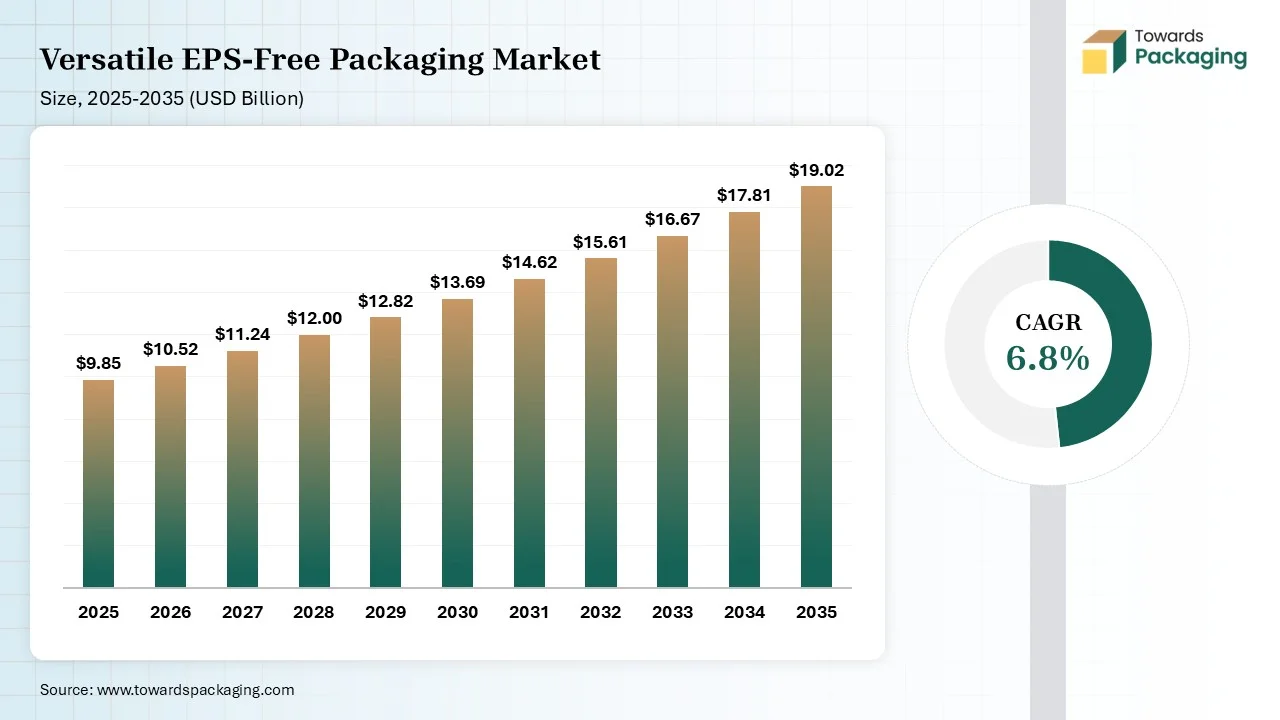
The versatile EPS-free packaging market is projected to grow from USD 10.52 billion in 2026 to USD 19.02 billion by 2035, registering a CAGR of 6.8% during the forecast period. This report delivers a comprehensive analysis of market size along with detailed segment data by material type, packaging format, and end-use industries. It further provides in-depth regional insights, key company profiles, competitive landscape analysis, value chain evaluation, and trade data, along with extensive information on manufacturers and suppliers shaping the market.
The Expanded Polystyrene (EPS) free packaging is created from paper-based material that is certified by the Forest Stewardship Council, which has four-color print that applies 70% less ink. The various packaging changes have also been avoided in half by utilizing classification between different products in the same series.
Market Size (2025): USD 9.85 Billion
CAGR (2025–2035): 6.8%
Market Volume (2025): 5.9 Million Tons
Volume CAGR (2025–2035): 6.1%
Pricing Data (2025):
Data-driven sustainability is a developing trend. High-level packaging producers are using energy application tracking systems, carbon footprint calculators, and waste management systems to count packaging-linked emissions. Such data transparency is not necessary for regulatory compliance but is also becoming a main factor in user decision-making, with consumers who are increasingly finding companies with transparent sustainability practices.
As the urge for sustainable packaging develops, latest inventions are growing to align with the demands of high-development sectors such as health and wellness, CBD, subscription e-commerce, and luxury cosmetics. Such sectors need packaging that completely balances branding aesthetics, structural protection, and compliance labelling.
The molded fiber segment dominated the market with 34% share in 2025, as they are also known as molded pulp, are environmentally friendly materials designed from a variety of recycled natural fibers, like cardboard, paperboard, and plant fibers like bamboo, bagasse, and sugarcane. They are widely utilized as a sustainable option to regular plastic packaging because of their recyclability and biodegradability.
Molded fibers are manufactured from a pulp slurry, which is crafted and dried into sturdy and lightweight products that serve an eco-friendly conscious solution for different sectors. Molded fiber can be converted, as it decomposes more smoothly in an industrial composting service as compared to a home compost setup. Certifications from companies such as Biodegradable Products Institute (BPI) and OK Compost check its compostability.
The bioplastics segment held the 22% market share in 2025, and it is also expected to grow at the fastest CAGR of 8.50% during the forecast period. They are specifically integrated from a variety of renewable raw materials, which include potatoes, starch or sugarcane, wheat, wood or cellulose, and lastly agricultural waste. Such links are being processed to make monomers, which are polymerized into plastic materials. Among the most widely used bioplastics in terms of food packaging are polyhydroxyalkanoates (PHA), polylactic acid (PLA), and starch-dependent polymers, as each delivers different properties and processing elements.
The corrugated & paperboard segment held the 20% market share in 2025 because corrugated paperboard and cardboard are the packhorse of electronic transportation. They are created from surfaces of paperboard, like fluted and liner medium, and can be produced with heavy recycled content. Current carton structures can use rigid virgin fibers from sustainably tracked forests, and are completely recyclable. In reality, corrugated cardboard are 100% recyclable material and is one of the most recycled materials in the world. Corrugated is lightweight in nature and convenient to brand and print, which can be tailored for custom -slotted or a die-cut for a machine of any size. Some of the top choices include foldable mailers and rigid boxes (book-style cartons).
The foam alternatives segment held the 14% market share in 2025 as mycelium packaging is developed, not produced, from the root design of fungi. Agricultural waste, such as corn husks or hemp, is linked together by mycelium as it develops into a mold, which makes a deep and film-like material. They are completely natural, compostable, and non-toxic options for EPS-free packaging. On the other hand, starch-based foams are created from renewable materials such as wheat, corn, and potato starch. They are frequently utilized as a direct substitution for EPS loose-fill packing peanuts or made into shapes and sheets for cushioning purposes. Such foams are generally non-toxic, compostable, and break down securely in soil and water.
The protective packaging segment dominated the market with 38% share in 2025 because expanded polystyrene (EPS) is a basic material in this packaging, which only aims to protect goods from damage during logistics, delivery, and handling. It absorbs effect and serves as a load while transportation, shields sensitive ingredients from vibration, shock, and stacking pressure. It can be shifted to track both dynamic and static forces, which assist in constant results, whether they are shifted by sea, air, courier, or road. They are specifically imperative for products that are fragile to mechanical disturbance, such as white goods implemented with lab requirements, integrated electronics, or user electronics.
The food packaging segment held the 26% market share in 2025, and it is also expected to grow at the fastest CAGR of 7.60% during the forecast period. Recyclable EPS packaging serves as an unavoidable insulation that manages constant temperatures for frozen and fresh food during logistics. Such temperature control mainly lowers the risk of contamination and spoilage, which ensures products arrive securely at their required location. For delicate foods such as dairy, seafood, and meats, accurate temperature control can mitigate toxic bacteria development and store foods safely for users.
The industrial packaging segment held the 18% market share in 2025, as these foams have been widely used all around the globe for several years. They are reliable, cheap, convenient, and lightweight to create material. But they are oil-based products that are not available anywhere and are not recyclable in terms of industrial applications. EPS foam frequency results in nature in which they are not degradable. Rather, they are ground into small parts which are potentially toxic to humans and animals in the long term.
Consumer goods packaging segment held the 18% market share in 2025, as Expanded polystyrene is greatly accepted in appliance packaging because of its cushioning results, moldability, and lightweight nature. EPS packaging for air coolers and air conditioners is being crafted to prevent appliances without any extra weight to shipments. One of the main benefits of EPS cushioning appliances is its potential to absorb and serve as an effective energy source. The cellular design of EPS includes an underlay, which lowers the force shifted to the appliance. This makes them ideal for preventing heavy units against prevalent transit effects.
The food and beverage segment dominated the market with a 32% share in 2025 because it manages cold or hot temperatures by storing meals and beverages at a secure level and delightful serving conditions. Trays, foam cups, and clamshells benefit from EPS’s lower thermal conductivity by ensuring food safety during delivery and transport. Additionally, they are lightweight, effective, and leak-resistant, which protects food and beverages from spillage while handling. Its overall power ensures stability in inventory of taurus, cups, or containers, which make them perfect for catering, restaurants, and retail food service.
The e-commerce and retail segment held the 24% market share in 2025, and it is also expected to grow at the fastest CAGR of 8.20% during the forecast period. With the growth of online shopping, EPS has become a popular option for e-commerce packaging. It serves as protection and cushioning for products during transportation, which lowers the risks of damage and improves the user experience. The development of retail and e-commerce has grown the urge for relevant packaging solutions, and EPS boxes have become a go-to option for online retailers. Generally, shipped products like cosmetics, electronics, and sensitive goods are frequently packaged in EPS boxes. Such shock-absorbing elements lower the risk of pollution during transit.
The electronics and electrical segment held the 18% market share in 2025 because this industry's brands use mushroom packaging to protect devices without any application of synthetic foams. The molded inserts comfortably accommodate small appliances and smartphones. The padding absorbs shock while travelling, which delivers an unforgettable unboxing experience for consumers. Such packaging assists in using eco-friendly regulations and lowers material waste in the globe by shipping the system as technology companies feature circular practices.
The healthcare and pharmaceuticals segment held the 14% market share in 2025 because pharmaceutical shipments mostly travel across long distances under strong conditions like specialized shading, temperature control, and protective warehousing. Honeycomb paperboard serves the structural power that demands to protect such fragile loads without any unwanted weight. Honeycomb tier sheets perfectly distribute weight evenly by protecting the carton from collapsing under heavy loads. This material results well in refrigerated or frozen supply chains that assist biologics and vaccines logistics.
The direct sales (B2B) segment dominated the market with a 55% share in 2025 because banana fibers are among the most current additions to biodegradable packaging. Several B2B companies are pulping banana stalks to make different types of textiles for sustainable bags and food packaging that biodegrade at the end of their lifecycle. Such packaging options are already commercially accessible. By using bleaching agents and alkali on banana peels, using other procedures, and using fibers that can be removed and updated to make biodegradable packaging.
The online channels segment held the 15% market share in 2025, and it is also expected to grow at the fastest CAGR of 8.00% during the forecast period. Plant fiber packaging is used for shipping. E-commerce companies have witnessed the plant-based packing of peanuts and the transportation of boxes created from plant fires instead of regular plastic or Styrofoam. This not only lowers waste but also mainly develops the complete sustainability of the shipping procedure, which requires eco-friendly e-commerce users and businesses similarly.
The distributors & wholesalers segment held the 30% market share in 2025 because packaging is one of the most prevalent applications of EPS packaging foam. Shape-molded pieces prevent appliances, electronics, glass products, and medical devices from being affected during transport and handling during storage and shipping, and the weight is low. EPS liners and coolers manage pharmaceuticals, food, and beverages at managed temperatures. When such materials are covered at distribution and stored in warehouse centres, they make important volumes of foam waste which can be classified for EPS-free foam, packaging recycling, and deep instated of being avoided.
Asia Pacific dominated the market with 36% share in 2025 and expects the fastest growth in the market with 8.40% CAGR during the forecast period due to the huge agricultural sector and low-cost raw materials such as hemp, rice husks, and corn stalks. Countries like India, China, and Japan are encouraging strong bans on single-use plastics, which has driven the urge for biodegradable packaging solutions. Specifically in India, they are experiencing a development in government -compulsory sustainable packaging choices, while Gen Z and users are encouraging environmentally friendly packaging in the e-commerce industry. Though there are dropping prices, mycelium composites have still urged a luxury amount over EPS foam, though parity is predicted worldwide by the year 2030.
India Versatile EPS-Free Packaging Market Trends:
The demand for EPS-free box packaging in India is redeveloping quickly due to the development of industries like food delivery, electronics production, e-commerce and pharmaceuticals. Organizations are constantly seeking packaging materials that give rigid protection while storing logistics costs less. They deliver an ideal balance of insulation, protection, and reliability. Due to such advantages, EPS-free packaging is predicted to stay one of the most widely used packaging solutions for several sectors in the future.
North America held the 24% market share in 2025 as Extended producer responsibility points to a policy strategy or rule in which manufacturers (i,e manufacturers, brand owners, and distributors) are totally responsible for the complete life cycle of their packaging and products, which has special importance on product end-of-life. In the U.S., manufacturers are required to officially register with the state’s PRO, which collects and administers fees for EPR packaging programs.
United States Versatile EPS-Free Packaging Market Trends:
The demand for this packaging in the United States is developing, which is initially being driven by a bulk wave of state-level restrictions on regular foam products, excessive corporate zero-waste compulsions, and a huge move in user predictions in terms of circular materials. The big markets like New York, California, and Colorado have active food-ware limitations. Additionally, fresh produce distribution networks are increasingly moving to molded fiber, sugarcane, and bamboo choices.
Europe is expected to grow at a considerable CAGR in the upcoming period, as governments, businesses, and consumers replace expanded polystyrene (EPS) packaging due to environmental concerns and stricter sustainability regulations. The region’s strong circular economy policies, plastic reduction targets, and growing demand for recyclable and compostable packaging are accelerating the adoption of EPS-free alternatives. Industries are increasingly shifting toward sustainable packaging formats to comply with European Union regulations and meet consumer expectations.
Germany Market Trends
Germany has an advanced recycling infrastructure, a strong manufacturing sector, and aggressive sustainability initiatives. German retailers, electronics manufacturers, and foodservice companies are rapidly replacing EPS packaging with recyclable paper-based and molded fiber alternatives. Consumers in Germany strongly prefer sustainable packaging, boosting brands to invest heavily in eco-friendly alternatives.
Latin America is considered to be a significantly growing area, as environmental awareness, plastic reduction initiatives, and sustainable packaging adoption continue to expand across the region. Governments, retailers, foodservice companies, and manufacturers are increasingly seeking alternatives to EPS packaging due to concerns regarding plastic waste, landfill pollution, and recycling difficulties, accelerating the adoption of molded fiber packaging, corrugated materials, biodegradable foams, paper-based containers, and recyclable protective packaging.
Brazil Market Trends
Brazil has a large foodservice sector, a growing retail industry, and rising sustainability initiatives. The country has introduced restrictions on single-use plastics and polystyrene food containers, encouraging businesses to adopt biodegradable and recyclable packaging alternatives. The country’s large agricultural export industry is increasing demand for sustainable protective packaging for fruits, vegetables, eggs, and processed foods.
The Middle East and Africa are expected to grow at a notable CAGR in the foreseeable future, as governments, businesses, and consumers increasingly focus on reducing plastic waste and adopting environmentally friendly packaging solutions. Growth in food delivery services, e-commerce, hospitality, retail, and healthcare industries is further accelerating demand for versatile EPS-free packaging. Growing environmental concerns and recycling challenges are encouraging a shift toward sustainable alternatives.
Saudi Arabia Market Trends
Saudi Arabia is emerging steadily in the market due to rapid urbanization, foodservice expansion, and sustainability initiatives. Restaurants, cafes, supermarkets, and food delivery companies are increasingly replacing EPS takeaway containers with biodegradable and recyclable alternatives. The government’s focus on waste reduction and sustainable industrial development is encouraging packaging manufacturers to invest in eco-friendly and recyclable materials.
My Material Type:
By Product Type:
By End-Use Industry:
By Distribution Channel:
By Regions:







Research & Advisory Analyst
Yogesh Kulkarni is an experienced Research Analyst specializing in the packaging sector, with a strong foundation in statistical analysis and market intelligence. He currently contributes his expertise to Towards Packaging.
Learn more about Yogesh Kulkarni

Reviewed By
Aditi Shivarkar, with 14+ years in packaging market research, specializes in food, beverage, and eco-friendly packaging. She ensures accurate, actionable insights, driving Towards Packaging Analytics & Consulting 's excellence in industry trends and sustainability.
Learn more about Aditi Shivarkar

Versatile EPS-Free Packaging Market
 Table of Content

 Download Sample
 Schedule a Meeting