Canada Household Packaging Market Insights for 2035

Canada Household Packaging Market Size, Trends, Segments, Companies, Competitive Analysis, Value Chain & Trade Analysis 2025-2035

The Canada household packaging market study delivers a data-rich evaluation featuring market size estimations, segmented demand patterns, pricing trends, and production statistics. It further includes extensive regional comparisons (NA, EU, APAC, LA, MEA), corporate strategies of leading players, competitive strengths and weaknesses, detailed value chain breakdowns, import–export analytics, and verified information on suppliers and converters operating in the ecosystem.

Last Updated: 13 November 2025 Category: Advanced Packaging Insight Code: 5817 Format: PDF / PPT / Excel

The Canada household packaging market provides a complete analysis of revenue size projections from 2026 to 2035, covering all statistical data on material types, product categories, packaging formats, and end-use segments. This report offers full regional insights across North America, Europe, Asia-Pacific, Latin America, and the Middle East & Africa, along with profiles of major companies, competitive benchmarking, value chain structure, trade flow statistics, and a detailed database of manufacturers and suppliers.

Major Key Insights of the Canada Household Packaging Market

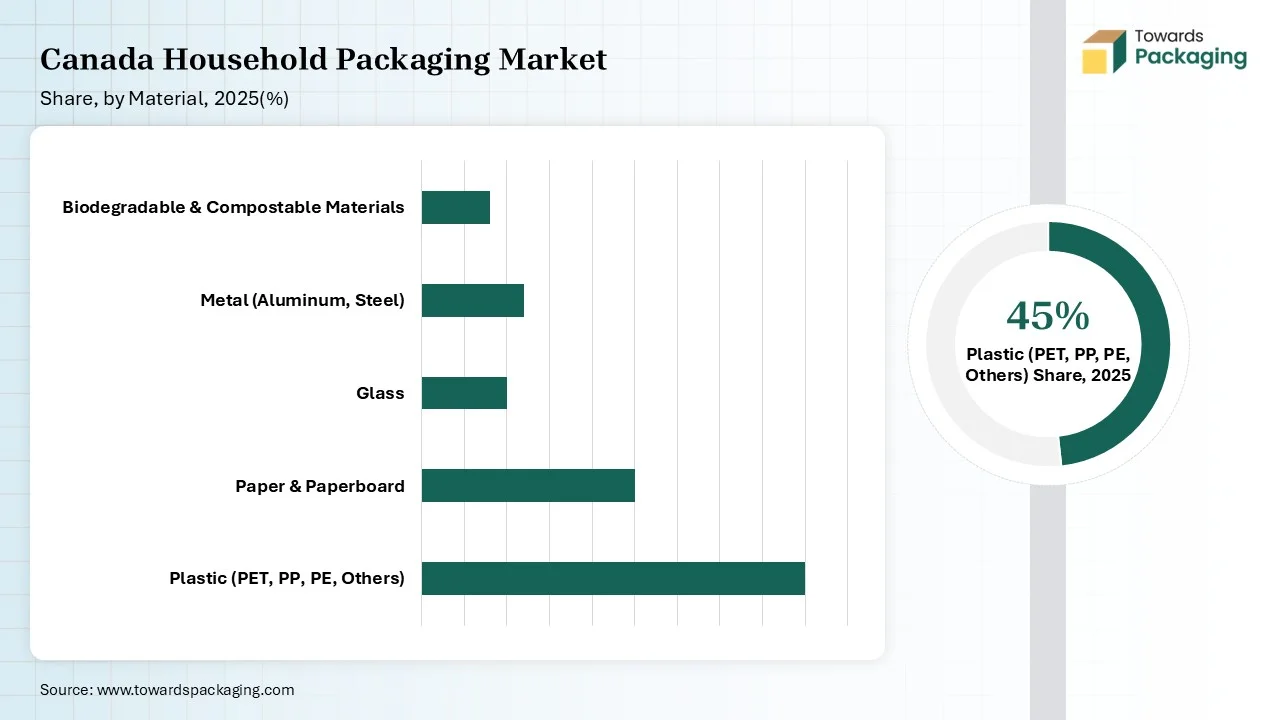
  • By material, the plastic packaging segment contributed the biggest market share of approximately 45% in 2024.
  • By material, the biodegradable & compostable materials segment will be expanding at a significant CAGR in between 2025 and 2034.
  • By packaging type, the rigid packaging (bottles & jars) segment contributed the biggest market share of approximately 50% in 2024.
  • By packaging type, the flexible pouches & sachets segment is expected to expand at a significant CAGR in between 2025 and 2034.
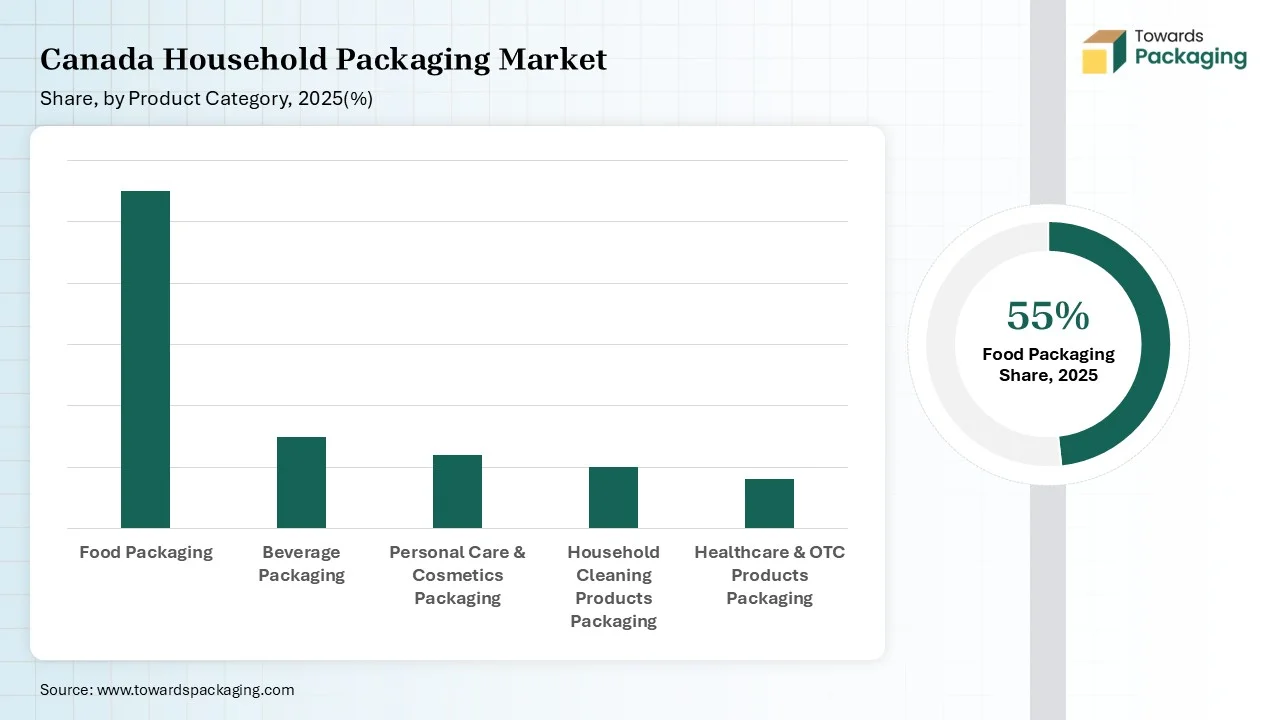
  • By product category, the food packaging segment contributed the biggest market share of approximately 55% in 2024. 
  • By product category, the personal care & healthcare packaging segment is expanding at a significant CAGR in between 2025 and 2034.
  • By functionality, the barrier protection & shelf-life segment dominated the market with the share of approximately 40% in 2024. 
  • By functionality, the sustainability & recyclability segment will be expanding at a significant CAGR in between 2025 and 2034.
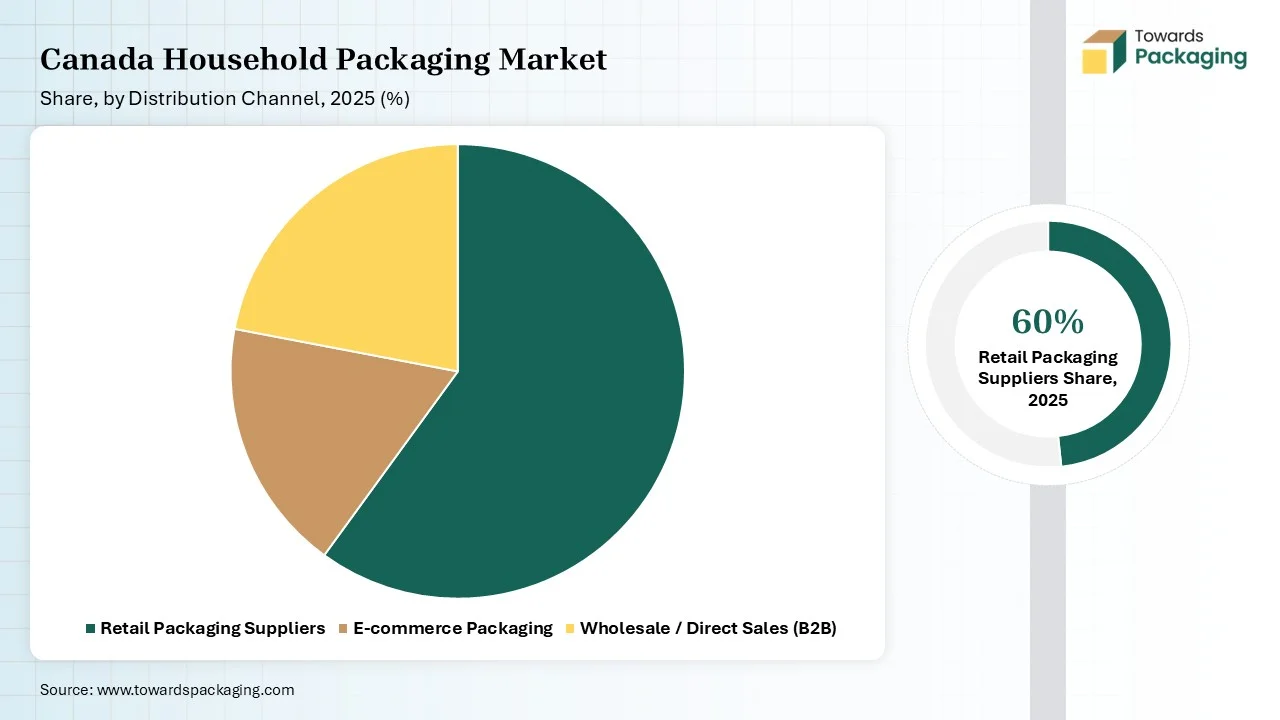
  • By distribution channel, the retail packaging suppliers segment contributed the biggest market share of approximately 60% in 2024.
  • By distribution channel, the e-commerce packaging segment is expected to expand at a significant CAGR in between 2025 and 2034.

Market Overview

The Canada household packaging market covers the production and distribution of packaging materials used for consumer household products such as food, beverages, personal care, cleaning agents, and healthcare goods. Packaging formats include plastic containers, paper & board cartons, glass bottles, metal cans, and flexible pouches. The market is shaped by sustainability regulations, rising demand for convenience packaging, e-commerce penetration, and consumer preference for recyclable and eco-friendly materials.

  • Minimalist Design: Accepting a minimalist design can create packaging that is more attention-grabbing by concentrating on clarity and simplicity. This strategy frequently uses clean lines. Straightforward messaging and huge white spacing are used to convey the product’s advantages smoothly.
  • Refillable Packaging: Refillable packaging is gaining popularity as it lowers the waste and pushes repeat purchases. Brands can serve durable containers, stylish containers that users can easily refill with the product pouches or at in-store stations.
  • Interactive Packaging: Interactive packaging totally engages users by including factors like games and puzzles that can make a different connection with the product. This method not only develops usability but also pushes social sharing, word-of-mouth marketing, and promotion.
  • Customizable Labels: In order to enable users to tailor labels with their name or messages that can make a different connection with the product. This method not only refines the user experience but also pushes social sharing.
  • Transparent Packaging: By using transparent materials that enable users to look at the product inside, it constructs transparency and trust. This method is specifically effective for products with visually appealing colors or textures, such as liquids or gels.

Appealing Designs and Consumer Preferences

  • There is a huge material exploration as well as minimalist and transparent designs attract high number of consumers towards this market.

Increasing E-commerce Services

  • The availability of a huge number of e-commerce platforms has provided accessibility of numerous products in reasonable charges push this market expansion.

High Demand for Sustainable Products

  • The increasing concern towards ecological issues has raised the demand for sustainable products.

How Can AI Improve the Canada Household Packaging Market?

The integration of AI technology in the Canada household packaging market plays a significant role in selection of materials to produce sustainable and unique designs. AI is widely used for designing intrinsic patterns to make household packaging look attractive which raise its adoption by several brands. With the incorporation of automation major market players are efficiently accelerating the production process without any error. Advanced technology help in the production of smart packaging with sensor, RFID tags, and various other technologies.

Market Dynamics

Market Driver

Demand for Convenient Packaging

The demand for convenient packaging of delicate products among consumers has driven the Canada household packaging market to grow significantly. In changing lifestyle of people and rapid shift towards urban areas with small space has influenced the demand for such packaging which is easy to move, dispose, and transport. Constant demand for sustainable packaging due to strict government regulation towards packaging industry has raised the demand for these household packaging. The increasing e-commerce sector has significantly raised the demand for such packaging which are widely used for wrapping delicate products. Technological advancement of the packaging process has raised the adoption of these packages and widen the scope of growth.

Market Challenges and Restraints

Rising Ecological Concern

The growing concern about ecological issues has restraint the Canada household packaging market. Government has restricted in the plastic packages which hindered the industry and made it high chargeable with enhanced packaging materials. Less advanced waste management infrastructures have also hindered the growth of this market.

Market Opportunity

Minimalist and Recyclable Designing

The increasing acceptance for minimalist and recyclable designing has enhanced the opportunities of the Canada household packaging market. Manufacturing of such packaging with mono-materials has raised the opportunities for this market to rise significantly. With the growing e-commerce sector there is a huge innovation in the packaging department for safe and enhanced packaging of products to protect them while transporting. Innovation in private labelling on the packages has increased the development scope in this market.
Material Type Insights

Why Plastic Packaging Segment Dominated the Canada Household Packaging Market In 2024?

The plastic packaging segment dominated the market in 2024 due to its prevalence in several containers, films, and bags. The rising demand for convenience and hygiene has influenced the growth of this segment. With the increasing concern towards ecology the demand for bioplastics has fuelled in household packaging industry in Canada. It has low carbon emission properties which increase its adoption in the food delivery and e-commerce sector.

The biodegradable & compostable materials segment is expected to grow at the fastest rate in the market during the forecast period of 2025 to 2034. It is due to the increasing demand for sustainable packaging in a wide variety of industries. This segment promotes materials which are renewable, natural, and cost-efficient that can be utilized by a broader range of businesses. Regulatory supervisory are constantly looking for such materials which are eco-friendly which push the growth of this segment.

Packaging Type Insight

Why Rigid Packaging (Bottles & Jars) Segment Dominated the Canada Household Packaging Market In 2024?

The rigid packaging (bottles & jars) held the largest share of the market in 2024 due to huge usage of these containers. These serves multiple purposes such as storage of products, décor, and many other such multi-usage enhanced the demand for this segment significantly. These are lightweight and transparent which increase the demand for these bottles & jars. These are versatile and comes with a wide customization option which push this segment to grow rapidly.

The flexible pouches & sachets segment is expected to grow at the fastest rate in the market during the forecast period of 2025 to 2034. This segment is growing rapidly due to its portability, convenience, and sustainability. It is widely accepted by food and personal care brands which has a huge range of packages required for different products. In the busy lifestyle of Canada there is a huge demand for small single-use portable packages in household sector boost the growth of this segment.
Product Category Insights

Why Food Packaging Segment Dominated the Canada Household Packaging Market in 2024?

The food packaging segment held the largest share of the market in 2024 due to increasing demand for packaging with extended shelf-life. The busy lifestyle of people promotes the requirement for portable packaging of food products that need to be convenience to use. Continuous innovation in this segment has raised the adoption of these packaging to enhance the experience of the consumers. There is a huge demand for eco-friendly packaging in food industry boost the acceptance of this market.

The personal care & healthcare packaging is expected to grow at the fastest rate in the market during the forecast period of 2025 to 2034. This segment is growing due to huge demand for refillable and biodegradable packaging of the products. This market introduced several such options that maintain the integrity of the products and easy-to-handle which increase the adoption of such packaging in this segment.

Functionality Insights

Why Barrier Protection & Shelf-Life Segment Dominated the Canada Household Packaging Market In 2024?

The barrier protection & shelf-life held the largest share of the market in 2024 due to its composite and flexible plastic materials. This industry is well-known to produce bio-based and recyclable films that provide enhanced barrier from adverse condition of the ecology. Huge advancement in this sector such as monitoring of food condition system and various other appeal the adoption of this sector. These films are made up of post-consumer recycled materials which is eco-friendly solution of packaging and influence the growth of the market.

The sustainability & recyclability segment is expected to grow at the fastest rate in the market during the forecast period of 2025 to 2034. This segment is experiencing robust growth due to strict packaging policies of the government in Canada. The increasing concern for ecological issues due to packaging among consumers has also promoted the adoption of such packaging. There is a presence of advanced infrastructure for recycling of materials which also boost the development of this sector.
Distribution Channel Insight

Why Retail Packaging Suppliers Segment Dominated the Canada Household Packaging Market In 2024?

The retail packaging suppliers held the largest share of the market in 2024 due to increasing focus towards innovation towards sustainable packaging. It has a huge demand for bulk production which promote the development of this industry. It consists of flexible packaging to meet the requirement of household packaging such as personal care and food industry. Investment for advancement of this industry is majorly promoted by significant retailers with an aim to meet the demand of the consumers.

The e-commerce packaging segment is expected to grow at the fastest rate in the market during the forecast period of 2025 to 2034. This segment is increasing significantly due to rising trend for online ordering among consumers. Presence of customized packaging and eco-friendly materials has influenced the demand for this industry in this segment. It provides packaging with complete safety of the products during transportation.

Country Insights

Huge Manufacturing Facility in Ontario Promote Dominance

Ontario held the largest share of the Canada household packaging market in 2024, due to the presence of huge manufacturing facilities available in this region. Presence high density labelling and packaging facilities providers has influenced the demand for this market. Huge advancement in the grocery market has raised the demand for enhanced quality packaging for the household products improved the production of such packages and help in expansion of this sector. Active investment by governmental sector has also boosted the market to grow significantly.

British Columbia & Alberta’s Huge Retail & Distribution Potential Support Growth

British Columbia & Alberta expects the significant growth in the Canada household packaging market during the forecast period. This market is growing in this region rapidly due to the presence of retail & distribution sector. It helps in the expansion of this market to meet the demand of the consumers. Continuous research and development in this market due to the presence of major market players has raised the adoption of this packaging sector.
Value Chain Analysis

  • Material Processing and Conversion: The material processing and conversion of the household packaging includes both the production of the packaging itself and the post-user recycling procedure. The particular procedure relies totally on the material, which is usually predominantly paper, plastic, and cardboard. The plastic packaging, such as wraps, containers, and films, is made from polymers through processes like injection molding, extrusion, and blow molding, too.
  • Package Design and Prototyping: Household packaging design is a multi-faceted procedure that balances aesthetics, safety, sustainability, and functionality to align with the demands of current users. Effective designs go beyond basic product protection to develop the user experience and rebuild the brand identity. Packaging should be crafted for different user demands, which include particulars that have disabilities or lower physical prowess. Characteristics like convenient-open sales, big and high-contrast lettering, and the Braille marks help develop accessibility.
  • Logistics and distribution: In the current globe, the latest cutting-edge solutions are continuously being developed in the space of packaging and transportation of household appliances. One of these achievements is tailored packaging materials that are made to serve with maximum protection for the devices. For instance, inventive materials that have shock-absorbing properties have been looked at to absorb shocks and vibrations during travel. These materials, generally presented in the design of special cushions, can be used collectively with regular packaging materials such as bubble wrap and foam to serve additional protection for the machines.

Top Companies in the Canada Household Packaging Market

Canada Household Packaging Market Top Key Players

Tier 1

  • Amcor plc
  • Smurfit Westrock (Smurfit Kappa + WestRock)
  • Ball Corporation
  • Crown Holdings, Inc.
  • Sealed Air Corporation
  • Mondi Group
  • Sonoco Products Company
  • Novolex Holdings

Tier 2

  • Berry Global, Inc.
  • Huhtamaki Oyj
  • Cascades Inc.
  • Winpak Ltd.
  • TC Transcontinental Packaging
  • Intertape Polymer Group (IPG)
  • Silgan Holdings
  • Greif

Tier 3

  • Coveris
  • Pratt Industries
  • DS Smith
  • International Paper
  • Graphic Packaging Holding Company

Latest Announcements by Industry Leaders

  • In October 2023, CocaCola North America Sustainability vice-president and general manager Kurt Ritter, expressed, “By transforming 500ml sparkling portfolio to 100% recyclable plastics the company is expecting the enhancement of quality and food standard. It helped the brand to serve sustainable packaging goal in Canada.”

Recent Developments

  • In January 2025, KinsBrae Packaging announced the launch of sustainable paper bottles by changing mono resource polyethylene pouches. These bottles are designed by Frugalpac which is a 100% recyclable paperboard with 84% less carbon footprint than glass material bottles.
  • In July 2025, Eco Guardian which is a top most Canadian creator of environment-friendly food & beverages packaging. It has declared its launch of online store which offer easy and fast access of premium products, with compostable packaging resolutions for households and businesses across Canada.

Canada Household Packaging Market Segments Covered

By Material

  • Plastic (PET, PP, PE, Others)
  • Paper & Paperboard
  • Glass
  • Metal (Aluminum, Steel)
  • Biodegradable & Compostable Materials

By Packaging Type

  • Rigid Packaging
  • Bottles & Jars
  • Cans & Tins
  • Cartons & Boxes
  • Trays & Containers
  • Flexible Packaging
  • Pouches & Sachets
  • Wraps & Films
  • Bags

By Product Category

  • Food Packaging
  • Beverage Packaging
  • Personal Care & Cosmetics Packaging
  • Household Cleaning Products Packaging
  • Healthcare & OTC Products Packaging

By Functionality

  • Convenience & Portability
  • Barrier Protection & Shelf Life Extension
  • Sustainability & Recyclability
  • Branding & Aesthetics

By Distribution Channel

  • Retail Packaging Suppliers
  • E-commerce Packaging
  • Wholesale/Direct Sales (B2B)

Tags

Share With : linkedin twitter facebook
  • Insight Code: 5817
  • No. of Pages: 150
  • Format: PDF/PPT/Excel
  • Last Updated: 13 November 2025
  • Report Covered: [Revenue + Volume]
  • Historical Year: 2021–2023
  • Base Year: 2024
  • Estimated Years: 2025-2034

Meet the Team

Aditi Shivarkar, with 14+ years in packaging market research, specializes in food, beverage, and eco-friendly packaging. She ensures accurate, actionable insights, driving Towards Packaging 's excellence in industry trends and sustainability.

Learn more about Aditi Shivarkar

Related Insights

FAQ's

Growth is driven by rising consumer demand for sustainable packaging, strict government regulations on single-use plastics, the boom in e-commerce, and lifestyle changes favoring convenient, portable packaging solutions. Technological innovations and AI integration in packaging design and production also support expansion.

E-commerce is accelerating demand for protective, customizable, and eco-friendly packaging. Companies are innovating with durable yet recyclable solutions to ensure product safety during delivery while aligning with consumer sustainability expectations.

Sustainability is central to market strategy. Minimalist and recyclable designs, bioplastics, and smart packaging solutions create investment opportunities. Companies focusing on eco-friendly innovations will capture regulatory support and consumer loyalty.

AI is improving material selection, enhancing design with consumer-attractive patterns, and enabling smart packaging with sensors and RFID. Automation is streamlining production, reducing errors, and lowering costs—making operations more competitive.

Government restrictions on single-use plastics and ecological concerns are pushing businesses toward sustainable alternatives. Compliance with Canada’s recycling and waste management policies is influencing material choices and investment in biodegradable packaging.

Global leaders like Amcor, Berry Global, Mondi, and WestRock compete alongside Canadian firms such as Cascades Inc., Winpak Ltd., and TC Transcontinental Packaging. Competition is intense, with sustainability and innovation as key differentiators.

The market is poised for strong growth between 2025 and 2034, supported by rising adoption of biodegradable materials, e-commerce-driven packaging, AI-driven innovation, and increasing private label packaging opportunities. Companies prioritizing sustainability and smart solutions will be best positioned.